
Key Takeaways
- No fully online PsyD program holds APA accreditation as of 2026; all use hybrid formats with in-person requirements.
- Total PsyD program costs range from roughly $80,000 to over $250,000 depending on institution and residency status.
- Graduating from an APA-accredited program is critical for licensure eligibility in most states.
- The full path from bachelor's degree to independent psychology licensure typically spans 5 to 8 years.
The Bureau of Labor Statistics projects 11% job growth for clinical and counseling psychologists through 2032, well above the national average. That demand has fueled interest in online and hybrid PsyD programs, especially among working professionals who cannot relocate or leave their jobs for a full-time campus program.
Choosing the right program is not straightforward. No fully online PsyD currently holds APA accreditation, which means graduates of unaccredited programs may face licensure barriers in many states. Tuition can range from roughly $80,000 to over $250,000, and not every degree delivers the same return. The gap between an accredited credential and an unaccredited one often determines whether a state licensing board will approve your application at all.
Best Online PsyD Programs for 2026
As of 2026, no fully online PsyD program holds APA accreditation. Every program on this list uses a hybrid or distributed model that pairs online coursework with mandatory in-person components such as residencies, practica, and predoctoral internships. That reality matters: if a program markets itself as "100% online," verify whether it carries APA accreditation and whether your target state's licensing board will accept the credential. The programs below are ranked using a composite that weighs online and hybrid delivery accessibility alongside institutional quality indicators, affordability, and available outcome data.
- Online or hybrid delivery availability
- Institutional graduation and retention rates
- Net price and graduate debt levels
- Program accreditation and licensure alignment
- Graduate earnings where reported
- Internal program database
- Independent program research
- NCES-IPEDS federal institutional data — nces.ed.gov
- College Scorecard graduate earnings — collegescorecard.ed.gov

Northern Arizona University
Northern Arizona University launched its PsyD in Clinical Psychology relatively recently, earning APA accreditation (on contingency) through 2028. The program is deeply rooted in Arizona's behavioral health landscape, training students to serve rural, underserved, and culturally diverse populations across the Southwest. A strong emphasis on integrated primary care and community mental health gives graduates a clear practice niche, and in-state tuition rates keep costs well below many private alternatives.
- Hybrid format: online coursework plus on-site clinical training
- 107 total units required for completion
- 2,000 hours of supervised clinical practice
- APA accredited (on contingency) through 2028
- Focused on rural, underserved, and culturally diverse populations
- Minimum 3.0 undergraduate GPA required for admission
- Prerequisite pathway available for non-psychology majors
- Individualized dissertation research component
Doctor of Psychology in Clinical Psychology — Hybrid

Liberty University
Liberty University offers a fully online Ph.D. in Psychology with a Behavioral Health Leadership concentration, one of the few doctoral psychology programs that can be completed entirely at a distance. Note that this is a Ph.D. rather than a PsyD, and its focus is on leadership, administration, and research rather than direct clinical licensure. Military-affiliated students benefit from a discounted rate of $300 per credit hour, and tuition has remained flat for nine consecutive years.
- 100% online delivery with no campus residency requirement
- 60 total credit hours
- SACSCOC regionally accredited
- Military tuition discount at $300 per credit hour
- Curriculum blends research methods with organizational leadership
- Prepares graduates for academic, administrative, and research roles
- No tuition increase for nine consecutive years
- Flexible course scheduling for working professionals
Ph.D. in Psychology, Behavioral Health Leadership — Online

Georgian Court University
Georgian Court University's Psy.D. in School Psychology is built around New Jersey's certification standards and maintains strong partnerships with regional school districts for practica and internship placements. Two entry pathways accommodate both bachelor's-level students (five-year track) and certified school psychologists seeking doctoral advancement (three-year advanced standing). The program's social justice emphasis and small student-to-faculty ratio of 11:1 give it a personalized training environment that is hard to find at larger institutions.
- Hybrid delivery with evening classes
- Two pathways: five-year full track or three-year advanced standing
- 47 to 112 credits depending on entry point
- 420 practicum hours plus 1,500 to 1,750 hour internship
- No GRE required for admission
- Aligned with NJ Department of Education certification standards
- $1,070 per credit tuition rate
- Strong regional school district partnerships for field placements
Psy.D. in School Psychology — Hybrid

University of Southern Maine
The University of Southern Maine's School Psychology Psy.D. is designed with Maine's credentialing framework in mind, preparing graduates for certification as school psychologists in the state and beyond. An optional M.S. in Educational Psychology can be awarded en route, giving students a usable credential before completing the full doctorate. Practica and internships are arranged primarily in Maine schools and agencies, making this a regionally focused program suited to students committed to practice in northern New England.
- Hybrid format supporting students across Maine and New England
- 111 total graduate credits required
- 600 hours of supervised practica
- 1,500 hour predoctoral internship
- Optional M.S. in Educational Psychology awarded en route
- Meets both NASP and Maine state certification requirements
- Dissertation research required
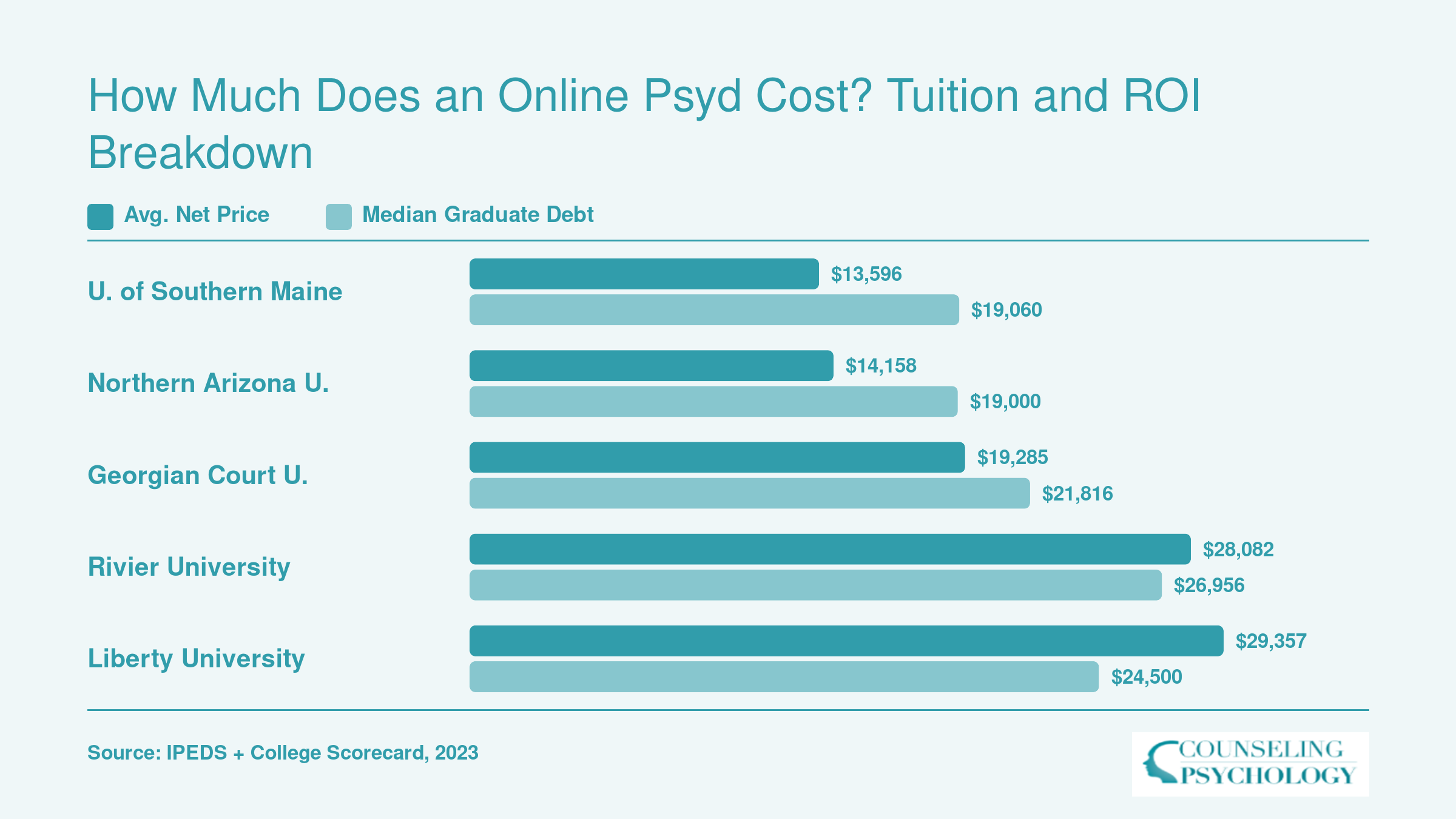
- Net price of $13,596 is among the lowest on this list
Psy.D. in School Psychology — Hybrid

Rivier University
Rivier University's APA-accredited Psy.D. in Counseling and School Psychology is structured explicitly to satisfy New Hampshire Board of Psychologists licensure standards. The practitioner-scholar model emphasizes real-world clinical competence, and placements are concentrated in New Hampshire and northern New England community agencies, schools, and clinical settings. At a minimum of five years and 2,000 internship hours, it is a substantial commitment, but graduates emerge ready to sit for the EPPP and practice independently.
- APA fully accredited program
- Hybrid delivery with weekday evening course schedule
- 60 to 130 total credit hours depending on prior coursework
- 2,000 hour internship required
- Meets New Hampshire psychology licensing requirements
- Practitioner-scholar training model
- $1,275 per credit tuition rate
- Multiple practicum experiences across clinical and school settings
Psy.D. in Counseling and School Psychology — Hybrid

Fielding Graduate University
Fielding Graduate University pioneered the distributed learning model for doctoral psychology, making it one of the earliest programs to blend online and residential formats for working professionals. The APA-accredited Ph.D. in Clinical Psychology offers concentrations in Forensic Psychology, Neuropsychology, and Health Psychology, giving students specialty depth that many competitors lack. Because students remain in their home communities and arrange local supervised clinical hours, the program naturally adapts to each individual's state licensure pathway.
- APA-accredited distributed learning model
- No GRE required for admission
- $10,385 per term tuition
- 5 to 6 year expected completion timeline
- Forensic psychology specialty training
- Local practicum placements arranged in student's home state
- APA-accredited with distributed learning delivery
- Designed for working professionals and career changers
- Specialized neuropsychology coursework and supervision
- Social justice emphasis woven throughout curriculum
- Faculty who are active clinical practitioners
- Flexible online and residential format
- APA-accredited distributed learning format
- Health psychology specialty focus
- Supports diverse student populations including military personnel
- No GRE required
- $10,385 per term tuition
- 5 to 6 year completion timeline
PhD in Clinical Psychology, Forensic Psychology Concentration — Hybrid
PhD in Clinical Psychology, Neuropsychology Concentration — Hybrid
PhD in Clinical Psychology, Health Psychology Concentration — Hybrid

Union Institute & University
Union Institute & University has historically offered a hybrid Doctor of Psychology with a Clinical Psychology concentration aimed at working professionals who hold a master's degree. However, the institution has faced significant accreditation and operational challenges in recent years, and current confirmation of the PsyD program's active status is difficult to verify. Prospective students should contact the university directly and confirm accreditation standing before applying. Detailed institutional outcome data such as net price, graduation rate, and graduate earnings are not currently available for this school.
- Hybrid learning format combining online and campus components
- Requires a master's degree in psychology or a related field
- Clinical psychology concentration
- Emphasis on evidence-based practice
- Financial aid reported as available
- Program status should be verified directly with the institution
Doctor of Psychology in Clinical Psychology — Hybrid
What Is a PsyD Degree and Who Is It For?
Research-intensive PhD or practice-focused PsyD: the two paths to a doctorate in psychology reflect fundamentally different career goals. The Doctor of Psychology (PsyD) degree emerged in the 1970s as a practitioner-scholar model, prioritizing clinical skill-building, assessment, and direct client intervention over empirical research and academic publication. Where a PhD trains psychologists to generate new knowledge and teach, the PsyD prepares graduates to apply existing evidence-based methods in real-world clinical settings.
Who Earns a PsyD?
Typical PsyD candidates include master's-level counselors, social workers, and marriage and family therapists seeking independent practice authority and licensure as psychologists. Mid-career professionals looking to shift from supervised clinical roles to autonomous private practice or leadership positions in hospitals, integrated care clinics, and correctional facilities also pursue the PsyD. Career changers drawn to clinical psychology over academic research often choose this route, valuing direct client impact and shorter research requirements.
Unlike PhD students who spend years designing studies and publishing dissertations, PsyD learners invest their time mastering psychological assessment, evidence-based therapies (CBT, DBT, ACT), diagnostic interviewing, and treatment planning. The dissertation component remains, but PsyD projects typically take the form of applied case studies, program evaluations, or literature reviews rather than original empirical research.
Program Structure and Timeline
Expect four to six years from enrollment to graduation. Coursework in psychopathology, psychopharmacology, ethics, and multicultural competence often runs online or in hybrid formats, but practicum placements and the required predoctoral internship (1,500 to 2,000 hours) always occur in person at affiliated clinics, hospitals, schools, or private practices. Online PsyD programs schedule intensive residencies (weekend intensives or week-long institutes) for clinical skill labs and supervision.
Career Pathways Beyond Clinical Practice
Most PsyD graduates pursue licensure as clinical psychologists, opening independent practices or joining group practices. The degree also supports specialization in forensic psychology (court evaluations, correctional treatment), health psychology (chronic illness, behavioral medicine), school psychology, and industrial organizational psychologist roles in corporate consulting. Any setting requiring doctoral-level psychological expertise, from trauma centers to corporate wellness programs, becomes accessible with PsyD licensure.
PsyD vs. PhD in Psychology: Key Differences
Both the PsyD and the PhD in psychology are doctoral degrees that qualify graduates to sit for licensure as a psychologist, but they differ sharply in training philosophy, cost structure, and the career paths they typically open up. Understanding those differences before you apply can save you years of time and tens of thousands of dollars.
Training Model and Dissertation
The PsyD follows a practitioner-scholar model, meaning coursework and supervised clinical hours take center stage. Students complete a doctoral project, which is usually a substantial clinical case study, program evaluation, or applied research paper rather than a traditional original-research dissertation.
The PhD follows a scientist-practitioner model. Students are expected to generate original empirical research, defend a dissertation based on that research, and often publish in peer-reviewed journals before graduating. Clinical training is still part of the curriculum, but the research demands are heavier.
Time to Degree and Acceptance Rates
PhD programs typically take five to eight years to complete, partly because dissertation timelines can stretch. PsyD programs generally run four to six years. On the admissions side, the gap is even wider: PhD programs in clinical psychology accept roughly 10 to 15 percent of applicants, while PsyD programs accept closer to 40 percent. The smaller PhD cohorts reflect both limited funding slots and the research mentorship model that pairs each student with a faculty advisor. If you are still exploring the full landscape of psychology degree programs, comparing time-to-degree across levels can help you plan more realistically.
Funding and Cost
This is where the financial calculus gets serious. PhD programs more often offer full tuition waivers and annual stipends because students contribute to faculty research. PsyD programs rarely provide the same level of support, so most PsyD students pay tuition out of pocket or through loans. Over a four-to-six-year program, the difference can amount to six figures. If minimizing debt is a top priority, factor funding availability into your decision early.
Career Outcomes
Both degrees lead to the same clinical license, yet graduates tend to follow different trajectories. PsyD holders skew heavily toward direct clinical practice: private practice, hospitals, community mental health centers, and integrated care settings. PhD holders are more likely to land in academic departments and research institutions. Prospective students interested in the clinical route may want to review clinical psychology doctorate programs for a closer look at program structures and outcomes. For tenure-track faculty positions, hiring committees generally prefer candidates with a PhD and a strong publication record. If your goal is full-time clinical work with patients, a PsyD is a direct route. If you see yourself running a lab or teaching at a university, the PhD is the stronger credential.
Neither degree is universally "better." The right choice depends on whether your career vision centers on research, practice, or some blend of the two, and on how much debt you are willing to carry to get there.
Questions to Ask Yourself
Online vs. Hybrid vs. On-Campus PsyD: What to Expect
Can you really earn a PsyD entirely online? The short answer is no, and understanding why helps you plan realistically before you apply.
The 'Online' Label Is Misleading
No PsyD program, regardless of how it markets itself, is fully remote. The degree requires supervised clinical hours, a pre-doctoral internship, and often a dissertation defense, none of which can happen entirely through a screen. When programs describe themselves as online, they mean the didactic coursework, lectures, and seminars are delivered remotely. Students still travel to campus for residency intensives and arrange in-person clinical placements in their local communities.
Capella University's PsyD, for example, combines online coursework with required face-to-face residencies, practicum training, and an internship.1 California Southern University describes its program as fully online, but students still need to complete supervised clinical hours in their area and navigate state licensure requirements on their own.1
How the Hybrid Model Actually Works
Most programs that call themselves hybrid follow a recognizable structure. Coursework is delivered through a learning management system, often supplemented by live video seminars where cohorts meet in real time. On-campus intensives, typically three to four weekends per year or week-long immersions once or twice per term, anchor the academic calendar and provide face-to-face connection with faculty and peers.
These residencies are not optional enrichment. They cover clinical skills, ethics, assessment practice, and professional development that programs consider too important to leave entirely to asynchronous formats.
Practicum and Internship: Your Responsibility
Finding clinical placements is where many students underestimate the workload. Hybrid programs generally employ practicum coordinators who approve sites, develop formal affiliation agreements, and monitor supervision quality. Many maintain lists of pre-approved training sites and offer seminars on how to negotiate training roles. What they rarely do is guarantee placement.
Students who live in rural areas or regions with fewer mental health agencies may struggle to find qualifying sites. Before enrolling, it is worth contacting a program's practicum office directly and asking how students in your state have managed placements in recent cohorts. Students drawn to specialized clinical work, such as a doctorate in addiction counseling, should verify that local practicum sites can accommodate those training goals.
Technology and Self-Discipline
Day-to-day doctoral work happens through video conferencing platforms, LMS portals, and in some programs, telehealth simulation labs that replicate clinical encounters online. The flexibility is real, but so is the demand for self-direction. Asynchronous doctoral coursework requires a level of independence that surprises students accustomed to the structure of a traditional classroom. Building a weekly schedule and treating online class sessions with the same seriousness as in-person ones matters more at this level than in any undergraduate program.
APA Accreditation and Why It Matters for Online PsyD Programs
APA accreditation is a program-level evaluation that confirms a doctoral psychology program meets the American Psychological Association's standards for curriculum, faculty qualifications, clinical training, and student outcomes. For students pursuing a PsyD, graduating from an APA-accredited program is a critical step toward licensure as a psychologist. Most state licensing boards require or strongly prefer an APA-accredited degree, and in some states, attending a non-APA-accredited program can block you from obtaining a license altogether. This makes understanding the accreditation status of any program, especially online or hybrid ones, essential before you enroll.
The Accreditation Landscape for Online PsyD Programs
As of 2025-2026, fully online PsyD programs are not eligible for APA accreditation.1 The APA's Standards of Accreditation apply uniformly to all delivery formats, and they mandate extensive in-person clinical experiences, including practica, internships, and residencies.2 While hybrid programs that combine online coursework with required on-site clinical training can earn APA accreditation, no fully remote PsyD program currently holds this designation.3 This distinction matters because many programs marketed as "online PsyD" are actually hybrid models with varying in-person requirements, and they may hold regional or national accreditation but not APA accreditation.
The APA maintains a public listing of accredited programs that incorporate distance education components, but the database does not allow you to filter specifically for PsyD programs with online options.2 You'll need to research each program individually to confirm how much of the curriculum is delivered online and whether it maintains APA accreditation. Students exploring other online doctoral programs in psychology should apply the same scrutiny to accreditation status.
Why Accreditation Tier Matters
Accreditation operates on two levels: institutional and program-specific. Regional accreditation (from bodies like the Higher Learning Commission) evaluates the entire university's academic quality and financial stability. National accreditation (such as DEAC) often applies to vocational or online institutions but carries less weight in academic and professional settings. For psychology licensure, however, program-level APA accreditation is the definitive marker. Employers, internship sites, and licensing boards recognize APA accreditation as the gold standard. A program may be regionally accredited yet lack APA recognition, leaving graduates with limited career and licensure pathways.
For online PsyD seekers, this hierarchy means a program might advertise both regional accreditation and a "PsyD" title, but if it's not APA-accredited, you could face significant hurdles later. Always verify the program's APA status directly, rather than relying on general institutional accreditation.
How to Verify a Program's Accreditation Status
Check the APA's Commission on Accreditation searchable database before applying.2 The database lists all currently accredited doctoral programs and those with distance education components. Since it doesn't offer a combined PsyD-and-distance filter, scan the list for hybrid programs and review each program's website or contact admissions to clarify how much is online. Additionally, confirm your state's licensing board requirements, because some boards maintain their own lists of approved programs. This step takes a few minutes but can save years of effort and expense if a program turns out to be ineligible for licensure.
How to Get Into an Online PsyD Program: Admission Requirements
Some applicants arrive at PsyD admissions with a master's degree already in hand; others apply straight from a bachelor's program. Both paths are viable at most online programs, but what separates a competitive file from a rejected one goes well beyond the degree on your transcript. If you are wondering how hard it is to get into grad school for psychology, the answer depends heavily on the components outlined below.
Baseline Academics
A 3.0 GPA is the floor at nearly every online PsyD program reviewed for 2025-2026. University of La Verne, Wright State University, and Nova Southeastern University all set that threshold for undergraduate records.234 Nova Southeastern raises the bar slightly for applicants with prior graduate coursework, expecting a 3.5 graduate GPA.4 Prerequisite coursework matters just as much as the cumulative number: most programs expect at least some grounding in statistics, abnormal psychology, and research methods before the first doctoral seminar. Nova Southeastern and Florida Institute of Technology each require 18 credits of psychology coursework at minimum.45
The GRE Is Mostly Gone
One of the clearest trends in doctoral admissions right now is the retreat from standardized testing. University of La Verne, Wright State, and Nova Southeastern have all dropped the GRE requirement entirely.234 Florida Tech stands out as an exception, still requiring the GRE General Test as of 2025-2026.5 If removing a high-stakes exam from your checklist sounds appealing, you have strong options. Keep in mind, though, that dropping the GRE has also opened these programs to larger applicant pools, so the rest of your file carries more weight than it once did.
What Actually Makes a File Stand Out
Online and hybrid PsyD cohorts tend to be less numerically selective than traditional research-focused PhD programs, with acceptance rates at some programs hovering around 40 to 60 percent. That relative accessibility does not mean you can submit a thin application. Admissions committees look hard at:
- Clinical experience: Direct client contact hours, whether through paid positions or structured volunteer work, signal that you understand what clinical practice actually involves.
- Personal statement: A specific, grounded account of your clinical interests and how a doctoral credential connects to them matters far more than a generic statement of ambition.
- Letters of recommendation: References from supervisors who have observed your work with clients, or from professors who can speak to your academic potential, carry the most weight.
- Writing sample or interview: Many programs use a writing sample or a formal interview to assess communication skills and professional fit before extending an offer.
Think of the application as a portfolio rather than a checklist. Each component should reinforce a coherent story about where you have been, what you want to do clinically, and why a PsyD is the right vehicle to get there.
How Much Does an Online PsyD Cost? Tuition and ROI Breakdown
Total program costs for an online or hybrid PsyD typically range from roughly $80,000 to well over $250,000, depending on credit requirements, residency status, and institutional pricing. The figures below show institution-level average net price alongside median graduate debt for several ranked programs. Keep in mind that these are institutional averages across all students and degree levels; your individual cost will vary based on financial aid, credit load, and program length. Because program-level earnings data at one and four years post-completion are not yet available for these programs, a full ROI comparison is limited, though institution-level ROI ratios suggest graduates generally earn roughly 1.8 to 2.9 times their median debt within a decade. Unlike PhD programs, PsyD programs rarely offer full funding, so strategies like employer tuition assistance, APA-affiliated scholarships, PSLF for those working in nonprofit or government roles, and the NHSC Loan Repayment Program (up to $50,000, tax-free, for a two-year service commitment at a qualifying shortage site) are critical for managing costs.
Licensed psychologists working in underserved areas may qualify for National Health Service Corps loan repayment (up to $50,000 or more over two years), and PsyD graduates employed by nonprofits are eligible for Public Service Loan Forgiveness after 120 qualifying payments. These federal programs can substantially offset six-figure doctoral debt, making an online PsyD more affordable than the sticker price suggests.
Licensure After an Online PsyD: State Requirements and EPPP Prep
State psychology boards operate independently, and that autonomy creates a patchwork of rules for PsyD graduates, particularly those who earned their degree partly or entirely online. While no state maintains an outright blanket ban on licensure for online doctoral psychology graduates, the practical hurdles can be steep.1 Most jurisdictions require completion of an APA-accredited (or regionally equivalent) doctoral program, accumulation of supervised clinical hours (typically 1,500 to 2,000 post-doctoral), passage of the Examination for Professional Practice in Psychology (EPPP), and sometimes a jurisprudence exam.2 Where online programs run into trouble is at the first gate: accreditation scrutiny and the specific language in each board's statutes about distance education.
General Licensure Pathway
The roadmap looks similar across most jurisdictions. After you complete an APA-accredited or equivalent doctoral program, you enter a supervised post-doctoral residency. These hours, ranging from 1,500 in some states to 2,000 or more in others, must be logged under a licensed psychologist. Once your supervisor signs off, you sit for the EPPP through Pearson VUE, a national standardized exam administered by the Association of State and Provincial Psychology Boards (ASPPB). Pass that, complete any state-specific jurisprudence or ethics test, and the board issues your license. The timeline from PsyD graduation to licensure is usually two to three years.
State-Specific Restrictions and Scrutiny
Some jurisdictions apply closer scrutiny to graduates of programs that are not APA-accredited, and a handful have historically questioned whether distance-education formats satisfy residency or supervised-practice requirements.3 California, for example, has a detailed checklist for equivalent programs and has been known to request syllabi, faculty credentials, and practicum logs from non-APA programs. Ohio and Texas boards have also flagged certain online programs during credential review, asking applicants to demonstrate that clinical training met in-person contact thresholds. These reviews do not automatically disqualify candidates, but they lengthen the process and sometimes require additional documentation or supplemental supervised hours.
EPPP Pass Rates and Data Gaps
Published data comparing EPPP pass rates for online or hybrid PsyD graduates versus traditional on-campus cohorts does not yet exist in the public domain.4 The ASPPB publishes aggregate pass rates by program but does not break out modality. Anecdotally, some online programs report first-time pass rates in the 80 to 85 percent range, which aligns with the national average for doctoral psychology programs overall. Without rigorous comparative studies, claims of parity remain unverified.
Contact Your Target State Board Before Enrolling
Before you submit a deposit to any online PsyD program, contact the psychology licensing board in the state where you intend to practice. Ask explicitly whether the program's format and accreditation meet licensure eligibility requirements. The ASPPB maintains a directory of psychology licensure websites and publishes the PSY|Book handbook, which outlines general requirements.5 Individual board staff can clarify how recent policy changes or internal interpretations might affect your application. This single phone call or email can prevent a costly post-graduation surprise.
Steps to Earning Your PsyD Online
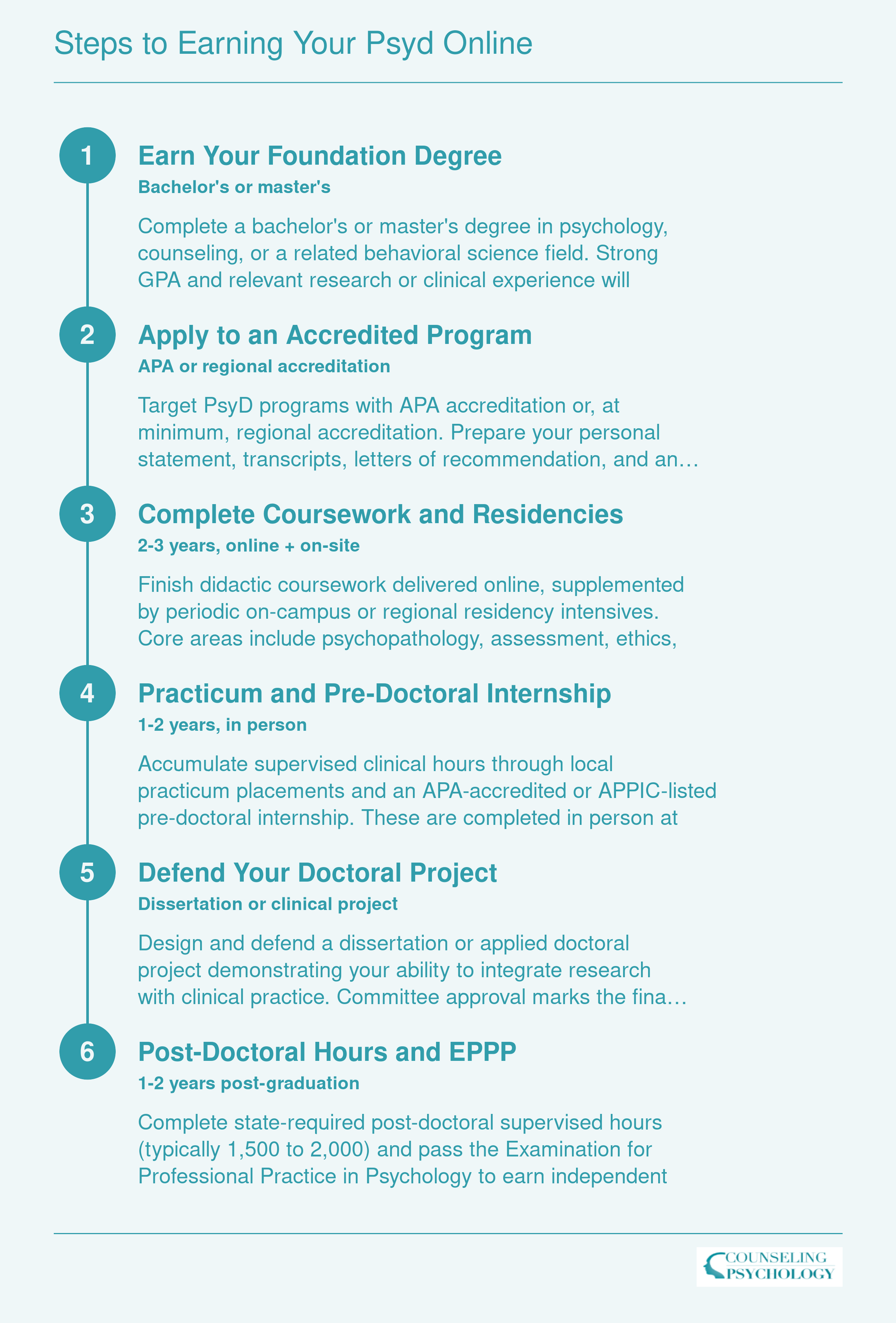
The path from undergraduate degree to independent licensure as a psychologist typically spans 5 to 8 years total: 4 to 6 years for the doctoral program itself, followed by 1 to 2 years of post-doctoral supervised experience before you can practice independently. Here is the credentialing ladder at a glance.
Frequently Asked Questions About Online PsyD Programs
Choosing a doctoral program is a major commitment, and prospective students understandably have a lot of questions about format, cost, and career outcomes. Below are direct answers to the questions we hear most often about online PsyD programs.
Related Psychology Degrees
- Best Online Applied Behavior Analysis
- Best Online Applied Psychology Degree
- Best Online Associate Degrees in Psychology
- Best Online Autism Spectrum Disorders
- Best Online Bachelor's in Psychology
- Best Online Child Psychology Degree
- Best Online Clinical Psychology
- Best Online Cognitive Psychology Degree
- Best Online Counseling Psychology
- Best Online Developmental Psychology
- Best Online Educational Psychology Degrees
- Best Online Forensic Psychology Degree
- Best Online Graduate Certificate in Psychology
- Best Online Health Psychology
- Best Online I/O Psychology
- Best Online International Psychology
- Best Online Master's in Psychology
- Best Online Neuropsychology
- Best Online Ph.D. in Psychology
- Best Online Positive Psychology
- Best Online Psychopharmacology Programs for
- Best Online School Psychology
- Best Online Social Psychology
- Best Online Sports Psychology
- Engineering Psychology Degrees
- Online Geropsychology