How to Become a Forensic Psychologist: A Step-by-Step Career Guide
Education, licensure, and experience requirements to launch your forensic psychology career
By Tara Moretti, LMHCReviewed by CounselingPsychology.org TeamUpdated May 22, 202610+ min read
Key Takeaways
Becoming a forensic psychologist typically requires 10 to 14 years of education and supervised training.
All states require a doctoral degree and passing the EPPP before granting independent licensure.
The national median salary for psychologists in this category is $117,580 per BLS data.
Board certification through the ABFP is optional but can strengthen credibility in court settings.
Television crime dramas compress forensic psychology into a montage of profiling serial offenders, but the actual profession centers on competency evaluations, child custody assessments, risk appraisals, and expert testimony. The real path to practicing independently requires 10 to 14 years of education and supervised training, starting with a bachelor's degree and ending well after a doctorate.
With a national median salary near $117,580 for psychologists in related specialty categories, the financial payoff can be substantial, but only after navigating doctoral admissions, a competitive predoctoral internship match, postdoctoral supervision, and the EPPP licensing exam. The timeline and cost vary sharply depending on whether you pursue a PhD, a PsyD, or a clinical doctorate with a forensic concentration.
What Does a Forensic Psychologist Do?
Forensic psychology sits at the intersection of psychological science and the legal system. If you are exploring how to become a forensic psychologist, understanding the day-to-day realities of the role is essential before committing to a decade or more of education and training.
Core Responsibilities
Forensic psychologists apply research methods, clinical assessment skills, and psychological theory to questions that arise in legal contexts. Their work typically spans several categories:
Psychological assessments: Evaluating defendants for competency to stand trial, assessing risk of reoffending, conducting child custody evaluations, and performing fitness-for-duty examinations. Assessment work, including interviewing subjects and administering standardized instruments, often accounts for the largest share of a practitioner's schedule.
Report writing and documentation: Every evaluation culminates in a detailed written report intended for judges, attorneys, or parole boards. Practitioners routinely note that report writing consumes as much time as the evaluations themselves, sometimes more.
Court testimony: Serving as an expert witness in criminal, civil, or family court cases. Although testimony can be high-profile, most forensic psychologists spend a relatively small percentage of their working hours on the stand compared to the time devoted to assessments and writing.
Consultation and research: Advising law enforcement agencies, consulting with attorneys on jury selection, contributing to policy development, or conducting academic research on topics like eyewitness memory or interrogation techniques.
No single published source provides a universal time-allocation breakdown for forensic psychologists. Because the Bureau of Labor Statistics groups forensic practitioners under the broader "psychologists" category, granular data on how these professionals divide their hours is limited. The most reliable picture comes from triangulating information across professional organizations like APA Division 41 (the American Psychology-Law Society), university program descriptions, and interviews with practicing professionals.
Forensic Psychology vs. Criminal Psychology
These two terms are often used interchangeably in popular media, but they are not the same. According to the American Psychology-Law Society, forensic psychology is defined broadly as the application of psychological knowledge to legal questions. A forensic psychologist might evaluate a plaintiff's emotional damages in a civil lawsuit or assess whether a juvenile defendant should be tried as an adult.
Criminal psychology, by contrast, focuses more narrowly on understanding criminal behavior, offender profiling, and treatment of individuals who have committed crimes. In practice, there is meaningful overlap. A forensic psychologist working in a correctional facility may perform many of the same tasks a criminal psychologist would. However, the forensic designation carries a wider scope that extends well beyond criminal cases into civil, family, and regulatory law.
If you are comparing graduate programs, reviewing course syllabi can clarify where a given program falls on this spectrum. Our guide on how to evaluate online counseling or psychology programs offers additional criteria to consider. Programs housed in clinical psychology departments with a forensic concentration tend to prepare graduates for the broader forensic role, while programs emphasizing criminology may lean more toward the criminal psychology side.
Where Forensic Psychologists Typically Work
Work settings vary considerably, and many forensic psychologists split their time across more than one:
Federal and state correctional facilities
Forensic psychiatric hospitals
Private practice (conducting independent evaluations on referral from attorneys or courts)
Academic and research institutions
Law enforcement agencies
Government agencies, including departments of juvenile justice and child protective services
The setting shapes the daily rhythm of the job. A forensic psychologist in private practice may spend the majority of their week conducting evaluations and writing reports, while one embedded in a state hospital might focus more on ongoing treatment and risk management. Understanding these distinctions early will help you tailor your education and supervised clinical hours toward the career path that fits your goals.
Forensic Psychologist Education Requirements: Bachelor's Through Doctorate
Becoming a forensic psychologist is a long educational commitment, typically spanning ten or more years of postsecondary study. The path unfolds in three stages: a bachelor's degree, an optional master's degree, and a doctoral degree. That final stage, the doctorate, is non-negotiable. Every U.S. state requires a doctoral degree for independent practice and licensure as a psychologist.
Stage One: The Bachelor's Degree (4 Years)
Most aspiring forensic psychologists begin with a bachelor's degree in psychology, criminal justice, or a closely related behavioral science. While the specific major matters less than the coursework you complete, doctoral admissions committees look for a strong foundation in core areas. Prioritize the following undergraduate courses to strengthen your application:
Abnormal Psychology: Provides essential grounding in psychopathology, which is central to forensic assessment.
Statistics and Research Methods: Doctoral programs are research-intensive, and quantitative competency is a baseline expectation.
Criminal Justice or Criminology: Demonstrates genuine interest in the legal system and builds vocabulary you will use daily in forensic settings.
Biological Psychology: Understanding the neurological underpinnings of behavior gives you credibility in courtroom and clinical contexts alike.
Supplementing these with courses in ethics, developmental psychology, and social psychology will round out your preparation.
Stage Two: The Optional Master's Degree (2 Years)
A master's degree in forensic psychology or a related discipline is not always required for doctoral admission, but it can be strategically valuable. Some students use a master's program to strengthen a weaker undergraduate record, gain supervised clinical exposure, or clarify their research interests before committing to a doctorate.
It is worth being direct about the limitations of a terminal master's degree in this field. A master's alone can open doors to certain forensic roles, such as correctional counseling, victim advocacy, trial consulting, or research assistance. However, it does not qualify you for independent clinical practice, and most jurisdictions will not accept master's-level professionals as expert witnesses. If your goal is to conduct forensic evaluations, provide court-ordered treatment, or testify in legal proceedings, you will need to complete a doctoral program.
Stage Three: The Doctoral Degree (4 to 7 Years)
The doctorate is where forensic psychologists develop advanced clinical skills, deep research expertise, and the specialized forensic competencies that set them apart. Programs typically include intensive coursework, a supervised clinical practicum, a predoctoral internship, and a dissertation.
One critical factor when selecting a doctoral program is accreditation by the American Psychological Association. APA accreditation signals that a program meets rigorous training standards, and most state licensing boards require graduation from an APA-accredited program as a condition of licensure eligibility. Choosing a non-accredited program can severely limit your ability to become licensed, regardless of the quality of training you receive. Verify accreditation status before you apply.
Whether you pursue a PhD or a PsyD (a distinction explored in the next section), the doctorate is the credential that unlocks independent forensic practice, board certification, and the full scope of professional opportunities in this field.
PhD vs. PsyD vs. Clinical Doctorate With Forensic Concentration
Choosing the right doctoral path is one of the most consequential decisions you will make on the road to becoming a forensic psychologist. Three main options exist: a PhD in forensic psychology, a PsyD in forensic psychology, and a clinical or counseling PhD that includes a forensic concentration. All three can lead to licensure, but they differ in meaningful ways across cost, competition, training emphasis, and career positioning.
Research Emphasis vs. Clinical Focus
PhD programs, whether forensic-specific or housed within a broader clinical or counseling department, place a high emphasis on research.1 Expect to design original studies, publish in peer-reviewed journals, and complete a dissertation grounded in empirical investigation. Clinical training is part of the curriculum, but the research component drives your timeline and professional identity.
PsyD programs flip that ratio. Clinical practice takes center stage, with less time devoted to independent research.1 If your goal is to conduct forensic evaluations, provide expert testimony, or work directly with justice-involved populations rather than run a research lab, a PsyD may align more naturally with your day-to-day career vision.
Program Length and Financial Realities
Timeline and cost often go hand in hand:
PhD (forensic or clinical/counseling with forensic concentration): Typically 5 to 8 years. Between 60 and 90 percent of students in PhD programs receive full funding, including tuition waivers and stipends.2 Acceptance rates hover around 10 to 15 percent, making these programs highly competitive.1
PsyD (forensic): Usually 4 to 6 years.3 Admission rates tend to range from 20 to 40 percent, so more applicants gain entry. The trade-off is financial: only 1 to 10 percent of PsyD students receive full funding, and total tuition commonly falls between $100,000 and $250,000 or more.2
Before committing to a program, calculate the full cost of attendance against realistic early-career earnings. A fully funded PhD that takes two extra years can still cost less in lifetime debt than a shorter, self-funded PsyD.
Forensic-Specific Doctorate vs. Forensic Concentration
Here is where prospective students often get stuck. A dedicated forensic psychology doctorate builds the entire curriculum around legal and criminal justice contexts. Practica might place you inside correctional facilities, forensic hospitals, or court clinics from your second year onward. A clinical or counseling PhD with a forensic concentration, by contrast, gives you a broader clinical foundation and layers forensic electives and select practica on top.
Both pathways qualify you for the same state psychology license. The practical difference lies in depth of specialized training during the program itself. Graduates of forensic-specific programs tend to enter the job market with more hours of forensic assessment, risk evaluation, and courtroom-related experience already logged. Graduates of the concentration route may need additional postdoctoral forensic training to reach the same level of specialization, but they also carry broader clinical versatility that opens doors in private practice, hospital settings, or academia.
Which Path Fits You Best
A quick way to orient your decision:
Academic or research career goals: A PhD, either forensic-specific or with a forensic concentration, positions you for faculty roles, grant-funded research, and policy work.
Direct clinical practice: A PsyD offers immersive clinical training and a shorter timeline, though at a higher financial cost.
Maximum flexibility: A clinical or counseling PhD with a forensic concentration lets you pivot between forensic work and general clinical practice as your interests evolve.
No single option is universally superior. Weigh your research interests, financial tolerance, and long-term career goals carefully, and look for APA-accredited programs regardless of the degree type you pursue.
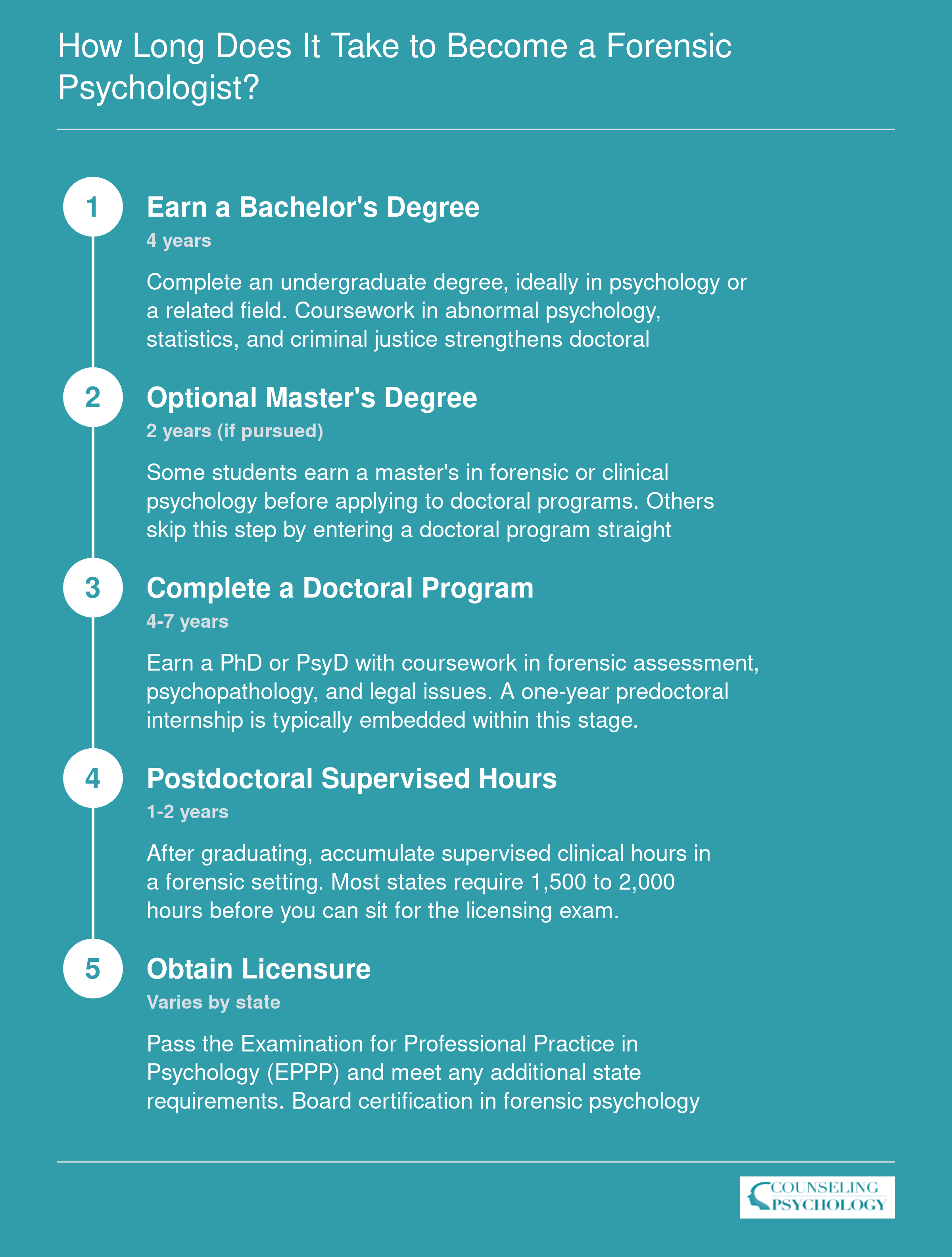
How Long Does It Take to Become a Forensic Psychologist?
The path from first-year undergraduate to independently practicing forensic psychologist typically spans 10 to 14 years. The exact timeline depends on whether you earn a standalone master's degree, which doctoral format you choose, and your state's postdoctoral supervision requirements. Students who enter a doctoral program directly from their bachelor's can shave roughly two years off the total.
Supervised Clinical Hours and Practicum Requirements
Earning a doctorate is only part of the path to licensure as a forensic psychologist. You also need thousands of hours of supervised clinical experience, and the structure of those hours matters as much as the total count. Understanding the three phases of supervised training will help you plan your timeline and choose placements that build genuine forensic competence.
Predoctoral Practicum Hours
During your doctoral program, you will complete practicum placements that provide your earliest hands-on clinical training. Depending on your state and program, predoctoral practicum requirements typically range from roughly 600 to 2,000 hours. These hours are usually embedded in your coursework years, and your program will coordinate placements that align with your area of focus. If you are targeting forensic psychology, seek out practicum sites in forensic psychiatric hospitals, correctional facilities, court clinics, community mental health centers with forensic units, or private forensic practices operating under licensed supervisors. Building forensic experience early strengthens your candidacy for the next, more competitive stage.
The Predoctoral Internship and the APPIC Match
Before you can finish your doctorate, most states require completion of a predoctoral internship totaling 1,500 to 2,000 hours of supervised work.1 APA-accredited internships are strongly preferred for licensure and career advancement. The standard route for securing one of these positions is the APPIC Match, a centralized matching process similar in concept to medical residency placement. The match is competitive.2 Not every applicant secures a position in a given cycle, and students should prepare applications carefully, with strong letters of recommendation and documented forensic experience from their practicum years. For broader guidance on navigating this process, see our overview of psychology internships.
Postdoctoral Supervised Experience
After completing your doctorate, most states require an additional 1,500 to 2,000 hours of postdoctoral supervised experience before you can sit for the licensure exam.3 Some states set the bar higher: Maryland, for example, requires 3,250 total supervised hours across all phases4, while California requires 3,000 total hours with at least 1,500 at the postdoctoral level.5 A small number of states have reduced or eliminated the postdoctoral requirement, so checking your jurisdiction's rules early is essential.
Does Forensic-Specific Supervision Matter?
Here is where it gets nuanced. No state currently requires supervision specifically in forensic settings as a condition of general psychologist licensure.1 However, forensic competence is expected of anyone who practices in this specialty. Some jurisdictions impose additional practice requirements or expect documented training in forensic contexts before you represent yourself as a forensic psychologist. Others accept general clinical supervision hours toward licensure, leaving it to you and your professional ethics to ensure you have adequate forensic training.
The practical takeaway: even where the rules do not mandate forensic-specific supervision, you should pursue it. Seek postdoctoral positions in settings like forensic hospitals, correctional systems, or court-affiliated clinics where your supervisor has deep forensic expertise. This protects your future clients and positions you for board certification in forensic psychology down the road.
Approved Settings for Supervised Hours
Forensic-relevant supervised hours can be accrued in a range of settings:
Forensic psychiatric hospitals: Provide exposure to competency evaluations, risk assessments, and treatment of individuals found not guilty by reason of insanity.
Correctional facilities: Offer experience with incarcerated populations, reentry planning, and crisis intervention.
Court clinics: Focus on custody evaluations, fitness-to-stand-trial assessments, and pretrial diversion programs.
Community mental health centers with forensic units: Blend general clinical skills with forensic case consultation.
Private forensic practices: Allow mentorship from experienced forensic psychologists in independent practice.
Planning your supervised hours strategically across all three phases (practicum, internship, postdoctoral) ensures you meet your state's total hour threshold while developing the specialized skills the forensic field demands.
Did You Know?
The APPIC predoctoral internship match is a make-or-break milestone. Students who do not match must reapply the following year, which can delay licensure by 12 months or more. To improve your odds, apply broadly across sites and build strong forensic practicum experience as early as possible in your doctoral program.
Licensure and Certification Steps for Forensic Psychologists
Earning a doctorate is a major milestone, but you cannot practice independently until your state licensing board grants you a license. Understanding the licensure pipeline, and the optional board certification that can elevate your career, will help you plan the final stretch of your training.
The State Licensure Process
Although exact requirements vary by jurisdiction, most states follow a similar sequence:
Degree verification: Your doctoral program transcripts are reviewed, and graduation from an APA-accredited program streamlines this step.
Supervised hours documentation: You submit proof that you completed the required postdoctoral supervised hours (typically 1,500 to 2,000, depending on the state).
EPPP examination: You sit for the Examination for Professional Practice in Psychology, described below.
Jurisprudence exam: Many states require a separate exam on that state's mental-health statutes, ethics codes, and administrative rules.
License issued: Once all components are approved, you receive your license to practice psychology independently.
The entire post-graduation licensure timeline usually spans one to two years, with the postdoctoral supervised experience consuming the bulk of that window.
Passing the EPPP
The EPPP is the standardized national exam administered by the Association of State and Provincial Psychology Boards. It contains 225 multiple-choice questions, of which 175 are scored and 50 are unscored pilot items used for future test development.1 You have 255 minutes (just over four hours) to complete the exam, and it covers eight content domains ranging from biological bases of behavior to ethical and legal issues.1
Scores are reported on a scaled range of 200 to 800. Most states require a minimum scaled score of 500 for independent practice, which corresponds to answering roughly 70 percent of scored items correctly.2 Graduates of APA-accredited doctoral programs pass on the first attempt at a rate of approximately 70 to 85 percent, a figure that drops noticeably for candidates from non-accredited programs.2 A small but growing number of jurisdictions also require Part 2 of the EPPP, a competency-based skills assessment with 170 items (130 scored) and its own 255-minute time limit, though this second part is not mandatory nationwide.1
ABPP Board Certification in Forensic Psychology
State licensure permits you to practice psychology in general. Board certification for psychologists through the American Board of Professional Psychology, specifically the specialty credential in forensic psychology (sometimes abbreviated ABFP), signals advanced expertise in the intersection of psychology and law. This credential is voluntary; no state requires it for licensure or legal practice.
That said, board certification is increasingly preferred in several high-stakes settings. Federal agencies, Veterans Affairs medical centers, and academic departments often list ABPP certification as preferred or required. In the courtroom, attorneys and judges may give greater weight to the testimony of a board-certified forensic psychologist, and some legal teams preferentially select board-certified experts when assembling their witness lists. Although salary data tied specifically to board certification is limited, holding the credential can expand the pool of referrals you receive for forensic evaluations and expert testimony, which in private practice directly affects income.
What the ABFP Process Involves
Candidates must first hold an active, unrestricted psychology license. From there, the requirements are substantive:
You must document completion of at least 100 forensic cases or 1,000 or more hours of forensic work. This can include competency evaluations, risk assessments, child custody evaluations, and similar activities.
You submit a practice sample, typically a de-identified forensic report and supporting materials, for peer review.
You complete an oral examination conducted by board-certified forensic psychologists who evaluate your clinical reasoning, ethical decision-making, and command of forensic issues.
The process is rigorous by design. It is meant to verify that you can apply psychological science competently within legal contexts, not simply that you have accumulated hours. Many forensic psychologists pursue board certification several years into their careers once they have built a substantial forensic caseload.
Whether you pursue ABFP certification immediately or after gaining experience, understanding this pathway early lets you document your forensic cases and hours from the start, saving time when you eventually apply.
Forensic Psychologist Salary: National, State, and Metro Data
Because the Bureau of Labor Statistics does not track forensic psychologists as a standalone occupation, the closest federal benchmark falls under the "Psychologists, All Other" category. The national median salary for this group is $117,580, though earnings vary widely based on experience, work setting, and geographic location. Forensic psychologists who move into senior management roles or combine clinical practice with consulting can earn substantially more.
Occupation
Total Employment
25th Percentile
Median Salary
75th Percentile
Mean Salary
Psychologists, All Other
17,790
$73,820
$117,580
$145,200
$111,340
Managers, All Other
630,980
$100,010
$136,550
$179,190
$149,890
Psychology Teachers, Postsecondary
41,610
$62,290
$80,330
$106,640
$93,530
Highest-Paying States for Forensic Psychologists
The Bureau of Labor Statistics tracks compensation for psychologists in specialty categories that include forensic practitioners. The table below highlights the states with the highest median annual wages, giving you a sense of where forensic psychology careers may offer the strongest earning potential. Keep in mind that higher wages often correspond to higher costs of living, so weigh location decisions carefully.
State
Median Annual Wage
25th Percentile
75th Percentile
Mean Annual Wage
California
$147,650
$78,310
$169,330
$130,940
Oklahoma
$147,010
$103,330
$161,350
$126,730
Nevada
$144,390
$131,250
$153,890
$130,120
Nebraska
$137,990
$93,790
$163,880
$125,420
North Carolina
$137,130
$90,440
$157,190
$122,490
South Carolina
$135,950
$115,090
$152,960
$127,190
Utah
$90,270
$82,220
$129,810
$99,720
Oregon
$82,960
$79,380
$130,520
$102,460
Texas
$81,830
$61,740
$133,240
$96,040
Illinois
$81,270
$51,700
$137,820
$92,810
Questions to Ask Yourself
Are you drawn more to research or to clinical work with individuals?
Your answer shapes whether a PhD (research-heavy) or a PsyD (practice-focused) is the better doctoral path. Each degree opens different doors in academia, assessment, and direct client work.
Do you see yourself in courtrooms, correctional facilities, or a private practice office?
Forensic psychologists work across very different settings, and each demands distinct skills. Clarifying your preferred environment early helps you choose the right practicum sites and postdoctoral training.
Are you prepared to commit 10 or more years of education and supervised training before practicing independently?
Between a bachelor's degree, a doctoral program, and required supervised clinical hours, the timeline is long. Realistic planning for finances and personal milestones now prevents burnout later.
Forensic Psychologist Job Growth Outlook
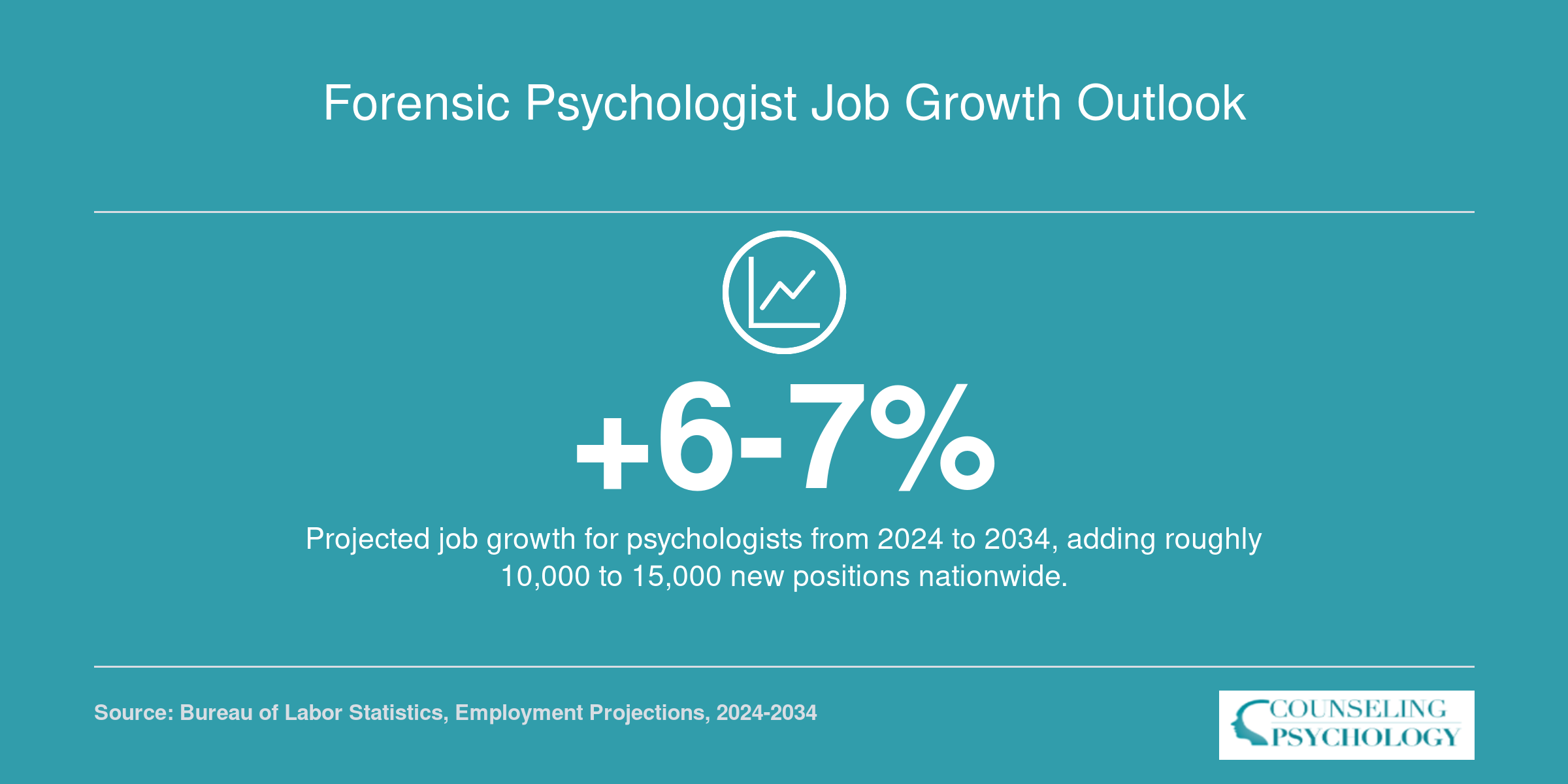
The Bureau of Labor Statistics projects steady demand for psychologists over the next decade, and forensic specialists stand to benefit from several converging trends. Expanding forensic caseloads, the ongoing opioid and mental health crisis within corrections systems, and the growth of specialty courts such as veterans' treatment courts are all fueling the need for psychologists with forensic training.
Career Paths and Work Settings in Forensic Psychology
Forensic psychology is not a single job description. The field branches into distinct subspecialties, each with its own client populations, assessment tools, and day-to-day rhythms. Understanding these tracks early helps you target the right training experiences and position yourself for the work you actually want to do.
Four Major Subspecialty Tracks
Juvenile forensic psychology: Practitioners in this track conduct delinquency evaluations, assess competency to stand trial in minors, and provide expert opinions during transfer (waiver) hearings that determine whether a youth will be tried as an adult. The work demands specialized knowledge of adolescent development and trauma.
Civil forensic psychology: This subspecialty centers on civil court matters: child custody evaluations, personal injury claims, testamentary capacity disputes, and civil commitment proceedings. Psychologists in this area frequently serve as court-appointed evaluators and must be comfortable producing reports that will be scrutinized by opposing counsel.
Correctional psychology: Correctional psychologists deliver mental health treatment inside jails, prisons, and federal detention facilities. They also conduct violence risk assessments and reentry planning. The environment can be demanding, but it offers consistent caseloads and direct clinical impact on an underserved population.
Police and public safety psychology: Professionals in this niche perform pre-employment psychological screenings for law enforcement candidates, fitness-for-duty evaluations for officers returning from critical incidents, and post-shooting debriefings. Agencies at the local, state, and federal levels all rely on these evaluations.
Primary Work Settings
Where you practice shapes your schedule, income stability, and professional autonomy. Here are the most common settings along with practical trade-offs.
Courts and the legal system: High visibility and intellectually stimulating cases, but demanding timelines and adversarial cross-examination.
Correctional facilities: Steady government salaries, loan repayment programs, and benefits, though the institutional environment can be isolating and emotionally taxing.
Forensic psychiatric hospitals: Opportunities for in-depth treatment with patients committed by courts. Caseloads tend to be more manageable, yet positions can be geographically limited.
Private practice: Maximum autonomy and the potential for premium hourly rates, especially for expert witness testimony, which commonly ranges from $200 to over $500 per hour. The trade-off is variable caseloads and the overhead of running a business.
Academic and research positions: Ideal for those who want to advance the science of forensic assessment or train the next generation. Tenure-track roles are competitive and typically pay less than clinical practice.
Government agencies (FBI, Bureau of Prisons, state departments of corrections or mental health): Structured career ladders, security clearances that open unique assignments, and solid retirement packages, balanced against bureaucratic constraints and possible relocation requirements.
Mid-Career Transition Into Forensic Work
You do not have to start over if you are already a licensed clinical or counseling psychologist who wants to pivot into forensic practice. Several pathways make this shift realistic without repeating a full doctoral program.
Postdoctoral forensic fellowships, typically one to two years, provide intensive supervised experience in forensic assessment and testimony. Continuing education for psychologists through workshops and certificate programs offered by organizations like the American Academy of Forensic Psychology can fill knowledge gaps in legal standards, case law, and specialized evaluation instruments. Pursuing board certification through the American Board of Forensic Psychology (ABFP) signals advanced competence to courts and hiring committees. You can also arrange forensic-focused supervision with a board-certified colleague to build case hours in a structured way.
The key is demonstrating a concentrated body of forensic training and supervised experience that meets the expectations of courts and credentialing bodies, even if your original doctoral program had a different clinical focus.
A Practical Note on Earnings in Private Practice
Forensic psychologists who build a reputation for credible, well-documented expert testimony often command hourly rates between $200 and $500 or more. That figure looks attractive, but it comes with caveats: referral volume can fluctuate with court schedules, cases may settle before you testify, and report preparation is time-intensive. Salaried positions in government or hospital settings typically offer lower per-hour compensation but provide predictable income, health insurance, and retirement contributions. Many forensic psychologists blend both models, maintaining a part-time salaried role while accepting select private referrals.
Frequently Asked Questions About Becoming a Forensic Psychologist
Below are answers to the questions prospective forensic psychologists ask most often. For deeper coverage of education pathways, licensure timelines, and salary benchmarks, explore the detailed sections above on counselingpsychology.org.
What degree do you need to be a forensic psychologist?
Most forensic psychologist positions require a doctoral degree in psychology, either a PhD or a PsyD, with coursework or a concentration in forensic topics. A bachelor's degree in psychology or a related field is the starting point, followed by graduate study. Some entry-level roles in the broader forensic behavioral science space accept a master's degree, but independent practice and the forensic psychologist title typically require doctoral-level training.
Do forensic psychologists need a doctorate?
In nearly every U.S. state, you must hold a doctoral degree to obtain licensure as a psychologist and use that title professionally. This applies to forensic psychologists as well. Doctoral programs provide the depth of clinical training and research competency needed for court testimony, psychological evaluations, and competency assessments. Without a doctorate, career options in the forensic space are more limited.
How long does it take to become a forensic psychologist?
The full timeline typically spans 10 to 13 years after high school. That includes four years for a bachelor's degree, five to seven years for a doctoral program (including dissertation work), a one-year predoctoral internship, and one to two years of postdoctoral supervised experience before licensure. Individual timelines vary depending on program structure and state requirements.
What is the difference between a forensic psychologist and a criminal psychologist?
Forensic psychology is a recognized specialty that applies psychological science to legal questions, including competency evaluations, child custody disputes, and expert witness testimony. Criminal psychology is a narrower, less formally defined area focused on understanding criminal behavior and offender profiling. In practice, many professionals work across both areas, but forensic psychology carries a specific credentialing pathway through organizations like the American Board of Professional Psychology.
Do you need ABPP board certification to be a forensic psychologist?
No, ABPP board certification in forensic psychology is voluntary. State licensure as a psychologist is the legal requirement for practice. However, earning the ABPP credential signals advanced competence, can strengthen your credibility in court settings, and may improve hiring prospects in competitive positions. Many experienced forensic psychologists pursue it after accumulating several years of specialized practice.
How much do forensic psychologists make?
Forensic psychologists earn salaries consistent with the broader clinical and counseling psychology field. According to the Bureau of Labor Statistics, the median annual wage for psychologists in this occupational group was approximately $96,100 as of the most recent published data. Actual earnings vary by employer type, geographic location, years of experience, and whether you work in private practice, government agencies, or correctional settings.
Can you become a forensic psychologist with a master's degree?
A master's degree alone generally does not qualify you for licensure as a psychologist or for the forensic psychologist title. However, master's-level professionals can work in related roles such as forensic counselor, victim advocate, or correctional treatment specialist. If your goal is to conduct forensic evaluations, provide expert testimony, or practice independently, pursuing a doctoral degree is the expected path.