What you’ll learn in this article…
- CACREP-accredited master's programs require at least 60 semester hours plus population-specific coursework and practicum training.
- The full path from bachelor's degree to licensed special populations counselor typically spans 8 to 12 years.
- National median pay for substance abuse, behavioral disorder, and mental health counselors reached $59,190 as of May 2024.
- Specialty certifications in areas like trauma, veteran services, or geriatric counseling improve both salary potential and job security.
A generalist counseling degree opens one career path; targeted training for high-need populations opens another with distinct clinical demands and, often, stronger job security. Special populations counseling refers to clinical work requiring tailored competencies for groups whose mental health needs extend beyond standard training: veterans navigating service-connected trauma, LGBTQ+ clients facing minority stress, older adults managing cognitive decline, refugees processing displacement, or children cycling through foster care.
These populations share a common thread: their clinical presentations are shaped by systemic factors, cultural contexts, and life circumstances that generalist preparation does not adequately address. The counselors who serve them effectively hold specialized credentials, complete population-specific practicum hours, and often pursue certifications beyond state licensure. For those just beginning to explore the profession, understanding how to become a counselor provides important context before narrowing into a specialization. Demand for this expertise is growing, particularly in community mental health centers, VA systems, and agencies serving immigrant and refugee communities.
What Are Special Populations in Counseling?
In counseling, a "special population" refers to any group whose mental health needs go beyond what general training prepares a clinician to address. These are people who face unique combinations of stressors, systemic barriers, cultural contexts, or clinical presentations that standard counseling models were not originally designed to serve well.
Who Falls Into This Category?
The term covers a wide range of communities. Some of the most recognized groups include:
- Military personnel and veterans: exposure to combat trauma, moral injury, and the difficulty of transitioning back to civilian life
- Racial and ethnic minorities: navigating identity, discrimination, and mental health systems that have historically underserved or misrepresented them
- LGBTQ+ individuals: minority stress, family rejection, gender dysphoria, and high rates of co-occurring anxiety and depression
- Older adults: grief, cognitive changes, isolation, and the stigma many in this generation attach to seeking help
- Children in foster care or the juvenile justice system: complex trauma, attachment disruption, and institutional involvement that shapes how they engage with adults
- People with disabilities: chronic pain, grief over lost function, and a healthcare environment that often conflates disability with mental illness
- Refugees and immigrants: acculturation stress, language barriers, and trauma that may include persecution or displacement
- Individuals with co-occurring disorders: the intersection of substance use and mental illness, which requires integrated treatment approaches most generalist programs only touch on briefly
Why General Training Is Not Always Enough
Each of these groups presents clinical challenges that routine master's-level training handles only at a surface level. Misdiagnosis is a real risk: PTSD in veterans is frequently confused with personality disorders, and trauma responses in refugee populations are sometimes read as psychosis. Culturally inappropriate treatment models, such as applying Western-centric frameworks around individualism and verbal disclosure to collectivist communities, can erode trust and produce poor outcomes. Students interested in serving military-connected clients can explore veterans therapy degree programs for focused preparation, while those drawn to cross-cultural work may benefit from multicultural counseling training.
Barriers to access compound these problems. Many individuals in these groups have historical reasons to distrust mental health systems, face language or economic obstacles, or live in areas with few culturally competent providers. Data on the availability of BIPOC therapists in the U.S. underscores just how significant these workforce gaps remain.
How the Field Has Responded
The American Counseling Association and the Council for Accreditation of Counseling and Related Educational Programs have both moved toward formalizing standards in this area. CACREP's curriculum requirements now embed multicultural and diversity competencies across all program areas, and the ACA has published dedicated ethical guidelines and competency documents for working with specific populations. These standards have pushed training programs to move beyond a single diversity course and integrate population-specific content throughout the curriculum.
Types of Special Populations Counseling Specializations
Counseling specializations are most usefully understood by who you serve, not by what degree you hold. The eight areas below represent the most clearly defined population-based tracks in the field today, each with its own clinical settings, evidence-based methods, and training expectations.
Military and Veteran Counseling
Clinicians in this area work primarily at VA medical centers, Vet Centers, DoD programs, and community agencies with VA contracts, though private practice is increasingly common. The core treatment toolkit includes Cognitive Processing Therapy (CPT), Prolonged Exposure (PE), EMDR, CBT, and Acceptance and Commitment Therapy (ACT), along with structural and strategic family therapy for military families. A CACREP-aligned Clinical Mental Health Counseling degree is the standard educational foundation, and most practitioners pursue additional post-graduate training in CPT, PE, or EMDR.1 The Certified Clinical Trauma Professional (CCTP) credential is widely sought in this setting. Those exploring this path can learn more about how to become a veterans counselor.
LGBTQ+ Affirming Counseling
Practitioners here work across community mental health centers, LGBTQ+ community centers, college counseling centers, HIV clinics, and private practice. Minority stress-informed CBT, affirmative therapy frameworks, Emotionally Focused Therapy (EFT), and WPATH-aligned care for gender-diverse clients form the core clinical repertoire. Graduate preparation typically includes multicultural counseling coursework as a foundation, supplemented by LGBTQ+-specific electives or certificates and familiarity with the WPATH Standards of Care.
Geriatric and Older Adult Counseling
This specialty spans primary care, long-term care facilities, assisted living, home-based services, and senior community centers. CBT adapted for late life, Problem-Solving Therapy (PST), reminiscence therapy, ACT, and caregiver psychoeducation are central approaches. Relevant training includes gerontology electives or certificates, coursework in dementia and neurocognitive disorders, grief and loss training, and the Certified Dementia Practitioner (CDP) credential. For a deeper look at this career path, see our guide on how to become a geriatric counselor.
Child and Adolescent Counseling
Settings include outpatient child and adolescent clinics, school-based mental health programs, residential treatment, and pediatric medical settings. The modality list is broad: Parent Management Training (PMT), Parent-Child Interaction Therapy (PCIT), Trauma-Focused CBT (TF-CBT), DBT adapted for adolescents (DBT-A), play therapy, and Multisystemic Therapy (MST). CACREP programs address human growth and development as a core requirement; play therapy coursework and the Registered Play Therapist (RPT) credential add specialized depth.1
Addiction and Substance Use Counseling
Clinicians work in outpatient SUD treatment programs, residential and detox facilities, Medication-Assisted Treatment (MAT) programs, drug courts, correctional settings, and integrated primary care. Motivational Interviewing (MI), CBT, contingency management, the Community Reinforcement Approach (CRA), 12-step facilitation, and integrated CBT for co-occurring disorders anchor the evidence base. State-specific credentials such as the CADC or LADC are often required or expected alongside NAADAC certifications.
Trauma Counseling Across Populations
Trauma counseling cuts across nearly every other specialization, with practitioners found in community mental health, VA and military settings, domestic violence agencies, refugee resettlement programs, and inpatient PTSD units. TF-CBT, CPT, PE, EMDR, Skills Training in Affective and Interpersonal Regulation (STAIR), DBT, and Narrative Exposure Therapy (NET) represent the primary evidence-based approaches. Post-master's training in one or more of these modalities is expected; the CCTP and EMDRIA certification are common credentialing pathways. Clinicians working with younger populations in this space may also benefit from training in childhood trauma counseling.
Refugee and Immigrant Counseling
This specialty operates in resettlement agencies, integrated health clinics, school-based programs, torture survivor treatment programs, and faith-based clinics. NET, culturally adapted TF-CBT, CPT and EMDR with cultural modification, strengths-based narrative approaches, and family systems work are central. Graduate preparation leans heavily on multicultural counseling foundations, refugee trauma training, interpreter competence, and global mental health certificates.
Disability Counseling
Disability counseling spans physical, sensory, intellectual and developmental, and psychiatric disabilities. Vocational Rehabilitation (VR) agencies, university disability services offices, community mental health centers, and medical rehabilitation settings are the primary employers. CBT, ACT, behavioral interventions, supported employment models, family systems approaches, and psychoeducation are common. Specialized training in VR counseling, disability studies coursework, and psychiatric rehabilitation credentials distinguish practitioners in this area.
Questions to Ask Yourself
Degree Programs for Special Populations Counseling
The degree you choose shapes both your clinical scope and the populations you can serve. Most counselors working with special populations hold a master's degree, though doctoral training opens doors to research, teaching, and advanced clinical leadership. Understanding your options helps you select a program that matches your career vision.
Master's Degree Pathways
A master's degree is the primary entry point for licensed counseling practice in nearly every state. You will encounter several credential types: the Master of Arts (MA), Master of Science (MS), and Master of Education (MEd) in clinical mental health counseling. While the abbreviations differ, what matters most is the program's accreditation status and whether it offers population-specific concentrations. Exploring best online master's in counseling programs can help you compare formats and specialization options side by side.
Many CACREP-accredited programs follow a 60-credit-hour standard, which most states now require for licensure.3 Within this framework, you can often add a specialization that prepares you for work with a particular group. William & Mary, for example, offers an online M.Ed. in Counseling with a Clinical Mental Health Counseling concentration that includes a Military and Veterans Counseling specialization, designed for students who want to serve military personnel and their families.1
Other programs offer standalone specialization tracks rather than add-on concentrations. Mercer University provides CACREP-accredited graduate counseling programs with dedicated rehabilitation counseling training.2 These standalone tracks typically satisfy both general licensure requirements and specialized certification criteria.
Dual Specializations
Some programs allow you to pursue dual specializations, combining clinical mental health counseling with addiction counseling or another track. This approach broadens your scope of practice and qualifies you to work with overlapping populations, such as veterans experiencing substance use disorders or trauma survivors with co-occurring conditions. Dual tracks typically add coursework and practicum hours, so expect a longer program timeline.
Doctoral Options
PhD and PsyD programs in counseling or counselor education are designed for professionals seeking research careers, faculty positions, or advanced clinical roles. A doctorate is not required for most direct-service positions with special populations, but it becomes relevant if you want to develop interventions, lead training programs, or supervise other clinicians at the highest level. Doctoral training also positions you for policy work or program evaluation in agencies serving underserved groups.
Finding Programs With Your Focus
The CACREP directory allows you to search by specialized practice area, making it easier to identify accredited programs that align with your population of interest.3 Whether you are drawn to rehabilitation counseling, military and veteran services, addiction treatment, or another focus, starting with CACREP-accredited options ensures your degree meets licensure standards and prepares you for the populations you want to serve.
Curriculum and Clinical Training Requirements
CACREP-accredited master's programs require a minimum of 60 semester hours, structured around eight core knowledge areas that every counseling student must complete before moving into population-specific coursework. Understanding how these foundational courses connect to specialized practice is essential when you are planning a career in special populations counseling.
The Core Curriculum Foundation
Regardless of your intended specialization, you will complete coursework across the following CACREP core areas:
- Human Growth and Development: Lifespan theories, neurodevelopment, and aging processes, all directly relevant when working with children, older adults, or individuals navigating major life transitions.
- Social and Cultural Diversity: Multicultural counseling competencies, power and privilege frameworks, and identity development models that underpin every special populations focus.
- Ethics and Professional Identity: Legal standards, scope of practice boundaries, and the ethical complexities that intensify when serving vulnerable groups.
- Group Counseling: Group facilitation skills used extensively in addiction recovery, veteran reintegration programs, and adolescent treatment settings.
- Research and Program Evaluation: Equips you to critically assess whether an intervention is evidence-based for the population you serve, not just evidence-based in general.
- Counseling Theories and Techniques: A broad survey of therapeutic modalities before you narrow your clinical toolkit.
These courses are not just boxes to check. They supply the conceptual scaffolding that makes population-specific training meaningful.
Population-Specific Electives and Concentrations
After (or alongside) core coursework, programs offer electives and concentration tracks tailored to particular groups. Common options include military culture and veteran transition coursework, LGBTQ+ affirming care training, gerontological counseling electives, trauma-informed care modules, and substance use disorder treatment courses. Some programs bundle these into formal certificate tracks or concentration titles on your transcript, which can matter when applying for positions in specialized agencies or VA medical centers.
Clinical Hours and Placement Strategy
CACREP mandates a minimum of 700 supervised clinical hours: 100 hours in practicum and 600 hours in internship. How you use those hours can define your early career trajectory. If you intend to counsel veterans, seek a practicum at a VA outpatient clinic or a community organization serving military families. Students drawn to addiction counseling should pursue internship placements at residential or outpatient substance use treatment facilities. Working with older adults? Geriatric behavioral health units and senior community centers provide concentrated exposure.
Do not wait until your internship semester to explore placement options. Build relationships with sites early, ideally during your first year, so supervisors already know your name when competitive slots open.
Evidence-Based Modalities Tied to Special Populations
Clinical training should also introduce you to the specific therapeutic approaches most strongly supported for your target group:
- EMDR and Cognitive Processing Therapy (CPT): Front-line treatments for PTSD, especially among veterans and survivors of interpersonal violence.
- Motivational Interviewing: A cornerstone technique in addiction counseling, effective across stages of change.
- Play Therapy: The primary modality for young children who lack the verbal capacity for traditional talk therapy.
- Dialectical Behavior Therapy (DBT): Originally developed for borderline personality presentations, now widely applied to adolescents and adults with chronic emotion dysregulation.
Not every program teaches all of these at the master's level, so review course catalogs carefully. Some students supplement their program with external training institutes to gain certification in EMDR or DBT before graduation. Students interested in trauma work with abuse survivors may also want to explore how to become a domestic violence counselor, where many of these modalities are central to daily practice. The counseling specializations salary comparison across this site illustrates how proficiency in high-demand modalities can influence your earning potential once licensed.
The bottom line: your coursework lays the intellectual groundwork, your electives sharpen your focus, and your clinical placements test whether your chosen population is truly the right fit. Treat all three as deliberate, connected decisions rather than separate requirements to fulfill.
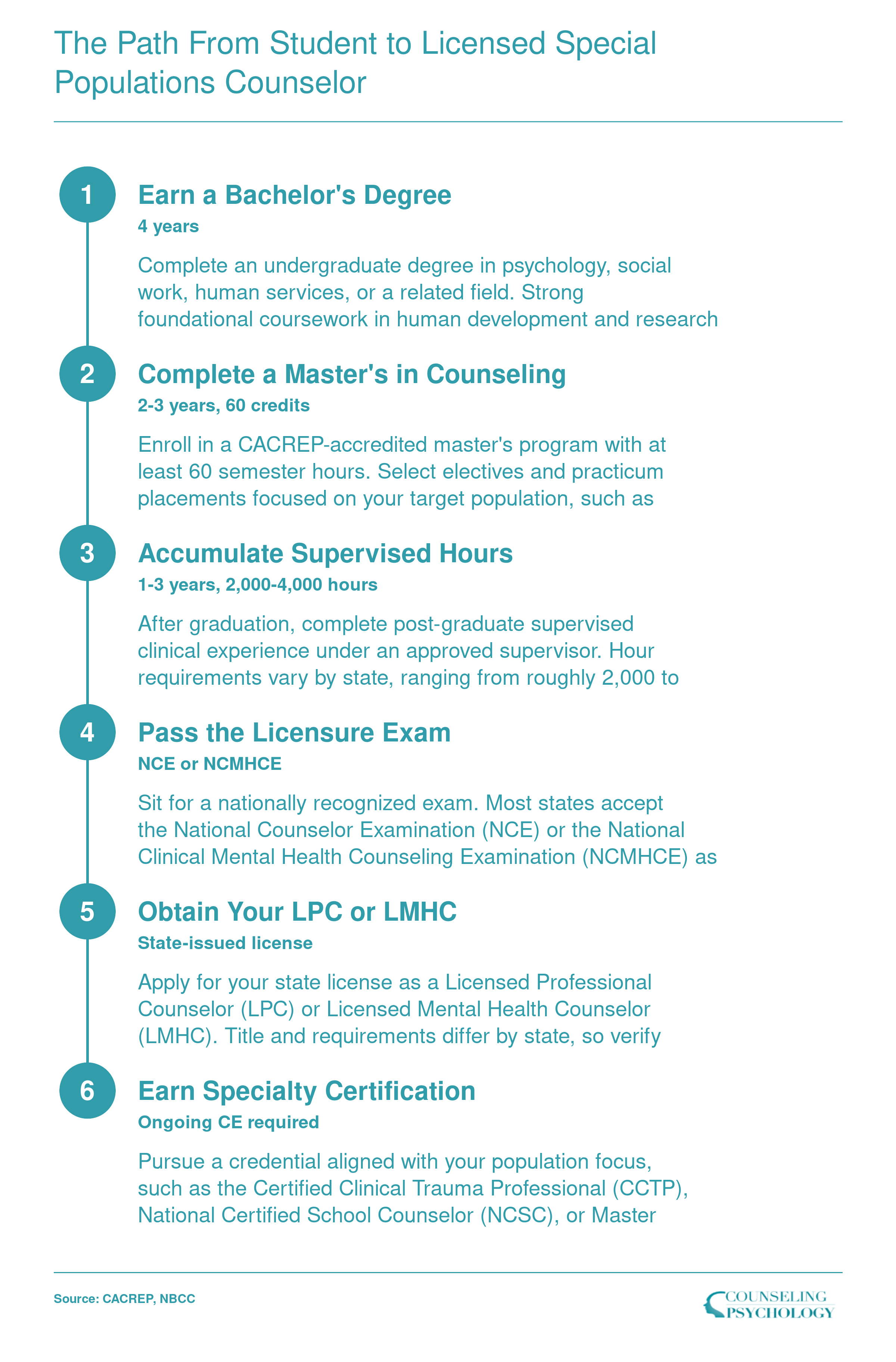
The Path from Student to Licensed Special Populations Counselor
Becoming a licensed counselor who works with special populations follows a structured credentialing ladder. Each stage builds on the last, and the entire journey typically spans 8 to 12 years depending on your pace and state requirements.
Accreditation, Licensure, and Specialty Certifications
The counselor licensure landscape is slowly moving toward greater consistency, with most states now aligning their requirements around CACREP-accredited education. This structural shift improves portability for graduates and signals to employers that a program meets rigorous national standards.
Why CACREP Accreditation Matters
CACREP (Council for Accreditation of Counseling and Related Educational Programs) accreditation is the dominant quality benchmark for master's programs in counseling. Graduating from a CACREP-accredited program streamlines the path to licensure in nearly every state because the curriculum already covers the core content areas and clinical hours that state boards require. For special populations counselors, this is especially important: many employers and specialty certification bodies require or strongly prefer a degree from a CACREP-accredited program. The growing push for interstate license portability, including the Counseling Compact, relies heavily on CACREP standards to define equivalent training across state lines. If you plan to work with underserved or specialized populations, where roles are often grant-funded or housed in integrated care settings, a CACREP-accredited degree keeps more doors open.
The Licensure Pathway: Different Titles, Same Process
Professional counselor licensure goes by many names. LPC (Licensed Professional Counselor), LMHC (Licensed Mental Health Counselor), LCPC (Licensed Clinical Professional Counselor), and others all reflect variations on a remarkably consistent underlying pathway. For a closer look at what each abbreviation means, see this guide to counseling licensure acronyms. Each state requires:
- A master's or doctoral degree in counseling or a closely related field, ideally from a CACREP-accredited program.
- Postgraduate supervised clinical experience, typically 2,000 to 4,000 hours, with a portion in direct client contact.
- A passing score on a national exam, usually the National Counselor Examination (NCE) or the National Clinical Mental Health Counseling Examination (NCMHCE).
Once licensed, you can practice independently and begin pursuing specialty population certifications that deepen your expertise without requiring a new license. If you are considering the licensed professional counselor route specifically, mapping out your supervised hours early will save time.
Specialty Certifications for Population-Specific Competence
Adding a nationally recognized certification validates your focused training with a particular population. Many certifications require an active clinical license and a set number of continuing education hours, plus direct work with the target population. Key certifications for special populations counselors include:
- Certified Clinical Trauma Professional (CCTP): Issued by Evergreen Certifications, this credential serves trauma survivors across the lifespan. Requires a master's degree, an independent practice license, and 12 hours of trauma-specific training. No exam is required; renewal needs 6 to 18 continuing education hours.1
- CCTP Level II (CCTP-II): For clinicians working with complex trauma (chronic, relational, developmental). Prerequisite is the CCTP or equivalent, plus 24 hours of training and documented experience with at least five complex trauma clients for six months each. Renewal requires 12 hours.2
Other widely recognized credentials to explore as your specialization sharpens include the Master Addictions Counselor (MAC) from NBCC, the Certified Rehabilitation Counselor (CRC) from CRCC, and the Registered Play Therapist (RPT) from the Association for Play Therapy. Each sets distinct education and experience thresholds, so plan ahead to ensure your graduate coursework and clinical placements align with the populations you want to serve.
LPC vs LCSW: Scope of Practice for Special Populations Work
A Licensed Professional Counselor (LPC) requires a master's in counseling and roughly 2,000 to 3,000 supervised clinical hours, while a Licensed Clinical Social Worker (LCSW) requires a Master of Social Work and typically 3,000 supervised hours.1 Both credentials qualify practitioners to provide psychotherapy, but the training philosophy, scope of practice, and workplace demand diverge in ways that matter when you plan to serve a specific population.
Education and Examination
LPC candidates complete a master's in counseling (usually 60 semester hours at CACREP-accredited programs) and sit for the National Counselor Examination (NCE) or the National Clinical Mental Health Counseling Examination (NCMHCE).2 Field education requirements average around 700 practicum and internship hours before graduation.3
LCSW candidates earn an MSW (typically 60 credits), complete roughly 900 field education hours during the degree, and then pass the Association of Social Work Boards (ASWB) Clinical examination.3 The MSW curriculum places heavier emphasis on systems-level intervention, policy advocacy, and case management alongside clinical training.
Scope of Practice and Clinical Focus
LPCs are trained primarily as psychotherapists. Their scope centers on assessment, diagnosis, and treatment planning for mental health disorders, which makes the credential a natural fit for direct clinical work with individuals and groups.3
LCSWs carry a broader mandate that integrates therapy with advocacy, resource coordination, and organizational leadership. In practice, an LCSW working with veterans might conduct trauma-focused therapy in one session and coordinate housing benefits in the next, because the credential explicitly covers that systems-oriented scope.
Where Each Credential Dominates
Workplace preference often depends on the population being served and the funding structures behind the setting.2
- VA and military systems: The Department of Veterans Affairs employs LCSWs at far higher rates than LPCs. Social work's systems-oriented training aligns with the VA's interdisciplinary, case-management-heavy model.
- Child welfare and hospital social services: LCSWs are typically the default credential in child protective services, foster care agencies, and hospital discharge planning teams.
- Private practice and outpatient therapy: LPCs are well represented here, where the work is predominantly one-on-one or group psychotherapy without the case management layer.
- Community mental health: Both credentials appear, though LPCs tend to fill direct-service therapist roles while LCSWs more often move into supervisory or program-leadership positions.
Salary and Insurance Reimbursement
The national median annual wage for mental health counselors (the BLS category that captures most LPCs) was approximately $53,710 as of the most recent federal data.2 LCSW-specific salary data is tracked under a different BLS category, and direct comparisons require caution because job titles, settings, and geographic markets vary widely. For a deeper breakdown by degree level and state, see our counselor salary overview.
That said, LCSWs often have an edge in insurance reimbursement.1 Medicare, Medicaid, and many private insurers have historically recognized social work licenses for direct billing, whereas LPC reimbursement eligibility varies by state and payer. Broader reimbursement access can translate into higher earning potential, particularly in private practice, because the clinician can serve a wider pool of insured clients.
Choosing Between the Two for Special Populations Work
If your goal is focused psychotherapy with a defined clinical population, such as adults with substance use disorders or couples navigating infertility, the LPC pathway offers deep clinical training without the systems-level coursework you may not need. If you envision working at the intersection of therapy and social services, coordinating care for refugees, advocating for policy changes affecting children in foster care, or leading programs inside a VA hospital, the LCSW's broader scope will serve you better.
Neither credential locks you out of special populations work entirely. The practical question is which training philosophy and which set of professional doors align with the population you intend to serve and the setting where that population is most commonly reached.
Salary and Job Outlook by Counseling Specialization
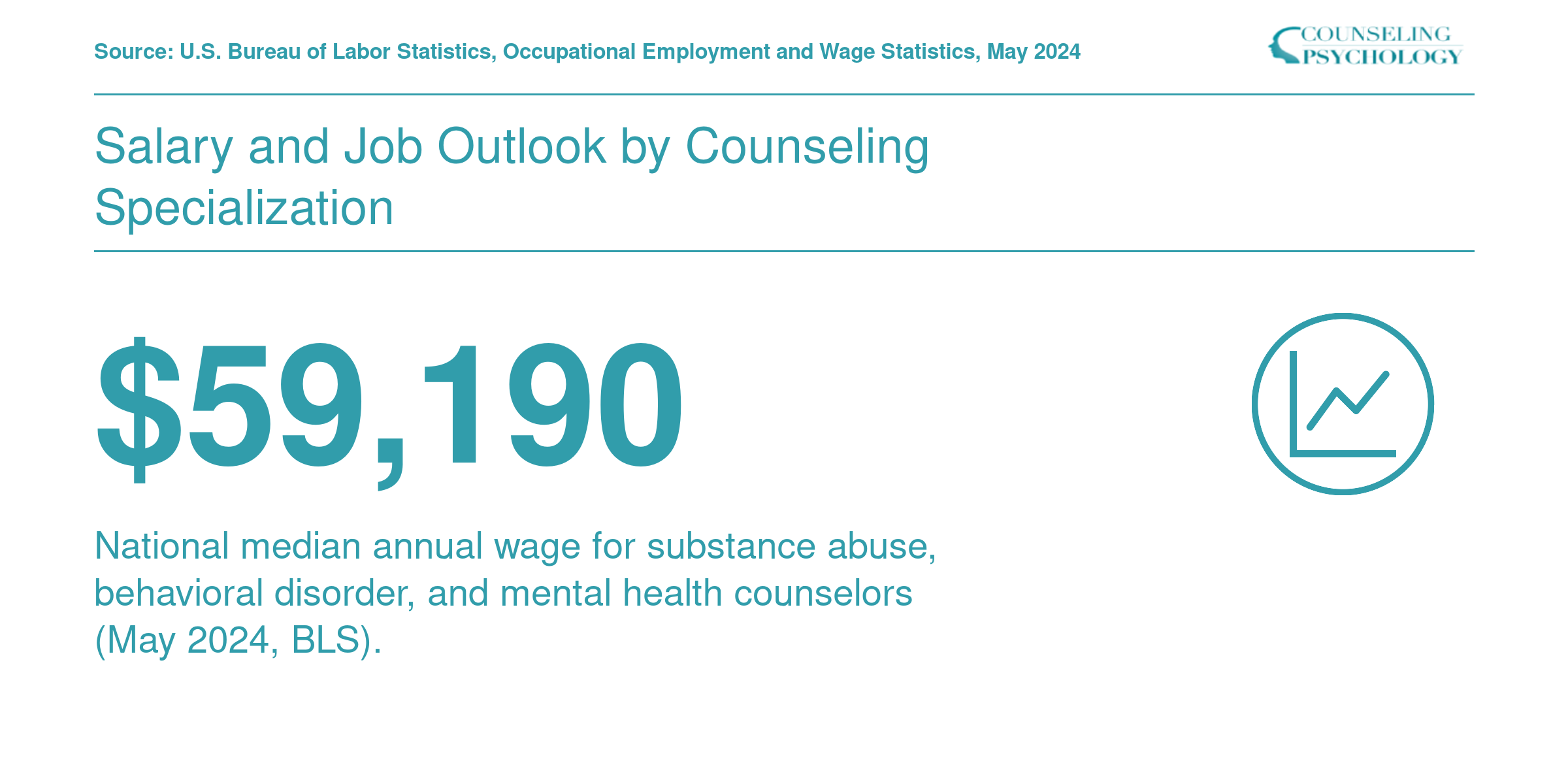
Compensation and demand vary across counseling specializations. According to BLS data, the national median annual wage for substance abuse, behavioral disorder, and mental health counselors was $59,190 as of May 2024, with a projected job growth rate of 8% from 2023 to 2033, well above the average for all occupations. BLS publishes separate occupational profiles for rehabilitation counselors, marriage and family therapists, and school and career counselors, but because verified median wage and growth figures for those categories were not available in our current research set, we present only the confirmed data point below rather than risk citing outdated or inaccurate numbers.
Counselors who earn specialty certifications and targeted training for specific populations consistently position themselves for higher compensation and access to niche roles where competition is thinner. Whether you pursue credentials in trauma work, veteran services, or geriatric counseling, the investment in additional qualifications pays off through stronger career differentiation, greater job security, and expanded professional opportunities that generalist practitioners may not reach.
How to Choose the Right Special Populations Program
With more counseling programs advertising population-specific tracks than ever before, the harder question is no longer whether options exist but how to evaluate them honestly against your goals.
Start With a Self-Assessment
Before comparing curricula or tuition rates, take stock of what you already bring to this work. Lived experience in a military family, fluency in a second language, or years volunteering at a recovery center are genuine professional assets. Match those assets to a population first, then let that target population drive your program search. A student whose career goal is working with refugee communities needs different clinical exposure than one drawn to veteran mental health, even if both end up in a licensed mental health counselor role.
Build a Decision Checklist
Once you have a population in mind, evaluate programs against four concrete criteria:
- CACREP accreditation: This is non-negotiable for most licensing pathways. The CACREP directory lets you filter by specialized practice area and delivery format, which speeds up the search considerably.1
- Population-specific concentrations: Look for tracks or elective sequences targeting your population. William & Mary's online M.Ed. in Clinical Mental Health Counseling, for example, offers a Military and Veterans Counseling specialization, while its School Counseling track centers children and adolescents in K-12 settings.2 Sacred Heart University's CACREP-accredited online M.S. in Clinical Mental Health Counseling incorporates coursework in substance use and addictions counseling.3
- Clinical placement partnerships: A program's practicum network matters as much as its course catalog. Programs near VA medical centers, children's hospitals, refugee resettlement agencies, or addiction treatment facilities often have standing relationships that give students direct access to their target population. Ask admissions staff specifically: where do your students complete practica, and which community partners do you place students with most often?
- Faculty expertise: Review faculty bios for research and clinical backgrounds in your area. A faculty member who has published on trauma-informed care with immigrant populations or co-occurring disorders brings a different depth to supervision than a generalist instructor.
Online vs. On-Campus Tradeoffs
Online programs remove geographic barriers and offer schedule flexibility that matters for students balancing work or family obligations. The William & Mary and Sacred Heart programs mentioned above show that rigorous, CACREP-accredited online clinical mental health counseling programs do exist for specialized tracks. The tradeoff is practicum access: online programs typically require students to arrange clinical hours locally, which can mean fewer built-in connections to population-specific agencies.
On-campus programs situated near diverse metropolitan areas, military installations, or major healthcare systems often provide richer and more direct clinical exposure to target populations. If you are committed to a specific population and live near the right kind of agency ecosystem, an on-campus program may accelerate that hands-on learning.
Neither format is universally better. The deciding factor is usually whether the program, online or on-campus, can place you in front of the population you intend to serve before you graduate.
Frequently Asked Questions About Special Populations Counseling
Choosing a counseling specialization raises practical questions about credentials, pay, and program formats. Below are answers to the most common questions prospective students ask about special populations counseling careers.