What you’ll learn in this article…
- Davenport University's new 3+2 program reduces total credits from 180 to 168, saving students time and tuition.
- The Bureau of Labor Statistics projects an 18% increase in demand for mental health counselors over the next decade.
- More than half of Michigan's population, over 6 million people, lives in mental health professional shortage areas.
- Students can earn a CADC addiction counseling credential and work in entry-level behavioral health roles while studying.
How can Michigan accelerate its pipeline of licensed counselors when over 6 million residents live in mental health professional shortage areas and traditional six-year degree paths cannot keep pace? Davenport University’s 3+2 accelerated pathway, launching fall 2026, compresses a Bachelor of Applied Science in Applied Psychology and a Master of Arts in Mental Health Counseling into five years, cutting twelve credits and tuition costs. In a state where demand for services is projected to rise 18 percent, faster training models are no longer optional; they are a workforce necessity.
What Is Davenport’s Accelerated 3+2 Counseling Program?
For students choosing a graduate program, the decision often comes down to entering the field quickly versus investing in extensive training. Davenport University’s new accelerated pathway aims to offer both.
A Streamlined Path to Licensure
Davenport University’s 3+2 program combines a Bachelor of Science in Health and Human Service Case Management with a Master of Arts in Mental Health Counseling1, allowing students to earn both degrees in five years. The integrated curriculum totals 157 credits3, significantly fewer than completing each degree separately. This reduction not only saves time but also lowers total tuition costs, making the journey to licensure more accessible. The bachelor’s degree serves as an intermediate credential, enabling students to pursue entry-level behavioral health roles while completing graduate studies.
Built-In Preparation for LPC and CADC Credentials
The program’s coursework is designed to meet the educational requirements for Michigan’s Licensed Professional Counselor (LPC) credential while also embedding addiction theory2. This dual focus means graduates can sit for both the National Counselor Examination (NCE) and the Certified Alcohol and Drug Counselor (CADC) exam, boosting their qualifications right out of the gate.
CACREP-Aligned and Ready for Practice
While the master’s in mental health counseling is currently CACREP-aligned2, meaning it follows the rigorous standards of the Council for Accreditation of Counseling and Related Educational Programs, the university is actively pursuing full accreditation. The curriculum includes 700 hours of supervised clinical experience (100 hours of practicum and 600 hours of internship)2, ensuring students are practice-ready.
Launching Fall 2026: Flexible and Impact-Driven
The program, unveiled as part of Davenport’s Vision 2030 initiative, will welcome its first cohort in fall 2026. Courses are delivered in a hybrid format, combining online coursework similar to online clinical mental health counseling programs with on-site clinical placements near the university’s Michigan campuses. As a combined-degree-only pathway, students are admitted directly into the 3+2 track, committing to both degrees upfront. This structure creates a seamless progression from undergraduate to graduate work without a separate master’s application. Admission requires a minimum 2.75 GPA3 and completion of prerequisite undergraduate coursework.
How the 3+2 Pathway Saves Time and Tuition
By trimming 12 credits from the traditional separate bachelor's and master's path, Davenport University's 3+2 program compresses the timeline to just five years. This integrated Bachelor of Applied Science in Applied Psychology and Master of Arts in Mental Health Counseling totals 168 credits instead of the typical 180, eliminating redundant coursework and accelerating your path to licensure.
Fewer Credits, Faster Completion
In a conventional model, earning a bachelor's degree in psychology (typically 120 credits) followed by a 60-credit CACREP-aligned master's degree means at least six years of full-time study. Davenport's combined curriculum front-loads graduate-level content into the undergraduate phase and streamlines course sequencing, allowing you to earn both degrees in 60 months. The result: you save an entire year of tuition, fees, and living expenses while still meeting all educational requirements for Michigan licensure.
Comparing Costs: Time vs. Sticker Price
Davenport's per-credit cost for the 2025, 2026 academic year is $1,104, bringing the estimated total program expense to between $115,000 and $130,000.1 At first glance, this appears higher than the average $62,500, $77,500 needed for a bachelor's and separate master's at Michigan public universities.2 However, a direct cost comparison misses the full picture. Traditional routes typically span 72, 84 months, extending the time you spend paying for housing, transportation, and student fees, not to mention the additional loan interest that accrues. By completing your education in 5 years, you enter the workforce as a licensed counselor up to two years sooner, potentially earning a full salary while your peers are still in clinical rotations. For out-of-state students, Davenport charges no additional tuition premium1, making it a uniquely accessible option regardless of residency.
Financial Aid and Scholarship Opportunities
Davenport University offers a range of financial aid packages, including federal grants, loans, and institutional scholarships. Prospective students are encouraged to speak with a financial aid advisor to explore merit-based scholarships, transfer credits that can further reduce total costs, and employer tuition reimbursement programs that many regional healthcare employers provide.
A Cost-Effective Route to Licensure
The 3+2 pathway integrates preparation for the Certified Alcohol and Drug Counselor (CADC) exam directly into the curriculum3, eliminating the need for separate post-graduate certification coursework. It also allows you to work in entry-level behavioral health roles3, such as technician positions in addictions or criminal justice settings, while completing your master's coursework, offsetting educational costs with earned income. By reducing the total time to licensure and blending bachelor's and master's studies, Davenport's model delivers a practical, budget-savvy alternative for the next generation of Michigan counselors.
Therapist Shortage in Michigan: Why Accelerated Programs Matter
National Trends Point to a Critical Shortage
Mental health counseling is one of the fastest-growing professions in the United States. The Bureau of Labor Statistics projects an 18 percent increase in demand for mental health counselors over the next decade, much faster than the average occupation.1 This surge reflects a broader societal recognition of mental health needs, but it also exposes a widening mental health workforce shortage.
Michigan's Mental Health Workforce Challenges
Michigan is no exception to these trends. Across the state, many counties are designated as Health Professional Shortage Areas for mental health, meaning the ratio of providers to residents falls short of federal benchmarks. Rural and underserved urban communities often face the longest rural mental health wait times for counseling services. The state’s behavioral health workforce pipeline has struggled to keep pace with rising demand, particularly as many experienced counselors approach retirement age. Without deliberate interventions, these gaps threaten to leave vulnerable Michiganders without timely access to care.
Accelerated Pathways That Close the Gap
Addressing the shortage requires more than just increasing awareness; it demands a faster, more efficient pathway into the profession. Traditional master’s programs can take two to three years after a bachelor’s degree, delaying entry into the workforce. Integrated models like Davenport University’s 3+2 pathway compress that timeline, allowing students to earn both a bachelor’s and a master’s degree in five years instead of six or more. This acceleration means that new counselors can begin serving clients sooner, helping to alleviate pressure on overburdened systems.
Moreover, programs that embed licensure preparation, including coursework for the Certified Alcohol and Drug Counselor credential, equip graduates with dual competencies, making them immediately valuable in a state where substance use disorders often co-occur with other mental health conditions. By streamlining the educational journey and aligning it directly with state licensure requirements, accelerated programs offer a direct response to Michigan’s urgent need for more mental health professionals.
Over 6 million Michigan residents, more than half the state's population, live in designated mental health professional shortage areas, according to the Health Resources and Services Administration.
Licensure Preparation: LPC and CADC Certification
As Michigan grapples with a severe therapist shortage, licensure pathways are being redesigned to balance rigor with speed. The state’s Licensed Professional Counselor (LPC) credential demands a 60-semester-hour master’s from a CACREP-accredited program, including a 600-hour supervised clinical internship. After graduation, candidates accrue 3,000 hours of post-degree supervised experience (100 hours must be direct supervision) over at least 24 months, fulfilling the supervised hours for counseling licensure, then pass the National Counselor Examination (NCE), and complete training in human trafficking and implicit bias. Background checks are required.1
How Davenport’s Curriculum Meets LPC Standards
Davenport University’s accelerated 3+2 pathway integrates the master’s-level coursework and practicum into a 168-credit combined degree, ensuring no content is sacrificed. The program covers all LPC-mandated areas: assessment, diagnosis, treatment planning, ethics, and multicultural counseling. Because the master’s component meets the 60-credit threshold and includes a 600-hour onsite internship, graduates are eligible for the NCE and can seamlessly transition to the state’s supervised practice phase. For detailed requirements, consult the Michigan Department of Licensing and Regulatory Affairs (LARA) Board of Counseling website.
CADC Certification Built In
The curriculum extends beyond LPC essentials by embedding addiction theory courses aligned with Michigan Certification Board for Addiction Professionals (MCBAP) standards. This prepares students to sit for the IC&RC exam to become a substance abuse counselor, earning the Certified Alcohol and Drug Counselor (CADC) credential. Unlike traditional paths that demand extra coursework, Davenport’s design weaves substance use competency directly into the degree, allowing students to pursue dual licensure without additional semesters. This integrated approach addresses a pressing need for counselors skilled in both mental health and addiction, especially as integrated care models gain traction across Michigan.
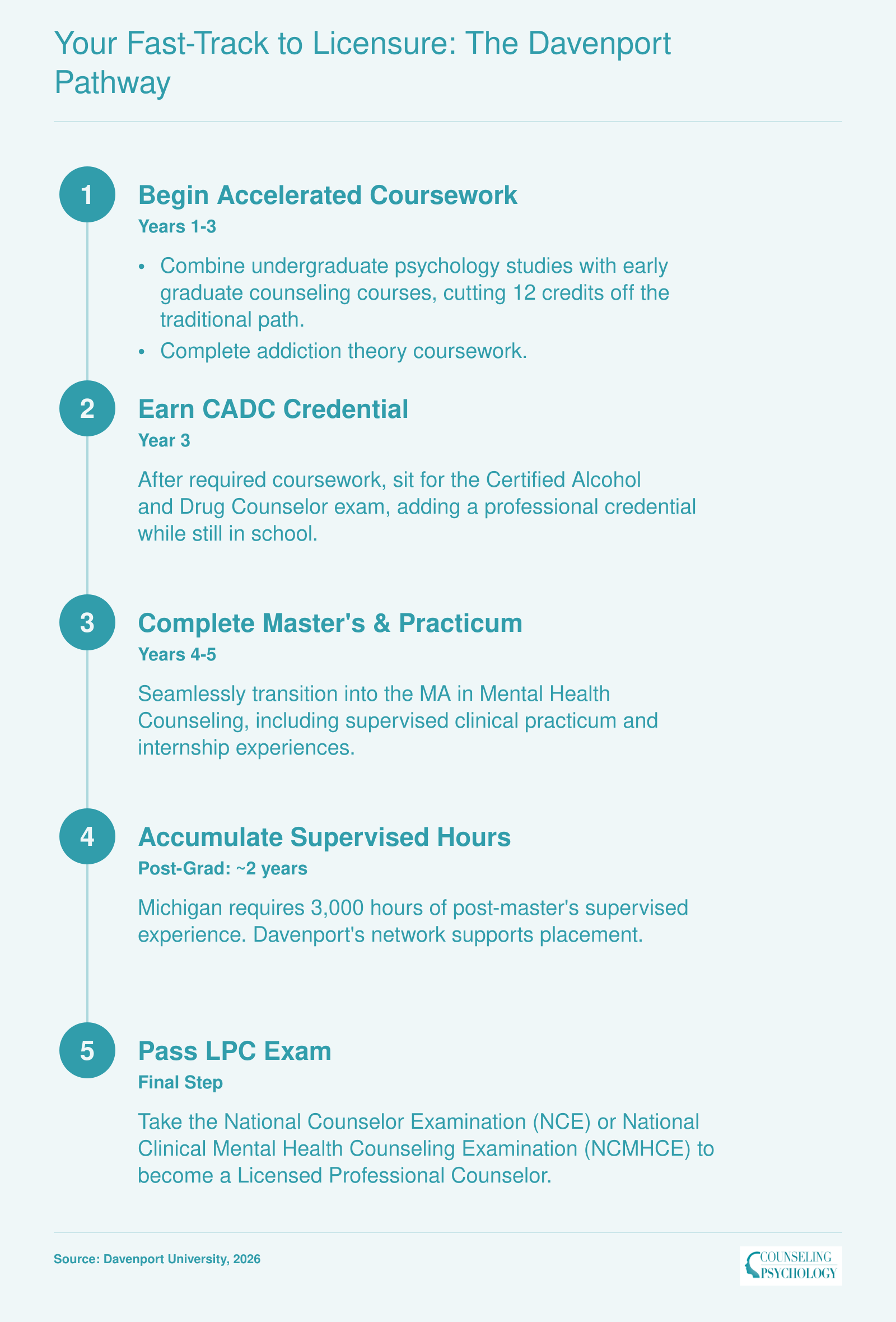
Your Fast-Track to Licensure: The Davenport Pathway
Davenport's 3+2 model compresses the typical six-year journey into a streamlined five-year sequence, with a valuable addiction counseling credential earned along the way.
How Davenport’s Program Compares to Other Michigan Counseling Degrees
Davenport University’s new accelerated 3+2 pathway allows students to earn both a bachelor’s and master’s degree in just five years, streamlining the path to licensure. Below is a side-by-side look at how the graduate portion of Davenport’s program stacks up against other Michigan counseling master’s degrees, including those with accelerated options.
| University | Program | Program Type | Credits | CACREP Accredited | CADC Preparation | Tuition (Total) | Delivery |
|---|---|---|---|---|---|---|---|
| Davenport University | M.A. in Mental Health Counseling (3+2 Combined) | Accelerated Combined Degree | 168 (combined) | No | Yes (addiction theory coursework) | $66,240 (master’s portion) | Online |
| Western Michigan University | Accelerated Master’s in Counseling Psychology | Accelerated Master’s (AGDP) | 60 | No | Not specified | Contact school | Not specified |
| Eastern Michigan University | MA in Clinical Mental Health Counseling | Traditional | 60 | Yes | Not specified | Contact school | Not specified |
| Central Michigan University | MA in Counseling | Traditional | 60 | Yes | Not specified | $49,740 | Hybrid |
| University of Detroit Mercy | M.A. in Counseling | Traditional | 60 | Yes | Yes (addiction counseling specialization) | Contact school | Not specified |
| Wayne State University | M.A. in Counseling | Traditional | 60 | Yes | Not specified | $49,980 | Hybrid |
| Spring Arbor University | M.A. in Counseling (MAC) | Traditional | 61 | Yes | Not specified | $41,907 | Not specified |
Flexible Online and In-Person Learning Options
The shift toward hybrid graduate education has made it possible for working adults to pursue licensure-track counseling degrees without pausing their careers. Davenport University’s accelerated counseling pathway is built around that reality, pairing a fully online Master of Arts in Mental Health Counseling with strategically placed in-person clinical training.
A Hybrid Model Designed for Working Adults
Davenport’s online master's in counseling program is delivered entirely online, so didactic coursework fits around professional and personal schedules. The format eliminates the commute to a physical campus for most classes and lets students access lectures, discussions, and assignments asynchronously or in real-time evening sessions. The program is cataloged specifically for working adults, and its 15-week semester structure creates a predictable rhythm.
Start Dates and Pacing
New cohorts begin in Fall and Winter: two entry points a year.2 The accelerated designation compresses the credit load, but the standard semester calendar means students still move through material in deliberate, manageable blocks. While the pathway is intensive, the online delivery provides the temporal flexibility that many part-time or full-time employees need.
Required In-Person Clinical Training
All clinical training hours are completed face-to-face at approved community sites, not on campus. Students complete 100 hours of practicum and 600 hours of internship (700 hours total) under supervised conditions.1 These placements are arranged near the student’s location, allowing them to build professional networks in the communities where they intend to practice.
Davenport's program allows you to work as a behavioral health technician in addictions, criminal justice, or education while earning your master's. Gain practical experience and income on your way to licensure.
Career Paths: Entry-Level Roles While You Study
Davenport’s accelerated pathway is designed to let you earn while you learn. While completing your graduate coursework, you can step into entry-level behavioral health positions that build clinical hours and strengthen your future licensure application.
Common Entry-Level Roles
- Addictions Technician , Support individuals in substance abuse treatment programs.
- Behavioral Health Specialist , Work directly with clients in community mental health settings, assisting with treatment plans and daily activities.
- Case Manager , Coordinate services for clients navigating mental health or addiction systems, often in nonprofit or government agencies.
- Psychiatric Aide , Provide bedside care and monitoring in psychiatric hospitals or residential facilities.
Where You Might Work
Typical employers include community mental health centers, substance abuse clinics, school-based programs, and criminal justice diversion initiatives. These settings expose you to diverse client populations and interdisciplinary teams.
Entry-Level Pay and Licensure Advantages
As a proxy for entry-level compensation, the Bureau of Labor Statistics reports a 25th percentile annual salary of $42,480 for Substance Abuse, Behavioral Disorder, and Mental Health Counselors in Michigan.1 However, these roles offer more than a paycheck: they deliver direct clinical hours that many state licensure boards count toward supervised experience. In fact, time spent as an addictions technician or case manager can often apply toward supervised experience required to become a licensed professional counselor. By the time you finish your master’s, you’ll already have a resume packed with relevant, paid experience.
Mental Health Counselor Salaries Across Michigan Metro Areas
Salaries for mental health counselors in Michigan can shift notably depending on location. The table below draws on 2024 data from the U.S. Bureau of Labor Statistics to show median and mean annual wages, along with total employment figures, for substance abuse, behavioral disorder, and mental health counselors in each metro area.
| Metro Area | Total Employment | Median Annual Salary | Mean Annual Salary |
|---|---|---|---|
| Detroit-Warren-Dearborn, MI | 5,170 | $50,950 | $59,990 |
| Grand Rapids-Wyoming-Kentwood, MI | 1,060 | $62,270 | $64,850 |
| Lansing-East Lansing, MI | 720 | $73,300 | $72,480 |
| Ann Arbor, MI | 440 | $59,530 | $65,330 |
| Saginaw, MI | 370 | $52,100 | $58,510 |
| Kalamazoo-Portage, MI | 330 | $64,510 | $63,260 |
| Bay City, MI | 310 | $37,120 | $46,140 |
| Flint, MI | 300 | $48,180 | $57,980 |
| Traverse City, MI | 160 | $61,880 | $64,040 |
| Battle Creek, MI | 150 | $67,800 | $68,130 |
| Muskegon-Norton Shores, MI | 130 | $68,560 | $62,780 |
| Midland, MI | 120 | $66,090 | $65,110 |
| Jackson, MI | 110 | $44,750 | $50,360 |
| Niles, MI | 90 | $63,110 | $62,690 |
| Monroe, MI | 60 | $66,370 | $71,280 |
Questions to Ask Yourself
Frequently Asked Questions About Accelerated Counseling in Michigan
Michigan faces a growing need for mental health counselors, and new accelerated pathways like Davenport University's 3+2 program aim to fill the gap. Below, we answer the most common questions from prospective students.
Admissions and Next Steps
Instead of completing a bachelor's degree before applying to a master's program, Davenport's accelerated 3+2 pathway lets you lock in your graduate trajectory from day one. The admission process, similar to psychology graduate school admissions, is designed to identify students ready for a rigorous, fast-paced training sequence.
Application Requirements
- GPA: A minimum cumulative GPA of 2.75 is required for both the undergraduate and graduate stages of the accelerated pathway.1
- Transcripts: Submit official transcripts from all previously attended high schools and colleges.
- Personal statement: A written statement outlining your motivation for pursuing mental health counseling and how the accelerated format fits your goals.
- Prerequisite courses: No specific prerequisite courses are required beyond standard college preparation; the program welcomes students from all academic backgrounds.
Deadlines and Cohort Size
Priority deadlines for the fall 2026 launch2 are approaching. Because the program maintains small cohorts to ensure quality mentorship and clinical placement support, prospective students are urged to apply early. Exact deadline dates are published on the Davenport University website and through admissions events.
Next Steps: Connect with Admissions
- Info sessions: Register for an online or on-campus information session to meet faculty and learn about the curriculum and licensure outcomes.
- Campus visits: Schedule a tour to see facilities and speak directly with advisors.
- Admissions contact: Reach out to the Graduate Admissions office at [email protected] or call (616) 554-1234 for personalized guidance on application steps, transcript evaluation, and financial aid.
Securing a spot early not only simplifies your planning but also gives you access to dedicated support from the moment you enroll.
Related Articles
How can Michigan quickly train enough licensed counselors to meet rising demand? Davenport University's new 3+2 pathway answers by combining a bachelor's and master's into a 168-credit program that saves both time and tuition. Students graduate in five years with integrated addiction counseling certification, ready to pursue LPC licensure. This streamlined model directly tackles Michigan's mental health workforce shortage by accelerating the pipeline of qualified professionals. Prospective students can visit the Davenport University website to learn more and apply for the fall 2026 cohort.