
What you’ll learn in this article…
- Online educational psychology degrees span four levels, from certificates completable in under a year to doctoral programs exceeding five years.
- California remains the only state licensing professionals explicitly as Licensed Educational Psychologists, so licensure paths vary widely.
- National median salaries for common graduate roles range from roughly $61,000 for instructional coordinators to over $100,000 for some doctoral positions.
- Both CAEP and APA program-level accreditation matter for credit transfer, licensure eligibility, and long-term career mobility.
Instructional coordinators, a role that commonly hires educational psychology graduates, earn a median annual wage of $70,860 nationally (BLS, 2023). Beyond K-12, the same skills are in demand in corporate learning and EdTech.
Online programs now span certificates through doctorates, attracting working teachers and career changers who need flexible pacing.
Licensure is the bottleneck. Only California issues a dedicated Licensed Educational Psychologist (LEP) credential; elsewhere, graduates qualify under school psychology or counselor licenses, making program alignment with state rules the first real filter.
Best Online Educational Psychology Programs
The programs below represent online-eligible educational psychology degrees ranked by a composite that weighs online availability, institutional quality indicators, graduate outcomes, and affordability. Because educational psychology spans master's, specialist, and doctoral levels, you will find a range of degree types here. Each program card highlights what sets the school apart, from concentration flexibility and practicum structures to tuition discounts and research opportunities.
- Online delivery availability
- Institutional quality indicators
- Graduate earnings and outcomes
- Net price and affordability
- Program depth and specialization options
- Independent program research
- NCES-IPEDS federal institutional data — nces.ed.gov
- College Scorecard graduate earnings — collegescorecard.ed.gov
- Internal program database

George Mason University
George Mason University houses one of the broadest educational psychology program suites on this list, with an MS offering six distinct concentrations and a PhD specialization, all available in hybrid or fully online formats. Virginia educators receive a 15% tuition discount on CEHD programs, and a Bachelor's-to-Accelerated-Master's pathway lets Mason undergraduates begin graduate coursework at undergraduate tuition rates. The university's 10-year median institutional earnings of roughly $76,300 rank highest among schools in this ranking, reflecting strong overall graduate outcomes.
- Six concentrations: Learning & Cognition, Assessment, Teacher Prep, and more
- Hybrid and fully online course format options
- 30-credit program with capstone project
- 15% tuition discount for Virginia PK-12 educators
- Individualized Studies track allows certificate stacking
- Discounted nonresident rate for online CEHD students
- Hybrid doctoral program with personalized study plans
- Requires a master's degree and relevant work experience
- Practical internship experiences beyond coursework
- Research methodology and interdisciplinary focus
- Financial aid options available
- Prepares for careers in academia, research, and policy
MS in Educational Psychology — Hybrid
PhD in Education, Educational Psychology Specialization — Hybrid

Alliant International University-San Diego
Alliant International University's fully online PsyD in Educational Psychology is built for practicing school psychologists who already hold a master's degree and state licensure. The 50-credit curriculum can be completed in roughly two years and emphasizes neuropsychology, multicultural counseling, and leadership. Housed in Alliant's California School of Education, the program integrates social justice themes throughout coursework and the required PsyD project.
- Fully online, 50-credit doctoral program
- Designed for licensed school psychologists with a master's
- 8-week term calendar for accelerated pacing
- Includes PsyD project and three signature assignments
- Covers child neuropsychology and psychopharmacology
- Multicultural counseling and social justice emphasis
- Leadership, supervision, and consultation coursework
- 9:1 student-to-faculty ratio institution-wide
PsyD in Educational Psychology — Online

Wichita State University
Wichita State University offers an EdD in Educational Leadership with an Educational Psychology track, a 55-credit hybrid doctoral program designed for a three-year completion timeline. No GRE is required, and students can customize an interdisciplinary emphasis area alongside core coursework in learning, cognition, and research methodology. In-state tuition is among the lowest on this list, with a net price near $13,200.
- 55 graduate credit hours, hybrid delivery
- Three-year designed completion timeline
- No GRE required for admission
- Customizable interdisciplinary emphasis area
- Dissertation and advanced research methodology training
- Mentorship and collaborative cohort learning model
- In-state tuition under $10,000 per year
- Requires a graduate degree in education or related field
EdD in Educational Leadership, Educational Psychology Track — Hybrid

University of Memphis
The University of Memphis provides both an online MS and an online PhD in Educational Psychology and Research, making it one of the few schools where students can pursue both levels entirely at a distance with the same faculty. The PhD requires 54 credit hours plus a dissertation and follows a research apprenticeship model that pairs each student with a faculty mentor. Embedded graduate certificates in areas like qualitative methods can be stacked with either degree.
- Fully online with the same faculty as on-campus sections
- Covers human development, learning, cognition, and motivation
- Flexible for both full-time and part-time students
- Prepares for career advancement or doctoral study
- Embedded graduate certificate options available
- Research methodology integrated throughout curriculum
- Online and face-to-face delivery options
- 54 credit hours plus dissertation and research residency
- Faculty research apprenticeship model
- Part-time and full-time enrollment accepted
- Funding opportunities through graduate assistantships
- Fall and spring admission cycles
- Prepares for academia, research, and consulting roles
MS in Educational Psychology and Research — Online
PhD in Educational Psychology and Research — Online
Capella University
Capella University's fully online PhD in Psychology with an Educational Psychology specialization uses a competency-based GuidedPath format across 84 quarter credits. Three virtual residencies replace in-person requirements, and up to 24 transfer credits are accepted. The program does not prepare students for clinical licensure but focuses on curriculum design, instructional systems, and educational research roles.
- Fully online, competency-based GuidedPath format
- 84 quarter credits with seven specialization courses
- Three virtual residencies (no campus travel)
- Up to 24 transfer credits accepted
- No GRE required; master's degree with 3.0 GPA needed
- Potential $5,000 scholarship available
- Tuition at $570 per quarter credit
- Not a licensure preparation program
PhD in Psychology, Educational Psychology Specialization — Online

Chaminade University of Honolulu
Chaminade University of Honolulu delivers a 100% online EdD in Educational Psychology with concentrations in School Psychology or Mental Health Counseling, completable in as few as 36 months. Rooted in culturally responsive practice relevant to Hawai'i and Pacific Islander communities, the program blends asynchronous and synchronous sessions. The Mental Health Counseling track includes a 600-hour internship aligned with Hawai'i DCCA licensing requirements.
- 100% online, 60-credit doctoral program
- Completable in 36 months
- Dissertation and evidence-based research focus
- Culturally responsive practice for Pacific communities
- Asynchronous and synchronous learning blend
- Prepares scholar-practitioner researchers for educational settings
- 100% online with a 600-hour clinical internship
- 60 credit hours with dissertation component
- Aligned with Hawai'i DCCA mental health license requirements
- Advanced counseling and culturally responsive coursework
- Serves both educational and clinical career paths
- Master's degree required for admission
EdD in Educational Psychology, School Psychology Concentration — Online
EdD in Educational Psychology, Mental Health Counseling Concentration — Online

Texas A&M University-Central Texas
Texas A&M University-Central Texas stands out for offering three distinct online or hybrid programs under its educational psychology umbrella. The Specialist in School Psychology prepares candidates for Texas LSSP licensure through a hybrid format with a two-semester internship. Two fully online master's options serve different goals: the MS in Educational Psychology with a Teaching Emphasis targets aspiring college instructors, while the Experimental Psychology track is a research-intensive pipeline to doctoral study. The institution's extremely low average net price reflects its mission of accessibility.
- 63 to 69 credit hours, hybrid delivery
- Prepares for Texas LSSP licensure
- NASP accreditation pathway
- Two-semester supervised internship required
- Web-enhanced coursework with on-campus components
- Strong job placement record in Texas school districts
- Fully online, 36 credit hours
- Focus on instructional design and assessment
- Prepares for college-level teaching roles
- Admission available fall, spring, and summer
- Research-based teaching practices emphasis
- No licensure preparation
- 100% online, 36 credit hours
- Non-licensure, research-intensive curriculum
- Designed to prepare students for doctoral programs
- Close faculty mentorship and independent research
- Emphasis on statistical analysis
- GRE scores and research experience preferred
Specialist in School Psychology — Hybrid
MS in Applied Psychology, Educational Psychology with Teaching Emphasis — On-Campus
MS in Educational Psychology, Experimental Psychology — On-Campus

University of the Southwest
The University of the Southwest offers a fully online EdD in Educational Psychology geared toward working professionals who want to study learning theories and educational leadership without relocating. An optional self-design track lets students tailor both coursework and dissertation focus. Two brief residencies and dedicated dissertation software support round out the remote experience. Tuition is set at a flat $799 per credit with no hidden fees.
- 100% online doctoral program
- Optional self-design track for customized focus
- Two required program residencies
- Dissertation software support provided
- Tuition at $799 per credit, no hidden fees
- Free laptop provided with first course
- Covers learning theories, leadership, and strategic planning
- Designed for working professionals
EdD in Educational Psychology — Online

Florida State University
Florida State University's online MS in Educational Psychology specializes in Learning and Cognition across a 33-credit curriculum accredited by SACSCOC. The program has earned recognition from U.S. News & World Report among online graduate education offerings and is built for working educators, trainers, and instructional designers who want to deepen their understanding of cognitive processes. FSU's institutional graduation rate exceeds 85%, and its 10-year median earnings stand near $61,700.
- Fully online, 33 credit hours
- Ranked by U.S. News for online graduate education
- Specialization in learning, cognition, and group dynamics
- Designed for working professionals in education and training
- Bachelor's degree required for admission
- SACSCOC accredited for regional portability
- Prepares graduates for instructional design and research roles
MS in Educational Psychology, Learning and Cognition — Online
Walden University
Walden University's online PhD in Psychology with an Educational Psychology specialization focuses on classic educational psychology theory, testing, measurement, and adult learning. Students holding a related master's degree may waive up to five courses, and the program accepts easy credit transfers with no application fee. The degree requires four residencies and a doctoral dissertation, and it is explicitly a non-licensure pathway suited to research, curriculum development, and higher education roles.
- Fully online with four required residencies
- 65 to 90 quarter credits depending on waivers
- Up to five course waivers with a related master's
- Focus on adult learning, testing, and measurement
- Tuition starting at $630 per quarter credit
- Dissertation required with 8-year maximum completion window
- Not a licensure preparation program
- HLC accredited with no application fee
PhD in Psychology, Educational Psychology Specialization — Online
What Is Educational Psychology?
What exactly do educational psychologists study, and how is their work different from what a general psychologist does?
At its core, educational psychology is the scientific study of how people learn. That scope is broader than most students expect. The field examines cognitive development, motivation, instructional design, and assessment, and it applies those insights well beyond the K-12 classroom. Corporate training departments, clinical rehabilitation settings, government policy offices, and EdTech startups all rely on the same foundational research about how humans acquire and retain knowledge.
How It Differs From General Psychology
General psychology investigates human behavior and mental processes across a wide range of contexts, from personality theory to neuropsychology. Educational psychology narrows that lens to learning environments and educational systems specifically. An educational psychologist asks: given what we know about memory, attention, and development, how should instruction be structured so learners actually succeed? That applied psychology focus is the distinguishing feature of the discipline.
Historical Roots, Practical Aims
The field traces its origins to researchers like Edward Thorndike, Jean Piaget, and Lev Vygotsky, each of whom shaped our understanding of how knowledge is constructed and transferred. But day-to-day work in educational psychology is overwhelmingly practical. Professionals in this field design curricula, evaluate the effectiveness of teaching strategies, develop standardized assessments, analyze learning outcome data, and advise organizations on evidence-based instructional practices.
A concrete example: an educational psychologist working with a school district might audit its reading intervention program, identify that the curriculum overloads working memory at critical stages, and redesign lesson sequences using cognitive load theory so students retain more of what they read. That blend of research knowledge and real-world problem solving is typical of the role.
Where Educational Psychologists Work
The employer landscape is wider than many prospective students realize. Common settings include:
- School districts: Designing intervention programs, training teachers, and analyzing student performance data.
- Universities: Conducting research on learning science or directing centers for teaching and learning.
- EdTech companies: Guiding product development so digital tools align with how people actually learn.
- Government agencies: Shaping education policy, evaluating federally funded programs, or developing workforce training standards.
- Healthcare systems: Building patient education materials or designing continuing education for clinical staff.
Because the discipline sits at the intersection of psychology, education, and data analysis, graduates tend to have flexibility in how they build a career. Some pursue roles in vocational rehabilitation counseling, while others move into policy, research, or instructional design. The degree you pursue, whether a certificate, a master's, or a doctorate, largely determines which of these paths opens first.
Questions to Ask Yourself
Educational Psychology Degree Levels Compared
Educational psychology is studied at four distinct credential levels, each with its own time commitment, credit load, and career payoff. The right entry point depends on whether you want a quick skill upgrade, a teaching license, a research role, or full licensure as a psychologist. Here is how the levels stack up.
Certificate, Bachelor's, Master's, Doctorate at a Glance
- Graduate certificate: Roughly 12 to 18 credits, finished in 6 to 12 months, and widely available fully online.1 Certificates don't lead to licensure on their own, but they're popular with classroom teachers, instructional designers, and curriculum staff who want focused training in learning theory, assessment, or motivation. Many programs are designed so the credits stack directly into a related master's, which is the real selling point for working professionals testing the waters.
- Bachelor's degree: Typically 120 credits over about four years, offered both online and on campus.2 A bachelor's in psychology or education is the standard prerequisite for graduate study. On its own, it qualifies graduates for entry-level roles in schools, social services, behavioral support, or education-adjacent positions in publishing and edtech, but not for any licensed psychologist title.
- Master's degree: Usually 30 to 48 credits, completed in 18 to 36 months, and one of the most common online formats in the field.1 Graduates work as instructional coaches, learning specialists, program evaluators, university student-affairs staff, or researchers. In most states, master's holders cannot use the title "educational psychologist," but they often work under adjacent titles such as educational consultant or learning specialist.
- Specialist (Ed.S.) and Doctorate (Ed.D./Ph.D.): The Ed.S. (around 60 to 72 credits) is the standard credential for school psychologists and is mostly campus-based due to supervised practicum requirements.3 Doctoral programs run 90 to 120 credits over four to seven years and are also primarily campus-delivered, though some Ed.D. programs offer hybrid formats.4
Why the Doctorate Matters for the Title
In states that license "educational psychologists" as a distinct profession (California is the most prominent example), a doctorate is typically required to use the title and practice independently. Master's graduates can still build meaningful careers in research, teaching, and consultation, but the protected title and the highest-paying clinical roles generally sit behind a doctoral credential and a supervised postdoctoral period. For professionals drawn to related applied fields, exploring how to become an applied psychologist can help clarify how doctoral requirements differ across specializations.
Related Articles
Educational Psychology Vs. School Psychology Vs. Counseling Psychology
Choosing among educational psychology, school psychology, and counseling psychology often comes down to where you want to work, whom you want to serve, and what credential you are willing to pursue. The three fields overlap in their interest in human development and learning, but they diverge sharply in curriculum focus, accreditation standards, and the licenses graduates ultimately hold.
How the Curricula Differ
Educational psychology programs emphasize research on cognition, motivation, instructional design, and assessment. Graduates frequently work in higher education, curriculum development, policy analysis, or educational technology rather than in direct clinical practice. School psychology programs, by contrast, center on psychoeducational assessment, behavioral intervention, and consultation within K through 12 settings. Counseling psychology programs train students for therapeutic work across the lifespan, covering theories of counseling, group dynamics, multicultural competence, and supervised clinical hours.
Because the day-to-day coursework varies so much, reviewing specific university program pages is essential. Compare course lists, practicum or internship hour requirements, and the licensure pathways each program explicitly prepares you for. Most program sites will state whether graduates are eligible for credentials such as the Nationally Certified School Psychologist (NCSP), Licensed Professional Counselor (LPC), or Licensed Psychologist (LP) designation.
Accreditation and Professional Standards
Different accrediting bodies govern each field, and the distinction matters for licensure eligibility:
- Educational psychology: Programs are often housed in colleges of education and may be accredited through the Council for the Accreditation of Educator Preparation (CAEP). Some doctoral programs also seek APA accreditation.
- School psychology: The National Association of School Psychologists (NASP) approves specialist-level programs, while the American Psychological Association (APA) accredits doctoral programs in school psychology.
- Counseling psychology: Doctoral programs typically pursue APA accreditation, while master's-level counseling programs are accredited by the Council for Accreditation of Counseling and Related Educational Programs (CACREP).
Checking the official accreditation directories on the APA, CAEP, and NASP websites is the most reliable way to confirm a program's standing before you apply.
Career Outcomes and Salary Research
The Bureau of Labor Statistics (BLS.gov) publishes median salaries, projected job growth rates, and typical education requirements for psychologists and counselors. Because each of these three fields feeds into different BLS occupational categories, looking up the specific category that matches your intended career path gives you a far more accurate picture than relying on a single "psychologist" figure. For a closer look at compensation trends by specialty and degree level, our overview of counselor salary data can help you benchmark expectations.
Getting State-Specific Guidance
Licensure requirements shift significantly from one state to another. Contacting professional associations directly, including the American Counseling Association (ACA) for counseling credentials and NASP for school psychology credentials, can clarify which degree level, supervised hours, and exams your target state requires. If you are still weighing your options across the broader counseling landscape, our guide to counseling degrees outlines each level and its typical career outcomes. This step is especially important if you plan to practice in a state different from the one where you earn your degree, because credential reciprocity is not guaranteed.
Licensure Pathways for Educational Psychologists
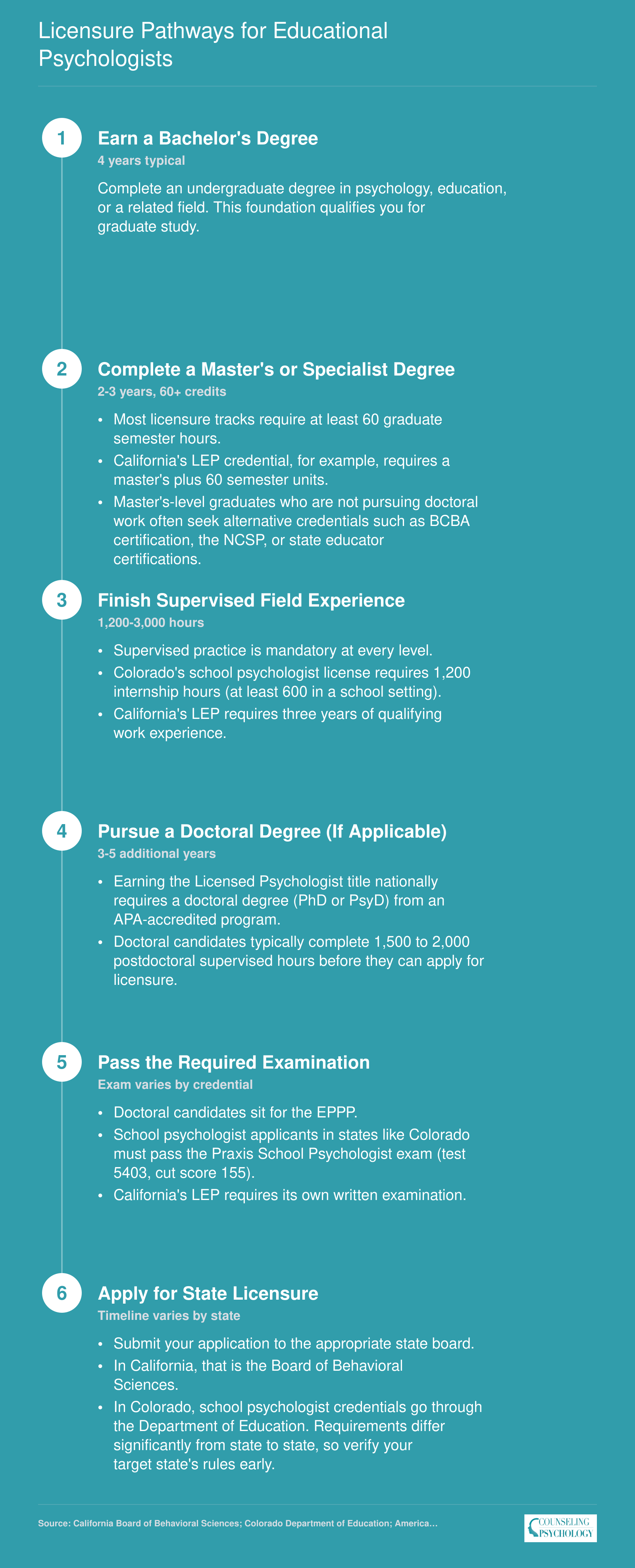
The road from your first psychology course to a state-issued license spans several milestones, and the exact credential you earn depends heavily on where you practice. California is currently the only state that licenses professionals under the explicit title "Licensed Educational Psychologist." In most other states, educational psychology graduates credential under adjacent titles such as Licensed Psychologist, School Psychologist, or Licensed Educational Specialist.
Curriculum and Clinical Requirements in Online Programs
Curriculum and clinical requirements refer to the specific courses you must complete and the supervised, hands-on fieldwork hours you must log before a program will grant your degree. These two components vary significantly between master's and doctoral tracks, and understanding them before you enroll can save you semesters of frustration.
What to Expect in the Coursework
Most online educational psychology programs share a common academic core at the master's level: learning theory, human development, research methods, assessment and measurement, and applied statistics. Doctoral programs layer on advanced research design, program evaluation, and specialized seminars in areas like cognitive science or motivation. Some programs fold in elective concentrations (gifted education, instructional design, special education policy) that let you tailor the degree toward a specific career.
Course delivery formats differ more than you might assume. Some programs are fully asynchronous, while others blend asynchronous modules with weekly live sessions. A handful require brief on-campus intensives, sometimes called residencies, typically lasting a few days to a week each semester. These residencies are more common at the doctoral level and often serve as the setting for dissertation defenses, advanced lab work, or cohort-building experiences.
Practicum, Internship, and Field Experience
Field experience is where online programs demand the most logistical planning on your part. Master's students in educational psychology often complete a practicum of 100 to 600 supervised hours in a school, university research lab, or community agency. Doctoral students should expect a substantially larger commitment, sometimes exceeding 1,500 hours across practicum and a formal internship or residency year.
How placements are arranged varies by program. Some maintain formal partnerships with school districts or clinics and will match you with a site. Others require you to locate and propose your own placement, which the program then vets and approves. Before committing, contact the program coordinator directly by email or phone to clarify this process. Ask specifically whether the program arranges placements in your geographic area or whether the burden falls on you, because this single factor can make or break the feasibility of finishing on time.
Accreditation Standards Shape the Requirements
Accrediting bodies set minimum thresholds that programs cannot negotiate away. NASP standards for school psychology, for example, specify practicum and internship hour minimums that every approved program must meet, regardless of delivery format. APA accreditation for doctoral programs in clinical or counseling tracks imposes its own set of practicum, internship, and competency benchmarks. Students interested in adjacent fields such as online masters in school counseling should pay equally close attention to CACREP standards, which govern those programs. If a program carries one of these accreditations, its clinical requirements are not optional add-ons; they are baked into the curriculum by design.
Review the accrediting body's published standards alongside the program's own handbook so you see both the floor (the minimum the accreditor requires) and the ceiling (any additional requirements the program itself layers on). Individual program websites typically spell out these details under sections labeled practicum, internship, or field experience.
Verify Requirements Before You Apply
The BLS Occupational Outlook Handbook provides a useful starting point for understanding licensure and practicum expectations at both degree levels, including notes on how requirements vary from state to state. But the BLS paints in broad strokes. For the specifics that will actually govern your path, go directly to the program's website, request its student handbook, and reach out to an admissions or program coordinator. The questions that matter most:
- Placement logistics: Does the program place students, or do you find your own site?
- On-campus requirements: Are there mandatory residencies, intensives, or campus visits?
- Hour minimums: How many practicum and internship hours does the program require, and do those meet your state's licensure threshold?
- Supervision format: Is supervision conducted in person, virtually, or through a hybrid model?
Gathering these details early gives you a realistic picture of the time, travel, and coordination the degree will demand beyond coursework alone.
Careers and Salary Outlook for Educational Psychology Graduates
Traditional K-12 roles versus emerging EdTech and corporate learning positions: that contrast now defines the career map for educational psychology graduates. The field still produces school-based specialists, but a growing share of alumni land in instructional design firms, healthcare training departments, university administration, and software companies building adaptive learning tools. For a broader look at the discipline, explore careers in psychology across specializations.
What You Can Do With an Educational Psychology Degree
The degree opens doors to a cluster of related occupations, each with its own credentialing path and salary band. The most common destinations include:
- Instructional coordinator: Designs curriculum and trains teachers on instructional standards. Median annual wage of $74,720 (BLS, 2024) with projected growth of 2% from 2024 to 2034.1
- School psychologist: Assesses learning and behavioral needs in K-12 settings. Median wage of $92,000 (BLS, 2024) and 8% projected growth, faster than average.2
- Training and development specialist: Builds learning programs for corporate, healthcare, and government employers. Median wage of $65,850 (BLS, 2024) with 11% projected growth, the strongest among these roles.3
- Curriculum developer: Often works inside the instructional coordinator category but increasingly hired directly by EdTech firms and publishers.
- Educational consultant: Advises districts, nonprofits, or families on assessment, intervention, or program design, typically as an independent contractor.
- Postsecondary education administrator: Runs admissions, student affairs, or academic programs at colleges and universities. Median wage of $103,960 (BLS, 2024) with growth in the 6 to 8% range.4
How Degree Level Shapes the Path
Career ceilings shift sharply by credential. A bachelor's in educational psychology generally leads to entry-level roles: instructional aide, behavior technician, training coordinator, or admissions counselor. A master's is the working credential for instructional coordination, curriculum design, applied behavior analysis, and most training and development positions. A doctorate is required for licensed practice as a psychologist, tenure-track faculty work, and senior research roles at testing organizations or federal agencies. Graduates interested in workplace performance may also consider becoming an industrial-organizational psychologist, a path that shares many of the same research foundations.
Where Demand Is Growing Fastest
The 11% growth rate for training and development specialists reflects real movement.3 Corporate L&D departments, hospital systems running clinical education, and EdTech companies building learner analytics products are all hiring people who understand how learning actually works. Healthcare in particular has expanded patient-education and clinician-training functions, and these jobs frequently pay above the BLS median once you factor in benefits and tuition reimbursement.
What Educational Psychology Graduates Earn by Career Path
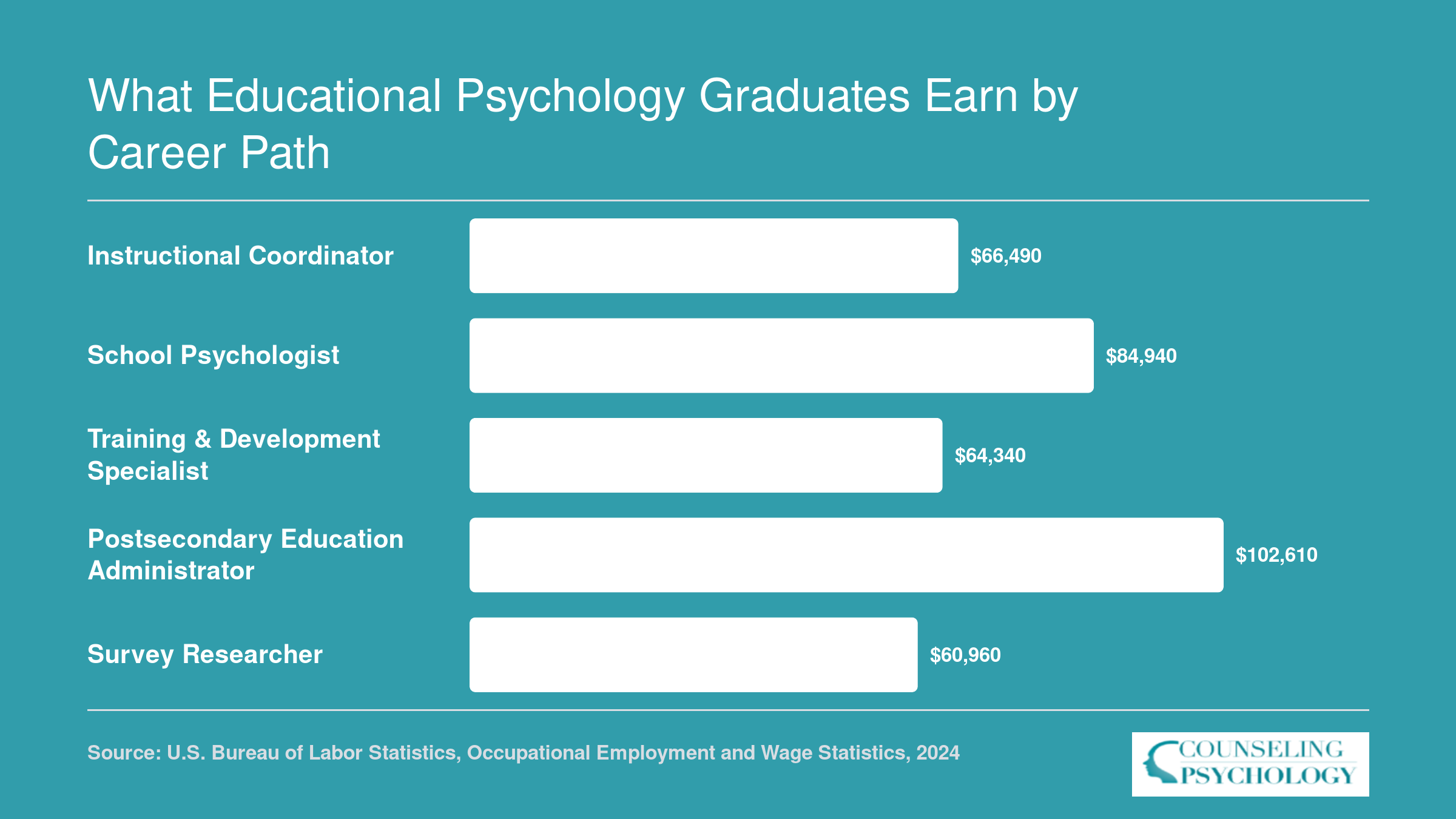
Earning potential varies widely depending on which career path you pursue after completing an educational psychology degree. The chart below compares national median annual salaries for common roles that educational psychology graduates enter. Keep in mind that these are national medians; actual salaries vary significantly by state, employer type, and years of experience.
How to Choose an Online Educational Psychology Program
Choosing an online educational psychology program means balancing affordability against flexibility, and the prestige of a program's accreditation against the convenience of its format. The right program is never perfect on every dimension, so the goal is to prioritize what matters most for your long-term career.
Accreditation: The Non-Negotiable Foundation
Accreditation operates on two levels. Institutional accreditation (specifically regional accreditation) ensures your degree will be recognized broadly, credits will transfer, and you'll remain eligible for federal financial aid. Programmatic accreditation signals alignment with professional standards. For educational psychology, that could mean CAEP (Council for the Accreditation of Educator Preparation) if the degree lives in a school of education and leans toward school-based practice, or APA (American Psychological Association) if it's housed in a psychology department and designed as a pathway toward licensed practice. Verify both levels early, because graduating from an unaccredited program can block licensure and limit employment options.
Cost and Funding: Understanding the True Price
- Net price: Across the programs we profile, net prices vary widely, with some state-university options falling below $15,000 in total tuition and private universities running higher. Always compare the net price (what you actually pay after grants and scholarships), not the published sticker.
- Employer reimbursement: Many school districts and mental health agencies offer tuition reimbursement for employees pursuing degrees related to their work. Check your HR policies.
- Federal loans and grants: Submitting the FAFSA opens access to Direct Unsubsidized Loans and, for eligible students, Pell Grants or TEACH Grants.
- Graduate assistantships: Some programs offer assistantships that cover a portion of tuition and provide a stipend in exchange for research or teaching work, even in online formats.
- State-specific grants: States sometimes offer incentives for educators or mental health professionals willing to work in high-need areas; consult your state's department of education or higher education agency.
Format Fit: Online, Hybrid, or With Residency
Programs fall along a continuum. Fully online degrees maximize scheduling freedom but may require you to arrange local practicum sites on your own. Hybrid models blend online coursework with occasional on-campus intensives, which can strengthen relationships with faculty and peers while adding travel costs. Online-with-residency programs mandate short campus residencies (often one or two weekends per term) to meet clinical skill requirements. Ask yourself how much flexibility you truly need given your work and family obligations, and whether you are willing to travel for in-person components. If you need entirely remote clinical training, confirm that the program provides placement support before committing.
Outcomes to Investigate Before You Enroll
Dig beyond marketing claims. The College Scorecard and state disclosure data can reveal: - Graduation rates: Low completion rates often signal that students struggle with course pacing, cost, or support. - Time-to-completion: Some programs advertise a two-year path but require a course load that makes that timeline unrealistic for working professionals. - Employment data: Look for the percentage of graduates employed in the field or continuing into advanced study within a year of finishing. Programs that fail to track or publish this information may lack the outcomes infrastructure you need to gauge return on investment. Students weighing whether to pursue further graduate work, such as a counseling doctoral program, should pay close attention to how well a master's program prepares graduates for that next step.
Red Flags That Should Give You Pause
- No regional accreditation: This alone should disqualify a program. Without it, your degree may not be recognized for licensure or further graduate study.
- Unclear practicum placement support: If the program cannot clearly explain how it helps online students secure local clinical placements, or simply states that you are responsible for finding your own, consider how that added burden affects your timeline.
- No published outcome data: A program that does not report graduation rates, employment rates, or licensure pass rates is asking you to make a high-stakes decision with incomplete information.
Before enrolling, verify that the institution holds regional accreditation AND that the specific program is recognized by CAEP (Council for the Accreditation of Educator Preparation) or APA (American Psychological Association). Institutional accreditation alone does not guarantee your credits will transfer or that you will qualify for licensure in your state.
Frequently Asked Questions About Educational Psychology Degrees Online
Choosing an online educational psychology program raises practical questions about career options, timelines, costs, and credentials. Below are answers to the questions prospective students ask most often, with specific data points to help you plan.
Explore Programs
Explore Programs
- Best Online Applied Behavior Analysis
- Best Online Applied Psychology Degree
- Best Online Associate Degrees in Psychology
- Best Online Autism Spectrum Disorders
- Best Online Bachelor's in Psychology
- Best Online Child Psychology Degree
- Best Online Clinical Psychology
- Best Online Cognitive Psychology Degree
- Best Online Counseling Psychology
- Best Online Developmental Psychology
- Best Online Forensic Psychology Degree
- Best Online Graduate Certificate in Psychology
- Best Online Health Psychology
- Best Online I/O Psychology
- Best Online International Psychology
- Best Online Master's in Psychology
- Best Online Neuropsychology
- Best Online Ph.D. in Psychology
- Best Online Positive Psychology
- Best Online Psychopharmacology Programs for
- Best Online PsyD
- Best Online School Psychology
- Best Online Social Psychology
- Best Online Sports Psychology
- Engineering Psychology Degrees
- Online Geropsychology