
Key Takeaways
- Kansas MFT programs at Friends, MidAmerica Nazarene, and Ottawa universities are all private and use hybrid formats.
- The 2024 Kansas median LMFT wage of $66,620 exceeded the national median of $58,510 by over $8,000.
- Kansas BSRB licensure requires 3,000 hours of supervised clinical experience after completing your MFT degree.
- Post-master's MFT graduate certificates offer licensed counselors the shortest path to adding family therapy credentials.
The supply of MFT programs in Kansas is small, with just three universities offering graduate tracks in the field. Demand for therapists is growing, making the choice of program particularly consequential. Accreditation type, whether COAMFTE or CACREP, directly affects your clinical training hours and license portability across state lines. Understanding how to become a marriage and family therapist is essential context, because in Kansas the limited number of programs means that fit and accreditation are not just preferences but career-defining decisions.
Top MFT Programs in Kansas for 2026
Kansas offers a small but focused set of graduate programs for aspiring marriage and family therapists. Each school below brings something different to the table, whether that is a COAMFTE-accredited clinical model, a CACREP-aligned counseling track, or a flexible hybrid format built around working professionals. Our ranking weighs what actually shapes your return on investment: what you pay after aid, what graduates earn, how likely students are to finish, and how debt stacks up against early-career income.
- Net price after financial aid
- Program-level earnings outcomes
- Institution-wide graduation rate
- Debt relative to post-graduation earnings
- Accreditation and licensure alignment
- Internal program database
- NCES-IPEDS federal institutional data — nces.ed.gov
- Independent program research
- College Scorecard graduate earnings — collegescorecard.ed.gov

Friends University
Friends University in Wichita has long been the flagship choice for clinical MFT training in Kansas, anchored by its COAMFTE-accredited Master of Science in Family Therapy. The 60-credit program requires 1,000 clinical training hours, including 500 direct client contact hours, giving graduates deep hands-on experience before they ever apply for licensure. Students should be aware that Friends is consolidating its family therapy program to the Lenexa (Kansas City area) campus after the final Wichita cohort graduates in 2028, while expanding online delivery options. A recent infusion of nearly one million dollars in program support funding signals ongoing institutional investment in the MFT track.
- COAMFTE-accredited, 60 total credit hours
- 16-month supervised clinical internship included
- 1,000 clinical hours with 500 direct client contact hours
- Hybrid format with evening and weekend course options
- Two campus locations: Wichita (closing 2028) and Lenexa
- Meets Kansas and Missouri LMFT licensure requirements
- 3.0 minimum GPA required for admission
- Comprehensive professional portfolio required at completion
Master of Science in Family Therapy — Hybrid

MidAmerica Nazarene University
MidAmerica Nazarene University in Olathe delivers a CACREP-accredited Master of Arts in Marriage, Couple, and Family Counseling designed for completion in 33 months. The program is built to satisfy licensure requirements in both Kansas and Missouri, making it a strong pick for students in the Kansas City metro area. With a median graduate debt of $15,000 and institution-wide median earnings of $62,972 at ten years post-enrollment, MNU shows one of the strongest debt-to-earnings ratios among Kansas options. Program-level earnings data shortly after completion is not yet available for this program.
- CACREP-accredited, 60 credit hours total
- Completable in 33 months
- Hybrid delivery with day, evening, and remote options
- Designed to meet Kansas and Missouri licensure standards
- 11:1 student-to-faculty ratio
- Median graduate debt of $15,000
- 3.0 GPA minimum and professional references required
- Interview is part of the admissions process
Master of Arts in Marriage, Couple, and Family Counseling — Hybrid

Ottawa University-Ottawa
Ottawa University offers a Master of Arts in Counseling with a Marriage and Family Therapy concentration from its main campus in Ottawa, Kansas. The hybrid program pairs online coursework with 900 hours of supervised field placement, giving students flexibility without sacrificing clinical experience. One important note: the program's published licensure alignment highlights Arizona and Wisconsin specifically, so Kansas students should verify course-by-course alignment with the Kansas BSRB before enrolling. Institution-wide graduation rates sit at 27.9%, and program-level earnings data is not yet available for this concentration.
- Hybrid format: online courses plus in-person field experiences
- 900 hours of supervised field placement required
- Six available concentrations within the MA in Counseling
- Includes gerocounseling as a listed concentration option
- Comprehensive exam and portfolio preparation required
- 12:1 student-to-faculty ratio
- Students must confirm Kansas BSRB licensure alignment independently
Master of Arts in Counseling, Marriage and Family Therapy Concentration — Hybrid
What MFT Programs in Kansas Actually Cost
Cost is one of the biggest factors Kansas students weigh when choosing an MFT program, and the sticker price rarely tells the whole story. All three Kansas schools offering marriage and family therapy programs are private institutions, so there is no in-state versus out-of-state tuition split. The figures below draw from federal data to help you compare published tuition, average net price after aid, and typical graduate debt side by side.
| Category | Friends University (Wichita) | Ottawa University (Ottawa) | MidAmerica Nazarene University (Olathe) |
|---|---|---|---|
| Annual Graduate Tuition | $11,988 | $12,562 | $13,597 |
| Average Net Price (institution-wide) | $27,715 | $27,963 | $32,165 |
| Median Graduate Debt at Completion | $25,000 | $21,500 | $15,000 |
| Pell Grant Recipients (% of undergrads) | 59.8% | 63.2% | 58.2% |
| Median Earnings 10 Years After Entry (institution-wide) | $52,113 | $55,552 | $62,972 |
| Student to Faculty Ratio | 12:1 | 12:1 | 11:1 |
| Program Format | Hybrid (evening and weekend) | Hybrid | Hybrid (on-site and online) |
| Total Credit Hours | 60 | Varies by concentration | 60 |
| Accreditation | COAMFTE | Regional | CACREP |
Questions to Ask Yourself
COAMFTE and CACREP Accreditation: What Matters for Kansas MFT Students
Choosing between a COAMFTE-accredited and a CACREP-accredited program shapes more than your classroom experience. It directly affects how smoothly you will move through Kansas licensure and whether you can practice across state lines. The decision carries weight for both your immediate post-graduation licensing timeline and your long-term career mobility.
What COAMFTE and CACREP Accreditation Mean
COAMFTE, the Commission on Accreditation for Marriage and Family Therapy Education, is the specialized accrediting body for marriage and family therapy programs. Its standards are built around relational/systemic therapy models and clinical training specific to MFT practice. CACREP, the Council for Accreditation of Counseling and Related Educational Programs, accredits a broader range of counseling degrees, including those that offer a concentration or specialization in marriage, couples, and family therapy. Both accreditation types can lead to licensure in Kansas, but they operate within different professional pipelines (MFT versus counseling), and the licensure path is not identical.
How the Kansas BSRB Treats Each Pathway
The Kansas Behavioral Sciences Regulatory Board (BSRB) automatically accepts degrees from COAMFTE-accredited programs as meeting the educational requirements for LMFT licensure. Graduates of CACREP-accredited programs that include an MFT concentration are not granted automatic approval; instead, each applicant is evaluated individually under the administrative regulation K.A.R. 102-5-3. The board reviews the applicant's transcript and course descriptions to ensure the curriculum covers all required content areas (e.g., family systems theories, MFT clinical skills, professional ethics). If gaps are identified, supplemental coursework may be required before the candidate can proceed.
No matter which accreditation path you take, all LMFT candidates in Kansas must complete the same post-degree supervised experience: 3,000 total hours, including at least 1,500 hours of direct client contact, spread over a minimum of 24 months. Supervision must total 100 hours, with at least 50 of those in individual format. Everyone sits for the same National Examination in Marital and Family Therapy. The accreditation distinction primarily affects the front-end educational review, not the back-end supervised practice or exam.
Which Kansas Programs Carry Which Accreditation
Currently, only two Kansas universities hold COAMFTE accreditation for their MFT programs. Kansas State University offers a Master's and PhD in Couple and Family Therapy, and Friends University provides a Master of Science in Family Therapy at its Wichita and Overland Park campuses. No other in-state institution holds COAMFTE status; if you encounter a program labeled "MFT concentration" within a counseling department, it likely falls under CACREP accreditation (or lacks programmatic accreditation entirely). Before enrolling in a non-COAMFTE program, request a pre-evaluation from the BSRB to confirm that its curriculum will satisfy K.A.R. 102-5-3.
The Interstate and Dual-Licensure Implications
COAMFTE accreditation is recognized by the Association of Marital and Family Therapy Regulatory Boards and tends to streamline licensure-by-endorsement when relocating to another state. Many states require a degree from a COAMFTE-accredited program for reciprocity, so this path generally offers greater geographic flexibility. CACREP accreditation, while not MFT-specific, can make it easier to pursue dual licensure. Because CACREP programs align with counseling education standards, graduates may already meet many requirements for the Licensed Professional Clinical Counselor credential in Kansas. Earning both an LMFT and LCPC broadens your scope of practice and can expand employment options, especially in settings that serve both individuals and families.
Related Articles
Earning Your MFT Degree Online vs. On Campus in Kansas
Kansas has a small but growing pool of MFT programs, and most now blend online coursework with in-person clinical requirements. All three ranked Kansas programs, Friends University, MidAmerica Nazarene University, and Ottawa University, use a hybrid format. That means fully online MFT programs are primarily offered by out-of-state schools. The Kansas Behavioral Sciences Regulatory Board (BSRB) does not restrict licensure applicants based on whether their degree was earned online, but the practical realities of each format still matter.
Pros
- Online programs offer scheduling flexibility that benefits working students juggling jobs, families, or existing clinical roles.
- Enrolling out of state online expands your choices well beyond Kansas's small in-state program pool.
- Total costs can drop significantly when you factor out commuting, parking, and potential relocation expenses.
- On-campus and hybrid formats build cohort bonds and peer support networks that carry into your career.
- In-person programs typically have established practicum site relationships, simplifying your 500 required direct client hours.
- Faculty mentorship is more accessible on campus, with informal advising and observation that online platforms struggle to replicate.
- Hybrid models, like those at Friends University (Wichita and Lenexa campuses) and MidAmerica Nazarene, blend online convenience with in-person clinical training.
Cons
- Even fully online programs require you to complete practicum and internship hours at an in-person site in Kansas, and arranging those placements yourself can be challenging.
- Some employers and supervisors still view online-only credentials with skepticism, especially in competitive clinical settings.
- Networking opportunities are inherently limited in virtual cohorts, making it harder to build local professional connections.
- On-campus programs in Kansas are few, so geographic choice is narrow: Wichita, Olathe, and Ottawa are the primary options.
- Campus-based schedules are less flexible, though programs like Friends University offset this with evening and weekend course formats.
- Living costs near urban Kansas campuses (particularly the Kansas City metro area around Olathe) can add meaningfully to your total investment.
- Out-of-state online programs may not align their curricula with Kansas BSRB licensure requirements, potentially leaving you with extra steps after graduation.
Steps to Earning Your LMFT License in Kansas
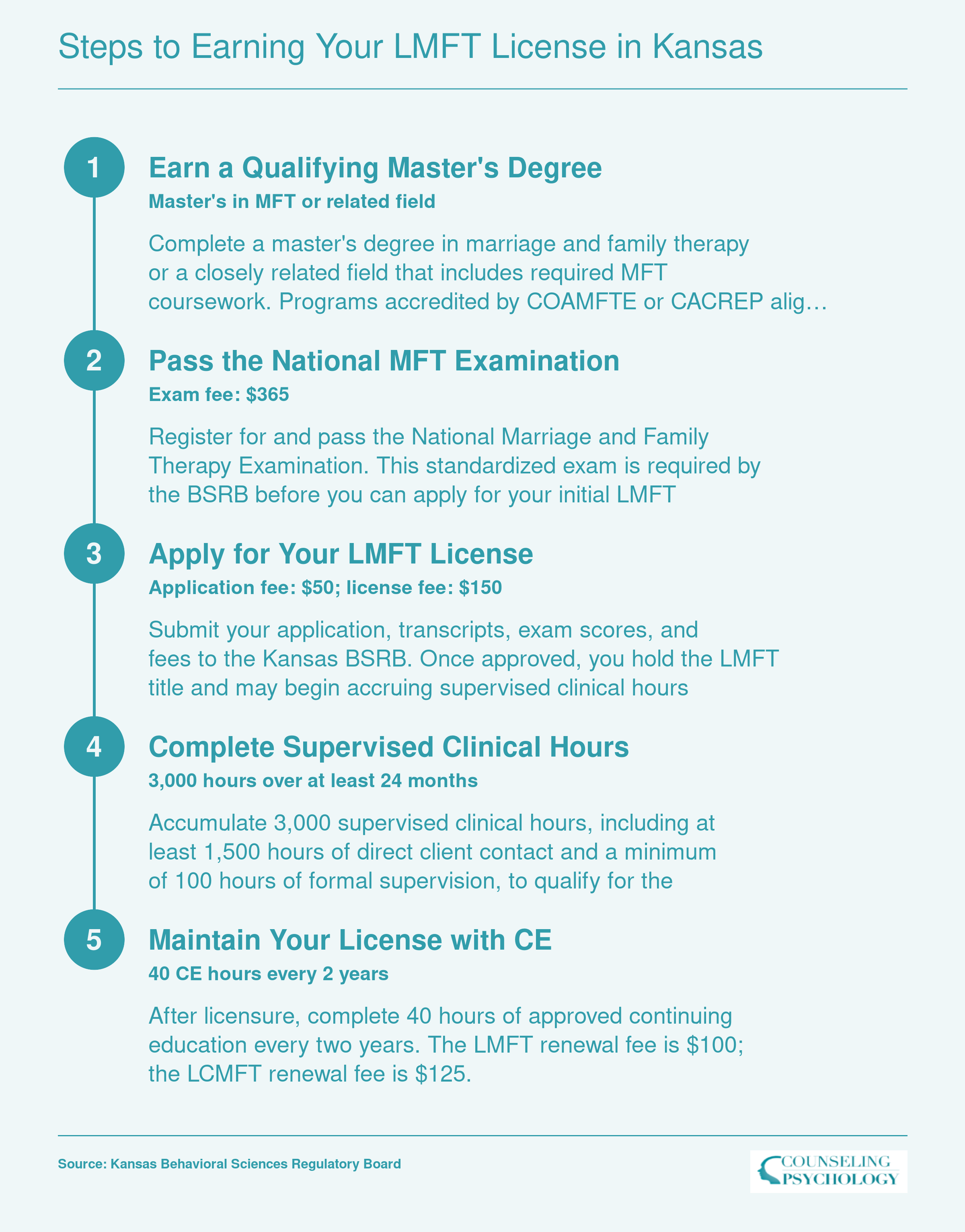
Kansas uses a two-tier system: the LMFT (Licensed Marriage and Family Therapist) is the initial credential, while the LCMFT (Licensed Clinical Marriage and Family Therapist) follows after extended supervised practice. Below is the typical credentialing sequence overseen by the Kansas Behavioral Sciences Regulatory Board (BSRB). The required licensing exam is the National Marriage and Family Therapy Examination, administered by the AMFTRB, with an examination fee of $365. The BSRB application fee is $50, and the original license fee is $150.
Kansas BSRB Licensure Requirements for Marriage and Family Therapists
Three thousand hours of supervised clinical experience stand between your MFT degree and full licensure in Kansas. The Kansas Behavioral Sciences Regulatory Board establishes the path to becoming a marriage and family therapist, and understanding each requirement helps you plan both your graduate education and post-degree training.
Qualifying Education and Coursework
The Kansas BSRB requires a qualifying graduate degree from an accredited marriage and family therapy program. While COAMFTE accreditation is the most direct path, the Board may accept degrees from regionally accredited institutions that meet minimum MFT-specific coursework standards. Your program should include foundational courses in systems theory, marriage and family therapy techniques, human development, ethics, and psychopathology. Verify that your program's curriculum aligns with Kansas requirements before enrolling, especially if you are considering a non-COAMFTE program.
Supervised Practice License: Your Post-Degree Training Tier
Once you graduate, you will apply for a supervised practice license, which allows you to accumulate clinical hours under qualified supervision. This intermediate tier is mandatory: you cannot practice independently or accrue licensure-qualifying hours without it. The supervised practice period requires a minimum of 24 months and 3,000 total supervised clinical hours, of which at least 1,500 must be direct client contact.2 The remaining hours may include case documentation, treatment planning, and professional development activities.
Supervision Structure and Qualifications
You must complete 100 hours of supervision during your post-degree training. At least 50 of those hours must be individual supervision. The remaining hours may be group supervision, but no more than 50 percent of your total supervision may occur in a group setting. Group sessions are limited to six supervisees. You are required to meet with your supervisor at least twice per month, with at least one individual session monthly. Supervision must occur at a ratio of one hour for every 15 clinical hours worked.
Your supervisor must be a Board-approved supervisor with at least two years of post-licensure experience as an LMFT. Kansas also permits supervision by licensed psychologists, licensed specialist clinical social workers, licensed clinical psychotherapists, and licensed professional counselors who meet Board criteria and have completed approved supervision training.
Licensure Examination
Kansas requires passing the AMFTRB National Examination. The exam registration fee is $220, and the administration fee is $75. You may take the exam before completing all supervised hours, but you must pass it before the Board will grant full LMFT licensure. Check the AMFTRB website for current passing score thresholds and testing windows.
Application Process and Fees
The BSRB application fee is $100. You will need to submit official transcripts, verification of supervised hours on Board-approved forms, your exam score report, and a completed background check. Processing times vary, but applicants should plan for four to eight weeks from submission to approval, assuming no deficiencies in documentation.
Continuing Education and Renewal
Licensed Marriage and Family Therapists in Kansas must complete 40 hours of continuing education every two years to renew their license. The BSRB specifies acceptable CE topics and providers in its regulations, and you are responsible for maintaining documentation of all completed courses.
Common Questions About MFT Education and Licensing in Kansas
Prospective MFT students in Kansas often have questions about admissions, scheduling, and licensure portability. Below are answers to the most common concerns, grounded in current program and Kansas BSRB requirements.
MFT Graduate Certificate Programs for Kansas Students
Graduate certificates in marriage and family therapy offer a focused pathway for professionals who already hold a master's degree in counseling, psychology, social work, or a related field but need additional MFT-specific coursework to pursue licensure in Kansas. If you are weighing broader options, our overview of counseling certificate programs can help you compare formats and outcomes.
Understanding Kansas BSRB Requirements for Certificate Programs
The Kansas Behavioral Sciences Regulatory Board sets specific educational standards for LMFT licensure, including required coursework in areas such as family systems theory, human sexuality, psychopathology, and professional ethics. Before enrolling in any certificate program, you should verify directly with the BSRB whether post-master's MFT certificates satisfy their coursework requirements. The board's website provides detailed guidance on acceptable educational credentials, and staff can clarify whether a specific program's curriculum aligns with Kansas licensing standards.
Not all graduate certificates carry equal weight for licensure purposes. The BSRB evaluates programs based on content coverage rather than simply accepting any credential labeled as MFT-focused. This means a certificate from one institution might meet all requirements while a similar-sounding program from another school falls short.
Finding Accredited Certificate Programs
Several regionally accredited universities offer graduate certificates in marriage and family therapy through online formats, making them accessible to Kansas residents regardless of location. When researching programs, look for institutions that clearly outline their curriculum against COAMFTE or CACREP standards, even if the certificate itself is not separately accredited. Program catalogs typically specify credit hour requirements, which commonly range from 15 to 24 credits depending on how comprehensively the certificate covers MFT competencies.
Tuition costs vary significantly based on the institution and delivery format. Expect to pay anywhere from $6,000 to $18,000 for a complete certificate program, though some universities charge considerably more. Always request a full cost breakdown including fees, technology charges, and any required campus residencies before committing.
Getting Personalized Guidance
The Kansas Association for Marriage and Family Therapy serves as a valuable resource for prospective students navigating certificate options. KAMFT members often share firsthand experiences about which programs translated smoothly into Kansas licensure and which required additional coursework. Many certificate graduates go on to build practices as a couples counselor, so understanding the licensure path from the start saves significant time and money. Contacting the BSRB directly remains the most reliable way to confirm whether your intended program meets current requirements, as licensing standards occasionally change.
Here is a path most prospective students miss: no major competitor resource highlights MFT graduate certificates in Kansas. For licensed professional counselors already practicing in the state, a post-master's certificate may be the shortest route to adding marriage and family therapy to your scope, without repeating a full master's degree.
LMFT Salary and Job Growth in Kansas
Kansas offers competitive compensation for licensed marriage and family therapists relative to national figures. According to BLS data, the Kansas median annual wage for MFTs was $66,620 as of 2024, notably higher than the national median of $58,510 reported for 2023. Keep in mind that Kansas has a relatively small MFT workforce (approximately 160 employed statewide), so wage figures can shift meaningfully from year to year. Nationally, MFT employment is projected to grow 13% from 2024 to 2034, well above the average for all occupations, reflecting rising demand for behavioral health services.
| Metric | Kansas (2024 BLS) | United States (2023 BLS) |
|---|---|---|
| Total Employment | 160 | 63,340 |
| 25th Percentile Wage | $44,320 | $45,250 |
| Median Annual Wage | $66,620 | $58,510 |
| Mean Annual Wage | $63,480 | $68,730 |
| 75th Percentile Wage | $78,020 | $78,440 |
| 90th Percentile Wage | N/A | $104,710 |
| Projected Job Growth (2024 to 2034) | N/A | 13% |