
What you’ll learn in this article…
- New Hampshire's LMFT pathway takes four to five years: roughly two years of coursework plus two to three years of supervised practice.
- COAMFTE accreditation is critical because New Hampshire's licensing board evaluates both degree type and programmatic accreditation standards.
- Only a handful of in-state MFT programs exist, so residents should also explore COAMFTE-accredited online options nationwide.
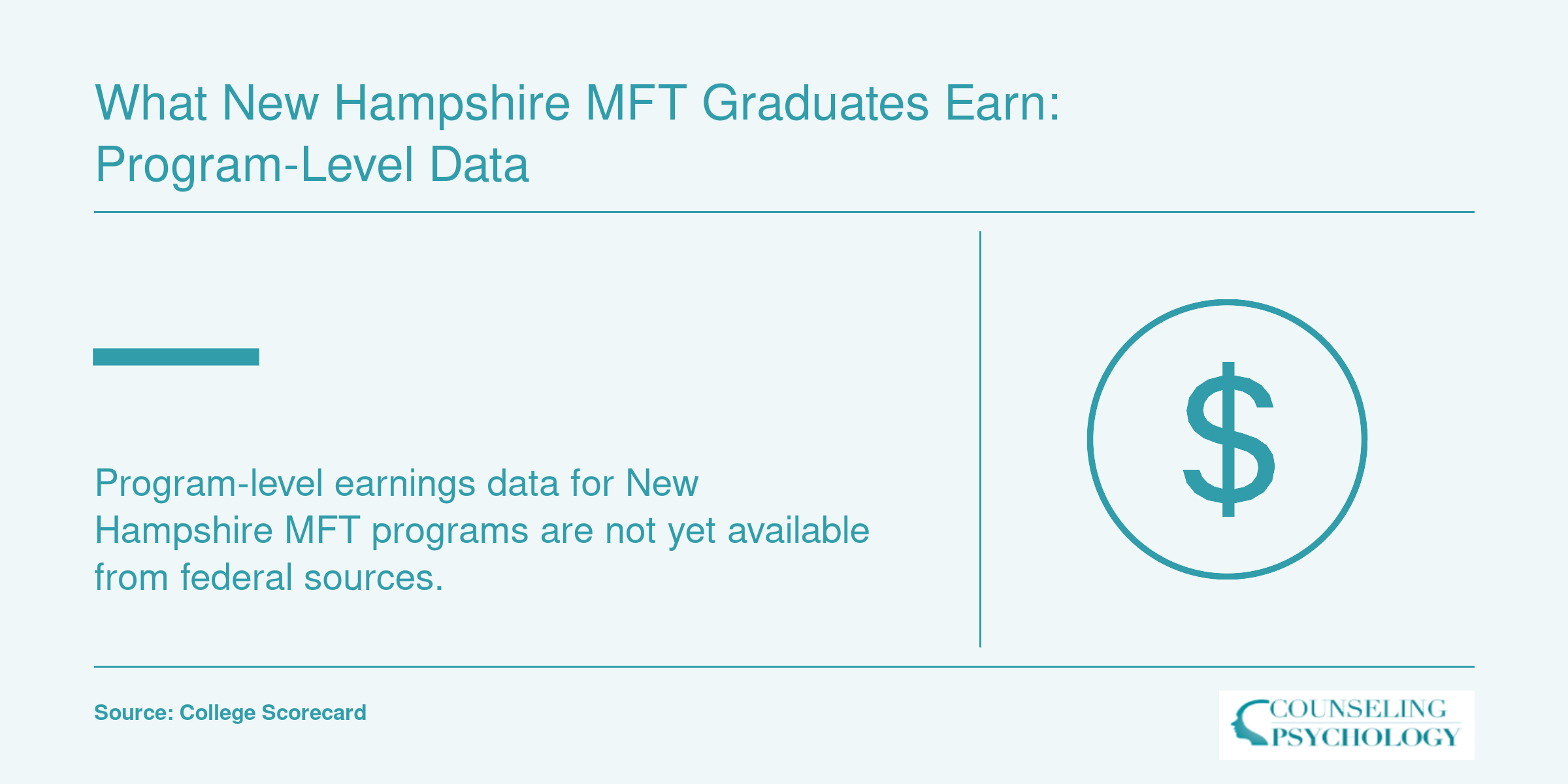
- Program-level earnings data for New Hampshire MFT graduates have not yet been published through federal sources.
New Hampshire has exactly three institutions offering MFT-relevant graduate training in 2026: the University of New Hampshire's COAMFTE-accredited master's program in Durham, Plymouth State University's graduate certificate, and Antioch University New England's post-master's certificate in Keene. That small number reflects a broader reality in the state: MFT-specific programs are scarce, and prospective students face a genuine choice between depth of training, cost, and credential type.
The practical tension here is credential alignment. New Hampshire's licensing board distinguishes between degree types and program accreditation status when evaluating LMFT applicants, which means the wrong program can add years to a licensure timeline or require additional coursework after graduation. COAMFTE accreditation is not a marketing distinction; it carries direct regulatory weight in this state.
For most applicants without an existing clinical master's degree, the UNH master's program is the only in-state path that directly satisfies licensure requirements on completion. The certificate programs serve a different function, primarily for credentialed clinicians adding a specialty. If you are still exploring the profession, our guide on how to become a family therapist offers a broader look at the career path. That distinction shapes every comparison worth making in the sections that follow.
Top MFT Programs in New Hampshire Ranked by Outcomes and Value
New Hampshire offers a small but focused set of MFT training options, ranging from a COAMFTE-accredited master's degree to post-master's certificates designed for working clinicians. We evaluated all three programs using a value-centered methodology that weighs graduate earnings, cost after aid, and institutional completion rates. Note that one flagship program has paused admissions for the current cycle, which prospective students should factor into their planning.
- Post-graduation earnings potential
- Net price after financial aid
- Institutional graduation rates
- Program accreditation and licensure alignment
- Clinical training depth
- NCES-IPEDS federal institutional data — nces.ed.gov
- College Scorecard graduate earnings — collegescorecard.ed.gov
- Independent program research
- Internal program database

University of New Hampshire
The University of New Hampshire delivers a rigorous, COAMFTE-accredited Master of Science in Marriage and Family Therapy through its Department of Human Development and Family Studies. The 72-credit, campus-based program in Durham boasts a reported 97% program graduation rate and a 100% national exam pass rate, and UNH has formally confirmed the curriculum meets licensure requirements in New Hampshire and every other U.S. state and territory. Prospective applicants should be aware that admissions have been paused for the 2025 to 2026 academic year, so checking the department's website for updates on the next open cohort is essential.
- COAMFTE-accredited, 72-credit campus program in Durham, NH
- Requires 500 hours of supervised clinical practice
- Includes specialized coursework in play therapy and sex therapy
- Two-year full-time track with two required summer sessions
- Part-time admission considered on a case-by-case basis
- Competitive stipends and scholarship opportunities available
- Admissions paused for 2025 to 2026; check for reopening updates
- Meets licensure requirements in NH and all U.S. states
Master of Science in Marriage and Family Therapy — On-Campus

Plymouth State University
Plymouth State University in Plymouth offers an MFT graduate program focused on preparing compassionate clinicians to serve diverse family systems across New Hampshire and the broader New England region. With a lower net price than UNH and a smaller student-to-faculty ratio of 15:1, Plymouth State provides a more intimate training environment. The curriculum emphasizes advanced therapeutic techniques grounded in a comprehensive family systems approach, positioning graduates for LMFT licensure in the state.
- Campus-based program at Plymouth State's NH campus
- Curriculum aligned with New Hampshire LMFT licensure requirements
- Emphasizes advanced clinical techniques and family systems theory
- Professional clinical training with hands-on practice opportunities
- 15:1 student-to-faculty ratio supports individualized mentoring
- In-state tuition approximately $18,903 per year (IPEDS)
Marriage and Family Therapy Graduate Certificate — On-Campus

Antioch University-New England
Antioch University's New England campus in Keene offers a Post-Master's Certificate in Couple and Family Therapy designed specifically for licensed or license-eligible mental health professionals who want to add systemic therapy skills without completing a second full degree. The 27 to 30 credit program uses an online format with periodic on-campus residencies, making it accessible to clinicians working in rural New Hampshire or neighboring states. There is no GRE requirement, and students can complete the certificate in as few as three semesters or spread it across up to ten, depending on their professional schedules.
- 27 to 30 credit certificate, no second master's degree required
- Online coursework with residency components in Keene, NH
- Tuition set at $840 per credit; same rate regardless of residency
- No GRE required for admission
- Flexible pacing from 3 to 10 semesters for working professionals
- Individualized program planning to meet specific licensure goals
- Designed for counselors, social workers, and psychologists
- Median graduate debt of $23,501 (College Scorecard)
Post-Master's Certificate in Couple and Family Therapy — On-Campus
Common Questions About MFT Education in New Hampshire
New Hampshire has a small MFT education landscape, so prospective students often have pointed questions about accreditation, program availability, and licensure pathways. Below are answers to the questions we hear most frequently.
What a Marriage and Family Therapy Degree Covers
What makes a marriage and family therapy degree different from other mental health programs, and why does that distinction matter for your career in New Hampshire?
Marriage and Family Therapy (MFT) is a specialized mental health discipline built on the principle that individuals are best understood and treated within the context of their relationships. Unlike counseling psychology, which often focuses on individual cognition and behavior, or social work, which emphasizes community resources and case management, MFT applies a systemic lens to mental health. Where a Licensed Professional Counselor (LPC) might address an individual's anxiety through cognitive-behavioral techniques, an MFT examines how that anxiety functions within family dynamics, couple relationships, or intergenerational patterns. This relational framework defines the profession and shapes every aspect of MFT training. If you are still weighing your options, our guide on how to become a marriage and family therapist offers a broader look at the career path.
Core Curriculum in MFT Programs
MFT graduate programs organize coursework around several foundational domains. You will study family systems theory in depth, learning models such as structural, strategic, narrative, and Bowen family systems therapy. Courses in psychopathology teach diagnostic assessment through a relational lens, while ethics and professional practice cover the unique confidentiality and boundary issues that arise when treating couples and families rather than individuals. Human development across the lifespan, multicultural competence, and research methods round out the academic foundation. Every course returns to the central question: how do relationships shape psychological health?
Clinical Training and Supervised Hours
MFT programs require substantial clinical practice, not just classroom learning. Accredited master's programs include at least 500 hours of direct client contact under supervision, with a significant portion involving couples or families. This hands-on training is essential for New Hampshire licensure, which mandates 1,000 post-degree supervised hours before you can sit for the LMFT exam. Programs that integrate early clinical experiences prepare you to meet state requirements efficiently.
Designed for Licensure
Unlike some adjacent mental health credentials, MFT degrees are purpose-built to lead directly to licensure as a Licensed Marriage and Family Therapist. Graduates of COAMFTE-accredited programs satisfy New Hampshire's educational requirements without additional coursework or credential translation, streamlining your path to independent practice.
Why COAMFTE Accreditation Is Critical for NH Licensure
While regional accreditation confirms an institution's overall academic quality, programmatic accreditation from COAMFTE specifically signals that an MFT curriculum meets the rigorous standards required for state licensure. This distinction matters because New Hampshire's licensing board evaluates both the degree type and the coursework content when reviewing applications.
What COAMFTE Accreditation Represents
COAMFTE (Commission on Accreditation for Marriage and Family Therapy Education) operates under the American Association for Marriage and Family Therapy (AAMFT) as the specialized accrediting body for MFT graduate programs. Earning COAMFTE accreditation means a program has demonstrated it covers all required clinical, theoretical, and ethical competencies, including supervised practicum and internship experiences that align with licensure expectations. Attending a COAMFTE-accredited program often simplifies the licensure process because the curriculum has already been vetted against national standards.
New Hampshire's Licensure Requirements: Flexibility with Caveats
Unlike some states that strictly mandate a COAMFTE-accredited degree, the New Hampshire Board of Mental Health Practice offers multiple pathways. It accepts degrees from COAMFTE-accredited programs, but it also considers regionally accredited master's or doctoral programs with a focus in marriage and family therapy that meet specific coursework requirements. Additionally, the board recognizes alternative pathways such as AAMFT clinical membership or completing postgraduate training under supervision. Candidates must show they have completed 60 semester hours of graduate coursework covering topics like systems theory, human development, and clinical practice, regardless of the program's accreditation type.
The Risks of Choosing a Non-Accredited Program
Even though New Hampshire does not require COAMFTE accreditation, selecting a program without it introduces potential hurdles. Graduates of non-COAMFTE programs may need to submit detailed syllabi, faculty qualifications, and evidence of equivalent clinical hours to satisfy the board's educational review. This process can delay licensure by weeks or months and sometimes leads to requests for additional coursework. Moreover, holding a degree from a non-accredited program can complicate licensure mobility if you later want to practice in a state with stricter rules.2 If you are also weighing broader counseling master's programs online, keep in mind that not all general counseling degrees satisfy MFT-specific coursework domains. Always verify that any MFT program you consider includes coursework and supervised clinical training that explicitly matches New Hampshire's curriculum requirements.
New Hampshire's limited in-state MFT program options mean you should widen your search: explore CACREP-accredited clinical mental health counseling programs that offer MFT coursework, and investigate COAMFTE-accredited online programs nationwide that accept New Hampshire residents. Many strong programs outside the state will prepare you for NH licensure.
MFT Degree Levels: Master's, Graduate Certificates, and Doctorates Compared
Do you need a full master's degree in marriage and family therapy to become licensed in New Hampshire, or can a graduate certificate get you there?
The answer depends on your existing credentials and your end goal. New Hampshire's Board of Mental Health Practice sets specific educational thresholds for LMFT licensure, and understanding which degree level qualifies you can save years of time and thousands of dollars.
Master's in Marriage and Family Therapy
A master's degree in MFT is the standard, direct pathway to LMFT licensure in New Hampshire. These programs typically require 48 to 60 semester hours of coursework and supervised clinical experience, spanning two to three years of full-time study. No prior graduate degree is needed to enroll. Graduates who complete a COAMFTE-accredited or regionally accredited program are eligible to sit for the AMFTRB national MFT exam, which New Hampshire requires for licensure.
This track is ideal for students entering the mental health field for the first time or those with a bachelor's degree in psychology, social work, or a related discipline who want to specialize in relational and systems-based therapy from the start.
Post-Master's Graduate Certificate (CAGS or CAS)
An MFT graduate certificate, sometimes called a Certificate of Advanced Graduate Study (CAGS) or Certificate of Advanced Study (CAS), is designed for clinicians who already hold a master's degree in another mental health discipline, such as clinical mental health counseling or social work. These programs focus specifically on MFT theory, systemic clinical practice, and the supervised hours needed to meet AMFTRB exam eligibility. Program length is typically one to two years.
Here is the critical nuance for New Hampshire residents: the state's licensing board generally requires that applicants demonstrate graduate-level coursework and clinical training equivalent to what a full MFT master's provides. A COAMFTE-accredited post-degree clinical training certificate, combined with a qualifying master's in a related field, can serve as a pathway to LMFT licensure. However, applicants using this route should confirm directly with the Board of Mental Health Practice that their specific certificate program and prior master's degree together satisfy all educational requirements. Not every certificate program will meet the board's standards, and approval is evaluated on a case-by-case basis.
Clinicians who benefit most from this route include licensed professional counselors, licensed clinical social workers, and psychologists who want to add MFT competencies or pursue dual licensure without completing an entirely new master's degree.
Doctoral Programs in MFT
Doctoral tracks in marriage and family therapy, typically a Ph.D. or a D.M.F.T., prepare graduates for advanced clinical work, research, university teaching, or program leadership. These programs usually run three to five years beyond the master's level. A doctorate is not required for LMFT licensure in New Hampshire, so this path suits candidates whose career goals extend beyond direct clinical practice into academia, supervision of other therapists, or policy development. Students interested in broader counseling doctoral programs can explore options across multiple specializations.
Choosing the Right Level
When deciding among these options, consider these factors:
- Current credentials: If you hold no graduate degree, the master's in MFT is your only viable route to New Hampshire LMFT licensure.
- Existing licensure: If you are already licensed as an LPC or LICSW and want to add MFT specialization, a graduate certificate may be the most efficient path, provided the program meets COAMFTE standards for post-degree training.
- Career trajectory: If you plan to teach, conduct research, or supervise other clinicians at an advanced level, a doctoral program aligns with those goals.
- Time and cost: A certificate program is shorter and less expensive than a full master's, but only makes sense if you already have a qualifying graduate degree.
Before enrolling in any program, verify its accreditation status and confirm with the New Hampshire Board of Mental Health Practice that the specific credential will count toward your LMFT application. Taking this step early prevents costly surprises later in your licensing journey.
Your Roadmap to LMFT Licensure in New Hampshire
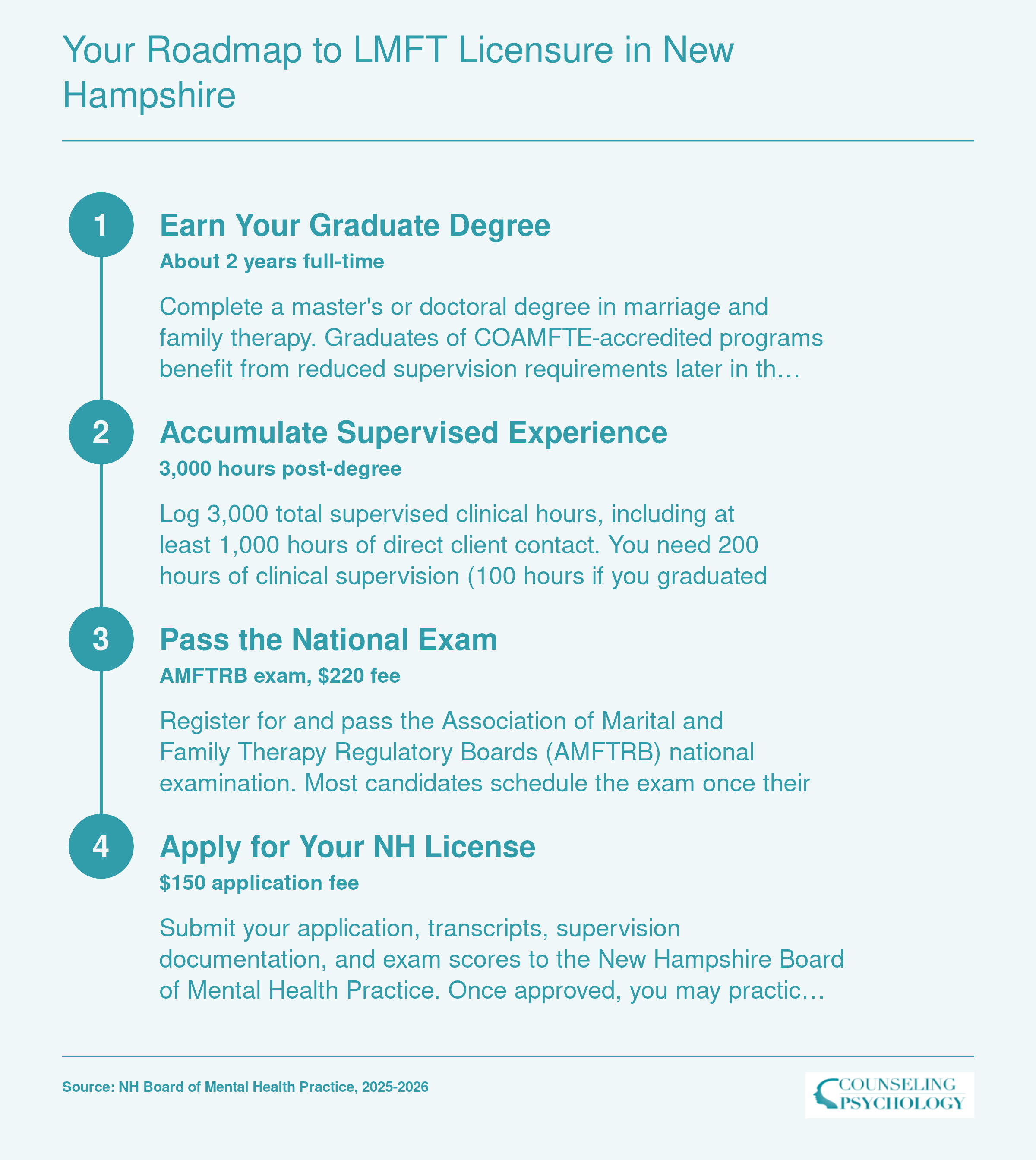
From your first graduate course to holding your LMFT license, the New Hampshire pathway typically spans four to five years. Plan on roughly two years of full-time coursework followed by two to three years of post-degree supervised practice before you sit for the national exam and submit your application to the NH Board of Mental Health Practice.
Completing an MFT Degree Online as a New Hampshire Resident
Attending classes on campus in Durham, Plymouth, or Keene is one path, but studying online from anywhere in the state is another. Each route carries trade-offs worth examining before you commit.
In-State Program Formats
Among the New Hampshire programs ranked on counselingpsychology.org, all three are primarily campus-based. The University of New Hampshire's MS in Marriage and Family Therapy is a full on-campus program in Durham. Plymouth State University and Antioch University New England likewise deliver their coursework on site, though Antioch's post-master's certificate in Couple and Family Therapy blends online courses with required residencies. If you need a fully online master's degree, the in-state options are limited, and you will likely need to look beyond New Hampshire's borders.
Out-of-State Online Programs Worth Considering
Several COAMFTE-accredited programs deliver MFT master's degrees entirely or primarily online and accept New Hampshire residents. Notable options include:
- National University: Offers a fully online MA in Marriage and Family Therapy with COAMFTE accreditation.
- Capella University: Delivers an MS in Marriage and Family Therapy online, supplemented by brief residencies and an in-person internship component.
- Touro University Worldwide: Provides a COAMFTE-accredited MA in Marriage and Family Therapy in a fully online format.
- Northwestern University: Runs its MFT@Northwestern MS program online, with a clinical training component built in.
- Liberty University: Offers a COAMFTE-accredited MA in Marriage and Family Therapy online.
Because New Hampshire requires graduation from a program that meets the educational standards set by the New Hampshire Board of Mental Health Practice, choosing a COAMFTE-accredited program (whether in state or out of state) is the clearest path to satisfying those requirements. Graduates of COAMFTE-accredited programs also benefit from reduced post-degree supervision hours for licensure in New Hampshire.
The Clinical Practicum Challenge
No matter how flexible the online coursework is, every MFT program requires supervised clinical hours completed face to face with real clients. Online students must arrange practicum and internship placements locally, which means identifying approved clinical sites in New Hampshire willing to host you. Some out-of-state programs offer placement assistance, but the responsibility often falls on the student. Before enrolling in any online program, confirm that it has a track record of supporting students in your region and ask specifically how clinical sites are vetted and approved.
SARA and Enrollment Eligibility
New Hampshire participates in the State Authorization Reciprocity Agreement (SARA), administered through the New England Board of Higher Education. SARA membership means that online programs based at institutions in other SARA-participating states are authorized to enroll New Hampshire residents without seeking separate state approval. This simplifies enrollment at schools like those listed above, but SARA status alone does not guarantee that the program's curriculum will meet New Hampshire's specific licensure requirements. Always verify with the New Hampshire Board of Mental Health Practice that your chosen program qualifies before you begin. If you are also weighing broader graduate options, reviewing best mft programs in New York or other state guides can help you compare COAMFTE-accredited choices across the region.
Questions to Ask Yourself
MFT Salary, Job Growth, and LMFT vs. LPC Pay in New Hampshire
When you're deciding between a career as a marriage and family therapist, a licensed professional counselor, or a clinical social worker, salary potential is a practical piece of the puzzle. But focusing only on median wages can obscure the range of earnings you might actually see, especially in a state like New Hampshire, where cost of living and local demand shape pay differently than national averages.
What Marriage and Family Therapists Earn in New Hampshire
New Hampshire's marriage and family therapists earned a mean annual wage of $60,490 in 2023.1 The state does not publish a separate median, but the salary range offers more telling detail: the 10th percentile sat at $44,490, while the 90th reached $80,300. That spread of $35,810 reflects differences in setting, experience, and region within a small but diverse state.
For broader context, the national median for MFTs was $58,510 the same year, with the middle 50% earning between $45,250 and $78,440. The top 10% nationally cleared $104,710. New Hampshire's mean wage lands just above the national median, but the upper end of its range falls shy of the national top tier, suggesting that high-earning private practice and metropolitan roles may be less concentrated in the Granite State.
LMFT vs. LPC Pay: How the Numbers Compare
The pay gap between marriage and family therapists and licensed professional counselors often narrows once you look beyond the national headline. Nationally, mental health counselors (the broad category that includes LPCs) earned a median of $49,710 in 2023, roughly $8,800 less than the MFT median. Yet in New Hampshire, the picture is less clear-cut: state-level data for mental health counselors is less granular, but local job postings and regional surveys suggest that experienced LPCs can command salaries competitive with their MFT counterparts, particularly in substance use and integrated care settings.
What often makes the difference is not the license title but the work context. MFTs who move into private practice or specialize in systemic family work may see faster income growth, while LPCs in community mental health might start lower but benefit from broader job postings. Both paths offer a route to solid middle-class earnings in New Hampshire.
MFT vs. MSW Salaries: Which Path Pays More?
Comparing MFT and social work salaries requires care because social work spans several specialties. Nationally, healthcare social workers (those in clinical roles) earned a median near $60,280 in 2023, while child, family, and school social workers earned about $50,820. That puts the MFT median of $58,510 above the lower social work tier but essentially neck-and-neck with clinical social workers.
In New Hampshire, social workers' earnings vary by license level, with LCSWs often outearning LMSWs substantially. Because clinical social workers and MFTs compete for some of the same employer roles (hospitals, VA centers, group practices), pay tends to converge. For students exploring counseling careers, the more important comparison may be the scope of practice: MFT programs focus exclusively on relational and systemic therapy, which can command a premium in couples and family practices, while MSW programs offer broader versatility that may open doors in medical and school settings.
Job Growth and Future Demand in New Hampshire
The Bureau of Labor Statistics projects a 13% increase in MFT positions nationally from 2024 to 2034, adding about 7,700 openings each year. New Hampshire mirrors this rising demand, driven by a statewide behavioral health workforce shortage and growing recognition of family-based intervention. Telehealth expansion has also widened access, allowing New Hampshire MFTs to serve rural areas where mental health professionals are scarce. For graduates of COAMFTE-accredited programs who complete the licensure process, the outlook is strong, and salary growth typically accelerates with independent licensure and a full caseload.
What New Hampshire MFT Graduates Earn: Program-Level Data
Median earnings one year after completion are typically reported at the program level through the College Scorecard, broken out by each institution's relevant degree classification. However, for the MFT programs in New Hampshire, these figures have not yet been published. When available, these earnings reflect all graduates of each program, not only those who go on to pursue LMFT licensure, so they may include individuals working in related roles or other fields entirely.