
What you’ll learn in this article…
- Most candidates spend 10 to 14 years after high school completing the full counseling psychologist licensure pathway.
- Doctoral programs frequently cover tuition and provide stipends, while master's programs rarely offer comparable funding.
- Work setting can shift a counseling psychologist's median salary by tens of thousands of dollars.
- CACREP accredited master's programs offer the most robust fully online or hybrid options for this field.
The Bureau of Labor Statistics projects 11% job growth for psychologists through 2033, and counseling psychologists remain in high demand across college counseling centers, VA hospitals, and community mental health settings. Online program options have expanded rapidly at the master's level, though doctoral training still requires substantial in-person clinical hours.
The confusion is real: CACREP-accredited master's programs lead to licensure as a professional counselor, while APA-accredited doctorates qualify graduates to use the title "psychologist" and administer psychological assessments. These distinctions affect scope of practice, salary ceilings, and the 10 to 14 years of training involved. State licensing boards enforce different postdoctoral supervision rules, so geography matters as much as program choice. For students weighing related options, clinical mental health counseling online programs offer a more targeted master's-level path worth comparing.
Best Online Counseling Psychology Programs
Online counseling psychology programs prepare students for careers in mental health counseling, clinical practice, and related helping professions. These programs blend theoretical foundations in psychology with practical clinical training, often requiring supervised fieldwork alongside online coursework. The schools ranked below represent a mix of prestigious research universities, faith-based institutions, and flexible online-focused programs that cater to working professionals seeking graduate-level credentials in counseling psychology.
- Independent program research
- U.S. Department of Education College Scorecard (collegescorecard.ed.gov)
- National Center for Education Statistics (NCES-IPEDS) (nces.ed.gov)
Northwestern University
Northwestern University is one of the nation's most prestigious research universities, boasting a 95% graduation rate and median alumni earnings of $89,363. Its counseling programs leverage world-class faculty and cutting-edge research in psychology and human development. The School of Education and Social Policy offers flexible graduate pathways designed for working professionals seeking advanced clinical skills.
- Offered through the School of Education and Social Policy
- Integrates evidence-based counseling theory with clinical practice
- Faculty include leading researchers in counseling psychology
- Supervised practicum and fieldwork experiences required
- Focus areas available in mental health and related specializations
- Northwestern alumni network spans healthcare and education sectors
- Median 10-year alumni earnings of $89,363 per IPEDS data
MS in Counseling — Hybrid
William & Mary
William & Mary's School of Education offers a highly regarded counseling program with an 89% graduation rate and strong post-graduation outcomes. The program is CACREP-accredited and emphasizes both clinical skill development and research. With median alumni earnings of $73,490 and a competitive 34% acceptance rate, the university offers strong value for both in-state and out-of-state students.
- CACREP-accredited counseling program
- Concentrations in clinical mental health and school counseling
- Blended format combines online coursework with in-person intensives
- Strong clinical practicum and internship requirements
- 89% undergraduate graduation rate reflects institutional quality
- In-state tuition of approximately $25,914 per year
- Median alumni earnings of $73,490 ten years post-enrollment
MEd in Counseling — Hybrid
Pepperdine University
Pepperdine University's Graduate School of Education and Psychology offers online master's-level programs in psychology and counseling that draw on the university's strong reputation in clinical training. With an 83% graduation rate and median earnings of $82,939, Pepperdine graduates are well-positioned for careers in mental health. The online programs maintain the same rigorous standards as their on-campus counterparts.
- Delivered through the Graduate School of Education and Psychology
- Curriculum covers clinical, developmental, and social psychology
- Designed for working professionals with flexible scheduling
- Faculty bring extensive clinical and research experience
- Pepperdine's 83% graduation rate signals strong student support
- Median 10-year alumni earnings of $82,939
MA in Psychology — Online
Arizona State University
Arizona State University is a national leader in online education, offering a flexible and affordable Master of Counseling program through ASU Online. With a net price of approximately $14,967 and median alumni earnings of $62,668, ASU provides strong return on investment. The program prepares students for licensure as professional counselors across a range of clinical settings.
- Fully online format designed for working professionals
- Prepares graduates for licensure as professional counselors
- CACREP-accredited program with rigorous clinical standards
- Supervised clinical practicum completed in students' communities
- In-state tuition approximately $12,223 per year
- Part of ASU's nationally recognized online education platform
- Median alumni earnings of $62,668 ten years after enrollment
Master of Counseling — Online
Eastern University
Eastern University offers an MA in Counseling Psychology that integrates Christian faith perspectives with clinical counseling training. The program prepares students for licensure as professional counselors while emphasizing holistic care of clients. Its hybrid delivery model allows working professionals to earn their degree with flexibility while still engaging in meaningful in-person clinical experiences.
- Integrates faith-based perspectives with clinical counseling
- Prepares students for state licensure as professional counselors
- Hybrid format blends online coursework with in-person sessions
- Emphasis on multicultural competence and social justice
- Supervised practicum and internship experiences required
- Small class sizes support personalized faculty mentoring
MA in Counseling Psychology — Hybrid
California Baptist University
California Baptist University offers an online Master of Science in Counseling Psychology that combines clinical skill development with a faith-informed approach. With a 62% graduation rate and median earnings of $61,504, CBU serves students seeking an affordable faith-based counseling education. The fully online format makes the program accessible to students across the country.
- Fully online delivery for maximum scheduling flexibility
- Christian worldview integrated into counseling curriculum
- Covers core areas of counseling theory and clinical practice
- Supervised field experience required for degree completion
- Tuition of $41,228/yr with average net price of $26,285
- Median alumni earnings of $61,504 ten years post-enrollment
- Designed for students pursuing careers in mental health settings
Online MS in Counseling Psychology — Online
Felician University
Felician University offers an online Master's in Counseling Psychology rooted in the Franciscan tradition of service and compassion. The program prepares students for professional counseling roles with a curriculum that emphasizes ethical practice, diversity, and clinical competence. Its fully online format is designed for adult learners balancing work, family, and academic commitments.
- Grounded in the Franciscan tradition of compassionate care
- Fully online program designed for working professionals
- Covers counseling theories, ethics, and clinical techniques
- Emphasis on multicultural awareness and social justice
- Supervised practicum and internship experiences included
- Prepares graduates for roles in community mental health
Online MA in Counseling Psychology — Online
Regis College
Regis College offers online graduate counseling programs that prepare students for licensure and careers in mental health. With a 72% graduation rate and median alumni earnings of $52,873, Regis provides a supportive learning environment for aspiring counselors. The college's Catholic heritage informs a commitment to service and ethical practice in its counseling curriculum.
- Online delivery with flexible scheduling for working adults
- Curriculum aligned with professional counseling licensure standards
- Rooted in a Catholic tradition of service and social responsibility
- Supervised clinical fieldwork completed in local communities
- Small cohort model promotes peer support and collaboration
- 72% graduation rate reflects strong institutional commitment
MA in Counseling Psychology — Online
Capella University
Capella University is a fully online institution offering an affordable MS in Clinical Mental Health Counseling designed for flexibility and accessibility. At $14,400 per year, it is among the most affordable options for aspiring counselors. While its 20% graduation rate reflects the challenges of its open-access model, Capella's self-paced format appeals to highly motivated working professionals seeking licensure-track education.
- Fully online with flexible pacing for working professionals
- CACREP-accredited program meeting national counseling standards
- Tuition of $14,400/yr makes it one of the most affordable options
- Curriculum prepares students for state licensure requirements
- Virtual residency experiences supplement online coursework
- Supervised practicum and internship in students' local areas
- Median alumni debt of $14,968 reflects affordability focus
MS in Clinical Mental Health Counseling — Online
Bay Path University
Bay Path University offers online graduate programs in counseling and applied psychology through its American Women's College and graduate school. The university is known for its commitment to empowering women and nontraditional learners through accessible, career-focused education. Its online counseling programs feature practitioner-oriented curricula designed to prepare students for professional roles in mental health.
- Online format designed for nontraditional and working students
- Curriculum blends psychology theory with applied counseling skills
- Strong commitment to supporting women and diverse learners
- Practicum and field experiences in students' local communities
- Career-focused coursework aligned with mental health industry needs
- Small class sizes support meaningful faculty-student interaction
MS in Applied Psychology / Counseling — Online
Counseling Psychology vs Mental Health Counseling: Key Differences
Choosing between a doctoral path and a master's level credential shapes everything from your training timeline to the populations you serve and the assessments you can administer. Understanding where counseling psychology, clinical mental health counseling, and clinical psychology diverge helps you match your career goals to the right educational investment.
Degree Level and Training Duration
Counseling psychology and clinical psychology both require doctoral degrees, either a PhD or PsyD, typically taking five to seven years to complete.1 Clinical mental health counseling, by contrast, is a master's level profession requiring roughly 60 semester hours, which most students finish in two to three years.2 This difference in training length translates directly into scope of practice: doctoral programs include extensive research training, supervised practicum hours, and a predoctoral internship that master's programs do not require.
The training models also differ. Counseling psychology programs generally follow a scientist-practitioner or practitioner-scholar framework, blending research competence with clinical skills.3 Clinical psychology programs emphasize a similar scientist-practitioner model, though some lean toward a clinical science orientation with heavier research demands. Clinical mental health counseling programs use a counselor education model focused on applied clinical skills and wellness-oriented interventions. Students considering counseling master's programs online should weigh these differences carefully before committing.
Accreditation Pathways
Accreditation determines whether your degree qualifies you for licensure in your target state. Counseling psychology and clinical psychology doctoral programs seek accreditation from the American Psychological Association.3 Master's programs in clinical mental health counseling pursue accreditation from CACREP, the Council for Accreditation of Counseling and Related Educational Programs.2 If you plan to work across state lines or in federal settings, APA accreditation for doctoral degrees or CACREP accreditation for master's degrees strengthens your portability.
Licensure Titles and Scope of Practice
Graduates of both counseling psychology and clinical psychology doctoral programs pursue licensure as a Licensed Psychologist, passing the Examination for Professional Practice in Psychology.3 Clinical mental health counseling graduates earn state-specific titles such as LPC, LMHC, LCPC, LPCC, or LCMHC, depending on jurisdiction, and typically sit for the National Counselor Examination or the National Clinical Mental Health Counseling Examination.2
A key scope difference involves psychological testing. Licensed psychologists are authorized to administer, score, and interpret a full range of psychological assessments, including cognitive and neuropsychological batteries. Licensed professional counselors generally have limited or no authority to conduct formal psychological testing, focusing instead on talk therapy, crisis intervention, and counseling-based assessment tools.
Counseling Psychology vs Clinical Psychology
Both specialties lead to the same licensure title and share the scientist-practitioner foundation, so confusion is common. The practical distinction lies in population focus and philosophical orientation. Counseling psychology historically emphasizes strengths-based approaches, developmental transitions, career counseling, and work with relatively healthy populations navigating life challenges.3 Clinical psychology traditionally centers on diagnosing and treating more severe psychopathology, though overlap between the two has grown considerably.1 Those interested in exploring what each credential can lead to should review the full range of careers in psychology. In employment settings, both credentials open similar doors, and many hiring managers treat the degrees as interchangeable for clinical roles. If you are drawn specifically to the clinical psychologist track, understanding these nuances early will help you choose the right doctoral program.
Questions to Ask Yourself
Are you targeting a doctoral degree that emphasizes research or a Master's that leads more directly to licensure?
Can your schedule and location accommodate in-person residencies, or do you need a program that is fully online?
Is APA accreditation non-negotiable for your intended career, or will a CACREP-accredited program suffice?
How to Become a Counseling Psychologist
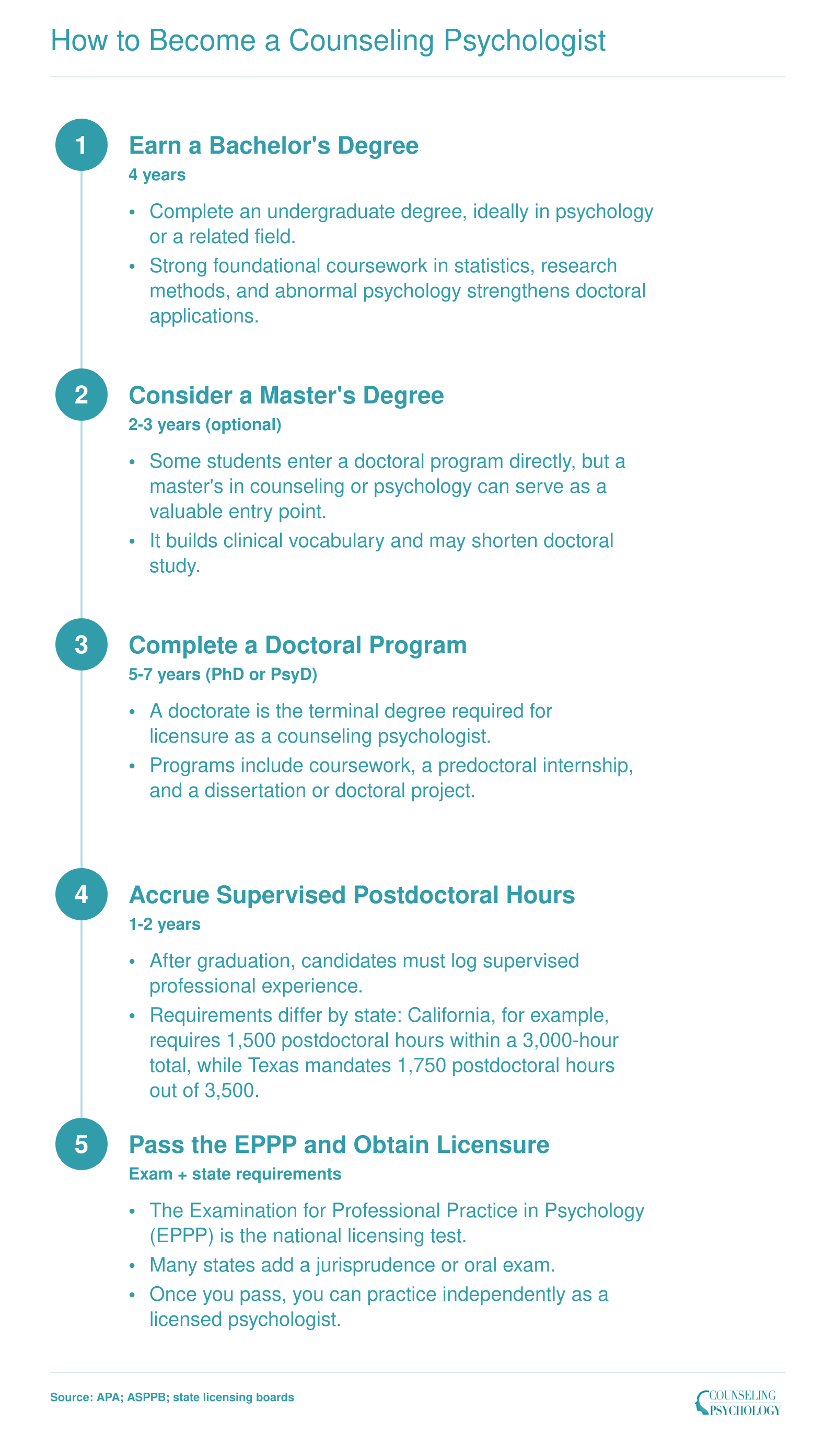
Earning the title of licensed counseling psychologist requires a structured sequence of education, supervised practice, and examination. Most candidates spend 10 to 14 years completing the full pathway after high school, though timelines vary by program format and state requirements. Below is the typical credentialing ladder.
Admissions Requirements for Counseling Psychology Programs: GRE, GPA, and More
Admissions requirements define the baseline qualifications you need to be considered for a counseling psychology program, whether online or in person. These typically include a combination of academic thresholds, standardized test scores, personal documentation, and relevant experience, all of which help programs assess your readiness for graduate-level coursework and clinical training. The specific expectations can shift significantly between master's level programs, which train licensed professional counselors, and doctoral programs, which prepare counseling psychologists. Online learners should be especially mindful that some distance-based programs may have the same prerequisites as campus cohorts, while others tailor their requirements to the needs of working adults, possibly adding technology readiness checks or synchronous orientation expectations.
Graduate Record Examinations (GRE) Policies
The GRE has long been a staple of graduate admissions, but its role is evolving rapidly. Many counseling psychology programs have moved to test-optional or test-flexible policies, allowing applicants to forgo the exam entirely or substitute other evidence of academic ability. Some programs offer automatic waivers based on GPA, with a 3.0 or higher cumulative undergraduate GPA being a common threshold. Others may waive the GRE for applicants who already hold a graduate degree or have extensive professional experience in a related field. When GRE scores are required, programs might set minimum scores (for example, a combined verbal and quantitative score around 300) or focus on specific section percentiles. Always locate each program's official admissions page or frequently asked questions (FAQ) section to confirm current GRE expectations, as policies can change from cycle to cycle. For a broader look at what programs expect, the psychology graduate school admissions process is covered in depth on our dedicated guide.
GPA, Recommendations, and Personal Statements
Grade-point averages serve as a quantitative filter for many programs, with typical counseling psychology master's degree programs expecting a minimum undergraduate GPA of 3.0, while doctoral programs may seek a 3.5 or higher to remain competitive. Some programs calculate GPA on the last 60 credit hours or the psychology-specific coursework. Letters of recommendation carry significant weight; most programs request two or three, ideally from faculty members or professional supervisors who can speak to your academic aptitude, interpersonal skills, and commitment to the helping professions. The personal statement is your opportunity to articulate why you are pursuing this degree, how your background aligns with the program's philosophy, and what you intend to contribute to the field. Many programs also require a resume or curriculum vitae documenting any volunteer or paid experience in counseling settings, crisis hotlines, or research activities.
Additional Components and Program-Specific Variations
Beyond the core pieces, applicants may encounter additional hurdles such as writing samples, prerequisite coursework (often including introductory psychology, statistics, and abnormal psychology), or group interviews. Criminal background checks and liability insurance proof might be required at the point of admission or before clinical placements. It is not safe to assume that any two programs share identical cutoffs or documentation needs; even within the same university, the master's and doctoral tracks can diverge. Reviewing how to compare online psychology programs can help you build a working checklist of each program's requirements, deadlines, and special instructions for online learners, so you avoid last-minute scrambling. The most reliable strategy remains creating a comparison spreadsheet drawn directly from the official websites of your target programs, noting every condition and noting any requirements specific to distance learners.
Counseling Psychology Degree Levels: Bachelor's, Master's, and Doctorate
A counseling psychology degree opens doors to a range of helping professions, but the opportunities you can pursue, and whether you can call yourself a psychologist, depend on the level of education you complete. Understanding what each degree level really prepares you for can save time, money, and the frustration of hitting a career ceiling.
Bachelor's in Counseling Psychology: A Launchpad for Entry-Level Roles
A bachelor's degree in counseling psychology introduces the foundations of human behavior, mental health, and therapeutic techniques. Graduates often work in supportive roles such as case manager, behavioral health technician, crisis hotline specialist, or human services assistant. These positions provide valuable frontline experience, but the bachelor's alone does not lead to state licensure as a therapist or counselor. For most, this counseling psychology degree is a stepping stone to graduate education.
Master's in Counseling Psychology: Your Route to Licensure as a Counselor
The master's is the entry-level degree for clinical practice in many states. With a Master of Arts or Master of Science in counseling psychology, you can pursue licensure as a Licensed Professional Counselor (LPC), Licensed Mental Health Counselor (LMHC), or similar title, depending on where you plan to practice. Licensed master's-level clinicians diagnose and treat mental health conditions, conduct therapy, and work across private practice, community agencies, and hospitals.
However, even with a master's degree and licensure, you are not a "counseling psychologist." That title is legally reserved for individuals who hold a doctoral degree and state licensure as a psychologist. This is a common point of confusion: aspiring therapists often assume a master's in counseling psychology leads to the psychologist title, when in reality it leads to licensure as a professional counselor. The job market and earnings may be similar, but the scope of practice and credential differ significantly.
Can you become a therapist with an online psychology degree? Yes, at the master's level. Many accredited online masters in mental health counseling meet state educational requirements for LPC or LMHC licensure, provided they include required clinical fieldwork. However, fully online doctoral programs in counseling psychology that lead to psychologist licensure are extremely rare; doctoral training almost always involves substantial in-person residencies and supervised clinical placements.
Doctoral Programs: Becoming a Licensed Counseling Psychologist
To earn the title of counseling psychologist, you need a Doctor of Philosophy (PhD) or Doctor of Psychology (PsyD) in counseling psychology. These programs emphasize advanced clinical training, research, and psychological assessment. Graduates must complete a predoctoral internship, postdoctoral supervised hours, and pass the Examination for Professional Practice in Psychology (EPPP) to become a counselor or licensed psychologist. With a doctoral license, you can practice independently, conduct psychological testing, teach at the university level, and often command higher earning potential.
APA accreditation at the doctoral level is critical for licensure eligibility in most states. Currently, APA accredits only a handful of online or hybrid counseling psychology doctoral programs. Most combine online coursework with intensive, periodic campus visits and community-based clinical placements. If your goal is the psychologist title, plan for a primarily on-ground or hybrid training experience.
Detailed breakdowns of online bachelor's, master's, and doctoral programs in counseling psychology are expanded in the sections that follow, covering admissions, curriculum, and career outcomes for each pathway.
Online vs On-Campus Counseling Psychology Programs
Can you study counseling psychology online? Yes, but the answer depends heavily on degree level and your long-term career goals. Master's level counseling programs offer the most robust online options, with many CACREP-accredited programs available in fully online or hybrid formats. At the doctoral level, no fully online APA-accredited counseling psychology programs exist as of 2025. Hybrid doctoral programs do allow the majority of coursework to be completed remotely, but they require multi-day or weekend on-campus residencies (typically one to two times per term) plus a full-time internship year. Accreditation standards, whether APA for doctoral programs or CACREP for master's programs, apply equally regardless of delivery format, so an online degree from a properly accredited program carries the same professional weight as one earned on campus.
- Geographic flexibility lets you access programs nationwide without relocating, expanding your options well beyond local universities.
- Online formats make it far easier to maintain employment or family responsibilities while completing coursework.
- CACREP-accredited master's programs are widely available online in clinical mental health counseling, school counseling, and related specializations.
- Hybrid doctoral programs allow most coursework to be completed remotely, reducing the time spent away from home and work.
- Broader program selection means you can prioritize fit, faculty expertise, and accreditation rather than settling for proximity.
- In-person practicum and internship hours are still required at every level, so you will need to arrange supervised clinical placements in your area.
- No fully online APA-accredited counseling psychology doctoral programs exist, meaning doctoral students must commit to periodic on-campus residencies.
- Networking can be more limited online; building peer relationships and faculty mentorship often takes more intentional effort in virtual settings.
- CACREP-accredited online master's programs lead to LPC, LPCC, or LMHC licensure only, not licensure as a psychologist, which requires a doctoral degree.
- Hybrid doctoral residencies typically occur one to two times per term and may require travel and lodging costs that add to overall program expenses.
Related Articles
Accreditation and Licensure Requirements for Counseling Psychologists
What does it actually take to get licensed as a counseling psychologist, and does the state you practice in change the answer? Yes, considerably. Every U.S. jurisdiction sets its own postdoctoral supervision rules, exam thresholds, and accreditation expectations, so the path from doctorate to license plate on the office door looks different in Sacramento than it does in Houston or Albany.
APA vs CACREP Accreditation
For doctoral-level counseling psychologists, APA accreditation is the gold standard. APA accredits doctoral programs in counseling, clinical, and school psychology, and most state psychology boards either require or strongly prefer graduation from an APA-accredited program for licensure as a psychologist. CACREP, by contrast, accredits master's-level counseling programs (clinical mental health counseling, school counseling, marriage and family) and is the standard for licensed professional counselor licensure, not for psychologist licensure.
The practical implication: if you intend to license as a psychologist and practice across state lines, an APA-accredited doctorate gives you the broadest portability, including eligibility for the PSYPACT interjurisdictional compact. A non-APA doctorate can box you into specific states.
State-Level Variation
A few representative examples illustrate the range:
- California: 1,500 hours of supervised professional experience, EPPP required, California Psychology Law and Ethics Examination (a jurisprudence exam) required. APA accreditation is not strictly mandated, but the program must meet specific curricular criteria the Board reviews case by case.1
- Texas: 1,750 supervised postdoctoral hours, EPPP plus the Texas Jurisprudence Examination required. APA accreditation is not universally required; the Board will consider regionally accredited doctoral programs that meet equivalency standards.2
- New York, Florida, Illinois, Ohio, Pennsylvania, Virginia, Georgia, Massachusetts: All require the EPPP (most use the national 500 cut score), most require a jurisprudence component, and supervised hour requirements typically range from 1,500 to 3,000 across pre- and postdoctoral experience combined.
The Non-APA PsyD Nuance
A growing handful of states, Texas and California among them, will evaluate PsyD graduates from regionally accredited but non-APA programs on a case-by-case basis if the curriculum, practicum, and internship hours match APA equivalency standards. This has opened doors for graduates of newer online or hybrid PsyD programs, but the review process is slower and the licensure is not portable to APA-strict states like New York. Students exploring counseling doctoral programs should verify directly with the board where they intend to practice before enrolling.
Counseling Psychologist Salary, Job Outlook, and Work Settings
The central tradeoff here is straightforward: doctoral-level training opens the door to significantly higher earnings, but it demands three to five additional years of your life and career compared to a master's-level counseling path. Whether that investment pays off depends on the work setting you are targeting and how far you want to advance professionally.
What the Numbers Actually Show
According to the Bureau of Labor Statistics Occupational Outlook Handbook, psychologists nationally earned a median annual wage of $94,310 in 2024.1 Employment in the field is projected to grow 6 percent from 2024 to 2034, roughly in line with the average for all occupations. That baseline figure covers a broad category of psychologists, so individual earnings vary considerably depending on degree level, specialty, and where you work.
For comparison, substance abuse, behavioral disorder, and mental health counselors, a category that includes many licensed professional counselors (LPCs), earned a national median of $59,190 in 2024.2 That gap of roughly $35,000 per year illustrates why some students pursue doctoral programs despite the added time. The counselor category, however, is growing much faster, with the BLS projecting 16.8 percent job growth from 2024 to 2034, well above average.2 Strong demand does not close the wage gap, but it does mean that master's-level counselors face a favorable job market. For a deeper breakdown by degree level and state, see our guide to counselor salary.
Salary by Work Setting
Where you practice shapes your paycheck at least as much as your degree level does. Counseling psychologists and related practitioners work across a range of environments, and compensation differs noticeably among them:
- Private practice: Often cited as a higher-earning path for licensed doctoral-level psychologists, though income depends heavily on caseload, billing rates, and whether you accept insurance.
- Hospitals and medical centers: Tend to offer stable salaries with benefits, frequently competitive with or above outpatient settings.
- Colleges and universities: Counseling center positions are common entry points for doctoral graduates; pay is typically mid-range but comes with strong benefits and academic-year schedules.
- Government agencies: Federal and state positions often pay well and offer defined benefit retirement plans, making them attractive for long-term financial stability.
- Community mental health centers: These settings serve high-need populations and typically pay less than hospitals or private practice, though loan forgiveness programs can offset that gap for qualifying practitioners.
Doctoral vs. Master's: The Long View
Doctoral-level counseling psychologists routinely out-earn master's-level LPCs, but the comparison is not purely about peak salary. A student who earns a master's degree and enters the workforce three to five years before a doctoral peer accumulates real income during those years. The financial case for the doctorate strengthens if you target settings, such as academic positions, VA medical centers, or independent practice, where the doctoral credential is either required or substantially rewarded. If your goal is community mental health work or school-based counseling, the master's path often offers a faster and more affordable route to a sustainable career.
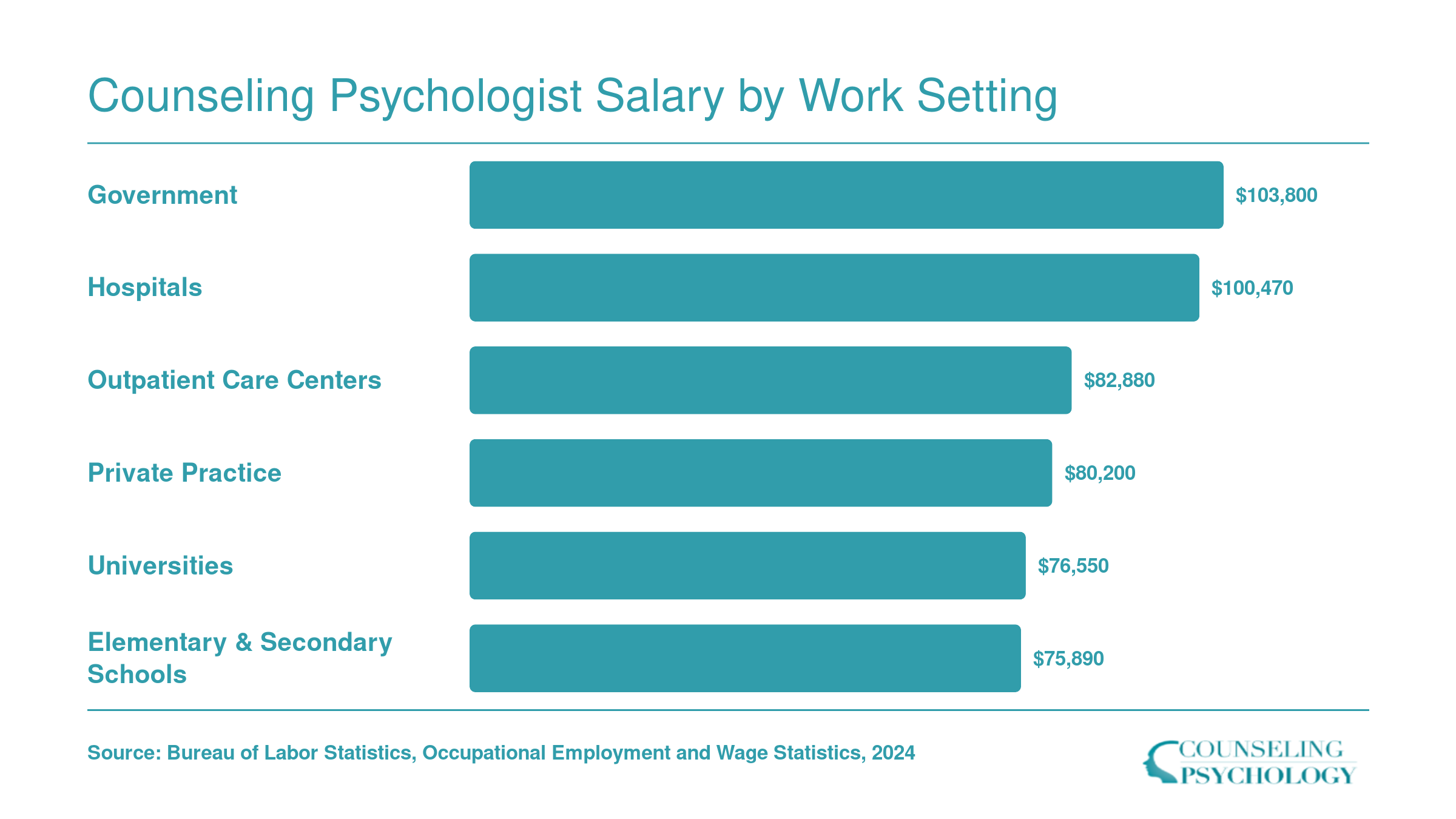
Counseling Psychologist Salary by Work Setting
Where you practice can matter as much as, or even more than, where you live. Work setting is one of the biggest salary levers for counseling psychologists, with median pay varying by tens of thousands of dollars depending on the employer type. The BLS groups counseling psychologists with clinical and school psychologists, and the figures below reflect national medians across common employment sectors.
Doctoral counseling psychology programs frequently cover full tuition and provide annual stipends through graduate assistantships, a funding advantage that master's level programs rarely match. When evaluating doctoral programs, ask specifically about APPIC listed internship stipends: at APA accredited sites, these averaged roughly $35,000 to $40,000 per year, which can substantially offset living expenses during your final training year.
Frequently Asked Questions About Counseling Psychology Programs
Prospective students often have overlapping questions about online formats, licensure timelines, and how counseling psychology stacks up against related fields. Below are straightforward answers drawn from current accreditation standards, licensing exam data, and workforce realities.
- Can I study counseling psychology online?
- Yes. Many universities now offer master's and doctoral counseling psychology programs in fully online or hybrid formats. Most programs still require in-person components for practicum and internship hours, since supervised clinical contact is central to licensure. Before enrolling, confirm the program meets your state's licensure requirements for distance education.
- What is the best online counseling degree?
- There is no single best program for every student. The strongest online counseling psychology degrees hold CACREP or APA accreditation, maintain strong practicum site networks, and post solid licensure exam pass rates. Weigh factors like total cost, clinical placement support, faculty credentials, and whether the curriculum aligns with the specific license you plan to pursue in your state.
- What is the difference between counseling psychology and clinical psychology?
- Both fields prepare you to provide therapy, but counseling psychology traditionally emphasizes strengths-based approaches, developmental concerns, and career or life transitions. Clinical psychology tends to focus more on diagnosing and treating severe psychopathology. At the doctoral level, both can lead to licensure as a psychologist, though training models and research emphases differ.
- How long does it take to get a counseling psychology degree?
- A bachelor's degree typically takes four years. A master's program adds two to three years, while a doctoral program (PhD or PsyD) generally requires five to seven years, including dissertation and internship. Online programs sometimes offer accelerated timelines for the master's level, but doctoral training rarely shortens below five years due to supervised practice requirements.
- Can I become a therapist with an online psychology degree?
- Yes, provided the program is properly accredited and meets your state's licensure criteria. Many licensed professional counselors and marriage and family therapists earned their degrees through online or hybrid programs. The key is completing the required supervised clinical hours and passing your state's licensing exam. Always verify that your state board recognizes the specific online program.
- Who gets paid more, counselor or therapist?
- Compensation depends heavily on degree level, license type, and work setting. Professionals with doctoral-level licenses (such as licensed psychologists) generally earn more than those with master's-level counseling licenses. Within master's-level roles, job titles like "therapist" and "counselor" often overlap, and pay differences tend to reflect the employer and specialty rather than the title itself.
- Are online counseling psychology programs APA accredited?
- APA accreditation applies only at the doctoral level, and as of 2026 very few fully online counseling psychology doctoral programs hold APA accreditation. Most APA-accredited programs use a hybrid model that combines online coursework with required on-campus intensives and in-person practicum placements. If APA accreditation matters for your career goals, verify a program's current status directly through the APA website.
- What are the EPPP pass rates for online counseling psychology programs?
- The ASPPB publishes program-level Examination for Professional Practice in Psychology (EPPP) pass rate data annually, with the most recent report covering 2025 results. Counseling psychology programs as a group tend to have pass rates slightly lower than clinical psychology programs, with some reporting rates in the low 70% range. Because a single national average is not published, check the ASPPB report for the specific program you are considering.
Explore Programs
Related Programs
- Best Climate Psychology
- Best Online Applied Behavior Analysis
- Best Online Applied Psychology Degree
- Best Online Associate Degrees in Psychology for
- Best Online Autism Spectrum Disorders
- Best Online Bachelor's in Psychology
- Best Online Child Psychology Degree
- Best Online Clinical Psychology Programs for
- Best Online Cognitive Psychology Degree
- Best Online Developmental Psychology
- Best Online Educational Psychology Degrees
- Best Online Forensic Psychology Degree
- Best Online Graduate Certificate in Psychology
- Best Online Health Psychology Programs for
- Best Online I/O Psychology
- Best Online International Psychology
- Best Online Master's in Psychology Programs for
- Best Online Neuropsychology Programs for
- Best Online Ph.D. in Psychology
- Best Online Positive Psychology Programs for
- Best Online Psychopharmacology Programs for
- Best Online PsyD Programs for
- Best Online School Psychology
- Best Online Social Psychology Programs for
- Best Online Sports Psychology Programs in
- Engineering Psychology Degrees
- Online Geropsychology