
What you’ll learn in this article…
- Most positions require a CACREP-accredited master's degree in rehabilitation counseling, typically taking six to eight years from undergraduate start to full credentialing.
- The Certified Rehabilitation Counselor (CRC) credential from CRCC is the primary national certification and carries significant weight with employers.
- BLS data shows the national median salary for rehabilitation counselors is approximately $40,000 to $42,000, with top-paying states offering considerably more.
- Job growth for rehabilitation counselors is projected to be modest, but state agencies, insurers, schools, and private practices all employ vocational rehabilitation counselors.
Roughly 88,930 rehabilitation counselors were working across the United States in 2024, helping individuals with disabilities secure or return to meaningful employment. The field demands a practical blend of clinical counseling skills, case management, and working knowledge of disability law, including the ADA and workers' compensation systems. Effective vocational rehabilitation counselors act as both advocates and career guides, often collaborating with physicians, employers, and social services to remove barriers. Entry typically requires a master's degree and the Certified Rehabilitation Counselor (CRC) credential, making graduate education the decisive step into this specialty.
What Is a Vocational Rehabilitation Counselor?
What does a vocational rehabilitation counselor actually do, and how do they differ from other types of counselors?
A vocational rehabilitation counselor helps individuals with physical, mental, developmental, or emotional disabilities develop the skills they need to find employment and live independently. Unlike general career counselors who serve any job seeker, or school counselors who work within K-12 and higher education settings, vocational rehabilitation counselors specifically address disability-related barriers that prevent people from entering or staying in the workforce.
Primary Client Populations
Vocational rehabilitation counselors work with a wide range of clients facing significant challenges. Common populations include:
- Traumatic brain injury survivors: Individuals relearning cognitive and physical skills after accidents or medical events
- Spinal cord injury clients: People adapting to mobility limitations and seeking accessible employment
- Mental health conditions: Clients managing depression, anxiety, schizophrenia, bipolar disorder, or PTSD
- Intellectual and developmental disabilities: Individuals with autism spectrum disorder, Down syndrome, or other conditions affecting learning and communication
- Sensory impairments: People who are blind, low-vision, deaf, or hard of hearing
- Chronic illness: Clients with conditions like multiple sclerosis, diabetes complications, or chronic pain syndromes
How Vocational Rehabilitation Differs from General Rehabilitation Counseling
The terms vocational counselor and rehabilitation counselor overlap heavily in practice, and the Bureau of Labor Statistics classifies both under the same occupation code. However, emphasis can vary by setting. Some vocational rehabilitation counselors focus on return-to-work scenarios, particularly in workers' compensation cases where an injured employee needs job retraining or workplace accommodations. Others concentrate on long-term independence and community integration, helping clients who have never held competitive employment build foundational work skills.
Regardless of the specific client or setting, vocational rehabilitation counselors share a core mission: removing barriers between disability and meaningful work. They assess functional limitations, coordinate with medical providers and employers, arrange assistive technology, and advocate for accommodations that level the playing field. The role demands both clinical expertise in disability and practical knowledge of labor markets, making it distinct within the broader counseling profession. For those drawn more specifically to clinical work with mood disorders, a path as a depression counselor may be worth exploring as a complementary or alternative specialization.
What Does a Vocational Rehabilitation Counselor Do?
Vocational rehabilitation counselors blend clinical assessment, career counseling, case management, and employer liaison work into a demanding but rewarding role. The day-to-day varies by setting, but several core responsibilities define the profession.
Client Intake and Assessment
A typical day begins with intake interviews and vocational evaluations. Counselors conduct interest inventories, aptitude tests, and transferable-skills analyses to understand what jobs align with each client's strengths and limitations. This assessment phase also includes reviewing medical records, functional capacity evaluations, and psychological reports. The goal is to develop a clear picture of the client's abilities, barriers, and employment goals.
Once the evaluation is complete, the counselor drafts an Individualized Plan for Employment (IPE), a roadmap that specifies services, training programs, assistive technology needs, and job placement targets. The IPE is reviewed with the client and updated as progress unfolds. Throughout the process, counselors maintain detailed case notes to satisfy both ethical standards and funding-source documentation requirements.
Caseload Realities
Caseload size shapes the pace and depth of counseling. State vocational rehabilitation agency counselors commonly manage 100 to 150 or more active cases at a time, requiring efficient triage and strong organizational systems. Private-sector and nonprofit caseloads tend to be smaller (often 30 to 60 clients), allowing more intensive, hands-on support but still demanding careful time management.
Employer Outreach and Job Placement
Securing employment is the ultimate measure of success. Counselors spend significant time reaching out to employers, educating hiring managers on reasonable accommodations, and coordinating with human resources to ensure smooth onboarding. After placement, follow-up visits and check-ins help troubleshoot early challenges and prevent job loss.
Collaboration With Other Professionals
Vocational rehabilitation is inherently interdisciplinary. Counselors regularly consult with occupational therapists, psychologists, social workers, and assistive technology specialists to address medical, mental health, and accessibility barriers. Those interested in the broader landscape of helping professions can explore counseling careers to compare related paths. Effective collaboration ensures that clients receive comprehensive support across all dimensions of their lives, not just employment services.
Questions to Ask Yourself
Vocational Rehabilitation Counselor Education Requirements
The merger of the Council on Rehabilitation Education (CORE) into CACREP in 2017 fundamentally reshaped how aspiring vocational rehabilitation counselors plan their education, creating a single accreditation pathway where two once existed. Understanding what that means for your degree choices is essential before you commit time and tuition to a program.
Why a Master's Degree Is the Standard
A master's degree is the baseline expectation for most vocational rehabilitation counselor positions, particularly those in state VR agencies or any role that requires professional licensure. If you hold only a bachelor's degree, you will generally qualify for support-level positions such as case aide, job coach, or intake specialist, but not for the counselor title itself. Employers and licensing boards alike treat the master's as the credential that confirms you have both the clinical depth and the specialized disability knowledge the work demands.
Choosing the Right Program
Rehabilitation counseling is the most direct path into this career. Programs in clinical mental health counseling and counseling psychology are also accepted in many states, though you may need to supplement coursework in disability-specific areas to meet licensure or certification requirements. Students drawn to the broader mental health track may want to explore how to become a mental health counselor before committing to a rehabilitation-specific program.
The gold standard is a program accredited by the Council for Accreditation of Counseling and Related Educational Programs (CACREP). After CORE merged into CACREP effective July 1, 2017, all previously CORE-accredited programs transitioned under the CACREP umbrella.1 Graduates of those programs from that date forward are considered CACREP graduates. As of 2024, CACREP lists more than 969 accredited programs across 483 institutions.2 Under the current 2024 standards, rehabilitation counseling falls under Section 5-G, while clinical rehabilitation counseling, a track that adds diagnosis and treatment of mental disorders and co-occurring conditions, is covered under Section 5-D.3
Graduating from a CACREP-accredited rehabilitation counseling program streamlines your eligibility for the Certified Rehabilitation Counselor (CRC) credential, which many employers prefer or require. For a broader look at the profession, including certified rehabilitation counselor requirements, see our companion guide.
What You Will Study
CACREP-accredited programs blend a broad counseling core with specialized rehabilitation content.3 Expect coursework in these areas:
- Core counseling curriculum: Professional orientation, social and cultural diversity, human growth and development, career development, counseling and helping relationships, group counseling, assessment and testing, and research and program evaluation.
- Specialized rehabilitation topics: Medical and psychosocial aspects of disability, vocational evaluation and assessment, case management, independent living, assistive technology, advocacy, and disability policy.
- Multicultural counseling: Competency in working across cultural, linguistic, and ability-related differences is threaded throughout both the core and specialty curricula.
Clinical rehabilitation counseling tracks layer on additional training in diagnosing and treating mental health disorders, preparing graduates for dual-focus roles.
Practicum and Internship Requirements
Classroom learning alone will not get you across the finish line. CACREP-accredited programs require supervised clinical experience, typically totaling 600 or more clock hours split between a practicum and an internship.3 During practicum, you apply foundational counseling skills in a controlled setting. The internship places you in a vocational rehabilitation environment where you carry a caseload, conduct assessments, develop employment plans, and coordinate services under the guidance of a qualified supervisor. Programs require faculty to hold a doctorate in counselor education or a related field, ensuring the mentorship you receive reflects current research and practice standards.
These hours are not just an academic requirement. They form the clinical foundation that licensing boards and the CRC certification process evaluate, so choose your placement sites thoughtfully.
Steps to Becoming a Vocational Rehabilitation Counselor
The path from undergraduate student to fully credentialed vocational rehabilitation counselor typically spans six to eight years. Below is the five-step credentialing ladder most professionals follow.
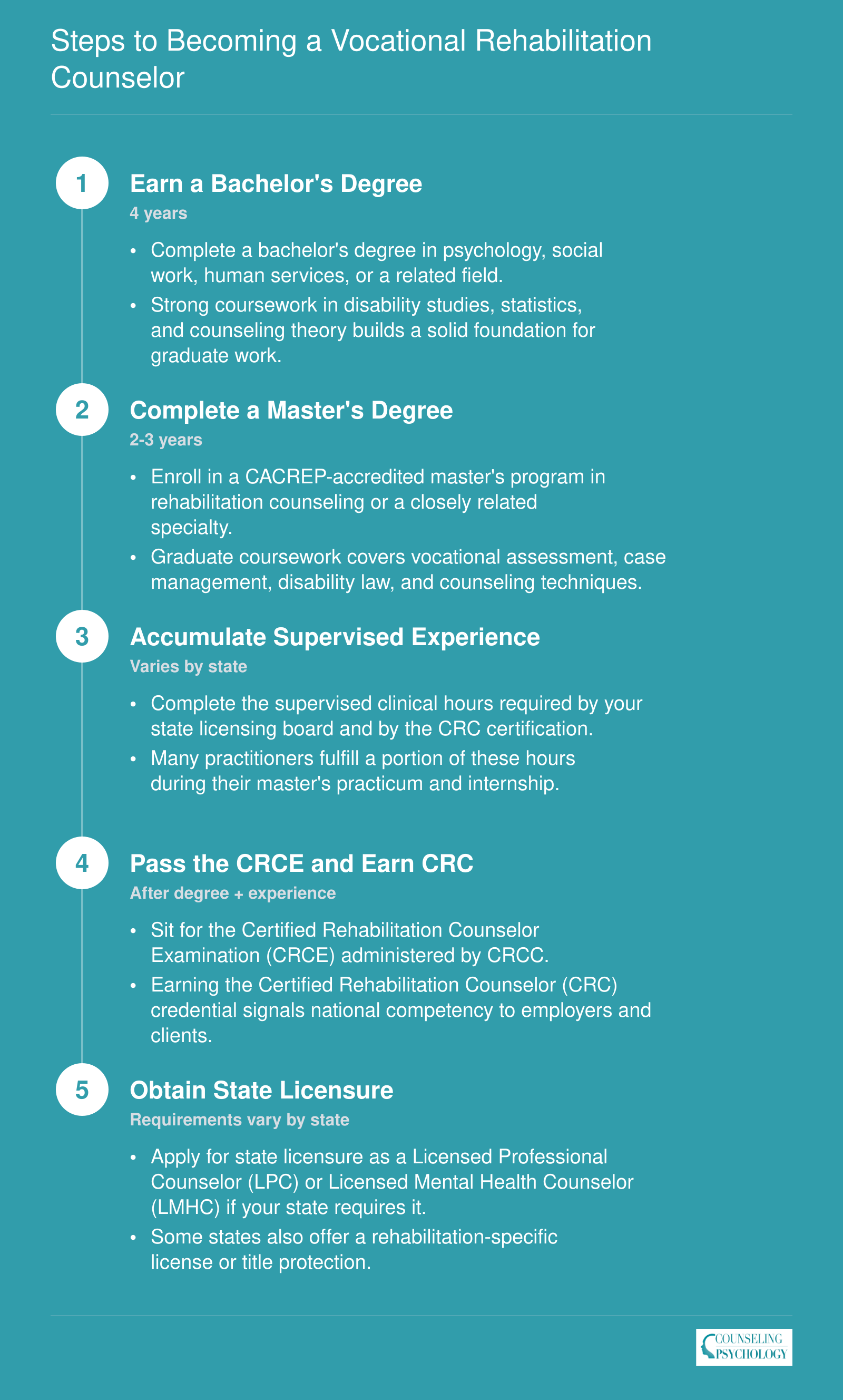
Licensure and Certification for Vocational Rehabilitation Counselors
The Certified Rehabilitation Counselor (CRC) credential, administered by the Commission on Rehabilitation Counselor Certification (CRCC), is the primary national certification in this field, and it carries real weight with employers across both public and private rehabilitation settings.
The CRC Credential: Eligibility and Exam
CRCC recognizes three eligibility pathways for the CRC:1
- CACREP-accredited master's: A graduate degree in rehabilitation counseling from a program accredited by the Council for Accreditation of Counseling and Related Educational Programs.
- Non-CACREP rehabilitation counseling master's: A rehabilitation counseling degree from a program without CACREP accreditation, combined with a supervised internship completed under a CRC.
- Related master's or doctoral degree: A graduate degree in a related field, paired with specific rehabilitation counseling coursework and documented supervision hours.
All pathways lead to the same credential and the same exam. The Certified Rehabilitation Counselor Examination (CRCE) consists of 175 questions delivered over 210 minutes.2 The exam uses a conjunctive scoring model, meaning candidates must pass both sections separately: one covering Counseling and one covering Rehabilitation and Disability. Clearing only one section is not sufficient. As of July 2025, the published pass rate sits at 52 percent, so preparation matters considerably.2 The application and exam fee is $420.1
Maintaining Your CRC: Renewal Requirements
Certification is valid for five years. Renewal requires 100 hours of continuing education within that cycle, including at least 10 hours focused specifically on ethics.1 The renewal fee is $405. CRCC treats ethical compliance as a standing requirement throughout the certification period, not just at renewal time. Counselors who let the credential lapse face reinstatement requirements rather than a simple renewal process.
State Licensure: LPC and LMHC Requirements
The CRC is a national certification, not a state license. For independent clinical practice, most states require a separate state-issued license, typically the Licensed Professional Counselor (LPC) or the Licensed Mental Health Counselor (LMHC) designation. If you are exploring the LPC path specifically, our guide on how to become a licensed professional counselor covers the process in detail. Requirements vary meaningfully by state:
- Texas: Requires a master's degree with 48 graduate semester hours, 3,000 hours of supervised post-graduate experience, and passage of the National Counselor Examination (NCE) or the National Clinical Mental Health Counseling Examination (NCMHCE).
- New York: Licenses counselors as LMHCs, requiring 60 graduate credit hours, 3,000 hours of post-degree supervised experience (with at least 2 years under a qualified supervisor), and the NCMHCE.
- California: Does not offer an LPC license; rehabilitation counselors practicing clinical work typically pursue licensure as a Licensed Professional Clinical Counselor (LPCC), which requires 3,000 hours of supervised experience and passage of the California Law and Ethics Exam alongside a national clinical exam.
CRC vs. State Licensure: Why Many Practitioners Carry Both
The distinction between these credentials is practical, not just semantic. The CRC signals specialized expertise in disability, vocational assessment, and rehabilitation planning. An LPC or LMHC signals authorization to provide clinical counseling services within a specific state. Many employers in state vocational rehabilitation agencies, hospitals, and private rehabilitation firms expect candidates to hold or be actively pursuing both. Carrying only the CRC may limit independent practice rights; carrying only a state license may limit competitiveness for rehabilitation-specific roles. Pursuing both credentials from the outset of your career is the most strategic path.
Related Articles
Vocational Rehabilitation Counselor Salary: National Overview
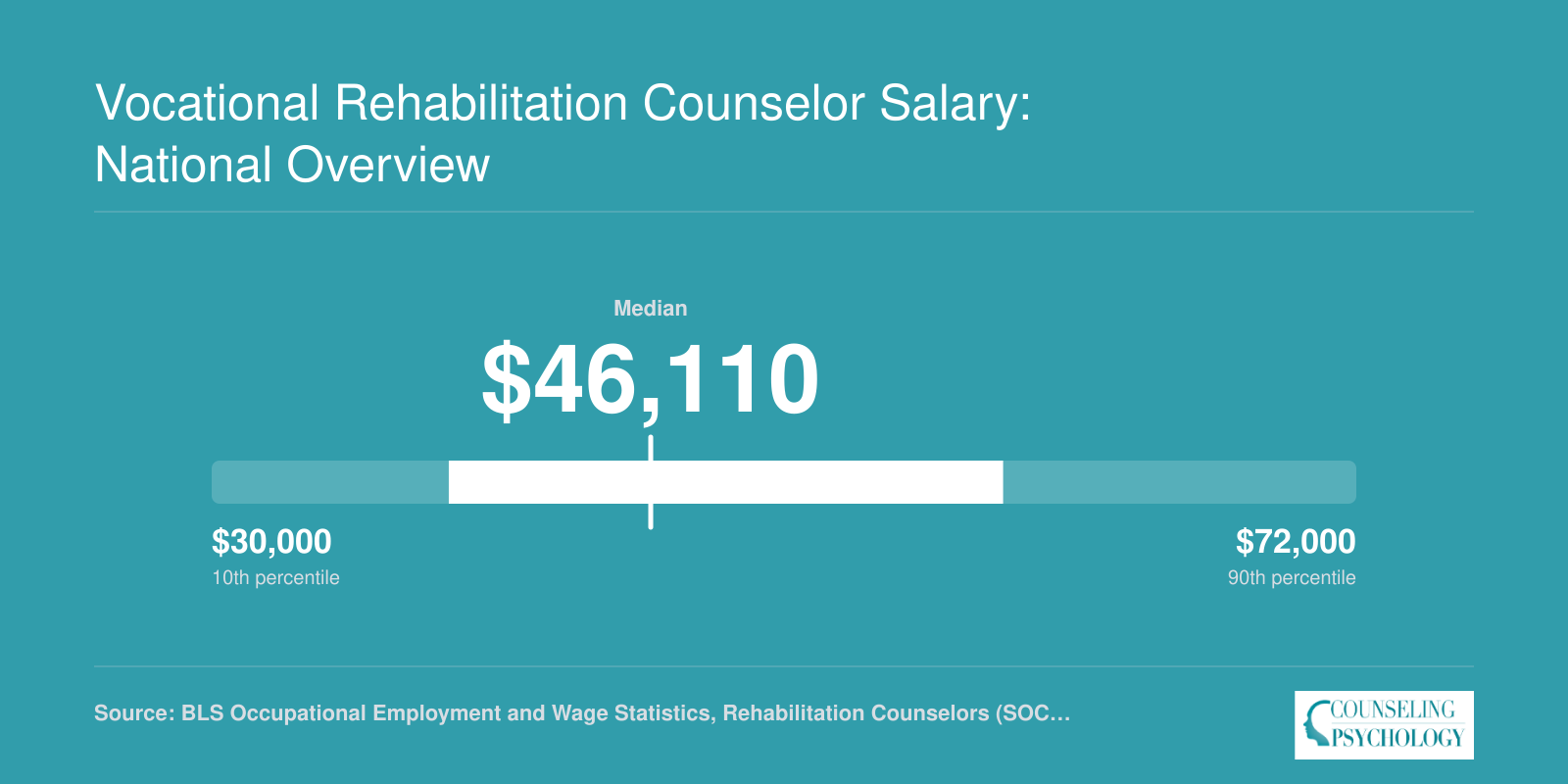
The Bureau of Labor Statistics groups vocational rehabilitation counselors under the broader Rehabilitation Counselors category (SOC 21-1015). The figures below reflect approximate 2024 national data for all rehabilitation counselors, not exclusively those specializing in vocational rehabilitation. With roughly 88,930 professionals employed nationwide, this distribution shows where most salaries fall.
Highest-Paying States and Metro Areas for Vocational Rehabilitation Counselors
Geography plays a significant role in rehabilitation counselor compensation. The table below ranks the ten highest-paying states by median annual salary for rehabilitation counselors, based on the latest BLS data. Keep in mind that higher salaries often correlate with a higher cost of living, so prospective vocational rehabilitation counselors should weigh both earning potential and local expenses when evaluating job opportunities.
| Rank | State | Median Annual Salary | Mean Annual Salary | Total Employment |
|---|---|---|---|---|
| 1 | Alaska | $82,400 | $78,670 | 130 |
| 2 | District of Columbia | $74,410 | $72,400 | 310 |
| 3 | North Dakota | $60,730 | $61,530 | 200 |
| 4 | Washington | $58,620 | $62,940 | 4,660 |
| 5 | Wyoming | $56,520 | $56,820 | 90 |
| 6 | Kentucky | $56,150 | $55,110 | 880 |
| 7 | Alabama | $54,320 | $54,300 | 460 |
| 8 | Rhode Island | $54,080 | $61,430 | 360 |
| 9 | Oregon | $52,630 | $56,750 | 1,880 |
| 10 | New Mexico | $51,540 | $54,360 | 210 |
When comparing offers, look beyond the base salary. State vocational rehabilitation agencies frequently include defined-benefit pensions, qualifying employment for Public Service Loan Forgiveness, and substantial paid time off. Those benefits can quietly outvalue a higher private-sector paycheck, especially over a full career, so weigh the total compensation package before assuming the bigger number wins.
Vocational Rehabilitation Counselor Job Outlook
Job outlook refers to how quickly a profession is expected to add positions over a set period, and for vocational rehabilitation counselors the picture is nuanced. According to the Bureau of Labor Statistics, rehabilitation counselors (SOC 21-1015) are projected to see approximately 1 percent employment growth from 2024 to 2034, which is slower than the 4 percent average projected across all occupations.1 Despite that modest growth rate, the BLS estimates roughly 7,600 openings per year during this window, driven largely by the need to replace counselors who retire, transfer to other roles, or leave the workforce entirely.2
Why Demand Persists Despite Slower Growth
The headline growth figure does not capture the full story. Several forces continue to sustain and, in some cases, intensify the need for qualified vocational rehabilitation counselors.
- Aging workforce: As baby boomers delay retirement or re-enter the labor market with acquired disabilities, caseloads at state vocational rehabilitation agencies remain high. At the same time, many experienced VR counselors are themselves approaching retirement, creating succession gaps that agencies must fill.
- Expanded disability rights legislation: Federal and state policy developments continue to broaden eligibility for rehabilitation services and reinforce employers' obligations under the Americans with Disabilities Act. Each expansion brings additional individuals into the VR system.
- Opioid and mental health crisis: Substance use disorders and mental health conditions increasingly contribute to disability caseloads, creating demand for counselors who can address complex, co-occurring barriers to employment.
- Employer interest in inclusive hiring: A growing number of private employers are actively building disability-inclusive talent pipelines, which drives demand for rehabilitation professionals who can serve as liaisons between job seekers and hiring organizations.
Where Demand Is Strongest
State VR agencies, which are federally funded under the Rehabilitation Act, have reported staffing shortages in many regions. High caseload-to-counselor ratios in these agencies mean that qualified applicants often find openings even when overall growth is flat. Outside the public sector, the private rehabilitation and workers' compensation sectors are expanding as insurers and employers invest more heavily in return-to-work programs designed to reduce long-term disability costs. Professionals interested in the substance use dimension of this work may also want to explore how to become a substance abuse counselor, since the overlap in caseloads can open additional career pathways.
Gaining a Competitive Edge
Candidates who hold the Certified Rehabilitation Counselor (CRC) credential tend to stand out in applicant pools, particularly for positions at state agencies and accredited rehabilitation facilities that may require or strongly prefer the certification. Bilingual skills offer another meaningful advantage: as VR agencies serve increasingly diverse populations, counselors who can conduct assessments and develop employment plans in more than one language are in higher demand.
While the projected growth rate is slower than the national average, vocational rehabilitation counseling remains a field with consistent turnover-driven openings and structural demand factors that are unlikely to diminish in the near term. Prospective counselors who invest in the right credentials and develop specialized competencies will find themselves well positioned in this job market.
Where Do Vocational Rehabilitation Counselors Work?
Vocational rehabilitation counseling employment has expanded well beyond traditional state agency cubicles, as insurers, school systems, and private practices increasingly recognize the economic and social value of disability-inclusive employment.
Top Employers by Industry
According to the Bureau of Labor Statistics (BLS), the largest employers of rehabilitation counselors (a category that includes vocational rehabilitation counselors) as of 2024 were individual and family services (22%), state vocational rehabilitation agencies (18%), residential care facilities (12%), and community and vocational rehabilitation programs (10%). The remainder work across educational services, government, and private practice. While state agencies remain a cornerstone of the field, growth in managed-care organizations and corporate disability management is diversifying where new graduates land.
Where Employment Is Concentrated
- State-level demand: California, Texas, and New York lead in total rehabilitation counselor jobs, but population-adjusted employment is often highest in the Midwest and Northeast, where state VR systems are deeply institutionalized.
- Metro-area hot spots: Large metropolitan areas like New York City, Chicago, and Los Angeles dominate, but smaller cities with major state agency headquarters or university-affiliated programs (e.g., Olympia, WA; Madison, WI) also show high concentration.
- Rural and underserved regions: Many state VR agencies actively recruit counselors for rural placements, sometimes offering loan repayment incentives. BLS county-level data underscores that rural counties often rely on just a few counselors serving multi-county caseloads.
How This Differs from Related Roles
O*NET data highlights that vocational rehabilitation counselors split time between office settings, client workplaces, and community visits, unlike school counselors, who work almost entirely on campus. Compared to mental health counselors, VR counselors place heavier emphasis on case management, job development, and coordination with employers. Those interested in community mental health counselor roles will notice a similar community orientation, but VR work blends clinical and workforce-development responsibilities in a way that makes the environment feel more dynamic and less confined to one setting.
How to Research Your Own Market
- Visit state VR agency websites: Most publish annual reports detailing staffing levels and priority service areas.
- Use BLS tools: The Occupational Employment and Wage Statistics query system lets you filter "Rehabilitation Counselors" by industry and metro area to see local concentration and pay.
- Check alumni outcomes: Many university vocational counseling programs post employment destinations and starting salary ranges of recent graduates, giving you a realistic preview of entry-level options.
BLS occupational maps confirm that the rehabilitation counseling workforce is geographically widespread but industrially concentrated, meaning location often plays more heavily than industry variety when choosing your first job.
Specialization Pathways Within Vocational Rehabilitation Counseling
Vocational rehabilitation counseling offers at least five distinct specialization pathways, each targeting unique client populations and employing different intervention models. These specialty tracks allow practitioners to build deep expertise while commanding higher compensation and opening doors to consulting or expert witness roles.
Psychiatric and Mental Health Rehabilitation
Counselors in this specialty work primarily with clients managing schizophrenia, bipolar disorder, major depression, and other serious mental illnesses. They coordinate with psychiatrists, case managers, and supported employment programs to help clients secure competitive integrated employment. Proficiency in evidence-based models such as Individual Placement and Support (IPS) is increasingly expected.
Traumatic Brain Injury Rehabilitation
TBI specialists assess cognitive and behavioral sequelae of brain injuries, design accommodations for memory deficits and executive function impairments, and collaborate with neuropsychologists and occupational therapists. This niche demands fluency in neurological terminology and adaptive technology.
Substance Abuse and Vocational Services
Counselors in this track integrate recovery principles with employment planning, often working in residential treatment centers or state addiction agencies. Additional credentials such as a Certified Addiction Counselor (CAC) or Licensed Alcohol and Drug Counselor (LADC) strengthen credibility and expand scope of practice.
Transition Services for Youth with Disabilities
Transition specialists help adolescents and young adults move from high school into postsecondary education, training, or employment. They partner with school districts under the Individuals with Disabilities Education Act (IDEA) and often hold dual credentials in special education or school counseling.
Forensic and Legal Vocational Expert Work
Forensic vocational experts provide testimony in personal injury, medical malpractice, and workers' compensation litigation, analyzing loss of earning capacity and vocational damages. Practitioners interested in the broader courtroom psychology field can explore forensic psychologist requirements as a complementary credential path. This specialty commands premium consulting fees, often $200 to $400 per hour, and requires certification as a Certified Vocational Evaluator (CVE) or Certified Disability Management Specialist (CDMS).
Building Specialty Expertise
Specialization often happens organically through caseload assignment, but deliberate pursuit through continuing education, advanced training, and targeted certifications accelerates expertise. The CDMS, CVE, and substance abuse credentials each open distinct practice doors and signal competence to employers and referral sources.
Frequently Asked Questions About Vocational Rehabilitation Counseling
Below are answers to some of the most common questions prospective students and career changers ask about entering vocational rehabilitation counseling. Each response draws on the education, licensure, salary, and outlook information discussed throughout this article.