![How to Become a Depression Counselor: Career Guide [2026]](https://www.counselingpsychology.org/wp-content/uploads/2023/01/depression-counselor.jpg)

What you’ll learn in this article…
- Most depression counselors need a master's degree, 2,000 to 4,000 supervised clinical hours, and a state license like the LPC or LMHC.
- The full path from freshman year to independent licensure typically spans 7 to 10 years.
- BLS projects 19% national employment growth for mental health counselors through 2033, well above average.
- Having personal experience with depression does not disqualify you from becoming a licensed therapist.
Depression is among the most prevalent mental health conditions in the United States, affecting an estimated 21 million adults in any given year. That scale of need has created sustained demand for clinicians who specialize in mood disorders, and for many counselors, depression treatment becomes the defining focus of their practice.
One point of confusion worth addressing early: there is no standalone "depression counselor" license. Professionals who specialize in treating depression hold broader clinical credentials such as Licensed Professional Counselor (LPC), Licensed Mental Health Counselor (LMHC), or Licensed Clinical Social Worker (LCSW), and then develop expertise in depression-specific modalities through graduate training, supervised hours, and continuing education.
The path from undergraduate enrollment to independent licensure typically spans seven to ten years and involves a master's degree, thousands of supervised clinical hours, and a state licensing exam. The investment is substantial, and salary outcomes vary considerably by setting, geography, and employer type. If you are still exploring which direction fits you best, our overview of counseling psychology careers is a good place to start.
What Does a Depression Counselor Do?
Demand for depression-focused mental health services has climbed steadily over the past decade, and the role of the depression counselor has grown in both scope and clinical complexity as a result.
A Specialization, Not a Separate License
The title "depression counselor" describes a clinical focus, not a standalone regulated credential. Practitioners who specialize in depression are typically licensed mental health counselors, licensed professional counselors, licensed clinical social workers, or psychologists who have concentrated their training and caseload around depressive disorders. This distinguishes them from general therapists, who may treat a broad range of conditions, and from psychiatrists, who are medical doctors with prescribing authority. Depression counselors operate through talk-based interventions; medication management falls outside their scope in nearly every state, with narrow exceptions for specially trained psychologists in a small number of jurisdictions. If you are weighing different paths within the field, our overview of counseling careers can help you compare options.
Conditions Treated
A counselor specializing in depression typically works with clients experiencing:
- Major depressive disorder: persistent low mood, loss of interest, and functional impairment lasting two weeks or more
- Persistent depressive disorder: a longer-duration, lower-intensity form of depression sometimes called dysthymia
- Seasonal affective disorder: depressive episodes tied to changes in light and season
- Postpartum depression: onset during pregnancy or in the year following childbirth
- Bipolar depressive episodes: the depressive phase of bipolar I or II disorder, often managed in coordination with a psychiatrist
- Treatment-resistant depression: cases that have not responded to standard first-line interventions and require more intensive or specialized approaches
Day-to-Day Responsibilities
On any given day, a depression counselor may conduct intake assessments to establish diagnosis and baseline functioning, develop individualized treatment plans, and deliver individual or group therapy sessions. Safety planning is a routine part of the work: when a client presents with suicidal ideation, the counselor follows structured protocols to assess risk and build a concrete safety plan. Coordination with prescribing providers, primary care physicians, and other members of a care team is common, particularly for clients managing medication alongside therapy.
Scope of Practice and Ethical Obligations
Ethical practice requires knowing the boundaries of what talk therapy can accomplish. When a client's depression is severe, worsening, or unresponsive to counseling, the clinician has a professional obligation to refer to psychiatric services or higher levels of care rather than continue treatment that is not producing results.
Populations Served
Depression counselors work across the lifespan and across settings. Common populations include adolescents navigating early-onset depression, working-age adults, older adults dealing with late-life depression, perinatal clients, and veterans, who face elevated rates of both depression and co-occurring conditions like PTSD. Counselors serving younger populations may benefit from specialized training in areas such as child counseling certification, while those working with military-connected clients sometimes coordinate with an army behavioral health specialist.
Depression Counselor Education Requirements
A depression counselor is a master's-trained (or doctoral-trained) clinician who diagnoses and treats major depressive disorder, persistent depressive disorder, and related mood conditions using evidence-based talk therapies. The credential pathway is layered: undergraduate preparation, a clinical graduate degree, and (optionally) a doctorate for those who want to practice as a licensed psychologist.
Bachelor's Degree: The Foundation
A four-year degree in psychology, social work, or human services is the standard launch point. Related majors like sociology, counseling, or behavioral health also work. Coursework typically covers abnormal psychology, developmental psychology, research methods, and statistics. Be clear-eyed about one thing: a bachelor's alone will not qualify you to diagnose or independently treat depression. It positions you for entry-level roles (case manager, behavioral health technician, crisis line worker) and, more importantly, builds the academic record graduate admissions committees want to see.
Master's Degree: The Licensure Minimum
A master's is the minimum credential for independent clinical practice. Two pathways dominate the field:
- Master's in Counseling (MA/MS): Look for programs accredited by CACREP (Council for Accreditation of Counseling and Related Educational Programs), typically 60 credit hours, leading to LPC, LMHC, or LPCC licensure depending on the state.
- Master of Social Work (MSW): Accredited by CSWE, with a clinical concentration that leads to LCSW licensure. MSWs often have broader scope in medical and community settings.
Some programs offer concentrations relevant to depression work, including mood disorders, affective science, trauma, or integrated behavioral health. Either pathway can lead to a depression-focused practice; the choice often comes down to whether you prefer the counseling model or the social work model of intervention. If you are still weighing the broader counseling route, our guide on how to become a counselor covers the full credential landscape.
Doctoral Degree: Expanded Scope
A PsyD or PhD in clinical or counseling psychology adds four to six years beyond the master's (or is entered directly from a bachelor's). The doctorate is required to become a clinical psychologist, which expands your scope to include psychological testing, formal diagnostic assessment, hospital privileges in many systems, and academic or research roles. PhD programs lean research-heavy; PsyD programs lean practice-heavy.
Choosing a Program
For depression-focused careers, evaluate programs on three criteria: practicum placements in community mental health centers, mood disorder clinics, or integrated primary care; coursework in psychopathology, CBT, IPT, and behavioral activation; and faculty whose research or clinical interests include depression, suicide prevention, or affective neuroscience. A program strong in all three will prepare you far better than one with only a generic clinical track.
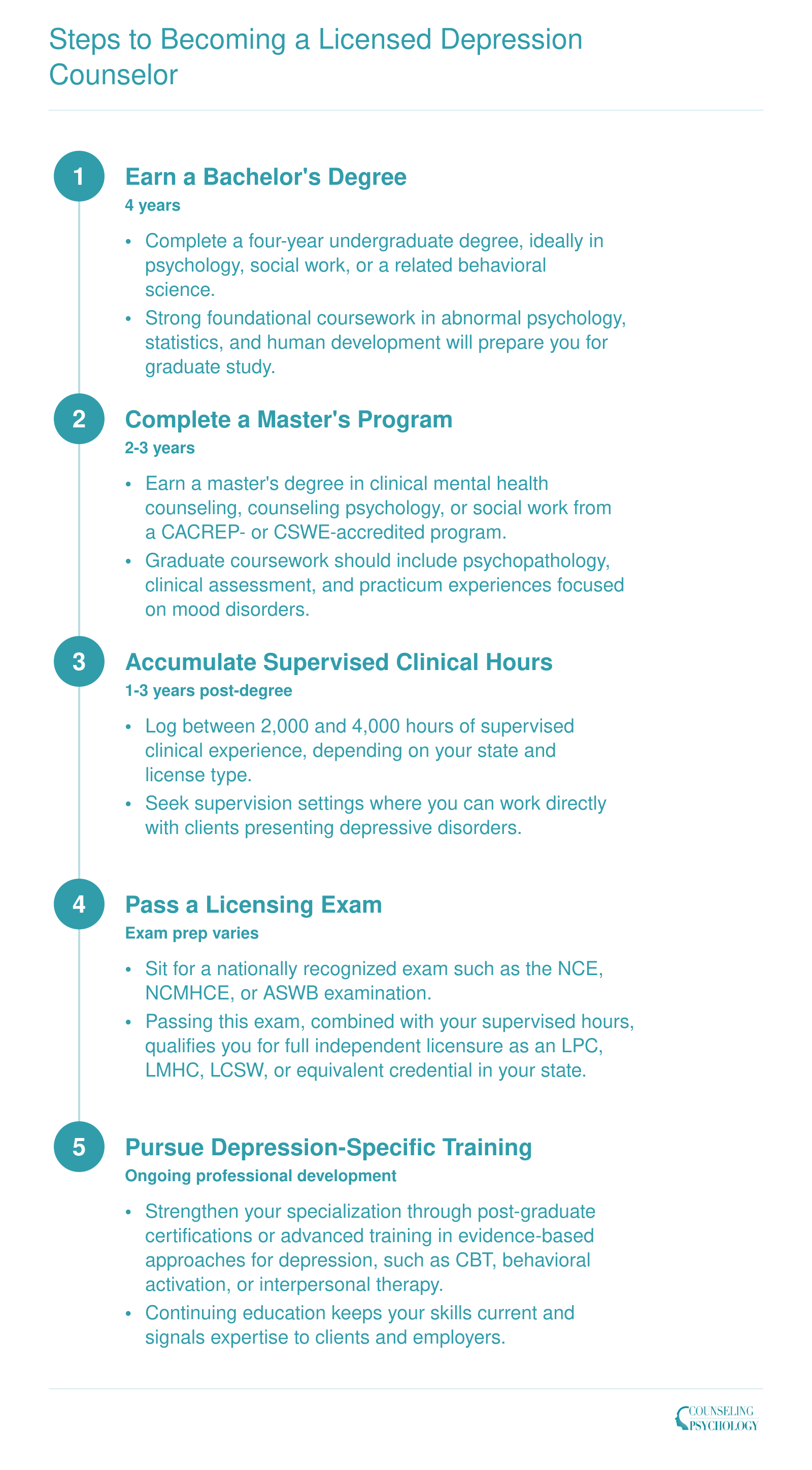
Steps to Becoming a Licensed Depression Counselor
From your first college course to full independent licensure, becoming a depression counselor is a multi-stage process that typically spans 7 to 10 years. The timeline below breaks down each milestone so you can plan ahead and stay on track.
Licensure and Certification for Depression Counselors
Which license do you need to diagnose and treat depression, and how long will it take to earn one?
The answer depends on your educational path and career goals. Three primary credentials authorize mental health professionals to work independently with clients experiencing depression: the Licensed Professional Counselor or Licensed Mental Health Counselor (LPC/LMHC), the Licensed Clinical Social Worker (LCSW), and the Licensed Psychologist. Each pathway has distinct requirements and scope considerations.1
Comparing the Three Main Licensure Pathways
The LPC/LMHC credential requires a master's degree in counseling or a related field. Candidates must complete between 1,000 and 3,000 hours of supervised clinical experience, depending on the state.1 The licensing exams are typically the National Counselor Examination (NCE) or the National Clinical Mental Health Counseling Examination (NCMHCE). LPC/LMHC holders can diagnose and treat depression and provide psychotherapy independently once fully licensed.
The LCSW credential requires a Master of Social Work (MSW) degree. Candidates must complete approximately 3,000 hours of supervised clinical practice and pass the Association of Social Work Boards (ASWB) Clinical exam.1 LCSWs can diagnose and treat depression while also providing case management and systems-level interventions that address social determinants affecting mental health.
Licensed Psychologists hold doctoral degrees (PhD or PsyD) and complete 3,000 to 4,000 hours of supervised experience. They must pass the Examination for Professional Practice in Psychology (EPPP).1 Psychologists can diagnose and treat depression, and they are uniquely qualified to conduct comprehensive psychological testing and assessment.
The Two-Year Rule for Independent Practice
Most states require two or more years of post-master's supervised clinical practice before granting full independent licensure. During this period, you work under the supervision of a fully licensed clinician while accumulating your required hours. Plan for this transitional phase when mapping out your career timeline. Some states allow provisional or associate-level practice during this window, which lets you begin seeing clients while completing supervision requirements.
Depression-Specific Certifications and Fellowships
Beyond core licensure, several credentials demonstrate specialized competence in treating mood disorders. The Beck Institute offers certification in Cognitive Behavioral Therapy, the gold-standard evidence-based approach for depression treatment. The National Board for Certified Counselors (NBCC) offers specialty credentials that can signal advanced training to employers. For psychologists, the American Psychological Association offers board certification in clinical psychology through the American Board of Professional Psychology, which recognizes advanced expertise.
Post-graduate fellowships focused on mood disorders provide intensive clinical training and can strengthen your candidacy for specialized roles in academic medical centers, research settings, or depression-focused clinics. These additional credentials are not required for practice but can distinguish you in competitive job markets and demonstrate commitment to evidence-based depression treatment.
Evidence-Based Therapies Used in Depression Counseling
Choosing which therapeutic approaches to master presents new depression counselors with a significant professional decision: invest deeply in one modality to become a specialist, or build competence across several evidence-based treatments to serve diverse client needs. Both pathways have merit, but understanding the core therapies and how to access quality training is essential regardless of which direction you pursue.
Therapies Recommended by Clinical Guidelines
The American Psychological Association's 2019 depression guideline1 and the National Institute for Health and Care Excellence's guideline (last reviewed in 2026)2 both emphasize shared decision-making between clinician and client, with several modalities earning strong empirical support.3
- Cognitive Behavioral Therapy (CBT): This structured, time-limited approach helps clients identify and restructure negative thought patterns contributing to depression. CBT has the largest evidence base of any psychotherapy for depression, with decades of randomized controlled trials demonstrating its effectiveness across age groups and severity levels.
- Behavioral Activation: Rather than focusing primarily on thoughts, behavioral activation targets the withdrawal and inactivity that maintain depressive episodes. Clients work with counselors to schedule meaningful activities and gradually reengage with their lives. Research shows it can be as effective as full CBT for many clients.
- Interpersonal Therapy (IPT): This approach addresses depression through the lens of relationships, focusing on grief, role transitions, interpersonal disputes, and social isolation. IPT typically runs 12 to 16 sessions and has particularly strong evidence for moderate to severe depression.
- Psychodynamic Therapy: Brief psychodynamic approaches explore how unconscious patterns and early relationships contribute to current depressive symptoms. While requiring more sessions than some alternatives, psychodynamic therapy shows solid outcomes in clinical trials.
- Brief Supportive Therapy: This approach emphasizes the therapeutic relationship itself, providing empathy, validation, and encouragement without the structured techniques of other modalities. It serves as an important comparison condition in research and works well for clients who prefer less directive treatment.
Emerging and Adjunctive Approaches
Several newer modalities complement the established treatments above. Acceptance and Commitment Therapy (ACT) helps clients develop psychological flexibility and pursue valued life directions despite depressive symptoms. Mindfulness-Based Cognitive Therapy (MBCT) combines meditation practices with cognitive techniques and has strong evidence specifically for preventing depression relapse. Collaborative care models integrate mental health counselors with primary care physicians and care managers, improving outcomes through coordinated treatment.
Accessing Quality Training
Post-graduate certification programs offer the most rigorous pathway to modality competence. The Beck Institute provides comprehensive CBT training with certification options, while the International Society of Interpersonal Psychotherapy (ISIPT) offers structured IPT training programs. Many counselors build skills through continuing education workshops at professional conferences, then deepen expertise through supervision with clinicians already trained in specific approaches.
Understanding these therapies is not optional knowledge for depression counselors. Most employers and insurance companies expect clinicians treating depression to use manualized, evidence-based protocols. Being able to articulate your therapeutic approach and cite its evidence base has become standard practice in hiring interviews and insurance credentialing applications.
Questions to Ask Yourself
Where Depression Counselors Work
Depression counselors provide mental health support across a range of settings, each with its own client populations, treatment modalities, and day-to-day rhythms. Where you choose to practice can shape everything from session lengths and paperwork demands to whether you work evenings or weekends.
Traditional Practice Settings
- Private practice: The most common venue for licensed professional counselors. Here you may operate solo or in a group, setting your own hours and building long-term therapeutic relationships with clients coping with depression.
- Hospitals and integrated care: These roles place you on interdisciplinary teams alongside psychiatrists, social workers, and medical staff, often treating patients whose depression co-occurs with chronic illness or acute medical issues.
- Community mental health centers: Serving largely underserved populations, these agencies typically offer sliding-scale fees and demand strong crisis-intervention skills. Counselors often manage higher caseloads and coordinate with case managers and housing services.
- Schools and colleges: From elementary through postsecondary, educational institutions employ counselors to address student depression, anxiety, and adjustment challenges, often in collaboration with parents, teachers, and academic advisors. If this path appeals to you, learn more about how to become a school counselor.
- Employee assistance programs (EAPs): Corporate contracts let you deliver short-term, solution-focused counseling to employees grappling with depression that affects work performance.
The Rise of Telehealth in Depression Counseling
Telehealth has reshaped access to depression care. Many counselors now conduct secure video sessions, reaching clients in rural or underserved areas who might otherwise go without treatment. For the latest telehealth adoption rates in mental health, the BLS Occupational Outlook Handbook and the CDC's National Center for Health Statistics publish regular data on service delivery and technology use. Professional groups such as the American Counseling Association and the National Board for Certified Counselors also issue telehealth policy briefs and state-by-state guides that clarify remote practice requirements.
Interstate Practice and the Counseling Compact
If you envision a telehealth career that crosses state lines, the Counseling Compact simplifies counseling licensure portability. Over 30 states have adopted compact legislation as of early 2026, paving the way for eligible counselors to practice in member states without holding multiple individual licenses. Because implementation is rolling out in phases, visit counselingcompact.org for current member states and timelines. Social workers should watch the ASWB for similar interstate agreements; for the latest, check aswb.org or your state board.
These developments give depression counselors flexibility to blend in-person and remote work, building careers that adapt to both client needs and personal lifestyle goals.
Depression Counselor Salary and Job Outlook
The Bureau of Labor Statistics (BLS) classifies depression counselors under the broader category of Substance Abuse, Behavioral Disorder, and Mental Health Counselors (SOC 21-1018). As of 2024, approximately 483,500 professionals were employed nationally in this field, and the BLS projects 17% job growth from 2024 to 2034, a rate it describes as much faster than average. Keep in mind that individual salaries vary considerably by license type, work setting, geographic location, and clinical specialization. The table below shows the 10 highest-paying states by median annual salary, along with total employment and the 25th to 75th percentile wage range in each.
| State | Total Employment | Median Salary | 25th Percentile | 75th Percentile | Mean Salary |
|---|---|---|---|---|---|
| Alaska | 1,060 | $79,220 | $63,690 | $96,940 | $88,870 |
| New Mexico | 2,070 | $70,770 | $55,060 | $80,840 | $71,010 |
| Oregon | 6,410 | $69,660 | $56,290 | $84,970 | $72,860 |
| North Dakota | 1,180 | $66,450 | $50,810 | $75,120 | $68,220 |
| District of Columbia | 980 | $66,140 | $47,980 | $83,040 | $71,200 |
| Utah | 4,720 | $65,920 | $42,210 | $94,630 | $71,890 |
| Idaho | 2,130 | $65,240 | $48,570 | $78,100 | $65,290 |
| New Jersey | 14,640 | $64,710 | $51,170 | $84,690 | $75,900 |
| Nebraska | 1,980 | $64,410 | $46,900 | $81,210 | $66,690 |
| Washington | 13,150 | $64,220 | $52,070 | $80,440 | $70,230 |
Highest-Paying Metro Areas for Mental Health Counselors
The table below ranks the ten highest-paying metropolitan areas for substance abuse, behavioral disorder, and mental health counselors by median annual salary, according to BLS data. Keep in mind that the metros topping this list, particularly San Francisco, Sacramento, and Portland, also carry some of the highest costs of living in the country, which can significantly offset the salary advantage. Metro areas anchored by large hospital systems, Veterans Affairs medical centers, or integrated behavioral health networks often concentrate more depression-focused positions, so exploring those regions may open additional clinical opportunities.
| Metro Area | Median Annual Salary | Total Employment |
|---|---|---|
| San Francisco, Oakland, Fremont (CA) | $72,950 | 8,080 |
| Portland, Vancouver, Hillsboro (OR, WA) | $71,530 | 3,640 |
| Sacramento, Roseville, Folsom (CA) | $69,510 | 3,570 |
| Seattle, Tacoma, Bellevue (WA) | $65,290 | 7,040 |
| New York, Newark, Jersey City (NY, NJ) | $64,900 | 23,790 |
| Houston, Pasadena, The Woodlands (TX) | $64,140 | 4,230 |
| Phoenix, Mesa, Chandler (AZ) | $63,990 | 6,830 |
| Washington, Arlington, Alexandria (DC, VA, MD, WV) | $63,170 | 7,590 |
| Chicago, Naperville, Elgin (IL, IN) | $61,150 | 14,010 |
| Riverside, San Bernardino, Ontario (CA) | $60,860 | 5,170 |
Can You Be a Therapist if You Have Depression?
Yes, having lived experience with depression does not disqualify you from becoming a therapist, and many highly effective clinicians bring personal mental health histories to their work. What matters is not whether you have experienced depression, but how you manage your mental health and maintain your capacity to serve clients ethically.
Ethical Considerations and Fitness to Practice
Every mental health professional has an ethical obligation to maintain fitness to practice. This means recognizing when personal symptoms might impair your clinical judgment and taking appropriate action. If you have a history of depression, you should:
- Engage in your own therapy: Many licensing boards and training programs expect or require that clinicians seek their own mental health care, both for personal growth and to model the process you ask clients to undertake.
- Develop self-awareness: Learn to recognize your early warning signs of depressive episodes and have a plan for managing them before they affect your work.
- Use supervision effectively: Even after full licensure, consulting with supervisors or peer consultation groups helps you process difficult cases and monitor your own wellbeing.
- Know when to step back: If symptoms become severe, ethical practice may require reducing your caseload, taking leave, or referring clients to colleagues temporarily.
Managing a Depression-Heavy Caseload
Specializing in depression counseling means regularly engaging with clients who are experiencing hopelessness, despair, and sometimes suicidal ideation. This work carries real risks of vicarious trauma, compassion fatigue, and burnout, particularly for clinicians who have their own vulnerability to depression.
Strategies for sustainability include maintaining a diversified caseload rather than seeing only clients with severe depression, scheduling breaks between intense sessions, and prioritizing self-care practices that you know support your mental health. Regular clinical supervision remains valuable throughout your career, not just during training, as it provides space to process the emotional weight of the work.
The Value of Lived Experience
Some clients find clinicians with lived experience more empathetic and credible. Research suggests that shared experience can enhance therapeutic alliance when handled appropriately. However, self-disclosure must be strategic, boundaried, and always in service of the client rather than your own needs. Deciding whether, when, and how much to share about your own history is a clinical decision that should be made thoughtfully, often in consultation with a supervisor, and never impulsively during a session.
Your personal history can be a source of genuine understanding and hope for clients, demonstrating that recovery is possible while maintaining the professional boundaries that keep the therapeutic relationship effective.
Becoming a depression counselor requires a master's degree, 2,000 to 4,000 supervised clinical hours, and a state license such as an LPC, LMHC, or LCSW. What truly sets you apart is specialized training in evidence-based approaches like CBT and IPT, so invest in that training early and keep building on it throughout your career.
Frequently Asked Questions About Depression Counseling Careers
Aspiring depression counselors often have practical questions about timelines, pay, and qualifications. Below are concise answers to the questions we hear most often, drawn from current licensure requirements and labor market data.
Required Skills and Qualities for Depression Counselors
Technical credentials open the door to this career, but the qualities you bring into the therapy room determine how much good you can do. Some counselors rely primarily on clinical knowledge; others lead with relational warmth. Effective depression counselors need both, woven together across every session.
Empathy and Active Listening
Research published through the National Institutes of Health consistently identifies empathy and active listening as foundational skills for mental health professionals.1 Building a strong therapeutic alliance, the sense of trust and collaboration between counselor and client, is one of the strongest predictors of positive outcomes in depression treatment. That alliance begins when clients feel genuinely heard. Active listening means more than staying quiet while someone speaks. It involves reflecting content, noticing tone, tracking patterns across sessions, and communicating that the client's experience matters.
Objectivity and a Non-Judgmental Stance
Depression often carries significant shame. Clients may disclose thoughts or behaviors they have never spoken aloud to anyone. A counselor who signals even subtle disapproval can shut down that disclosure immediately. Objectivity here does not mean emotional distance. It means holding a steady, validating presence regardless of what a client shares, so the person feels safe enough to do the hard work of recovery.
Assertiveness in the Therapeutic Process
Validation alone is not enough. Depression counselors also need the confidence to gently challenge cognitive distortions, avoidance behaviors, and self-defeating patterns. This requires a particular kind of assertiveness, one that is warm rather than confrontational, and collaborative rather than directive. Knowing when to push and when to simply hold space is a skill that develops with supervised experience and ongoing reflection.
Analytical and Assessment Skills
Accurate diagnosis and treatment planning demand careful thinking. A depression counselor must weigh symptom severity, rule out co-occurring conditions, choose among several evidence-based modalities, and adjust the approach as the client progresses or plateaus. This analytical work happens behind the scenes, but it shapes every decision made in the room.
Commitment to Ongoing Training
Evidence-based practice in depression treatment continues to evolve. Newer applications of cognitive behavioral therapy, advances in behavioral activation, and emerging research on trauma-informed care all require counselors to keep learning well beyond licensure. Professionals who invest in continuing education consistently deliver more responsive, effective care, and many licensing boards require it for good reason. Counselors working with overlapping presentations, such as grief or loss, may also benefit from exploring grief counseling certification pathways to broaden their clinical range.