
What you’ll learn in this article…
- Most states require a CACREP-accredited master's degree of 48 to 60 credit hours for LPC licensure.
- Post-degree supervised clinical hours range from roughly 2,000 to over 3,000 depending on your state.
- The national median annual wage for mental health counselors was $59,190 as of 2024 BLS data.
- Thirty-eight jurisdictions had joined the Counseling Compact by 2026, easing multistate practice.
The U.S. Bureau of Labor Statistics projects employment of mental health counselors to grow 19 percent between 2023 and 2033, far faster than the average for all occupations. The Licensed Professional Counselor (LPC) credential is the most common master's-level counseling license in the country, held by practitioners in every state.
Titles differ by jurisdiction. You'll see LPC in Texas and Georgia, LPCC in California and Ohio, and LMHC in New York and Florida, but the underlying path is broadly consistent: a 60-credit master's degree, 2,000 to 4,000 supervised clinical hours, and a national licensing exam.
The friction sits in the details. Credit requirements, supervision ratios, and exam choices vary enough between states that relocating mid-process can add a year or more to licensure.
What Is a Licensed Professional Counselor (LPC)?
A Licensed Professional Counselor is a master's-level mental health professional who is trained and legally authorized to assess, diagnose, and treat a wide range of emotional, behavioral, and mental health conditions. Once fully licensed, an LPC can work independently, without clinical supervision, providing services directly to individuals, couples, families, and groups.
Scope of Practice
LPCs are trained to deliver a broad set of clinical services. In practice, this typically includes:
- Individual therapy: Working one-on-one with clients to address issues such as depression, anxiety, trauma, grief, and relationship difficulties.
- Couples and family counseling: Facilitating sessions that address relational dynamics and communication patterns.
- Group therapy: Leading structured groups focused on shared challenges such as addiction recovery or grief support.
- Assessment and treatment planning: Conducting clinical interviews, using standardized tools to evaluate mental health status, and developing individualized treatment goals.
One important boundary: LPCs cannot prescribe medication in the vast majority of states. Medication management falls under the scope of psychiatrists, primary care physicians, and, in some states, specially certified psychiatric nurse practitioners. When a client needs pharmacological treatment, an LPC typically coordinates care by referring to or collaborating with a prescriber.
A State-Issued License, Not a National Certification
The LPC credential is granted by individual state licensing boards, not by a single national body. This is a practical distinction that matters a great deal. Because each state sets its own requirements for education, supervised hours, and examinations, the title itself varies from state to state. You may encounter Licensed Mental Health Counselor (LMHC) in New York and Florida, Licensed Professional Clinical Counselor (LPCC) in California and Ohio, or Licensed Clinical Professional Counselor (LCPC) in Illinois. All of these generally describe the same category of professional, even though the letters differ.
How LPCs Differ from Related Credentials
The counseling field includes several credentials that can look similar from the outside but reflect genuinely different training paths:
- Psychologist (PhD or PsyD): Doctoral-level training with a heavier emphasis on psychological testing, research, and assessment. Requires significantly more years of education than an LPC.
- Licensed Clinical Social Worker (LCSW): A master's-level credential, but rooted in a social work degree rather than a counseling or psychology program. LCSWs often emphasize connecting clients with community resources and systemic supports alongside clinical therapy.
- Psychiatrist (MD or DO): A medical doctor who specializes in mental health. Psychiatrists can prescribe medication and typically focus more on diagnosis and pharmacological treatment than on ongoing talk therapy.
Understanding where the LPC sits among these credentials helps you choose the educational path that fits both your interests and your intended scope of practice. For a broader look at the options available, explore careers in counseling before committing to a specific route. Those drawn to doctoral-level work may also want to learn how to become a clinical psychologist to compare timelines and training demands.
LPC Vs. LPCC Vs. LMHC: Understanding Counselor License Titles by State
One of the most confusing realities in professional counseling is that the same credential goes by a different name depending on where you practice. The United States has no single national license for professional counselors, so each state sets its own title, abbreviation, and requirements.1 If you plan to practice across state lines or relocate after licensure, knowing these distinctions upfront can save you significant time and paperwork.
The Most Common License Titles
Three abbreviations cover the majority of states, though the full list of variations is longer than most students expect. For a broader overview of counseling licensure acronyms, it helps to see all the abbreviations in one place.
- LPC (Licensed Professional Counselor): Used in Alabama, Texas, and the District of Columbia, among others. It is the most historically common title and serves as the baseline most people picture when they hear "licensed counselor."
- LMHC (Licensed Mental Health Counselor): The title in Florida, Indiana, Massachusetts, New York, and Washington. States using LMHC often frame the credential explicitly around mental health practice, though the scope of practice is broadly comparable to an LPC.
- LPCC (Licensed Professional Clinical Counselor): California, Minnesota, Ohio, and Kentucky use this designation. California's version carries a notably higher supervised hours requirement: 3,000 hours completed over a minimum of 104 weeks, which is more demanding than many other states.2
State-Specific Variations Worth Knowing
Beyond those three, a handful of states have carved out their own distinct titles:
- LCPC (Licensed Clinical Professional Counselor): Used in Illinois, Maine, and Nevada. Illinois operates a two-tier system, meaning candidates move through a lower-level license before qualifying for the full LCPC.
- LCMHC (Licensed Clinical Mental Health Counselor): North Carolina and New Hampshire use this title, blending the "clinical" and "mental health" language from other traditions.
- LPC-MHSP: Tennessee's unique designation stands for Licensed Professional Counselor with Mental Health Service Provider endorsement, reflecting the state's additional specialty layer.
- LPCMH: Delaware's title, which stands for Licensed Professional Counselor of Mental Health.
- LPC-MH: South Dakota's variation on the standard LPC credential.
- LIMHP-CPC / LPC: Nebraska uses both designations depending on practice setting and scope.
Why Requirements Differ Even When Titles Look Similar
A shared abbreviation does not guarantee identical requirements. Florida, for example, began requiring graduates to hold degrees from CACREP-accredited programs starting in 2025, a standard that not every state has adopted.1 Supervised hours requirements range from roughly 2,000 to 4,000 hours nationally, and some states specify how those hours must be distributed across direct client contact, supervision sessions, and administrative work.
Before you choose a graduate program, confirm which license title your target state uses and check that program's accreditation status against that state's specific requirements. The scope differences between these titles can also shape the kind of work you do day to day, whether that involves community mental health counselor roles or private practice.
Questions to Ask Yourself
Step 1: Earn a Master's Degree in Counseling
Every state in the U.S. requires aspiring Licensed Professional Counselors to hold a master's degree in counseling or a closely related field. The typical program comprises 48 to 60 semester credit hours, though exact requirements vary by state. Most jurisdictions mandate at least 60 credits, aligning with the preparation standards set by the Council for Accreditation of Counseling and Related Educational Programs (CACREP).1 Understanding degree requirements, accreditation, and program structures is essential before you enroll.
Acceptable Degree Titles and Specializations
States generally accept a Master of Arts (M.A.) or Master of Science (M.S.) in Clinical Mental Health Counseling, Counseling Psychology, or related counseling specializations. Some states also recognize degrees in School Counseling, Rehabilitation Counseling, or Marriage and Family Therapy, provided the curriculum includes the necessary clinical coursework. If your degree title does not explicitly state "counseling," check with your target state's licensing board early. A few states permit candidates with related degrees to qualify by completing additional coursework in core counseling competencies such as diagnosis, ethics, and techniques.
Is CACREP Accreditation Required to Become an LPC?
CACREP accreditation is not universally required, but it is increasingly important. As of 2026, four states mandate a CACREP-accredited degree for LPC licensure: Florida (effective July 1, 2025)2, Kentucky, North Carolina, and Ohio.1 Many other states prefer CACREP credentials or grant streamlined pathways, such as reduced supervision hours or reciprocity agreements, to graduates of CACREP programs. CACREP accreditation also enhances portability if you plan to move or seek licensure in multiple states. The organization's 2024 standards, implemented in October 2025, govern the approximately 1,000 accredited programs nationwide and ensure consistency in curriculum, clinical training, and faculty qualifications.3
Program Length and Accelerated Options
Most CACREP-accredited master's programs are designed to be completed in two years of full-time study, typically requiring 60 credit hours. Some institutions offer accelerated formats that condense coursework into 18 to 21 months through year-round enrollment, intensive summer terms, or hybrid delivery. While these accelerated tracks can speed your path to supervised practice, they demand a rigorous schedule and may limit opportunities for elective coursework or part-time employment. Weigh your capacity for intensity against the benefit of entering the workforce sooner.
Choosing the Right Program
When evaluating programs, confirm that the curriculum meets your state's specific credit-hour and content requirements. Verify CACREP accreditation status on the official CACREP website, and ask admissions offices about clinical placement support, pass rates on the National Counselor Examination, and alumni licensure outcomes. The quality of your master's program directly shapes your readiness for supervised practice and the licensing exam. If you are still exploring the broader landscape, our guide on how to become a counselor outlines every major step from start to finish.
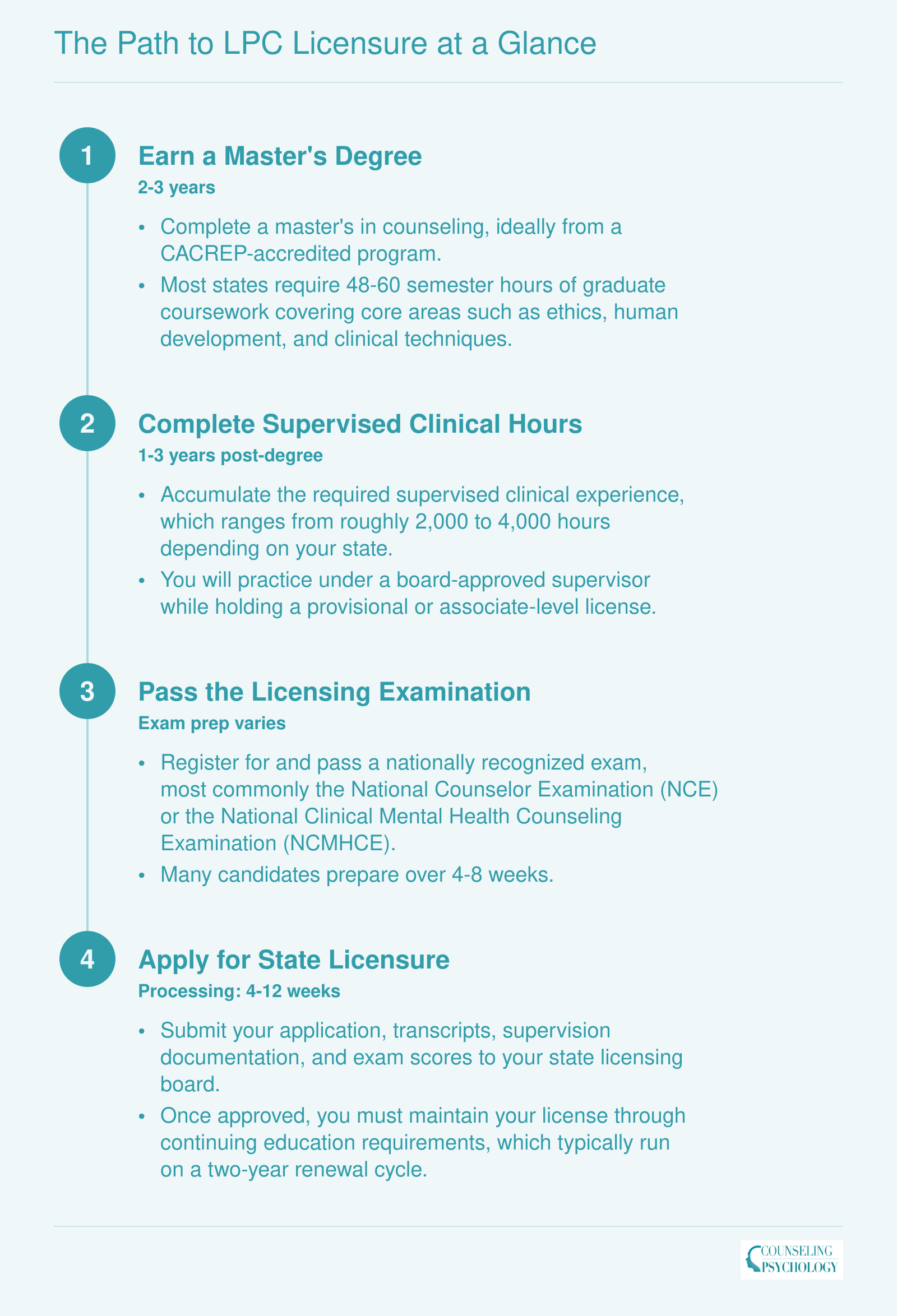
The Path to LPC Licensure at a Glance
Becoming a licensed professional counselor requires a structured sequence of education, supervised practice, examination, and state approval. The total timeline from bachelor's degree completion to full LPC licensure typically spans 4-6 years, depending on your state's requirements and whether you pursue supervised hours on a full-time or part-time basis.
Step 2: Complete Supervised Clinical Experience
Supervised clinical experience forms the bridge between classroom theory and independent practice, and this phase typically represents the longest portion of your journey to LPC licensure. Understanding the distinction between in-program clinical hours and post-graduate supervision requirements helps you plan realistically and avoid surprises.
In-Program Clinical Hours: Practicum and Internship
Your master's program includes structured clinical training through practicum and internship courses. Most CACREP-accredited programs require between 600 and 1,000 hours of supervised clinical work before you graduate. During practicum, you begin seeing clients under close faculty supervision, typically accumulating 100 hours of direct client contact. Internship follows with a more intensive caseload, often requiring 600 or more hours at an approved site. These in-program hours give you foundational skills but represent only the first phase of your supervised experience.
Post-Graduate Supervised Hours: The Provisional License Phase
After earning your degree, most states require substantial additional supervised experience before granting full licensure. This is where requirements vary dramatically across jurisdictions. The typical range falls between 2,000 and 4,000 hours of combined direct and indirect client contact, with 3,000 hours being the most common requirement nationally.1
To accumulate these hours legally while working with clients, you will apply for an associate or provisional license. Different states use different titles for this credential:
- LPC-A (Licensed Professional Counselor-Associate): Used in Texas and several other states
- PLPC (Provisionally Licensed Professional Counselor): Common in Louisiana and Missouri
- LAC (Licensed Associate Counselor): Used in New Jersey and other jurisdictions
- LPCC-S or similar designations: Vary by state
This provisional credential allows you to practice counseling under the oversight of an approved supervisor while building the hours needed for full licensure. If you are comparing this process to other therapy disciplines, the LMFT supervision hours requirements follow a similar structure but differ in specific totals.
How Many Supervised Hours Do You Need for LPC Licensure?
State requirements range from approximately 1,500 hours to 4,500 hours of post-graduate supervised experience.1 Florida sits at the lower end with 1,500 hours required2, while Colorado requires 2,000 hours. On the higher end, New Jersey mandates 4,500 hours, and Kansas and Kentucky each require 4,000 hours.1 States like Arizona, Delaware, and Illinois fall in the middle range with requirements between 3,200 and 3,360 hours.
If completing your licensure quickly is a priority, states with lower hour requirements offer a faster path. At 20 hours per week of qualifying clinical work, meeting a 2,000-hour requirement takes roughly two years, while a 4,000-hour requirement extends closer to four years.
Supervisor Qualifications and Verification
Your supervision must come from an approved professional, typically a fully licensed LPC, LPCC, or other mental health clinician who holds supervisory credentials in your state. Some states require supervisors to complete specific training or hold a supervision endorsement before overseeing provisional licensees. Before beginning your post-graduate hours, verify with your state licensing board exactly which professionals qualify as approved supervisors, what documentation you need to maintain, and how frequently supervision sessions must occur. Proper documentation from the start prevents the frustrating discovery that some of your hours do not count toward licensure.
Step 3: Pass the Licensing Examination
The counseling licensure landscape is steadily shifting toward competency-based assessments that mirror real clinical decision-making. As states refine their requirements, candidates must choose between two nationally recognized exams: the National Counselor Examination (NCE) and the National Clinical Mental Health Counseling Examination (NCMHCE). Both are developed and administered by the National Board for Certified Counselors (NBCC) and represent the final academic hurdle before supervised practice and full licensure.1
The Two Primary Exams: NCE and NCMHCE
The NCE is a broad, generalist exam comprising 200 multiple-choice questions.1 It assesses knowledge across eight core counseling areas, including human development, ethical practice, and career counseling. With a first-time pass rate typically between 70% and 80%, the NCE emphasizes foundational competencies expected of all counselors.2
The NCMHCE, by contrast, is a clinical simulation exam containing 130 to 150 case-based multiple-choice questions.1 Candidates work through vignettes that require diagnostic and treatment planning decisions, making it a more applied test of clinical judgment. The pass rate generally falls between 60% and 75%, reflecting its emphasis on real-world clinical reasoning over factual recall.2
Which Exam Does Your State Require?
State requirements vary significantly. The NCE is accepted by the majority of state boards as the standard examination for Licensed Professional Counselor (LPC) licensure. The NCMHCE is increasingly required or accepted for clinical mental health counselor credentials, particularly in states that distinguish between general and clinical practice. A handful of jurisdictions allow candidates to choose either exam, while others mandate a specific test based on the intended scope of practice. Always verify current exam requirements with your state's licensing board, as policies can change. For a broader overview of the counseling licensure process, review your state's specific board guidelines.
What to Expect on Test Day
Both exams are computer-based and offered at Pearson VUE testing centers throughout the year. The NCE is a four-hour session with straightforward multiple-choice questions. The NCMHCE allows slightly more time due to its case-study format. Scores are typically available immediately upon completion, and passing the exam is a prerequisite for most state licensure applications. Candidates who do not pass may retake the exam after waiting periods set by their state board, usually one to three months.
The fastest realistic path to full LPC licensure takes about four years post-bachelor's: enroll in a CACREP-accredited 60-credit master's program (two years), choose a state requiring approximately 2,000 supervised hours instead of 3,000 or more, take the NCE during your final semester if your state permits it, and begin accruing supervised clinical hours immediately after graduation. Strategic planning of your program, exam timing, and post-degree supervision can compress the timeline from degree to license.
Step 4: Apply for State Licensure and Maintain Your License
The most significant structural change for LPC licensure in recent years is the growing adoption of the Counseling Compact, which now includes 38 jurisdictions as of 2026, reshaping how counselors practice across state lines.1
The State Application Process
After completing your master's degree, supervised experience, and passing the required examination, you submit a full application to your state licensing board. While requirements vary, most states request official transcripts from your graduate program, verification of supervised clinical hours on board-specific forms signed by your supervisors, and your exam score report. A criminal background check, usually involving fingerprinting, is mandatory. Some states also require a jurisprudence exam covering state-specific laws and ethical standards. Application fees typically range from $100 to $300. Processing times can take several weeks, so plan ahead if you need your license by a certain date.
License Renewal and Continuing Education
Licenses are not permanent. Most states operate on a biennial renewal cycle, meaning you must renew every two years.2 To qualify, you will need to complete continuing education (CE) hours, commonly 20 to 40 hours per period. Required topics often include ethics, suicide prevention, and cultural competency, though each board sets its own mandates.2 For example, some states require training in telehealth, domestic violence, or substance abuse. CE can be earned through workshops, online courses, and professional conferences, but verify that the provider is approved by your board. Renewal fees generally range from $100 to $250. Retain your CE certificates; many boards audit a percentage of licensees each cycle.
Licensure Portability and the Counseling Compact
Portability has long been a challenge for LPCs. The Counseling Compact, now with 38 member jurisdictions including 37 states as of 2026, is a landmark solution.1 It allows LPCs who are licensed and reside in a member state to obtain a privilege to practice in other member states without undergoing full licensure. As of now, Arizona, Minnesota, Ohio, and Louisiana have fully implemented the compact and are issuing privileges.1 To qualify, your home license must be active and in good standing, and you must maintain residency in your home state.2 The initial privilege fee is $55, with renewal at $55 per cycle, tied to your home license expiration.2 For states not yet in the compact, traditional endorsement or reciprocity processes apply, which may require additional verification and fees.
Telehealth and Cross-State Practice
The compact significantly benefits telehealth providers. Once granted a practice privilege in another member state, you can deliver remote counseling services to clients in that state without holding its license.2 This streamlines multistate virtual practice and reduces administrative hurdles. However, the privilege only authorizes distance practice; to physically relocate to another state, you would still need to obtain a full license there. It is also important to confirm that your professional liability insurance covers interstate telehealth. For clients in non-compact states, research whether that state offers a temporary telehealth registration or out-of-state practice allowance, as regulations vary.
Licensed Professional Counselor Salary and Job Outlook
Licensed professional counselors fall under the Bureau of Labor Statistics category of Substance Abuse, Behavioral Disorder, and Mental Health Counselors (SOC 21-1018). As of 2024, the national median annual wage for this group was $59,190, and employment is projected to grow 17 percent from 2024 to 2034, a rate characterized as much faster than average. With roughly 48,300 openings projected each year over that decade, demand for licensed counselors remains strong across settings.
| Metric | National Figure (2024) |
|---|---|
| Total Employment | 440,380 |
| Median Annual Wage | $59,190 |
| Mean Annual Wage | $65,100 |
| 25th Percentile Annual Wage | $47,170 |
| 75th Percentile Annual Wage | $76,230 |
| Projected Job Growth (2024 to 2034) | 17% (much faster than average) |
| Estimated Annual Openings (2024 to 2034) | 48,300 |
Highest-Paying States for Mental Health Counselors
Geographic location plays a significant role in how much licensed professional counselors earn. The table below ranks the ten highest-paying states (and the District of Columbia) by median annual wage for substance abuse, behavioral disorder, and mental health counselors, according to BLS data. Keep in mind that higher wages in some states often reflect a higher cost of living, so it is worth weighing salary against local expenses when choosing where to practice.
| State | Median Annual Wage | 25th Percentile Wage | 75th Percentile Wage | Total Employment |
|---|---|---|---|---|
| Alaska | $79,220 | $63,690 | $96,940 | 1,060 |
| New Mexico | $70,770 | $55,060 | $80,840 | 2,070 |
| Oregon | $69,660 | $56,290 | $84,970 | 6,410 |
| North Dakota | $66,450 | $50,810 | $75,120 | 1,180 |
| District of Columbia | $66,140 | $47,980 | $83,040 | 980 |
| Utah | $65,920 | $42,210 | $94,630 | 4,720 |
| Idaho | $65,240 | $48,570 | $78,100 | 2,130 |
| New Jersey | $64,710 | $51,170 | $84,690 | 14,640 |
| Nebraska | $64,410 | $46,900 | $81,210 | 1,980 |
| Washington | $64,220 | $52,070 | $80,440 | 13,150 |
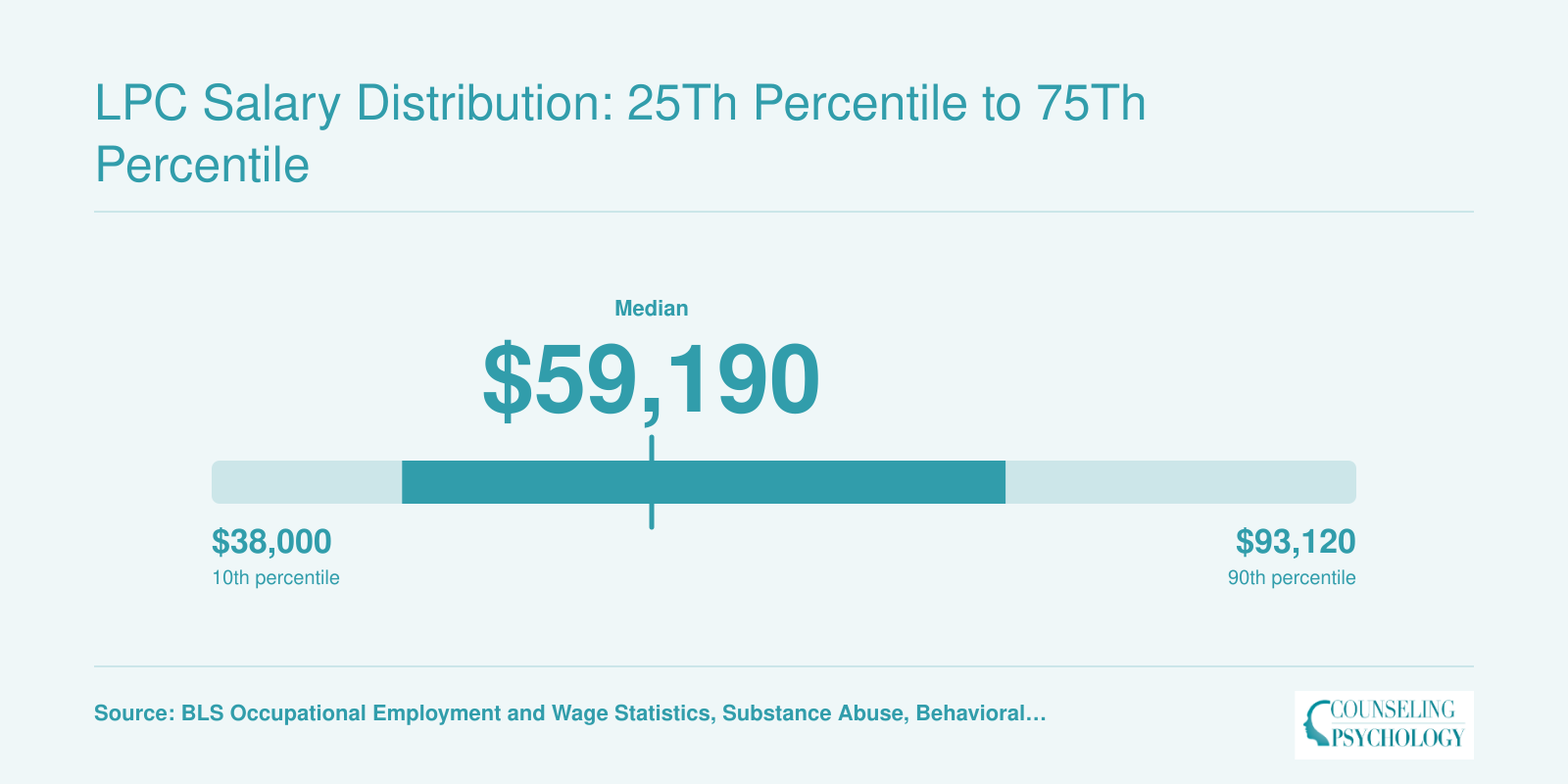
LPC Salary Distribution: 25Th Percentile to 75Th Percentile
The national salary range for substance abuse, behavioral disorder, and mental health counselors illustrates a meaningful spread from early-career to experienced professionals. Licensed professional counselors just entering the field tend to fall closer to the 25th percentile, while those who hold advanced credentials such as LPCC status, pursue specializations, or build a private practice often earn at or above the 75th percentile.
Career Paths and Work Settings for LPCs
Choosing where you practice shapes everything from your daily routine to your long-term earning potential. The autonomy of private practice isn't for everyone, and the structure of agency work offers its own rewards. Licensed professional counselors work across a wide spectrum of settings, each with distinct client populations, reimbursement models, and professional cultures.
Common Work Settings
- Private practice: Many LPCs eventually open solo or group practices, which offer schedule control and higher earning potential but require business skills and time to build a caseload.
- Community mental health centers: These agencies provide vital safety-net services and expose counselors to severe, chronic conditions; pay is often lower, but supervision and loan repayment programs are common.
- Hospitals and integrated health systems: Inpatient psychiatric units, emergency departments, and medical floors employ LPCs for crisis intervention, assessment, and brief therapy.
- Schools and universities: K-12 schools and college counseling centers need LPCs to address academic, social-emotional, and career concerns, often with benefits that align with the academic calendar.
- Substance abuse treatment facilities: Residential and outpatient programs rely on LPCs for individual and group therapy, often using evidence-based modalities like motivational interviewing and cognitive behavioral therapy.
- Employee assistance programs (EAPs): Corporate-funded EAPs offer short-term, solution-focused counseling to employees, typically delivered over the phone or via telehealth.
- Telehealth platforms: Since the expansion of virtual care, many LPCs work remotely for digital health companies, providing flexible access to clients across state lines (where licensure compacts permit).
Scope of Practice: What LPCs Can Treat
LPCs are trained to diagnose and treat a broad range of mental health conditions. Common presenting concerns include depression, anxiety disorders, post-traumatic stress disorder (PTSD), substance use disorders, complicated grief, relationship conflict, and behavioral disorders in children and adolescents. Many counselors also support clients through life transitions, career indecision, and identity exploration. It is important to note that exact scope of practice is defined by each state's licensing board, and some states restrict certain diagnoses (e.g., bipolar disorder) or require additional training for specific modalities. Always check your state's regulations.
Specializations That Boost Your Career
Pursuing a specialization can deepen your expertise, attract a focused client base, and increase earning potential. Common pathways include:
- Trauma-focused therapy: Training in eye movement desensitization and reprocessing (EMDR) or prolonged exposure therapy certifies you to work with PTSD populations.
- Substance abuse counseling: Adding a credential like the Licensed Clinical Addictions Specialist (LCAS) or Master Addiction Counselor (MAC) opens doors to higher reimbursement rates in specialty clinics.
- Child and adolescent therapy: Additional coursework in play therapy or family systems allows you to work in schools, foster care agencies, or pediatric medical settings. Those drawn to younger populations may want to explore how to become a child counselor for a closer look at degree and certification requirements.
- Marriage and family therapy: While it may require a separate license in some states, integrating family systems training lets LPCs treat couples and families more effectively. If this path interests you, review the steps to become a couples counselor.
- Career counseling: Specializing in assessments, vocational guidance, and executive coaching can lead to roles in university career centers or private consulting.
The LPCC Pathway to Supervision and Expanded Scope
In many states, LPCs can pursue an additional credential, often called Licensed Professional Clinical Counselor (LPCC), after completing extra post-licensure supervised hours. This designation allows you to independently diagnose and treat more complex conditions, and it is often required to supervise provisionally licensed counselors. Earning the LPCC strengthens your professional standing and can make you eligible for insurance panel credentialing that otherwise excludes standard LPCs.
Frequently Asked Questions About Becoming an LPC
Aspiring counselors often have practical questions about the steps, timeline, and credentials involved in becoming a licensed professional counselor. Below are answers to some of the most common questions, drawn from current licensing standards and industry practice as of 2026.