
Key Takeaways
- Most states require a CACREP-accredited master's degree plus 2,000 to 4,000 hours of supervised experience for licensure.
- BLS projects 4% job growth for career counselors from 2024 to 2034, adding roughly 13,300 new positions.
- The full path from bachelor's degree through licensure typically takes 7 to 9 years.
- Unlike career coaches, licensed career counselors hold a regulated scope of practice that includes clinical mental health services.
Career counseling sits at an unusual intersection right now: rising layoffs in tech and federal agencies, AI-driven shifts in entry-level hiring, and a growing demand for credentialed guidance on what to do next.
The work spans a wide territory. One day might involve helping a sophomore choose between psychology and nursing; the next, coaching a 50-year-old engineer through a forced career pivot, or supporting a recent immigrant in translating foreign credentials.
The path into the field is long and regulated. Plan on six to eight years total: a bachelor's degree, a CACREP-accredited master's in counseling, 2,000 to 4,000 supervised clinical hours, and state licensure. The credential floor is high, which is exactly what separates licensed counselors from the unregulated coaching market.
What Does a Career Counselor Do?
Career counselors occupy a distinct professional niche: they combine clinical counseling skills with deep knowledge of labor markets, occupational trends, and vocational psychology to help people navigate some of life's most consequential decisions. The role goes well beyond handing someone a list of job openings. It requires the ability to assess a client's interests, values, and aptitudes, then translate that data into a concrete, actionable plan.
Day-to-Day Responsibilities
On any given day, a career counselor might move through a surprisingly wide range of tasks:
- Administering assessments: Tools like the Strong Interest Inventory, the Myers-Briggs Type Indicator, and Holland Code-based instruments help clients identify career paths that align with their personalities and strengths.
- Resume and job-search strategy: Counselors review resumes, craft targeted application strategies, and coach clients on personal branding for specific industries.
- Mock interviews: Practicing behavioral and situational interview questions in a structured setting helps clients build confidence and refine their self-presentation.
- Labor-market guidance: Pulling current wage data, projected growth rates, and regional hiring trends allows counselors to ground a client's aspirations in real-world conditions.
- Connecting clients to resources: This includes referrals to workforce development programs, apprenticeship pipelines, tuition assistance, and professional networking groups.
Where Career Counselors Work
The setting shapes the work. In K-12 schools, career counselors help adolescents explore postsecondary pathways and align coursework with emerging interests. To get a closer look at what that environment involves, see our overview of a day in the life of a school counselor. College career centers tend to focus on internships, graduate school preparation, and entry-level placement. Workforce development agencies serve adults who are unemployed or underemployed, often coordinating with government-funded training programs. Private practice offers the most autonomy, while corporate outplacement firms specialize in supporting employees through layoffs or organizational restructuring.
The Clinical Side of Career Work
Career counseling is not purely transactional. Clients frequently present with anxiety related to job loss, identity crises tied to career transitions, or depression stemming from prolonged unemployment. Licensed career counselors are trained to recognize and address these mental health dimensions, which separates the work from coaching-only approaches. A counselor might spend part of a session processing a client's grief after a layoff before pivoting to goal-setting and networking strategy.
This blend of clinical skill and practical career guidance is what defines the profession and, as we will explore in the next section, what distinguishes it from career coaching.
Career Counselor vs. Career Coach: Key Differences
Licensed counselor versus unregulated coach: the difference sounds subtle, but it carries real consequences for your education path, your legal scope of practice, and the clients you are allowed to serve.1
Education and Licensure
Becoming a career counselor requires a master's degree in counseling or a closely related field, followed by supervised clinical hours and a state licensing exam. The title itself is protected in most states, meaning only individuals who meet those requirements can legally use it. Oversight comes from a state licensing board, and practicing without a license can result in serious legal penalties.
Career coaching has no equivalent gatekeeping. There is no minimum degree requirement, no mandatory supervised hours, and no licensing exam. Anyone can call themselves a career coach regardless of their background. The only accountability mechanism is general consumer protection law, which addresses fraud but does not regulate professional standards.
Scope of Practice
The most consequential distinction is what each role can actually do with a client. A licensed career counselor can address mental health concerns that intersect with career challenges, such as anxiety around job transitions, grief after a layoff, or identity issues tied to work. That clinical scope is built into the license.
A career coach cannot address mental health. When a coaching client's concerns cross into psychological territory, the ethical and legal obligation is to refer that person to a licensed professional. Coaches who attempt to provide mental health support risk harming clients and exposing themselves to legal liability. If you are weighing the counselor credential against other licensed roles, our comparison of a Licensed Professional Counselor (LPC) vs. Licensed Clinical Social Worker (LCSW) may also be useful.
Credentialing Bodies
The two fields also organize around different professional bodies. Career counselors look to the National Career Development Association (NCDA), which offers credentials and ethical standards aligned with the broader counseling profession and the American Counseling Association. Career coaches more commonly pursue credentials through the International Coaching Federation (ICF), a separate organization with its own competency framework.
Which Path Fits Your Goals?
If you want to work in schools, mental health agencies, college career centers, or any setting where clients may present complex psychological needs alongside career questions, the licensed counselor path is the appropriate route. A counseling degree also opens doors to specializations you might not expect; explore careers you could get with a counseling degree for a broader view. If your interest is purely in professional strategy, resume coaching, or corporate talent development, coaching credentials may suffice. The section that follows can help you think through that choice more concretely.
Questions to Ask Yourself
Step 1: Earn a Bachelor's Degree
The good news about your undergraduate path is that flexibility outweighs rigidity: no single major is required to enter a career counseling graduate program. The tradeoff is that this openness demands intentional course selection and early experience building if you want a competitive application.
Recommended Undergraduate Majors
While admissions committees welcome applicants from diverse academic backgrounds, certain disciplines provide stronger conceptual foundations for graduate-level counseling study:
- Psychology: Offers direct exposure to human behavior, research methods, and therapeutic theory. Students who enjoy this track may also explore paths like how to become a clinical psychologist.
- Education: Builds understanding of learning processes and developmental stages across the lifespan.
- Sociology: Provides context for how social systems, institutions, and inequality shape career trajectories.
- Human Development: Focuses specifically on growth across life stages, a core competency for career counselors working with diverse age groups.
Other viable paths include social work, communications, or business with a human resources emphasis. What matters most is how you supplement your major with targeted coursework.
Coursework That Strengthens Graduate Applications
Graduate programs look for evidence that you can handle clinical concepts and research demands. Prioritize courses in abnormal psychology, statistics or research methods, human development across the lifespan, and introduction to counseling or helping skills. If your institution offers career development theory or vocational psychology electives, take them. These courses signal genuine interest and reduce your learning curve in graduate school.
Building Applied Experience Early
Graduate admissions committees increasingly value hands-on exposure to helping roles. Seek opportunities as a peer advisor, career center intern, or residence life staff member. Volunteering with crisis hotlines, tutoring programs, or community mental health organizations demonstrates commitment beyond the classroom. Even 100 to 200 hours of applied experience can distinguish your application from candidates with identical GPAs. If school-based advising appeals to you, learning how to become a school counselor can help you understand that adjacent career path early on.
Timeline Considerations
A bachelor's degree typically requires four years of full-time study. This undergraduate phase represents roughly half of the six- to eight-year total timeline to become a licensed career counselor. Use this period strategically: the relationships you build with faculty become recommendation letters, and the experiences you accumulate become interview talking points. Treating your bachelor's as active preparation rather than a prerequisite to check off positions you well for the rigorous graduate training ahead.
Step 2: Complete a Master's in Counseling (CACREP Accreditation Matters)
What kind of graduate program do you need to become a licensed career counselor? Every U.S. state requires a master's degree in counseling or a closely related field for professional licensure, and that degree must meet specific standards recognized by state boards. The Council for Accreditation of Counseling and Related Educational Programs (CACREP) sets those standards and accredits programs nationwide.1 Understanding CACREP accreditation is essential before you choose a program.
What Is CACREP Accreditation?
CACREP is the specialized accrediting body for counseling education programs in the United States.1 As of 2024, CACREP has accredited 949 counseling programs at 458 institutions nationwide.2 CACREP-accredited master's programs require at least 60 semester credits and follow a standardized curriculum covering eight core areas: professional counseling orientation and ethical practice, social and cultural diversity, human growth and development, career development, counseling and helping relationships, group counseling and group work, assessment and testing, and research and program evaluation.3
The 2024 CACREP standards also mandate supervised clinical training: 100 hours of practicum (including at least 40 direct client contact hours) and 600 hours of internship (with at least 240 direct hours).3 These requirements ensure that every graduate receives consistent, rigorous preparation for clinical practice.
Why CACREP Accreditation Matters for Licensure
Many states require or strongly prefer CACREP-accredited degrees for licensure as a professional counselor. Some state boards will accept non-CACREP programs if they meet equivalent standards, but proving equivalency often requires additional documentation and review. More importantly, CACREP accreditation makes your credential portable: if you move to another state, licensing boards recognize the degree's rigor and you face fewer administrative hurdles.
The National Board for Certified Counselors (NBCC), which issues the widely recognized National Certified Counselor credential, also requires graduation from a CACREP-accredited program or completion of specific coursework that mirrors CACREP standards.
Finding and Choosing a CACREP-Accredited Program
The CACREP directory lists every accredited program by state, institution, and specialty track. Not all CACREP programs offer a dedicated career counseling track, but most clinical mental health counseling or school counseling programs include career development coursework that prepares you for career-focused roles.
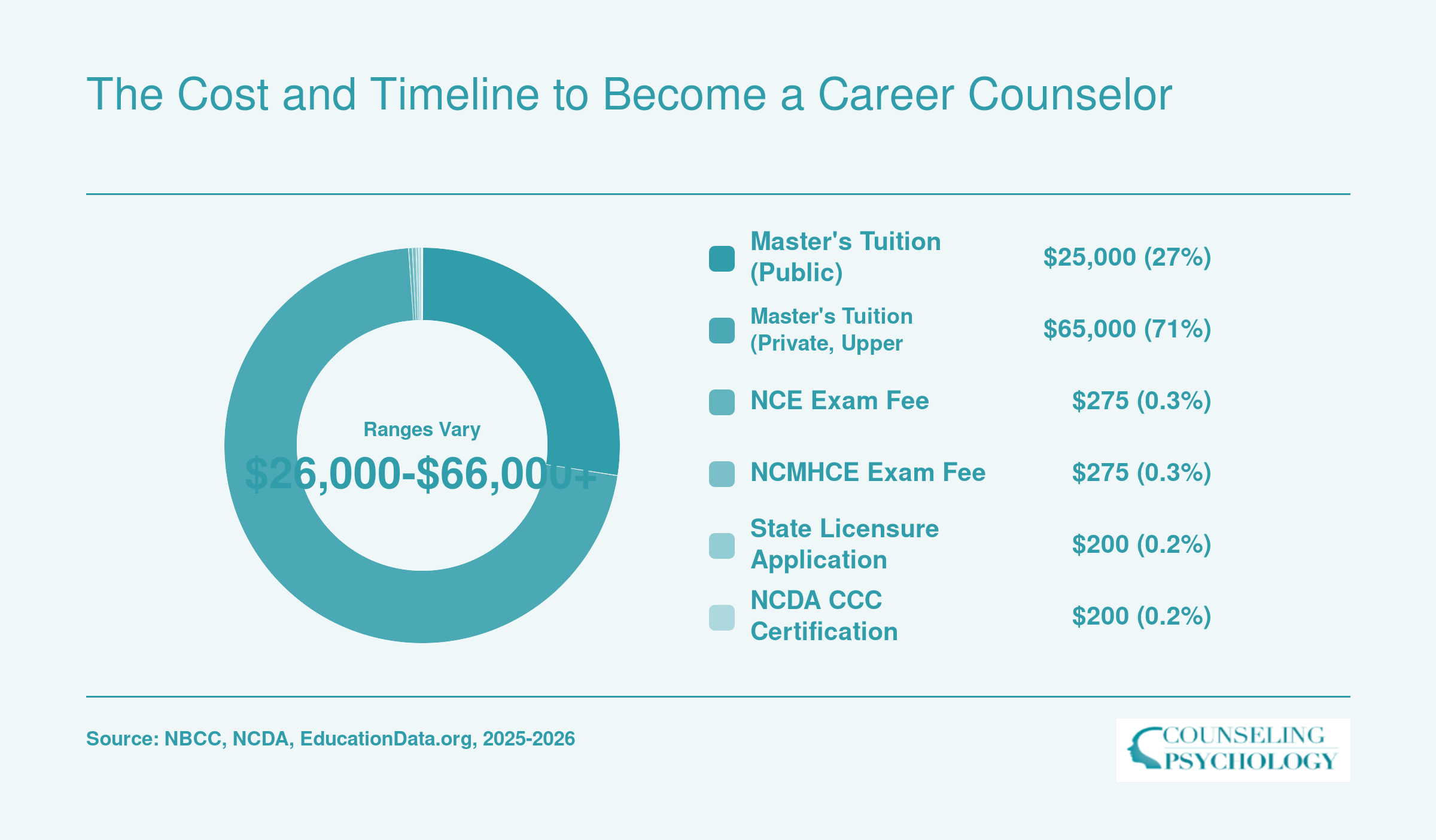
Typical CACREP master's programs run 48 to 60 credit hours and take two to three years of full-time study. Tuition varies widely: public universities generally charge between $400 and $800 per credit hour (total program cost of $24,000 to $50,000), while private institutions range from $700 to $1,200 per credit ($40,000 to $80,000 total).
Programs for Career Changers and Working Adults
Many CACREP programs welcome mid-career students from non-counseling backgrounds. Admissions committees look for interpersonal skills, commitment to helping others, and relevant life or work experience. Programs increasingly offer evening, weekend, or hybrid formats to accommodate working adults. Some offer accelerated tracks or part-time options that extend completion to three or four years while allowing you to maintain employment.
The Cost and Timeline to Become a Career Counselor
Becoming a career counselor is a significant investment of both time and money. Expect a total timeline of roughly 7 to 9 years: four years for a bachelor's degree, two to three years for a master's in counseling, and one to two years of post-graduate supervised experience before full licensure. Below is a breakdown of the major cost components you should plan for.
Step 3: Gain Supervised Clinical Experience
In-program practicum versus post-degree residency: these two phases of supervised experience define the transition from student to licensed practitioner. Both are required for licensure, but they differ sharply in duration, intensity, and setting.
Practicum During Your Master's Program
Most CACREP-accredited master's programs embed a practicum course in the final year, requiring approximately 100 hours of direct client contact under the supervision of a faculty member or site supervisor. Students typically split their time between on-campus role-play, intake sessions, and placements in school counseling offices, college career centers, or community agencies. The practicum is designed to integrate classroom theory with real-world skill-building before you graduate.
Post-Graduate Supervised Hours
After earning your master's degree, you must complete a much longer supervised residency to qualify for state licensure. Most states require between 2,000 and 3,000 hours of supervised clinical experience, with a minimum number of direct client-contact hours and face-to-face supervision meetings. For candidates pursuing Licensed Professional Counselor (LPC) credentials, these hours are typically logged in outpatient clinics, private practices, or career counseling centers. The process shares similarities with LMFT supervision hours requirements in terms of structure and documentation. School counselor candidates often accumulate their post-graduate hours within a school district, working under a certified school counselor.
Finding a Qualified Supervisor
Your supervisor must hold the same license you are pursuing or an equivalent credential recognized by your state board. Because career counseling is a specialized niche within the broader counseling field, locating a supervisor with both the required license and expertise in vocational assessment or job-placement counseling may require outreach to professional associations, alumni networks, or regional career centers. Plan ahead: some states maintain searchable directories of approved supervisors, while others leave the vetting process to the candidate.
Accumulating Hours Part-Time
Many states allow supervised hours to be earned on a part-time basis, a critical flexibility for mid-career professionals who cannot afford to leave their current job. Part-time accumulation extends the timeline to licensure but keeps income stable during the transition. Verify your state board's rules on minimum weekly hours and supervision frequency before committing to a part-time arrangement.
Step 4: Obtain Licensure and Certification
Licensure and certification are two separate tracks, and understanding the difference between them shapes every decision you make at this stage. Licensure is a legal requirement granted by your state, while certification is a voluntary credential issued by a national body that demonstrates specialized competence.
State Licensure: LPC, LCPC, and LMHC
Every state regulates the practice of counseling independently, which is why the license title varies across the country. You may pursue a Licensed Professional Counselor (LPC), Licensed Clinical Professional Counselor (LCPC), or Licensed Mental Health Counselor (LMHC) designation depending on where you practice. The underlying requirements are broadly similar: a master's degree from an accredited program, a set number of supervised clinical hours (typically 2,000 to 4,000 depending on the state), and passage of a licensing exam. For a deeper look at these requirements, see our guide to getting a counseling license.
Two exams are widely accepted for licensure: the National Counselor Examination (NCE) and the National Clinical Mental Health Counseling Examination (NCMHCE), both administered by the National Board for Certified Counselors (NBCC). Some states accept either exam; others require one specifically. Check your state licensing board directly before registering, because requirements change and the board's guidance is authoritative.
Setting-Specific Requirements
Your work setting determines which credentials actually matter:
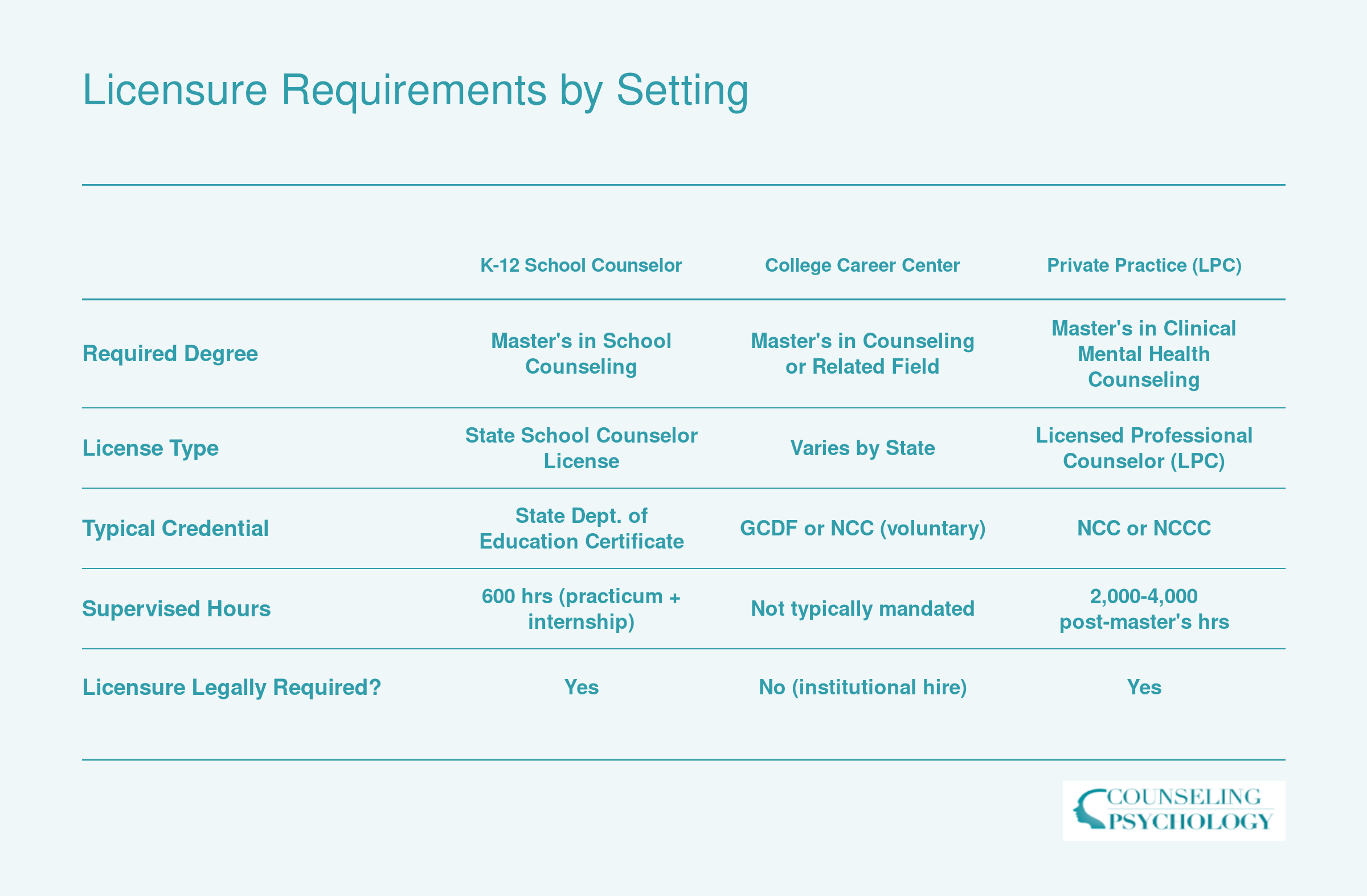
- K-12 school counseling: Most states require a separate school counseling credential issued by the state department of education, not the counseling licensure board. Requirements often include coursework in school counseling specifically, plus a supervised internship in a school setting.
- Private practice: A full LPC, LCPC, or LMHC is non-negotiable. Without it, you cannot legally provide counseling services independently or bill insurance.
- College and university career centers: Licensure is not always required for these roles, but hiring committees increasingly prefer it. A relevant national certification can strengthen your application considerably in a competitive field.
The NCDA Certified Career Counselor (CCC) Credential
For counselors who want to signal deep expertise in career work specifically, the Certified Career Counselor (CCC) credential from the National Career Development Association (NCDA) is the field's primary voluntary certification.1
Eligibility requires a master's degree in counseling or a closely related field, plus 600 hours of career counseling experience.2 Rather than a multiple-choice exam, the CCC uses a competency-based portfolio process that includes case studies demonstrating your practice.1 CACREP graduates may qualify for a streamlined application pathway.2
Once credentialed, renewal occurs every three years. Maintaining the CCC requires 30 hours of continuing education during the renewal cycle, along with an annual maintenance fee of $40 or a biennial fee of $50.2 Counselors who prefer an alternative to the continuing education requirement can substitute 60 hours of documented professional activity. Full details, including current application fees and portfolio guidelines, are available at ncda.org.
Taking both a state license and the CCC together positions you well for senior roles in college career centers, workforce development agencies, and private practice settings that serve clients navigating career transitions.
Licensure Requirements by Setting
Not every career counseling role demands the same credentials. The licensure landscape varies significantly depending on where you practice. Here is a side-by-side look at the four most common settings and what each one requires.
Where Career Counselors Work and What They Earn
Career counselors work across a variety of settings, from K-12 schools and universities to government agencies and private practice. According to the Bureau of Labor Statistics, the national median annual wage for educational, guidance, and career counselors and advisors was $65,140 as of the most recent published data. Earnings vary by experience, setting, and location, but the field offers a solid middle-class income with room for growth.
| Pay Benchmark | Annual Salary |
|---|---|
| 25th Percentile | $51,690 |
| National Median | $65,140 |
| Mean (Average) | $71,520 |
| 75th Percentile | $83,490 |
Highest-Paying States for Career Counselors
Geography plays a significant role in career counselor compensation. The table below shows the top 10 highest-paying states (and the District of Columbia) for educational, guidance, and career counselors and advisors, based on the most recent BLS data. Keep in mind that higher salaries in states like California, Washington, and D.C. often reflect elevated costs of living, so it is worth weighing take-home pay against local expenses when choosing where to practice.
| State | Total Employment | Median Annual Salary | 25th Percentile | 75th Percentile | Mean Annual Salary |
|---|---|---|---|---|---|
| California | 44,160 | $94,320 | $66,500 | $122,160 | $96,440 |
| Washington | 5,910 | $83,930 | $64,680 | $109,390 | $87,560 |
| District of Columbia | 1,800 | $80,280 | $61,930 | $101,050 | $80,820 |
| Alaska | 660 | $80,020 | $61,000 | $88,860 | $75,070 |
| Massachusetts | 11,850 | $78,840 | $63,800 | $100,250 | $82,910 |
| New Jersey | 7,590 | $77,940 | $64,900 | $99,180 | $82,460 |
| New Mexico | 1,760 | $76,490 | $56,930 | $84,460 | $76,030 |
| Maryland | 6,210 | $74,970 | $61,860 | $97,910 | $79,410 |
| Oregon | 3,330 | $74,000 | $57,540 | $98,090 | $79,550 |
| Delaware | 1,750 | $72,450 | $51,710 | $86,980 | $71,140 |
Career Counselor Job Outlook and Growth
The Bureau of Labor Statistics projects 4% job growth for educational, guidance, and career counselors from 2024 to 2034, about as fast as the average for all occupations.1 That translates to roughly 13,300 new jobs over the decade, with an estimated 31,000 openings each year when accounting for replacements.
Projected Job Growth
While 4% may sound modest, it reflects steady demand rather than a boom. The occupation employed approximately 342,350 people nationally in 2024, so even average growth adds a significant number of positions.1 The sustained need for career guidance, particularly as students and workers navigate changing labor markets, keeps the profession on solid footing.
What's Driving Demand
Several trends are fueling this outlook. First, rising college enrollment diversity, including more first-generation students and adult learners, increases the demand for career counseling in higher education. Second, workforce displacement from AI and automation pushes companies to invest in outplacement services and career development for employees, opening opportunities in corporate settings. Third, employer focus on talent retention means career counselors are valued not just in schools but in private organizations that want to help staff chart growth paths. Professionals who combine counseling expertise with knowledge of labor market data and coaching techniques will be particularly well-positioned. The broader mental health workforce shortage is also widening the door for counselors across settings.
Where the Jobs Are Growing
The fastest expansion is in higher education career services and corporate talent-development roles. Colleges are adding career advisors to help graduates launch careers, while companies embed career counseling within HR functions. Corporate roles often carry titles like career coach, talent development specialist, or outplacement consultant, and they frequently require familiarity with adult learning theory and workforce analytics. By contrast, K-12 school budgets can be variable: some districts maintain robust counseling teams, but funding constraints may slow growth in lower-resourced areas.
Frequently Asked Questions About Becoming a Career Counselor
Below are answers to some of the most common questions prospective career counselors ask. Where possible, each response references specific timelines, credentials, and data points discussed throughout this guide.