
What you’ll learn in this article…
- Most states require a master's degree, 2,000 to 4,000 supervised clinical hours, and a national exam for licensure.
- The full path from bachelor's degree through licensure typically takes seven to ten years.
- BLS projects mental health counselor employment to grow 17% from 2024 to 2034, far above average.
- Career changers with any bachelor's degree can enter a CACREP-accredited master's program, often with few prerequisites.
What does it take to become a licensed mental health counselor? The path is more standardized than most people realize: a bachelor's degree, a master's in clinical mental health counseling (typically 60 graduate credits), two to three years of supervised post-degree hours, and a passing score on a national licensure exam. Most candidates complete the full sequence in six to eight years.
The terms "mental health counselor" and "mental health therapist" describe the same licensed role. The difference is largely informal, a matter of how clinicians and employers refer to the position, not a separate credential or scope of practice.
Demand is concrete and growing. The Bureau of Labor Statistics projects 17% employment growth for this occupation between 2024 and 2034, roughly triple the average across all U.S. occupations. The practical tension for most candidates is not whether jobs exist, but which state license to pursue and how to fund two to three years of graduate training before supervised hours even begin.
What Does a Mental Health Counselor Do?
Before mapping out the steps to enter this profession, it helps to understand exactly what the day-to-day work looks like, because the title "mental health counselor" covers a wider range of responsibilities than many prospective students expect.
Core Responsibilities
A mental health counselor assesses, diagnoses, and treats mental health and emotional disorders using talk therapy and evidence-based modalities such as cognitive-behavioral therapy (CBT), dialectical behavior therapy (DBT), solution-focused brief therapy, and motivational interviewing. The goal is to help clients develop coping strategies, process trauma, manage symptoms of anxiety or depression counselor specialties, strengthen relationships, and work toward measurable therapeutic goals.
On a typical day, a licensed mental health counselor might move through several of the following tasks:
- Intake assessments: Gathering a new client's history, presenting concerns, and risk factors to build a clinical picture.
- Individual and group sessions: Delivering 45- to 60-minute therapy sessions, often five to eight per day depending on the setting.
- Treatment planning: Collaborating with clients to set goals, select interventions, and define timelines for progress reviews.
- Documentation: Writing session notes, updating diagnoses, and maintaining records that satisfy insurance and regulatory requirements.
- Crisis intervention: Responding to clients in acute distress, conducting safety assessments, and coordinating with emergency services when necessary.
Where Mental Health Counselors Work
Work settings vary widely, and the environment you choose shapes your caseload, schedule, and client population. Common options include:
- Private practice (solo or group)
- Community mental health centers
- Hospitals and integrated health systems
- K-12 schools and university counseling centers
- Substance abuse and addiction treatment facilities
- Telehealth platforms, which have expanded significantly in recent years
Some counselors split their time across two or more settings, maintaining a part-time private caseload alongside agency work. For a broader look at where these roles fit within the field, explore our overview of counseling careers.
Counselor vs. Therapist: Is There a Difference?
This is one of the most common points of confusion for people researching how to become a mental health counselor. In everyday conversation, "therapist" and "counselor" are used interchangeably, and functionally the roles overlap almost entirely. The distinction is largely one of professional titling and regulation. "Therapist" is a broader umbrella term that can apply to psychologists, social workers, marriage and family therapists, and counselors alike. "Licensed mental health counselor" (or licensed professional counselor, depending on your state) is a specific credential tied to defined education, supervised experience, and examination requirements. When someone holds an LMHC or LPC license, they are a therapist, but not every therapist is a licensed counselor. Understanding this distinction matters as you evaluate degree programs and plan your licensure path, topics covered in the steps ahead.
Step 1: Earn a Bachelor's Degree
A bachelor's degree, typically four years of full-time study, is the non-negotiable starting point for entering a master's program in clinical mental health counseling. There is no single required major, but what you study and how well you perform will shape your graduate school options.
Best Majors for Aspiring Counselors
Most successful applicants come from a small cluster of related undergraduate fields. These majors expose you to human behavior, research, and helping-profession frameworks that map directly onto graduate counseling curricula:
- Psychology: the most common pre-counseling major; covers cognition, personality, and abnormal behavior.
- Sociology: useful for understanding systemic and cultural influences on mental health.
- Human services: practice-oriented, with exposure to case management and community agencies.
- Social work: strong applied foundation, particularly if you later weigh an LCSW vs. LMHC path.
Adjacent majors like education, public health, and family studies are also well regarded.
GPA and Prerequisite Coursework
Most master's programs in counseling expect a minimum undergraduate GPA of 3.0 on a 4.0 scale. Competitive CACREP-accredited programs, especially at well-known universities, often see admitted students closer to 3.4 or higher, and some weigh the last 60 credits more heavily than your overall average.
Whether or not your major is psychology, certain courses will make your application stronger and your first semester easier:
- Abnormal psychology or psychopathology
- Introductory and developmental psychology (lifespan or child)
- Statistics
- Research methods
- An introductory counseling or helping skills course, if offered
If You're Changing Careers
A bachelor's in business, engineering, nursing, or the humanities does not disqualify you. Admissions committees regularly admit career-changers, particularly those with relevant volunteer or work experience in crisis lines, schools, or community agencies. If you are weighing other directions in the field, our broader guide on how to become a counselor outlines pathways across multiple specializations. You may, however, need to complete prerequisite psychology courses through a community college or post-baccalaureate program before applying, or enroll in a bridge program offered by some graduate schools specifically for non-psychology majors.
Step 2: Complete a Master's in Clinical Mental Health Counseling
A master's degree is mandatory for licensure in all 50 states. You cannot become a licensed mental health counselor without one. Every state licensing board requires applicants to hold a graduate degree in counseling or a closely related field, and the vast majority specify that the program must meet standards set by the Council for Accreditation of Counseling and Related Educational Programs (CACREP). This requirement is non-negotiable: if you want to practice as a licensed mental health counselor, you must invest the time and tuition to earn a qualifying master's degree.
What Is CACREP Accreditation and Why Does It Matter?
CACREP is the gold-standard accrediting body for counselor education programs in the United States. As of the 2025-2026 academic year, CACREP accredits more than 900 programs across the country, and clinical mental health counseling is the largest specialty area within the CACREP portfolio.1 The organization's 2024 Standards, which took effect on July 1, 2024, govern everything from faculty qualifications to curriculum content to clinical training requirements.2
Why does CACREP matter? Many states either require or strongly prefer graduation from a CACREP-accredited program for licensure eligibility. Even in states that do not mandate CACREP graduation, employers and supervisors often favor candidates who hold degrees from accredited programs because the curriculum and clinical training are standardized and rigorous. Starting January 1, 2027, applicants for the National Certified Counselor (NCC) credential will be required to have graduated from a CACREP-accredited program, further cementing the credential's importance in the profession.3 If you choose a non-CACREP program, you may face additional scrutiny during the licensure application process, and some states may require you to document specific coursework or complete additional supervised hours to compensate for gaps in your training.
Typical Curriculum and Clinical Training
CACREP-accredited clinical mental health counseling programs typically require 60 semester credit hours. The curriculum includes a common core covering professional counseling orientation, social and cultural diversity, human growth and development, career development, counseling and helping relationships, group counseling and group work, assessment and testing, and research and program evaluation.2 On top of that foundation, you will take specialty courses in psychopathology, diagnosis, treatment planning, crisis intervention, multicultural counseling, ethics, and evidence-based interventions.
Embedded in every CACREP program is a practicum and internship sequence that requires at least 600 supervised clinical hours, with a minimum of 240 hours spent in direct client contact. These experiences take place at approved community mental health centers, hospitals, schools, private practices, and other clinical sites. Your work is supervised by licensed counselors or other qualified mental health professionals, and you receive regular feedback on your clinical skills, ethical decision-making, and professional development.
Online Programs and In-Person Requirements
Many CACREP-accredited programs now offer fully online or hybrid formats, and these degrees are widely accepted by licensing boards and employers. The didactic coursework (lectures, readings, exams, discussion boards) can be completed remotely, but the practicum and internship hours must be completed in person at an approved site in your local area. The program will help you identify and secure placements, but you are responsible for arranging your schedule, commuting to the site, and meeting the clinical hour requirements. If you are considering an online program, confirm that the school can support students in your state and that you will have access to adequate supervision and placement assistance.
Questions to Ask Yourself
Step 3: Gain Supervised Clinical Experience
Earning your master's degree is a major milestone, but it does not make you a licensed counselor. Every state requires a period of post-degree supervised clinical experience before you can sit for a licensure exam, and meeting those requirements is where many new graduates spend one to three years of their early careers.
How Many Hours Do You Need?
The most common requirement across the country is 3,000 total supervised hours, though the range runs from roughly 2,000 hours at the lower end to 4,000 hours at the higher end depending on your state.1 California, for example, requires 3,000 hours for the Licensed Professional Clinical Counselor credential.2 Arizona requires 3,200 total hours, including at least 1,600 hours of direct client contact and a minimum of 100 hours of supervision, with at least 50 of those supervision hours provided by a licensed professional counselor.3 North Carolina sets its direct client contact minimum at 2,000 hours.5 Checking your specific state licensing board early in your master's program is essential, because the details vary considerably and they shape how long this phase takes.
Direct Contact vs. Total Hours
Not all supervised hours are the same. States typically distinguish between direct client contact hours (time spent in actual counseling sessions with clients) and total hours (which can include related activities such as case documentation, consultation, and group supervision). The ratio matters. Most boards specify a minimum floor for direct contact hours within the total, so you cannot fulfill the requirement through administrative work alone.
Supervision itself is also structured. Most states require a set number of individual supervision sessions, often with a minimum ratio of individual to group supervision hours. Supervisors are generally required to hold an active counseling license and, in many states, a separate supervisory credential or endorsement. If you are curious how individual supervision hours work in the marriage and family therapy track, the structure is similar but the specific hour counts differ.
Where New Graduates Find Supervised Positions
Finding a role that provides built-in supervision is one of the most practical concerns for anyone completing their master's. The most common settings include:
- Community mental health agencies: High client volume, diverse presenting concerns, and supervision structures are often already in place for associate-level clinicians.
- Group private practices: Many practices actively hire supervised counselors and absorb the cost of supervision as part of the employment arrangement.
- VA hospitals and federally qualified health centers: Federal settings frequently offer supervision support, competitive pay for associates, and exposure to complex cases.
- School-based and nonprofit programs: These roles can accumulate hours quickly given consistent caseloads.
Before accepting a position, confirm in writing that the supervisor meets your state board's qualifications. A supervision relationship that does not satisfy your board's requirements means those hours will not count, regardless of how much clinical work you do.
Step 4: Pass a Licensure Exam and Get Licensed
Once you have finished your supervised clinical hours, the next milestone is passing a national licensure exam. All states require this step before you can practice independently as a licensed mental health counselor. The National Board for Certified Counselors (NBCC) administers the two primary exams: the National Counselor Examination (NCE) and the National Clinical Mental Health Counseling Examination (NCMHCE).12 Which test you need depends entirely on your state's licensing board rules, so confirming early is essential. For a broader overview of state-by-state requirements, our guide to getting a counseling license is a helpful starting point.
Choosing the Right Exam for Your State
State requirements vary. Some states accept either the NCE or NCMHCE, while others mandate a specific one. A handful also require a supplemental jurisprudence exam on state laws and ethics. In general:
- NCE: Covers broad counseling knowledge and is often preferred for general licensure or the National Certified Counselor (NCC) credential.1
- NCMHCE: Focuses on clinical mental health skills through simulated case scenarios and is required by many states for clinical licensure or the Certified Clinical Mental Health Counselor (CCMHC) credential.2
Check with your state board early to understand exactly which exam is required and whether additional jurisprudence or oral components apply.
Exam Formats and Content
Both exams are computer-based and delivered through Pearson VUE, but their structures differ significantly.
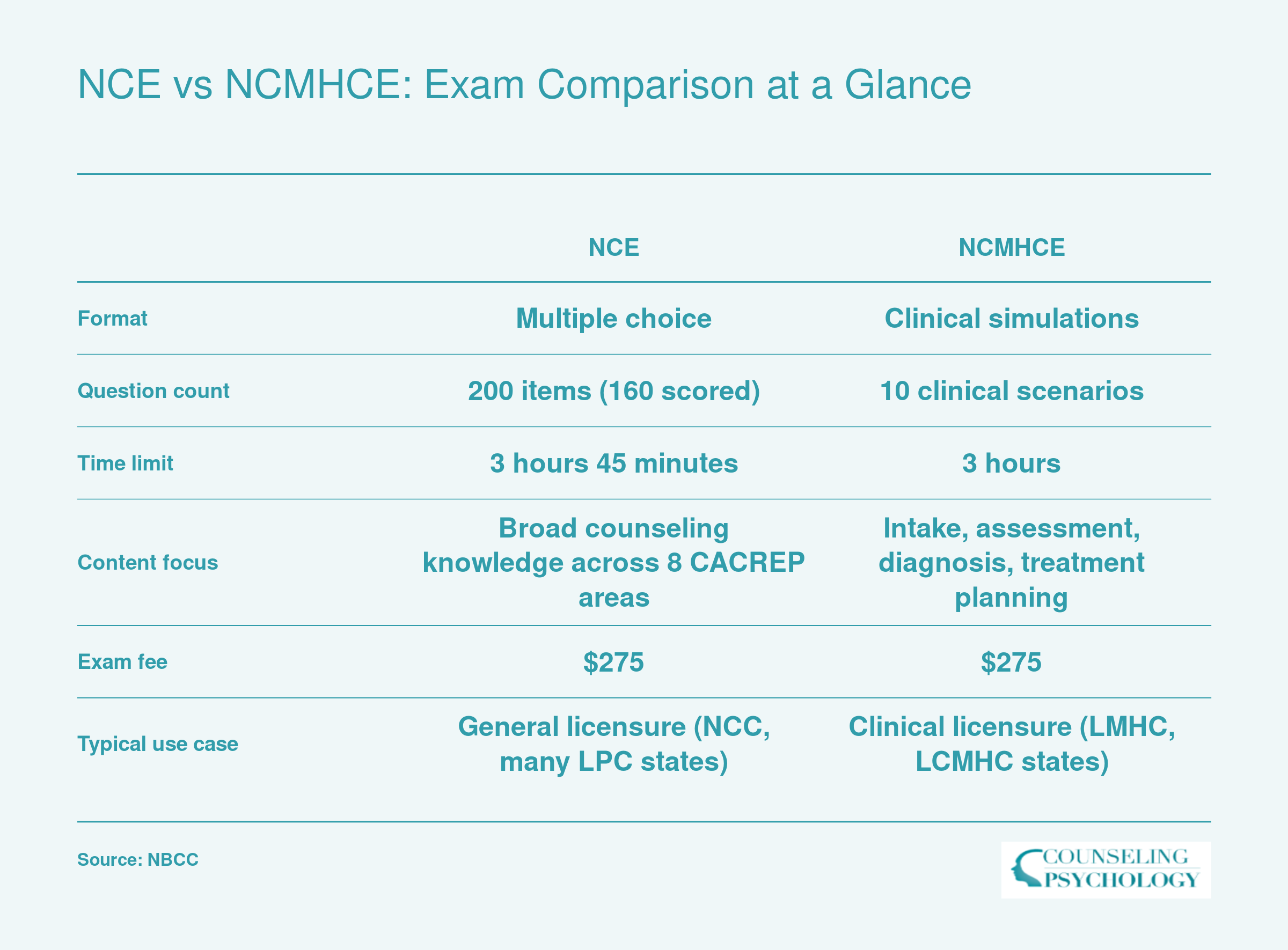
- NCE: Consists of 200 multiple-choice questions (160 scored, 40 unscored) across six content domains. You have 225 minutes to complete it. Remote proctoring via OnVUE is available. The exam fee ranges from $275 to $375.1
- NCMHCE: Presents 11 clinical case studies, each followed by multiple-choice questions. A total of 100 questions are scored, with one unscored case. Testing time is 180 to 240 minutes, and the exam is offered only at authorized Pearson VUE test centers. The fee is also $275 to $375.2
NBCC does not publish pass rates for either exam.13 The NCE assesses foundational knowledge, while the NCMHCE evaluates your ability to make clinical decisions in realistic scenarios. Both exams cover six domains, though the specific areas differ to match each exam's purpose.
Applying for Licensure and Taking the Exam
The licensure process generally follows these steps:
- Submit your application to the state counseling board, including official transcripts from your master's program and detailed supervision logs that verify your completed clinical hours.
- Receive approval from the board to sit for the exam. Processing times vary by state, so plan for potential delays.
- Register with NBCC for the required exam. After registration, you will schedule your test through Pearson VUE.
- Pass the exam. Once you achieve a passing score, the board issues your license to practice as a mental health counselor.
Some states also require a separate state jurisprudence exam, which you can typically take online. Keep all documentation organized throughout the process to avoid setbacks.
NCE vs NCMHCE: Exam Comparison at a Glance
Most states require one of two national exams for mental health counselor licensure. The NCE is a broad knowledge test, while the NCMHCE focuses on clinical decision-making through simulated case scenarios. Knowing which exam your state requires early on lets you tailor your study plan accordingly.
LMHC vs LPC vs LMFT vs LCSW: Understanding License Types
While LMHC and LPC represent two titles for the same counseling license, LMFT and LCSW credentials open doors to distinct, specialized practice areas. Knowing the differences helps you align your graduate education and clinical training with the clients or settings you most want to serve.1
LMHC and LPC: The Core Counseling License
Licensed Mental Health Counselor (LMHC) and Licensed Professional Counselor (LPC) are essentially the same credential under different names. Which title you earn depends entirely on the state where you become licensed. About half of U.S. states use LPC, while others use LMHC, and a few use variations like Licensed Clinical Professional Counselor (LCPC) or Licensed Professional Clinical Counselor (LPCC). All require a master's degree in counseling or clinical mental health counseling that meets state-specific coursework standards.
- Degree: A master's in counseling, clinical mental health counseling, or a closely related program with required core content.
- Supervised hours: 2,000 to 4,000 post-degree clinical hours under a board-approved supervisor, with specifics varying by state.
- Licensing exam: Typically the National Counselor Examination (NCE) or the National Clinical Mental Health Counseling Examination (NCMHCE) administered by NBCC, often paired with a state jurisprudence exam.
- Scope of practice: Individual and group psychotherapy, with counselors also working in career counseling, rehabilitation, and psychoeducation.
If your goal is to provide general mental health counseling across a wide range of concerns, the LMHC or LPC pathway is the direct route. The name difference does not affect clinical duties or employment opportunities.
LMFT: Specializing in Relational Therapy
Licensed Marriage and Family Therapists (LMFTs) focus on relational and systemic issues. Their training is built around couples, marriage, and family dynamics rather than individual psychopathology alone. To become an LMFT, you must complete a master's or doctoral program in marriage and family therapy (or a closely related field with a designated MFT curriculum) that meets accreditation standards set by the Commission on Accreditation for Marriage and Family Therapy Education (COAMFTE).
- Degree: A master's or doctorate in marriage and family therapy or a program with an MFT specialization.
- Supervised hours: 2,000 to 4,000 hours, with a required portion dedicated to direct client contact with couples and families.
- Licensing exam: The national Marriage and Family Therapy exam developed by the Association of Marital and Family Therapy Regulatory Boards (AMFTRB), plus any state-required jurisprudence exam.
- Scope of practice: Systems-based therapy for couples, families, and individuals through a relational lens.
Pursuing LMFT licensure commits you to a specific educational track. If you already know you want to specialize in couple or family work, learning how to become a couples counselor can help you map out the steps.
LCSW: Clinical Social Work with a Broader Lens
Licensed Clinical Social Workers (LCSWs) are clinicians trained in a social work framework that combines psychotherapy with a strong emphasis on social justice, advocacy, and resource linkage. The required degree is a Master of Social Work (MSW) from a program accredited by the Council on Social Work Education (CSWE). The MSW curriculum includes a clinical concentration for those seeking the LCSW.
- Degree: A CSWE-accredited MSW with a clinical focus.
- Supervised hours: 2,000 to 3,000 hours of post-MSW clinical social work experience, documented by a qualified supervisor.
- Licensing exam: The ASWB Clinical examination, the most advanced level offered by the Association of Social Work Boards.
- Scope of practice: Psychotherapy alongside case management, advocacy, and connecting clients to community services. LCSWs often work in hospitals, schools, and government agencies where a macro-level perspective is valued.
Choosing Your Path
If you are primarily interested in conducting individual psychotherapy and treating mental health conditions, the LMHC or LPC is the most direct educational route. The LMFT path is ideal for those who want to center their work on relational systems. The LCSW offers versatility in both clinical and macro practice but requires an MSW degree, which covers broader social welfare topics beyond therapy. While each license can open doors to rewarding clinical careers, they are not interchangeable. Your choice should match the population, setting, and therapeutic approach you find most meaningful.
How Long Does It Take to Become a Mental Health Counselor?
One of the most common questions prospective counselors ask is how long does it take to become a mental health counselor. The answer depends on where you are starting and whether you study full time or part time. For a traditional student beginning right after high school, the full path to licensure typically spans roughly 7.5 to 9 years. Career-changers who already hold a bachelor's degree can often reach licensure in about 4 to 5 years, while part-time students should plan for approximately 6 to 7 years from the start of their master's program.
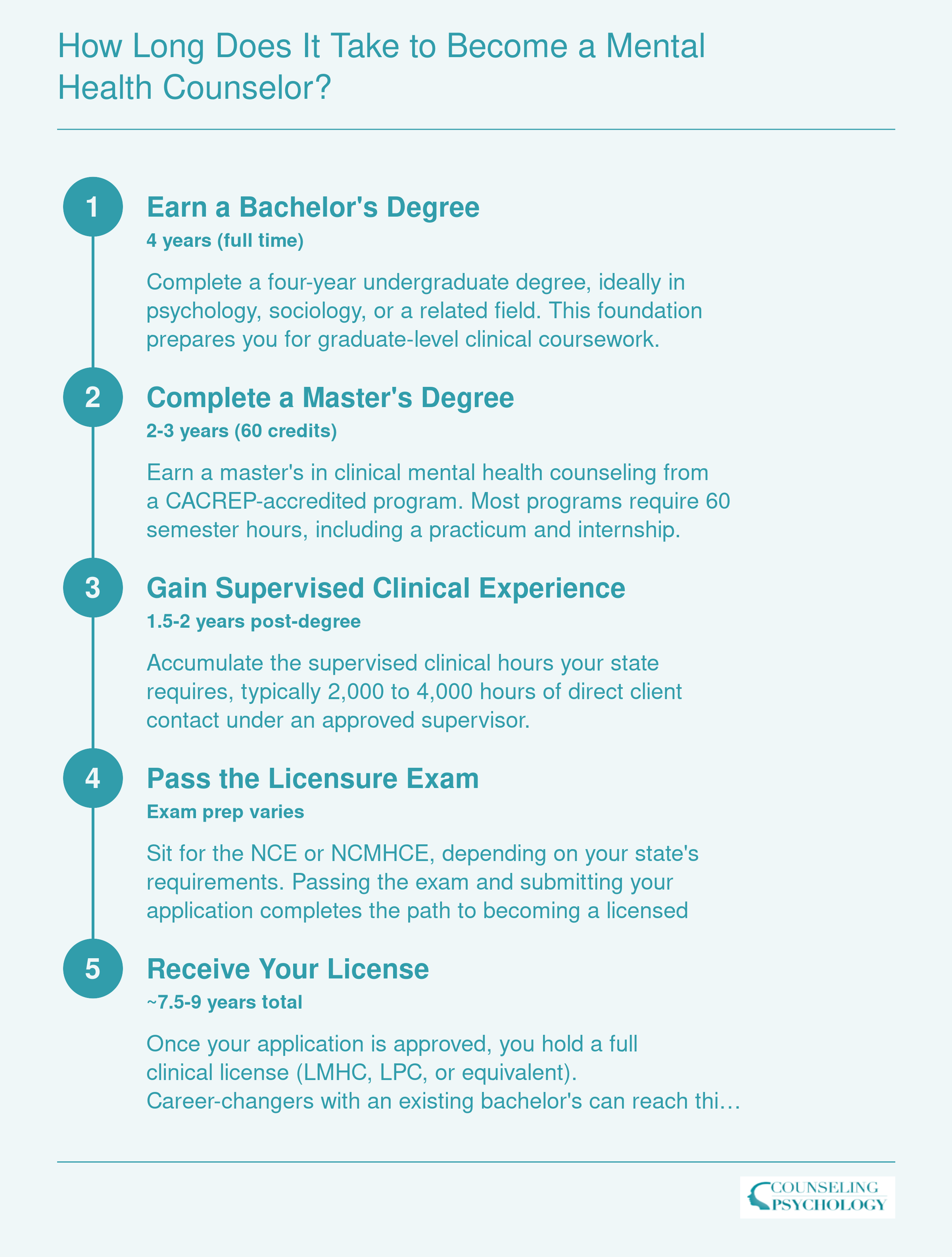
If you already hold a bachelor's degree in any field, you are eligible to apply to a CACREP-accredited master's program in clinical mental health counseling, often after completing a few prerequisites. Many programs are designed for working adults and offer evening or online formats, and prior careers in teaching, human resources, nursing, or ministry can be genuine assets in clinical practice.
Mental Health Counselor Salary and Job Outlook
Mental health counseling offers both competitive compensation and strong long-term demand. According to the Bureau of Labor Statistics, the occupation is projected to grow 17% between 2024 and 2034, well above the average for all occupations. That pace of growth translates to roughly 48,300 openings each year over the decade, driven by expanded insurance coverage for behavioral health services, greater public awareness of mental health needs, and continued integration of counseling into primary care settings.
| Metric | National Figure |
|---|---|
| Median Annual Salary | $59,190 |
| Mean (Average) Annual Salary | $65,100 |
| 25th Percentile Annual Salary | $47,170 |
| 75th Percentile Annual Salary | $76,230 |
| Total National Employment | 440,380 |
| Projected Job Growth (2024 to 2034) | 17% |
| Projected Annual Openings (2024 to 2034) | 48,300 |
Highest-Paying States for Mental Health Counselors
Where you practice can significantly affect your earning potential as a mental health counselor. The table below highlights the ten highest-paying states (and the District of Columbia) ranked by median annual salary, based on BLS state-level data for substance abuse, behavioral disorder, and mental health counselors. Alaska leads by a wide margin, with a median salary nearly $9,000 above the next closest state. Keep in mind that higher wages in some states often reflect a higher cost of living, so weigh salary figures alongside local expenses when planning your career.
| State | Median Annual Salary | 25th Percentile | 75th Percentile | Total Employment |
|---|---|---|---|---|
| Alaska | $79,220 | $63,690 | $96,940 | 1,060 |
| New Mexico | $70,770 | $55,060 | $80,840 | 2,070 |
| Oregon | $69,660 | $56,290 | $84,970 | 6,410 |
| North Dakota | $66,450 | $50,810 | $75,120 | 1,180 |
| District of Columbia | $66,140 | $47,980 | $83,040 | 980 |
| Utah | $65,920 | $42,210 | $94,630 | 4,720 |
| Idaho | $65,240 | $48,570 | $78,100 | 2,130 |
| New Jersey | $64,710 | $51,170 | $84,690 | 14,640 |
| Nebraska | $64,410 | $46,900 | $81,210 | 1,980 |
| Washington | $64,220 | $52,070 | $80,440 | 13,150 |
Frequently Asked Questions About Becoming a Mental Health Counselor
Below are answers to some of the most common questions prospective students ask about entering the mental health counseling profession. For deeper detail on any topic, explore the step-by-step sections earlier in this guide.