

What you’ll learn in this article…
- Most transpersonal psychologists need a doctoral or master's degree plus 1,500 to 4,000 supervised clinical hours for licensure.
- No standalone transpersonal psychologist license exists in any U.S. state, so practitioners pursue LPC, LMFT, or psychologist credentials instead.
- The national median salary for the closest BLS proxy category, Psychologists All Other, was roughly $112,000 as of recent data.
- Only a handful of regionally accredited U.S. programs offer dedicated transpersonal psychology concentrations at the graduate level.
Between 1,500 and 4,000 supervised clinical hours stand between a transpersonal psychology graduate and independent practice. That gap highlights the core tension: the field integrates spiritual and transcendent experiences into a discipline built on empirical licensure standards. Transpersonal psychology bridges clinical science with the study of consciousness, peak experiences, and meaning-making beyond the ego.
In practice, no state issues a transpersonal-specific license. Practitioners anchor their work in a recognized clinical credential, often as a psychologist, counselor, or social worker, and fold transpersonal methods into that framework. Earnings and career pathways depend on the underlying credential, not on a standalone transpersonal designation.
What Is a Transpersonal Psychologist?
What exactly does a transpersonal psychologist study, and how does this work differ from traditional therapy or spiritual guidance?
Transpersonal psychology is an area of psychology that seeks to integrate spiritual and transcendent human experiences within the framework of modern psychology.1 Unlike conventional psychological approaches that focus primarily on pathology or everyday functioning, transpersonal psychologists explore experiences that extend beyond the individual ego: peak experiences, altered states of consciousness, spiritual emergence, and the journey toward self-transcendence.2 The field views the human psyche as more than mind and body, recognizing a deeper Self or spiritual dimension as central to psychological health and growth.3
Historical Foundations
The discipline emerged from humanistic psychology in the late 1960s, with Abraham Maslow, Stanislav Grof, and other researchers arguing that psychology needed to address the full range of human experience, including mystical and transcendent states.4 The Association for Transpersonal Psychology, founded in 1969, formalized the field and established it as a distinct area of psychological inquiry. Where humanistic psychology emphasizes personal growth and self-actualization within the individual personality, transpersonal psychology extends this developmental scope, focusing on stages of growth beyond the conventional adult ego.5
Day-to-Day Work of Transpersonal Psychologists
In clinical practice, transpersonal psychologists integrate contemplative and spiritual dimensions into psychotherapy.6 A typical day might include:
- Individual therapy sessions: Working with clients experiencing existential crises, spiritual emergencies, or seeking deeper meaning and purpose in life
- Contemplative interventions: Incorporating meditation, guided imagery, breathwork, and dreamwork into treatment, all grounded in psychological theory
- Research and teaching: Investigating consciousness, the psychological effects of meditation, or the integration of spiritual practices into mental health treatment
- Consultation: Advising organizations or healthcare providers on integrating transpersonal approaches into existing programs
Clients often seek out transpersonal psychologists when facing questions of ultimate meaning, processing profound or unusual experiences, or navigating spiritual development alongside psychological healing.
How It Differs from Related Fields
Transpersonal psychology occupies a distinct position between clinical psychology and spiritual counseling. Clinical psychologists typically work from evidence-based models that do not centrally integrate spiritual or transcendent frameworks into treatment. Spiritual counselors, by contrast, often draw from religious doctrine or ministry training and may or may not incorporate psychological theory.3
Mindfulness-based therapy, while it uses meditation as a core technique, typically maintains a secular stance, bracketing religious and metaphysical questions to focus on symptom reduction and stress management.7 Transpersonal psychology takes a pluralistic approach, drawing from multiple contemplative traditions and secular consciousness research while maintaining psychology's commitment to rigorous theory and evidence.6
This integration of spirituality and psychological science defines the transpersonal psychologist's unique contribution to mental health care.
Transpersonal Psychology Degree Requirements: Bachelor's to Doctorate
The path to becoming a transpersonal psychologist begins with a strong academic foundation and advances through graduate specialization. Because transpersonal psychology integrates spiritual and transcendent aspects of human experience with traditional psychological theory, your degree choices should align with both clinical competence and depth-oriented inquiry.
Undergraduate Preparation
A bachelor's degree in psychology or a related field provides essential groundwork. Coursework in general psychology, research methods, abnormal psychology, and human development is standard. Some programs also offer electives in consciousness studies, Eastern philosophy, or holistic health, which align well with transpersonal themes. While a specific "transpersonal" major is rare at this level, building an interdisciplinary background in psychology, religious studies, or neuroscience can strengthen your graduate school applications. Students drawn to spiritually integrated therapeutic work may also want to explore a counseling degree as a complementary pathway.
Master's Programs in Transpersonal Psychology
Graduate study is where transpersonal training truly begins. A few accredited institutions offer master's degrees specifically in transpersonal psychology, often with online or low-residency options. For example, Sofia University (formerly the Institute of Transpersonal Psychology) holds regional accreditation from WSCUC and offers a Master of Arts in Transpersonal Psychology that can be completed partially online. Naropa University, accredited by the Higher Learning Commission (HLC), provides a Master of Arts in Clinical Mental Health Counseling with a concentration in Transpersonal Wilderness Therapy, blending contemplative practice with clinical skills. The California Institute of Integral Studies (CIIS), also WSCUC-accredited, offers a Master of Arts in Integral Counseling Psychology that draws heavily on transpersonal frameworks. These programs typically require a bachelor's degree, letters of recommendation, a statement of purpose, and sometimes an interview to assess personal readiness for self-inquiry.
Doctoral Study and Specialization
A doctoral degree, either a PhD or PsyD, is generally required for independent licensure as a psychologist. Sofia University offers a PhD in Transpersonal Psychology, while CIIS provides a PsyD and PhD in Integral and Transpersonal Psychology. These programs involve advanced research, clinical practicum placements, and dissertation work exploring topics such as meditation, psychedelic-assisted therapy, or cross-cultural spirituality. For those considering a counseling-oriented doctorate, resources on counseling doctoral programs can help you compare accredited options. Accreditation is crucial: both regional bodies like WSCUC and programmatic accreditors like CACREP (for counseling-focused programs) influence licensure eligibility. However, note that CACREP standards may not fully encompass transpersonal curricula, so many graduates seek licensure through regionally accredited doctoral programs that meet state psychology board requirements.
- Key Steps to Locate Accredited Programs:
- Visit the websites of accrediting bodies such as WSCUC and HLC to verify institutional accreditation status.
- Check official school pages for Naropa University, CIIS, and Sofia University for current degree offerings and admission deadlines.
- Consult the U.S. Bureau of Labor Statistics (BLS.gov) for career path information and typical education levels in psychology fields, which can help align your academic plan with occupational goals.
- Reach out to professional organizations like the Association for Transpersonal Psychology (ATP) for updated program directories and practitioner insights.
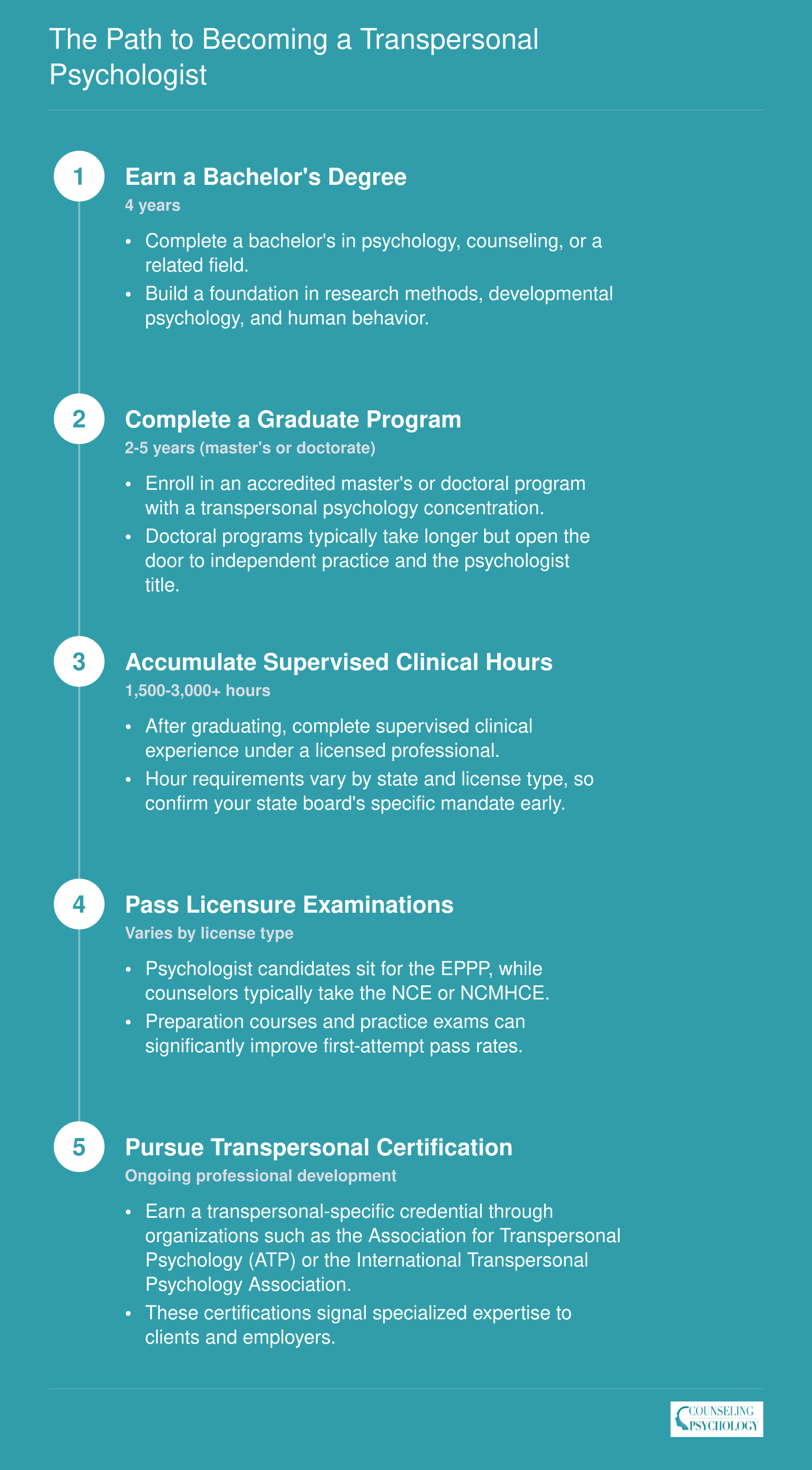
The Path to Becoming a Transpersonal Psychologist
Becoming a transpersonal psychologist requires a deliberate sequence of education, supervised practice, and credentialing. The timeline below outlines each milestone and the approximate time investment at every stage.
Accredited Transpersonal Psychology Programs
Transpersonal psychology sits in an unusual accreditation niche: the institutions are regionally accredited like any university, but the specialty itself has no field-specific programmatic accreditor. That means due diligence falls heavily on the applicant. It matters because licensure boards and employers care about who accredits the school, not whether the curriculum calls itself transpersonal.
Which Accreditors Actually Matter
Two regional bodies cover most transpersonal programs. The WASC Senior College and University Commission (wascsenior.org) accredits California-based schools including Sofia University and the California Institute of Integral Studies (CIIS). The Higher Learning Commission (hlcommission.org) covers Naropa University in Colorado. Atlantic University in Virginia holds DEAC accreditation, which is recognized by the U.S. Department of Education but is a distance-education accreditor rather than a regional one, a distinction that can affect licensure portability in some states.
If a program leads to counseling licensure, also check CACREP (cacrep.org). Few transpersonal-branded programs hold CACREP accreditation directly, but some schools offer a separately CACREP-accredited counseling track alongside transpersonal coursework. Confirm before enrolling.
Where the Programs Actually Live
The core institutions to investigate:
- Sofia University (Palo Alto, CA): Offers MA and PhD degrees in transpersonal psychology, with online and hybrid formats. WSCUC accredited.
- Naropa University (Boulder, CO): Contemplative psychology and transpersonal counseling psychology at the MA level, primarily on-campus with some low-residency options. HLC accredited.
- California Institute of Integral Studies (San Francisco, CA): MA and PhD programs in integral and transpersonal psychology, on-campus and online tracks. WSCUC accredited.
- Atlantic University (Virginia Beach, VA): MA in transpersonal studies, fully online. DEAC accredited.
Verifying for the 2026 Cycle
Program pages should clearly state degree type (MA, MS, PhD, PsyD), delivery format, and current accreditation status. If any of those are vague or buried, treat it as a warning sign. Call the admissions office and ask three direct questions: Is the institution's regional accreditation current? Does this specific program meet licensure requirements in the state where I plan to practice? Are 2026-2027 cohorts still enrolling in the format I want?
The BLS occupational outlook page for psychologists (bls.gov) links to the APA, which maintains directories useful for cross-checking doctoral programs, though APA accreditation itself is rare in the transpersonal subfield. If you are weighing a doctorate outside the transpersonal niche, you can also compare online Ph.D. in counseling options to understand how accreditation standards differ across programs.
Questions to Ask Yourself
Licensure and Certification for Transpersonal Psychologists
Between 1,500 and 4,000 supervised clinical hours stand between a transpersonal psychology graduate and independent practice, depending on the state and licensure track chosen. There is no standalone "transpersonal psychologist" license anywhere in the United States. Practitioners who integrate transpersonal approaches into their work must obtain licensure through existing state psychology or counseling boards, then apply transpersonal methods within that professional framework.
Doctoral-Level Licensure as a Psychologist
If you complete a doctoral program in transpersonal or clinical psychology, the path to licensure typically includes:
- EPPP requirement: The Examination for Professional Practice in Psychology is the national standardized test required by all U.S. jurisdictions. Some states add a supplemental jurisprudence or oral exam.
- Supervised experience: States mandate between 1,500 and 4,000 hours of supervised postdoctoral work, with most falling in the 1,500 to 2,000 hour range. Requirements vary, so check your state board early.
- Degree verification: Your doctoral program must meet the state's educational standards, which usually means regional accreditation and, increasingly, APA accreditation or equivalent.
Once licensed, you practice as a psychologist and may specialize in transpersonal modalities such as spiritual emergence work, mindfulness-based interventions, or holotropic breathwork without needing additional state permission.
Master's-Level Counseling Licensure
For those who earn a master's in transpersonal psychology or counseling, the Licensed Professional Counselor (LPC) or Licensed Marriage and Family Therapist (LMFT) credential is the more common route. This pathway parallels what you would find across many careers in psychology, though the transpersonal specialization adds a distinctive lens. Requirements include:
- National exam: Most states accept either the National Counselor Examination (NCE) or the National Clinical Mental Health Counseling Examination (NCMHCE).
- Supervised hours: States typically require between 2,000 and 4,000 hours of post-master's supervised clinical experience, completed under a board-approved supervisor.
- Coursework alignment: Your program must cover state-mandated content areas. Some transpersonal master's programs are structured to meet these standards, while others may require supplemental coursework.
This pathway allows you to practice psychotherapy and incorporate transpersonal techniques into your clinical work.
Transpersonal-Specific Certifications
Several organizations offer certifications that supplement, but do not replace, state licensure:
- Graduate certificates: Saybrook University offers a graduate certificate in transpersonal psychology, while Alef Trust provides a 12-month online Transpersonal Coaching Psychology Certificate for practitioners seeking specialized credentials.3
- Hypnotherapy credentials: The National Association of Transpersonal Hypnotherapists (NATH) offers Certified Transpersonal Hypnotherapist and Master Transpersonal Hypnosis designations requiring a minimum of 200 training hours plus 50 to 100 supervised hours.4
- Continuing education: Shorter transpersonal CE certificate programs range from 40 to 60 hours and can satisfy continuing education requirements while deepening specialized knowledge.
These credentials signal advanced training to clients and employers but carry no independent practice authority.
Emerging Psychedelic Therapy Credentials
Transpersonal practitioners interested in psychedelic-assisted therapy should monitor developing credential pathways:
- Oregon and Colorado: Both states have created legal frameworks for psilocybin therapy, with state-level facilitator licensing now available or in development. Oregon's program requires completion of an approved training program and supervised practice hours.
- MAPS training: The Multidisciplinary Association for Psychedelic Studies offers MDMA-assisted therapy training programs ranging from 100 to 200 hours. While federal approval of MDMA therapy remains pending, this training positions practitioners for future practice.
These emerging credentials represent natural extensions of transpersonal psychology's interest in non-ordinary states of consciousness. However, they remain distinct from core licensure and should be pursued as supplemental specializations rather than primary credentials.
Regardless of which path you choose, the sequence remains consistent: complete an accredited degree, accumulate supervised hours, pass the required examination, and then layer on transpersonal-specific training to distinguish your practice.
Transpersonal Psychology Career Paths and Job Outlook
As a transpersonal psychologist, you can work in diverse environments that value the integration of spiritual and transcendent experiences with traditional psychological practice. Common settings include private therapy practices, integrative health centers, universities conducting consciousness research, and consulting roles for organizations seeking to enhance employee wellbeing through mindfulness and meaning-centered approaches. Many professionals blend transpersonal frameworks with licensure as a clinical or counseling psychologist, which broadens their scope of practice and employability.
Where Transpersonal Psychologists Work
- Private Practice: You can offer individual therapy, group facilitation, or workshops focused on spiritual emergence, meditation, and personal growth.
- Clinical and Medical Settings: Hospitals with integrative medicine departments and community mental health centers occasionally seek practitioners comfortable with clients' spiritual concerns.
- Academia and Research: Transpersonal research is conducted at a handful of universities, exploring topics like near-death experiences, psychedelic-assisted therapy, and exceptional human potential.
- Corporate and Organizational Consulting: Applying transpersonal principles to leadership development and stress reduction is a growing niche. Those interested in workplace-focused psychology may also want to explore how to become an industrial organizational psychologist, a related but distinct career path.
Job Market Outlook
The Bureau of Labor Statistics (BLS) projects 6 percent growth for psychologists nationally from 2024 to 2034, with about 12,900 openings per year.1 This category is broad, and the BLS does not offer a separate projection for the "Psychologists, All Other" occupation (SOC 19-3039), which is where transpersonal psychology roles are typically classified. Without discrete data, it is wise to interpret the 6 percent estimate as a general indicator while recognizing that demand for holistic and spiritually integrated services is shaped by cultural trends and public acceptance.
Tracking Demand in a Niche Field
Because transpersonal psychology is not a licensable specialization in most states, employment data rarely appears on traditional job boards. To gauge real-time demand:
- Use the BLS Occupational Outlook Handbook for psychologists to filter by occupation and location, revealing which regions employ "Psychologists, All Other" in higher numbers.
- Visit program websites for schools like Sofia University or the California Institute of Integral Studies; many share career placement statistics and alumni employment rates directly on their admissions or outcomes pages.
- Reach out to professional associations like the Association for Transpersonal Psychology (ATP) or APA Division 32 (Society for Humanistic Psychology) for member surveys or workforce reports that capture niche activity not reflected in government data.
A proactive approach, combining federal data, school outcomes, and insider networks, gives you the most realistic picture of where opportunities exist and how they are evolving.
Transpersonal Psychologist Salary: National Overview
Because the Bureau of Labor Statistics does not track transpersonal psychologists as a standalone occupation, the closest proxy is the BLS category "Psychologists, All Other," which captures specialty psychology roles outside of clinical, counseling, school, and industrial-organizational designations. The national figures below reflect May 2024 BLS data for this broader group of roughly 17,790 professionals. Actual earnings for transpersonal psychologists will vary based on licensure level, practice setting, geographic location, and whether the practitioner holds a doctoral degree.
| Wage Metric | Annual Amount |
|---|---|
| 25th Percentile | $73,820 |
| Median (50th Percentile) | $117,580 |
| Mean (Average) | $111,340 |
| 75th Percentile | $145,200 |
Transpersonal Psychologist Salary by State
Because the BLS does not track transpersonal psychologists as a standalone occupation, the table below uses state-level data for the broader "Psychologists, All Other" category (BLS 19-3039). These figures offer a useful proxy, but actual earnings for transpersonal practitioners will vary based on licensure type, practice setting, and specialization. States where the BLS did not release reliable wage estimates have been excluded.
| State | Median Annual Salary | 25th Percentile | 75th Percentile | Mean Annual Salary | Estimated Employment |
|---|---|---|---|---|---|
| California | $147,650 | $78,310 | $169,330 | $130,940 | 1,780 |
| Oklahoma | $147,010 | $103,330 | $161,350 | $126,730 | N/A |
| Nevada | $144,390 | $131,250 | $153,890 | $130,120 | 100 |
| Nebraska | $137,990 | $93,790 | $163,880 | $125,420 | 50 |
| North Carolina | $137,130 | $90,440 | $157,190 | $122,490 | 480 |
| South Carolina | $135,950 | $115,090 | $152,960 | $127,190 | 140 |
| Tennessee | $135,570 | $103,790 | $148,120 | $123,640 | 240 |
| Alabama | $134,370 | $114,670 | $150,010 | $126,770 | 100 |
| Kansas | $133,540 | $108,510 | $152,960 | $127,940 | 110 |
| Connecticut | $132,040 | $92,180 | $141,730 | $117,500 | 170 |
| Ohio | $131,310 | $112,050 | $145,140 | $123,170 | 380 |
| South Dakota | $128,560 | $89,190 | $155,360 | $121,650 | 30 |
| Massachusetts | $128,180 | $79,680 | $153,300 | $123,810 | 510 |
| Arizona | $128,040 | $65,110 | $144,580 | $111,330 | 270 |
| Missouri | $127,230 | $89,780 | $148,700 | $114,990 | 250 |
| Pennsylvania | $126,460 | $78,200 | $145,480 | $114,620 | 520 |
| Virginia | $125,630 | $102,490 | $151,550 | $121,130 | 510 |
| New Jersey | $124,800 | $93,600 | $125,900 | $114,860 | 470 |
| Kentucky | $124,550 | $116,560 | $143,690 | $122,270 | 220 |
| Indiana | $123,880 | $72,000 | $142,130 | $111,440 | 190 |
| Iowa | $123,740 | $59,460 | $144,460 | $104,670 | 80 |
| Florida | $123,610 | $86,940 | $145,560 | $117,450 | 1,120 |
| Maryland | $123,490 | $77,290 | $152,840 | $118,410 | 710 |
| Idaho | $122,720 | $91,060 | $134,640 | $111,820 | 60 |
| Washington | $120,080 | $100,610 | $138,940 | $115,620 | 380 |
| Colorado | $118,640 | $84,810 | $141,930 | $113,940 | 350 |
| Arkansas | $118,600 | $55,990 | $134,430 | $101,380 | 90 |
| District of Columbia | $117,960 | $107,900 | $148,350 | $120,880 | 190 |
| New York | $113,730 | $72,450 | $136,790 | $107,470 | 870 |
| Georgia | $113,730 | $53,500 | $147,470 | $107,680 | 420 |
| Louisiana | $113,620 | $66,070 | $145,000 | $114,240 | 150 |
| Mississippi | $111,430 | $48,210 | $143,400 | $104,180 | 60 |
| Rhode Island | $111,310 | $108,280 | $149,820 | $111,420 | 130 |
| Minnesota | $110,190 | $78,960 | $131,310 | $103,820 | 400 |
| Wisconsin | $107,540 | $77,030 | $137,880 | $110,320 | 910 |
| Utah | $90,270 | $82,220 | $129,810 | $99,720 | N/A |
| Oregon | $82,960 | $79,380 | $130,520 | $102,460 | 630 |
| Texas | $81,830 | $61,740 | $133,240 | $96,040 | 2,160 |
| Illinois | $81,270 | $51,700 | $137,820 | $92,810 | 960 |
| Michigan | $78,670 | $56,490 | $131,140 | $91,060 | 330 |
| Vermont | $76,490 | $63,540 | $95,710 | $85,670 | 100 |
| New Hampshire | $75,990 | $67,630 | $133,970 | $93,840 | 80 |
| Maine | $63,490 | $63,490 | $92,740 | $80,140 | 270 |
| West Virginia | $41,900 | $33,470 | $77,410 | $63,650 | 240 |
Highest-Paying Metro Areas for Psychologists
Because the BLS does not track transpersonal psychologists as a standalone occupation, the closest proxy is the "Psychologists, All Other" category (19-3039). The table below ranks major metro areas by median annual wage, giving you a sense of where psychologists in specialized niches, including transpersonal practice, tend to earn the most. Cost of living varies significantly across these metros, so weigh that alongside the raw salary figures.
| Metro Area | Total Employment | Median Annual Wage | 25th Percentile | 75th Percentile |
|---|---|---|---|---|
| Los Angeles-Long Beach-Anaheim, CA | 500 | $160,640 | $122,820 | $160,640 |
| San Diego-Chula Vista-Carlsbad, CA | 240 | $146,350 | $101,660 | $160,510 |
| Riverside-San Bernardino-Ontario, CA | 120 | $146,060 | $103,050 | $168,330 |
| Miami-Fort Lauderdale-West Palm Beach, FL | 220 | $132,160 | $61,170 | $153,860 |
| Baltimore-Columbia-Towson, MD | 270 | $132,060 | $103,990 | $159,810 |
| Atlanta-Sandy Springs-Roswell, GA | 240 | $131,020 | $53,500 | $157,230 |
| Denver-Aurora-Centennial, CO | 120 | $130,520 | $99,780 | $149,450 |
| Virginia Beach-Chesapeake-Norfolk, VA-NC | 110 | $129,310 | $105,350 | $150,320 |
| Philadelphia-Camden-Wilmington, PA-NJ-DE-MD | 320 | $128,400 | $78,200 | $147,950 |
| Kansas City, MO-KS | 110 | $127,460 | $98,710 | $144,460 |
| Tampa-St. Petersburg-Clearwater, FL | 280 | $127,130 | $105,230 | $149,970 |
| Boston-Cambridge-Newton, MA-NH | 420 | $126,870 | $75,990 | $149,050 |
| Phoenix-Mesa-Chandler, AZ | 200 | $124,880 | $59,760 | $144,580 |
| New York-Newark-Jersey City, NY-NJ | 1,030 | $121,470 | $85,220 | $127,840 |
| Orlando-Kissimmee-Sanford, FL | 180 | $120,640 | $95,640 | $142,960 |
| Seattle-Tacoma-Bellevue, WA | 290 | $119,640 | $97,360 | $135,180 |
| Minneapolis-St. Paul-Bloomington, MN-WI | 270 | $115,850 | $99,200 | $131,310 |
| San Antonio-New Braunfels, TX | 260 | $115,360 | $73,590 | $142,480 |
| Washington-Arlington-Alexandria, DC-VA-MD-WV | 730 | $112,880 | $80,130 | $146,680 |
| Providence-Warwick, RI-MA | 150 | $111,330 | $111,310 | $149,850 |
| Boulder, CO | 120 | $108,380 | $84,810 | $141,930 |
| Milwaukee-Waukesha, WI | 380 | $107,550 | $73,880 | $137,880 |
| Madison, WI | 160 | $105,050 | $77,970 | $139,760 |
| Pittsburgh, PA | 120 | $99,590 | $67,420 | $140,630 |
| Chicago-Naperville-Elgin, IL-IN | 710 | $89,640 | $57,800 | $142,130 |
| Dallas-Fort Worth-Arlington, TX | 370 | $82,190 | $61,430 | $148,280 |
| Portland-Vancouver-Hillsboro, OR-WA | 430 | $82,960 | $79,380 | $122,430 |
| San Francisco-Oakland-Fremont, CA | 410 | $63,880 | $41,600 | $176,130 |
Transpersonal Psychology Vs. Related Fields
Transpersonal psychology sits within a family of approaches that address meaning, growth, and the inner life, but each field differs in theoretical roots, training requirements, and clinical focus. Understanding these distinctions helps you choose the specialization that aligns with your interests and the populations you want to serve.
Theoretical Foundations
Transpersonal psychology is often called the "fourth force" in psychology, building on behaviorism, psychoanalysis, and humanistic psychology while extending into spiritual and transcendent dimensions of human experience.1 Humanistic psychology, the "third force," emphasizes human potential and self-actualization without necessarily addressing spirituality.2 Spiritual counseling explicitly incorporates clients' religious or spiritual beliefs into the therapeutic process, while mindfulness-based cognitive therapy (MBCT) integrates meditation practices with cognitive-behavioral techniques, primarily targeting depression relapse prevention.
Education and Credentials
Transpersonal psychologists and humanistic practitioners both work under standard mental health licenses (psychologist, licensed professional counselor, marriage and family therapist, or clinical social worker) with specialized training in their orientation. Spiritual counselors may be licensed clinicians or non-licensed spiritual directors, depending on whether they provide psychotherapy or purely spiritual guidance. MBCT practitioners hold existing mental health licenses and complete formal training in the protocol, typically through recognized programs that include supervised practice.
Clinical Techniques
Each approach uses distinct methods:
- Transpersonal: Mindfulness, meditation, dream analysis, exploration of archetypes, and work with altered states of consciousness
- Humanistic: Client-centered therapy emphasizing unconditional positive regard, empathy, and genuineness
- Spiritual counseling: Spiritual assessment, prayer, scripture study, ritual, and meaning-making conversations
- MBCT: Structured mindfulness meditation, cognitive-behavioral exercises, psychoeducation, and home practice assignments
Licensure Paths
None of these specializations carry a separate license. Transpersonal, humanistic, and MBCT practitioners all work under existing mental health credentials. Spiritual counselors need a standard license if they provide psychotherapy; those offering spiritual direction without clinical intervention typically do not require licensure.
Populations Served
Transpersonal psychologists often work with adults navigating existential questions, grief, trauma, or a search for meaning.3 Humanistic practitioners serve clients with depression, anxiety, self-esteem concerns, and life transitions. Spiritual counselors support individuals for whom faith is central, including those facing spiritual struggles, grief, or terminal illness. MBCT specialists focus specifically on adults with recurrent major depressive disorder who want to reduce relapse risk. If you are weighing less conventional paths in the field, exploring non-traditional careers in psychology can help you compare additional options.
Frequently Asked Questions About Transpersonal Psychology
Transpersonal psychology is a specialized field, and prospective students often have practical questions about education, licensure, and career options. Below are answers to the most common questions we hear from people exploring this path.
Explore Careers
- Become a Behavior Interventionist
- BCaBA
- BCBA
- Biogerontologist
- Child Psychologist
- Clinical Psychologist
- Cognitive Neuroscientist
- Cognitive Psychologist
- Comparative Psychologist
- Consumer Psychologist
- Counseling Psychologist
- Criminal Psychologist
- Cultural Psychologist
- Forensic Psychologist
- Air Force Psychologist
- Applied Psychologist
- Army Psychologist
- Educational Psychologist
- Engineering Psychologist
- Environmental Psychologist
- Experimental Psychologist
- Navy Psychologist
- Neurologist
- Neuropsychologist
- Personnel Psychologist
- Physiatrist
- Police Psychologist
- Positive Psychologist
- Psychiatrist
- Psychological Anthropologist
- Psychometrician
- Registered Behavior Technician (RBT)
- Rehabilitation Psychologist
- School Psychologist
- Social Psychologist
- Spiritual Psychologist
- Sports Psychologist