
What you’ll learn in this article…
- A practitioner track combining a master's degree and certification typically takes six to seven years from start to finish.
- No single national accreditor governs positive psychology certifications, so evaluating each program's reputation is essential.
- The BLS projects 11 percent job growth for psychologists from 2023 to 2033, faster than the national average.
- Only the doctoral track leads to licensure and the legal authority to diagnose and treat mental health conditions.
How do you actually become a "positive psychologist" when no state license carries that exact title? The answer splits into two distinct tracks: the doctoral-level licensed psychologist who infuses positive psychology into clinical assessment and therapy, and the certified positive psychology practitioner who applies the science of well-being in coaching, organizational consulting, or education without a clinical license.
The first requires an APA-accredited doctoral degree, a passing EPPP score, and supervised hours. The second depends on reputation and program choice, because no single national accreditor governs positive psychology certifications. Employers in corporate and coaching settings increasingly accept credentials from established university-based programs, but hospitals and mental health clinics still require the psychologist license. Both tracks share common ground with other counseling careers, though the credential requirements diverge significantly.
What Is a Positive Psychologist?
The first thing to sort out before pursuing this field is whether you want the clinical authority of a licensed psychologist or the faster, more flexible path of a practitioner who applies positive psychology tools in coaching, workplace, or educational settings. The two roles share a research foundation but lead to very different day-to-day work, scope of practice, and earning ceilings.
A Science, Not a Mood
Positive psychology is the scientific study of what makes life worth living: the conditions, traits, and behaviors that allow people and communities to flourish. Martin Seligman, who launched the field in the late 1990s, organized it around the PERMA model, five pillars that researchers use to measure well-being:
- Positive Emotion: the everyday experience of joy, gratitude, hope, and contentment.
- Engagement: the absorbed, flow-state focus people find in meaningful work or hobbies.
- Relationships: the quality of social connections that sustain mental health.
- Meaning: belonging to and serving something larger than the self.
- Accomplishment: the pursuit and attainment of goals for their own sake.
These five domains give the field its empirical backbone and distinguish it from self-help. Interventions are tested in peer-reviewed studies before practitioners apply them.
Licensed Psychologist vs. Practitioner
Here is where the career fork matters. A licensed positive psychologist holds a doctorate (PhD or PsyD) in psychology, has completed supervised clinical hours, and is licensed by a state board. That credential allows them to diagnose mental health conditions, deliver therapy, and bill insurance, typically while specializing in well-being interventions. Candidates interested in the doctoral route can explore master's degree in psychology programs as a common stepping stone.
A positive psychology practitioner or coach, by contrast, usually holds a certificate or master's degree in the specialty and works in non-clinical settings: corporate wellness, executive coaching, schools, healthcare teams, or private coaching practice. Practitioners apply evidence-based interventions but cannot diagnose or treat mental illness.
It is worth emphasizing that "positive psychologist" is not a separate license category in any state. It is a specialization layered on top of standard psychology licensure, similar to how a clinician might specialize in trauma or child psychology.
A Field Built From Several Disciplines
Positive psychology pulls from clinical psychology, professional coaching, organizational behavior, and education research. That cross-disciplinary DNA is why graduates land in such varied roles, from therapist's office to HR department to university classroom, which the later sections of this guide unpack in detail.
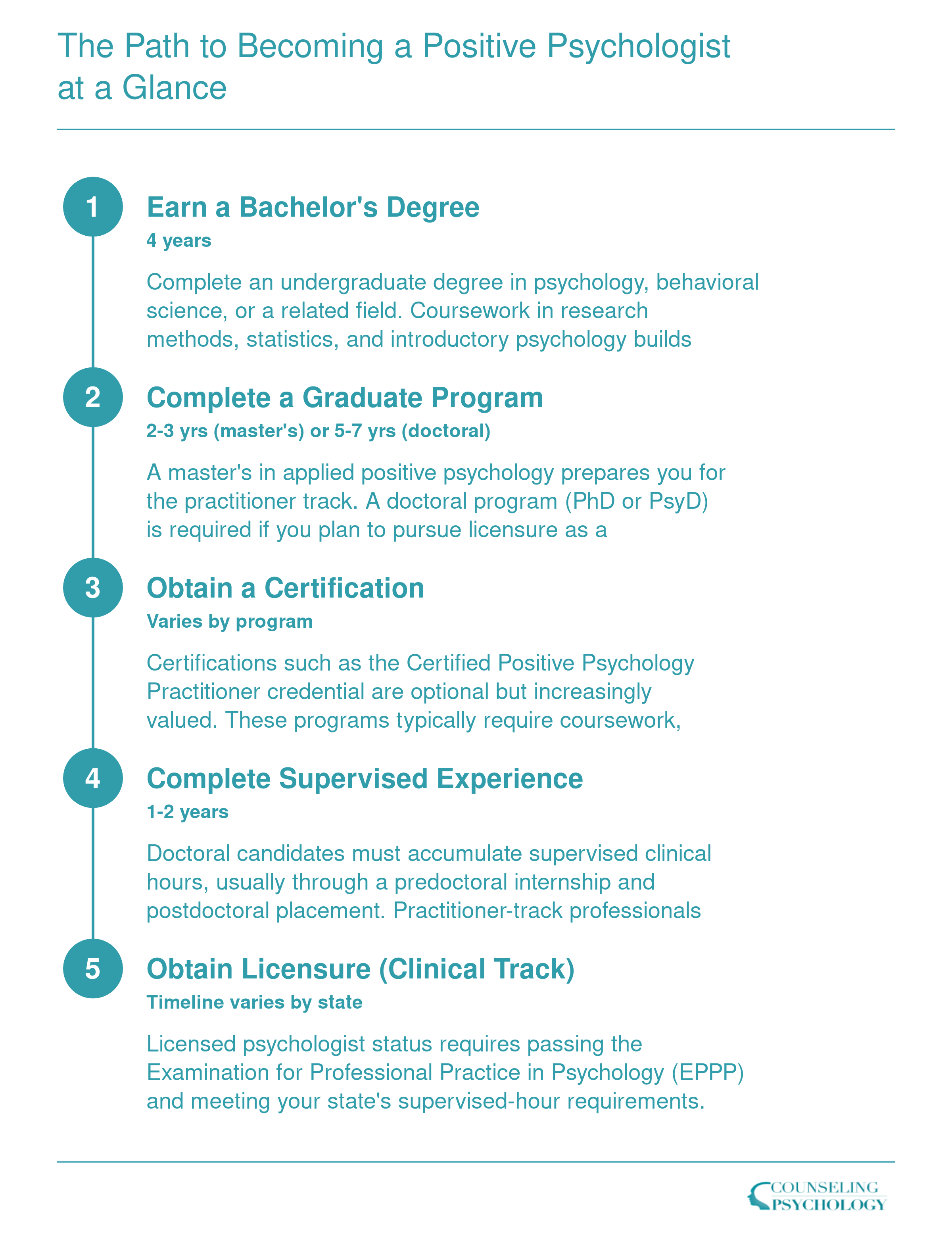
The Path to Becoming a Positive Psychologist at a Glance
Positive psychology careers follow one of two tracks. The practitioner track is shorter, combining a master's degree with a certification and typically taking six to seven years total. The licensed psychologist track requires doctoral training and supervised clinical hours, often spanning nine to thirteen years from start to licensure.
Step 1: Earn a Degree in Positive Psychology
Positive psychology does not yet have a single, standardized degree path the way clinical psychology does. Instead, you will find it woven into graduate programs across departments of psychology, applied psychology, and the behavioral sciences. Knowing where to look, and what questions to ask, saves considerable time.
Understand What Programs Actually Exist
A small number of universities offer graduate degrees with an explicit positive psychology focus. Three programs are frequently cited by practitioners in the field:
- University of Pennsylvania (MAPP): The Master of Applied Positive Psychology, launched by Martin Seligman's team, is a one-year, primarily in-person program based in Philadelphia. It draws students from coaching, education, healthcare, and organizational development.
- Claremont Graduate University: Offers graduate work in positive developmental psychology and well-being science, with options to pursue master's and doctoral-level study. Delivery is largely on-campus, though course formats evolve, so confirm current offerings directly with the department.
- University of East London: Its MSc in Applied Positive Psychology and Coaching Psychology is a well-known UK-based option that has historically attracted international students. Delivery formats have included both in-person and distance-learning tracks.
Beyond these, many universities embed positive psychology content into broader counseling psychology, educational psychology, or organizational psychology programs without labeling the concentration explicitly. Searching a program's faculty research profiles, course catalog, and dissertation topics often reveals more than the program title alone.
How to Research Your Options
Start with the official websites of programs you are considering. Look for mentions of well-being, flourishing, strengths-based approaches, or positive interventions in curriculum descriptions and faculty bios. The International Positive Psychology Association (IPPA) maintains resources and a professional network that can point toward degree programs and training opportunities. The Positive Psychology Center at the University of Pennsylvania similarly offers a resource hub worth bookmarking early in your search.
The U.S. Bureau of Labor Statistics (BLS.gov) is useful for a different reason: it outlines occupational categories related to the kind of work positive psychologists do, which helps clarify which credential or degree level a particular career track actually requires.
Contact Admissions Directly
Program details change. Cohort sizes shift, delivery formats move online or return to campus, and new concentrations are added. Before making any decision, contact the admissions office of each program you are seriously considering. Ask specifically about current degree type, total credit hours, delivery format, and how graduates typically use the degree in practice. That conversation will tell you more than any third-party directory.
Step 2: Choose a Certification or Training Program
The certification landscape in positive psychology is fragmented by design: no single national accreditor governs these credentials, so choosing a program means evaluating the issuing body's reputation, professional affiliations, and alignment with your career goals.
What 'Accredited' Actually Means Here
In most licensed mental health fields, accreditation means a recognized body such as the American Psychological Association has reviewed and approved a program's curriculum and faculty. Positive psychology certifications operate differently. The closest thing to an external quality signal is affiliation with the International Positive Psychology Association (IPPA), recognition by the International Coaching Federation (ICF) for coaching-oriented programs, or backing by an accredited university. None of these is equivalent to APA program approval, but they do provide meaningful external validation. When evaluating any certificate, ask whether the issuing organization has a track record in the field, whether trainers publish peer-reviewed research, and whether the credential is recognized by employers or licensing boards relevant to your intended role.
The Leading Programs Compared
- CAPP (Certified Applied Positive Psychology Practitioner): Issued by The Flourishing Center, this blended-format program combines online coursework with live practice components. It holds IPPA Level 3 recognition, the highest tier IPPA awards to training programs, which signals that the curriculum meets the association's standards for evidence-based content and practitioner competency.1
- Penn MAPP Certificate Track: The Positive Psychology Center at the University of Pennsylvania offers a certificate pathway connected to its Master of Applied Positive Psychology program. Delivered entirely online, it carries the weight of a Penn credential, which is useful for professionals who want university backing without committing to a full graduate degree.2
- IPPA-Affiliated Certificate Programs: A range of providers hold IPPA affiliation at various levels. Delivery format, cost, and depth vary widely across these offerings, so reviewing the specific curriculum and instructor credentials matters more here than the affiliation label alone.
- Harvard Extension School: Harvard Extension offers a graduate certificate in Positive Psychology and Well-Being.3 As a university-backed credential, it appeals to practitioners who want an academic institution's name associated with their training, and it can pair well with existing graduate coursework.
Certification Versus a Full Degree: Which Path Fits You
The honest answer depends on what you plan to do. A certificate is well-suited for coaches, organizational consultants, educators, and wellness professionals who want to apply positive psychology frameworks without pursuing clinical licensure. If your goal involves providing therapy, conducting psychological assessments, or working toward a license as a psychologist or licensed counselor, a certificate alone will not satisfy the degree requirements those pathways demand. Professionals on a clinical track may also consider counseling doctoral programs that allow room for a positive psychology specialization. In that case, the certificate is best viewed as a supplement to, not a substitute for, graduate-level academic training.
When comparing programs, prioritize transparency about cost, time commitment, and what the credential actually signals to the employers or clients you want to reach.
Questions to Ask Yourself
Step 3: Complete Supervised Experience and Licensure
A critical distinction shapes this step: licensure applies only if you are pursuing the doctoral-track psychologist path. If your goal is to work as a positive psychology coach or certified practitioner, state licensure is not required, though voluntary credentialing (covered in Step 2) strengthens your professional standing. Understanding which track you are on will determine how much time and structure this phase demands.
Supervised Clinical Hours for Doctoral Candidates
Every state requires doctoral graduates to accumulate a substantial number of supervised clinical hours before they can sit for the licensing exam. While the often-cited range nationally is 1,500 to 2,000 hours, many states set the bar considerably higher. New Jersey, New York, and Texas each require 3,500 total supervised hours, with at least 1,750 of those completed during a post-doctoral period.123 New Jersey further specifies a minimum of 1,000 direct client-contact hours and 200 hours of formal supervision, at least half of which must be individual.1 New York mandates at least two hours of supervision per week for full-time trainees (or two hours every two weeks for part-time).2 These requirements typically span a pre-doctoral internship (often APA-accredited) followed by one to two years of post-doctoral supervised practice. The supervised-experience process mirrors what candidates in other careers in psychology navigate, so doctoral students in positive psychology should plan accordingly.
The EPPP: Your National Licensing Gateway
The Examination for Professional Practice in Psychology, or EPPP, is the standardized test that virtually every state licensing board requires.3 It consists of 225 multiple-choice questions covering domains such as biological bases of behavior, cognitive-affective bases, social and cultural foundations, assessment, treatment, and ethics.1 Most states set a scaled passing score of 500, though New York converts this to a score of 75 on its own scale.2 The EPPP is widely regarded as rigorous; first-time pass rates for graduates of APA-accredited doctoral programs have historically hovered in the mid-80 percent range, while candidates from non-accredited programs tend to pass at notably lower rates. Thorough preparation, often involving several months of dedicated study, is the norm.
Title Protection: Why Your Title Matters
In most U.S. jurisdictions, the title "psychologist" is legally protected.1 Only individuals who hold a valid state license may use it. This is not merely a formality; unauthorized use can result in disciplinary action or fines. If you hold a master's degree and a positive psychology certification but do not have a doctoral-level license, you should use titles such as "positive psychology coach," "certified positive psychology practitioner," or a similar descriptor that accurately reflects your credentials. Misrepresenting yourself as a psychologist puts both your career and your clients at risk.
Continuing Education and Professional Community for Non-Licensed Practitioners
Practitioners who are not pursuing licensure still benefit from ongoing professional development and peer accountability. The International Positive Psychology Association (IPPA) offers membership that includes access to conferences, research updates, and networking with other professionals in the field. Organizations like the Positive Psychology Guild provide continuing education units and structured peer supervision, which can substitute for the formal oversight that licensed psychologists receive through their state boards. APA Division 17 (Society of Counseling Psychology) also publishes resources relevant to applied positive psychology work. Staying engaged with these communities helps non-licensed practitioners maintain ethical standards, keep pace with evolving research, and build credibility with clients and referral sources alike.
Whether you are logging your 3,500th supervised hour or building a coaching practice without a license, the common thread at this stage is accountability: to a supervisor, a professional community, or both.
Positive Psychology Practitioner vs. Licensed Psychologist
These two paths share a foundation in the science of well-being, but they differ sharply in scope of practice, timeline, and the populations you can serve. Understanding what each credential allows (and restricts) is essential before you commit years and tuition dollars to either route. The right choice depends on your intended client base, preferred work setting, and appetite for extended graduate training.
Pros
- Practitioner or coach path: you can complete certification in roughly one to two years at a fraction of doctoral program costs, letting you start earning sooner.
- Practitioner path offers flexibility to work across corporate wellness, education, nonprofit, and private coaching settings without state licensure constraints.
- Licensed psychologist path: you hold a protected title, can diagnose mental health conditions, bill insurance, and access a broader clinical scope of practice.
- Licensed psychologists generally command a higher earning ceiling and qualify for positions in hospitals, VA systems, and university counseling centers.
- APA ethical standards (Standard 2.01, Boundaries of Competence) provide licensed psychologists a structured framework that reinforces professional credibility with clients and employers.
Cons
- Practitioners cannot diagnose, treat mental disorders, or bill insurance; most states restrict use of the title 'psychologist' to licensed professionals, limiting how you market your services.
- The coaching and practitioner space is largely unregulated, which means credential quality varies widely and clients may question legitimacy without a recognizable license.
- Licensed psychologists face a seven to ten year (or longer) training pipeline that includes a doctoral degree, predoctoral internship, and postdoctoral supervised hours.
- Doctoral training carries significant education costs, and licensure requirements vary by state, so relocating can mean additional examinations or supervised hours.
- Licensed psychologists who also offer coaching may find that their state board treats those activities as psychology practice, adding regulatory and ethical complexity.
Positive Psychologist Salary and Job Outlook
The Bureau of Labor Statistics does not track positive psychologists as a separate category, so the figures below reflect the broader psychology occupations most closely aligned with this specialization. Depending on practice setting and credentials, a positive psychologist's earnings may fall anywhere within these ranges. Nationally, BLS data show roughly 154,860 psychologists employed across all subcategories, with about 12,900 openings projected annually through 2034. The overall psychologists group is expected to grow 6% from 2024 to 2034, roughly double the 3% average for all occupations. Clinical and counseling psychologists, the subcategory that captures many positive psychology practitioners, are projected to grow even faster at 11% (2022 to 2032).
| BLS Occupation | National Employment | 25th Percentile Salary | Median Salary | 75th Percentile Salary | Mean Salary |
|---|---|---|---|---|---|
| Psychologists (All) | 154,860 | $71,140 | $94,310 | $126,340 | $102,100 |
| Clinical and Counseling Psychologists | 72,190 | $67,470 | $95,830 | $131,510 | $106,850 |
| School Psychologists | 63,830 | $73,240 | $86,930 | $108,210 | $93,610 |
| Psychologists, All Other | 17,790 | $73,820 | $117,580 | $145,200 | $111,340 |
| Industrial-Organizational Psychologists | 1,050 | $80,790 | $109,840 | $198,170 | $134,400 |
Highest-Paying Metro Areas for Psychologists
The BLS tracks salary data for clinical and counseling psychologists, school psychologists, and a residual "all other psychologists" category that can include positive psychology practitioners. The table below focuses on clinical and counseling psychologists (BLS 19-3033) and the "all other" category (BLS 19-3039), since positive psychologists most often fall into one of these classifications. Keep in mind that higher metro salaries typically reflect elevated cost of living and stronger local demand for mental health services, not necessarily a premium for one specialization over another. A metro with a large employment base also signals more opportunity to build a caseload or join an established practice.
| Metro Area | BLS Category | Total Employment | Median Salary | 25th Percentile | 75th Percentile |
|---|---|---|---|---|---|
| San Francisco, Oakland, Fremont, CA | Clinical & Counseling Psychologists | 2,220 | $160,210 | $104,640 | $173,270 |
| Denver, Aurora, Centennial, CO | Clinical & Counseling Psychologists | 1,430 | $126,260 | $110,600 | $152,810 |
| Philadelphia, Camden, Wilmington, PA/NJ/DE/MD | Clinical & Counseling Psychologists | 2,090 | $106,330 | $75,150 | $138,720 |
| New York, Newark, Jersey City, NY/NJ | Clinical & Counseling Psychologists | 7,610 | $101,400 | $78,180 | $135,810 |
| Los Angeles, Long Beach, Anaheim, CA | Clinical & Counseling Psychologists | 3,760 | $100,330 | $80,340 | $134,820 |
| San Diego, Chula Vista, Carlsbad, CA | Clinical & Counseling Psychologists | 1,510 | $99,990 | $60,270 | $155,420 |
| Washington, Arlington, Alexandria, DC/VA/MD/WV | Clinical & Counseling Psychologists | 2,160 | $99,590 | $72,410 | $131,520 |
| Chicago, Naperville, Elgin, IL/IN | Clinical & Counseling Psychologists | 2,980 | $98,240 | $66,570 | $149,140 |
| Los Angeles, Long Beach, Anaheim, CA | Psychologists, All Other | 500 | $160,640 | $122,820 | $160,640 |
| Philadelphia, Camden, Wilmington, PA/NJ/DE/MD | Psychologists, All Other | 320 | $128,400 | $78,200 | $147,950 |
| Boston, Cambridge, Newton, MA/NH | Psychologists, All Other | 420 | $126,870 | $75,990 | $149,050 |
| New York, Newark, Jersey City, NY/NJ | Psychologists, All Other | 1,030 | $121,470 | $85,220 | $127,840 |
| Washington, Arlington, Alexandria, DC/VA/MD/WV | Psychologists, All Other | 730 | $112,880 | $80,130 | $146,680 |
| Milwaukee, Waukesha, WI | Psychologists, All Other | 380 | $107,550 | $73,880 | $137,880 |
Where Do Positive Psychologists Work?
The setting you choose shapes not just your daily work but also your earning potential and the credentials you will need to get there. Organizational roles tend to pay more than clinical ones, but clinical positions open the door to insurance-billable income that can create a steadier revenue floor. Understanding where positive psychology actually gets applied helps you match your training investments to realistic outcomes.
Private Clinical Practice
Clinicians in private practice draw on positive psychology frameworks, such as strengths identification, gratitude interventions, and well-being goal-setting, alongside traditional therapeutic approaches. This setting requires full licensure (LPC, LMFT, or licensed psychologist, depending on your degree level and state). The payoff is the ability to bill insurance and build a recurring caseload, though overhead costs for independent practice can be substantial.
Corporate Wellness and Organizational Development
This is one of the fastest-growing entry points for positive psychology practitioners. Companies hire well-being consultants, employee engagement specialists, and HR strategists to design programs around resilience, flourishing, and strengths-based management. Many corporate roles accept a master's degree combined with a recognized positive psychology certification rather than full clinical licensure. Compensation in this sector frequently exceeds what clinical roles pay, particularly at mid-to-large employers. For a broader look at how pay varies across the field, see our breakdown of counselor salary expectations.
Education: K-12 and Higher Education
School counselors, student affairs professionals, and curriculum designers integrate positive psychology to build social-emotional learning programs and campus well-being initiatives. K-12 roles typically require a state school counseling credential. College and university positions range from staff counselor (requiring licensure) to non-clinical roles in student success or residence life, where a certification may suffice.
Healthcare and Hospital Settings
Hospitals, rehabilitation centers, and integrated health clinics increasingly embed strengths-based care into chronic illness management and behavioral health units. These roles almost always require licensure, and often a doctoral degree for senior clinical positions.
Coaching, Consulting, and Emerging Areas
Independent coaching is credential-flexible: a certified positive psychology practitioner credential combined with an ICF coaching designation can be enough to build a practice. Emerging niches are worth watching closely. The U.S. Army's Comprehensive Soldier and Family Fitness program, developed in partnership with the University of Pennsylvania, put resilience training into large-scale institutional practice (those interested in military-adjacent work may also explore becoming an army behavioral health specialist). Tech companies, including major platform and software firms, now staff dedicated well-being teams. Public health agencies at the state and federal level are beginning to adopt strengths-based frameworks for community mental health. These areas do not yet have standardized credential requirements, which makes early entry more accessible but also means the landscape will likely formalize over the next decade.
The International Positive Psychology Association has grown to more than 2,000 members worldwide, reflecting the field's rapid expansion from academic theory to applied practice across coaching, healthcare, education, and organizational consulting. This global network connects researchers, practitioners, and students committed to the scientific study of human flourishing.
Frequently Asked Questions About Positive Psychology Careers
Positive psychology is a growing field, but the career path can look different depending on whether you pursue certification, a graduate degree, or full licensure. Below are answers to the questions prospective students ask most often.
Explore Careers
- BCBA
- Biogerontologist
- Child Psychologist
- Clinical Psychologist
- Cognitive Neuroscientist
- Cognitive Psychologist
- Comparative Psychologist
- Consumer Psychologist
- Counseling Psychologist
- Criminal Psychologist
- Cultural Psychologist
- Forensic Psychologist
- Air Force Psychologist
- Applied Psychologist
- Army Psychologist
- Educational Psychologist
- Engineering Psychologist
- Environmental Psychologist
- Experimental Psychologist