

What you’ll learn in this article…
- Most social psychology careers require a Ph.D., meaning roughly 10 to 12 years of education after high school.
- The BLS national median for psychologists in the "all other" category was $112,740 as of its latest published data.
- Social psychologists differ from sociologists and I-O psychologists in training, licensure requirements, and typical research focus.
- Applied roles in tech, consulting, and public health are growing alternatives to traditional academic positions.
Social psychology has quietly moved from the seminar room into product teams at Meta, behavior change units inside the CDC, and randomized policy trials run by governments. The field now spans tech UX research labs, public health messaging campaigns, jury consulting, and traditional tenure-track work, with applied roles growing faster than academic openings.
Becoming a social psychologist almost always requires a doctorate, with most students spending 10 to 12 years in higher education before securing a senior research role. The PhD-or-bust reality is the central tension: admission to funded doctoral programs is highly competitive, the opportunity cost is significant, and the resulting career can land anywhere from a university lab to a Series C startup.
Compensation, licensure rules, and job titles differ sharply depending on which side of that academic-applied line you end up on.
What Is a Social Psychologist?
Social psychologists study the scientific mechanisms by which the presence, actions, and expectations of others shape human thought, emotion, and behavior. Unlike clinical psychologists who diagnose and treat mental illness, or sociologists who examine large-scale institutional patterns, social psychologists focus on the psychological processes that govern interpersonal influence and group life. Their work sits at the intersection of individual cognition and social context, investigating how even subtle cues from others can redirect decisions, reshape self-perception, and trigger collective action.
Foundational Questions in Social Psychology
The field tackles a set of enduring questions, each grounded in experimental method and real-world application. Four stand out:
- Conformity: Why do people align their judgments with a group even when the group is clearly wrong? Solomon Asch's line-judgment experiments in the 1950s remain the archetype, and their logic surfaces today in jury deliberation research and peer-pressure interventions in public health campaigns.
- Prejudice: What cognitive shortcuts and social structures sustain discrimination, and how can they be disrupted? Gordon Allport's contact hypothesis laid the groundwork for modern diversity training, while implicit-association studies now inform hiring audits at Fortune 500 companies.
- Persuasion: Which message features drive attitude change, and under what conditions? Robert Cialdini's principles of influence (reciprocity, scarcity, authority) underpin everything from nonprofit fundraising appeals to user-experience design in mobile apps.
- Group Dynamics: How do roles, norms, and power differentials emerge in teams, and when do they lead to cooperation versus conflict? Philip Zimbardo's Stanford prison experiment, though ethically contested, spotlighted how quickly situational forces override individual disposition, a lesson now applied in organizational leadership training and military debrief protocols.
Where Social Psychologists Work
Although university research labs remain a common home, social psychologists also hold positions in federal agencies (the CDC, NIH, and Defense Department), technology companies (designing nudges to reduce misinformation spread), nonprofit advocacy groups (testing messaging to shift public opinion), and private consulting firms (advising on team cohesion and customer behavior). The skill set transfers wherever human behavior intersects with policy, product, or persuasion. Those exploring broader careers in psychology will find that social psychology's emphasis on experimental rigor opens doors across many of these sectors.
Educational Threshold for the Title
The professional designation "social psychologist" is generally reserved for those who complete a PhD in social psychology or a closely aligned doctoral program. That credential signals mastery of experimental design, statistical modeling, and theory development. However, graduates with a bachelor's or master's degree in social psychology pursue related roles such as research coordinator, user-experience researcher, data analyst in behavioral insights units, or program evaluator for social interventions. These positions draw on the same conceptual toolkit but stop short of the independent research and teaching authority that a doctorate confers.
What Does a Social Psychologist Do?
Academic research and applied practice look nothing alike on a Tuesday morning, and that contrast captures much of what makes social psychology an unusually flexible field.
A Day in Academic Social Psychology
A university-based social psychologist might spend the morning reviewing data from a lab experiment on conformity, the afternoon in a grant-writing session, and the evening preparing a lecture on attitude change. The core rhythm involves designing studies, collecting and analyzing behavioral or survey data, submitting manuscripts to peer-reviewed journals, and mentoring graduate students. Securing external funding through agencies like the National Science Foundation or National Institutes of Health is also a significant part of the job, often consuming more time than many early-career researchers expect.
A Day in Applied Social Psychology
The applied side looks considerably different. A behavioral scientist embedded in a tech company might run A/B tests on notification wording to study how framing affects user engagement. A consultant advising a government health agency might analyze messaging strategies for a vaccination campaign, drawing on research about social norms and risk perception. The work is faster-paced, the deliverables are internal reports rather than journal articles, and the audiences are product managers and policy directors rather than academic reviewers.
Common Activities Across Both Settings
Whether the setting is a university lab or a corporate research team, social psychologists tend to share a recognizable set of tasks:
- Study design: Creating experiments, surveys, or observational protocols to test behavioral hypotheses
- Data analysis: Working with quantitative and sometimes qualitative data to identify patterns in human behavior
- Communication: Translating findings into reports, presentations, or publications that inform decisions
- Intervention development: Building and testing programs meant to shift behavior, from public health nudges to workplace inclusion initiatives
- Consultation: Advising organizations on how social dynamics, bias, or group behavior affect outcomes
Where Applied Social Psychologists Actually Work
One of the more important things to know before entering this field: applied social psychologists rarely carry that exact job title. In tech, the same skill set shows up under roles like User Experience Researcher or Quantitative UX Researcher at companies including Meta and Microsoft, or as Behavioral Economist and Behavioral Scientist at Google and Airbnb.1 Google and Meta have both posted roles specifically requiring backgrounds in social psychology, cognitive psychology, or related behavioral science fields.1
In government, the U.S. Office of Evaluation Sciences and the U.S. Department of Veterans Affairs recruit PhD-level social and behavioral scientists to improve program design and policy messaging. The Centers for Disease Control and Prevention hires behavioral scientists to support public health communication. Internationally, the U.K. Behavioural Insights Team has become a well-known employer in this space.1
Consulting firms round out the picture. McKinsey and Deloitte both field behavioral science practices. Specialized shops like Ideas42 and Mathematica hire behavioral designers and senior researchers to work on social impact projects ranging from financial inclusion to criminal justice reform.
The demand cutting across all of these sectors reflects growing recognition that UX research, behavioral nudge units, DEI consulting, and public health communications are fundamentally problems about human behavior, which is exactly what social psychology trains people to study. According to the Bureau of Labor Statistics, employment of psychologists is projected to grow faster than average across several of these domains.
Social Psychologist Vs. Sociologist Vs. Related Roles
Social psychology, sociology, and industrial-organizational (I-O) psychology each examine human behavior from a different lens. Understanding the boundaries among these fields helps prospective students align their interests with the right graduate training.1 While all three rely on scientific methods, they target distinct levels of analysis: individual cognition in social settings, societal institutions, and workplace dynamics.
Social Psychologist: The Individual in Context
Social psychologists explore how a person's thoughts, feelings, and actions are shaped by the real or imagined presence of others. A PhD in social psychology usually sits within a psychology department, and training emphasizes tightly controlled laboratory experiments to test causal relationships.2 Licensure is not typically required for research and teaching roles. Common employers include universities, research institutes, and organizations that hire behavioral researchers.
Sociologist: Institutions and Social Systems
Sociologists study society at the group level, focusing on institutions, social structures, and patterns of inequality.3 A PhD in sociology comes from a sociology department, and the training prioritizes empirical research and data analysis at the macro level, often using surveys, historical records, and demographic data. No licensure is required. Typical employers are colleges and universities, government agencies, policy organizations, nonprofits, and some private-sector analytical roles.
Industrial-Organizational Psychologist: Workplace Dynamics
I-O psychologists apply psychological principles to improve hiring, productivity, engagement, and safety in organizations. Most professionals hold a master's or doctoral degree from a psychology department with a specialized I-O track.2 The focus is on data analytics, measurement, and applied workplace research. Licensure is not required. Employers range from private companies and consulting firms to HR departments and organizations seeking evidence-based solutions for employee evaluation, leadership, and workflow.
Key Distinctions at a Glance
- Unit of study: Social psychologists zoom in on the individual interacting with a social environment; sociologists zoom out to groups, institutions, and whole societies; I-O psychologists concentrate on individuals and teams within work settings.
- Typical degree: A PhD in psychology for social psychologists; a PhD in sociology for sociologists; a master's or PhD in I-O psychology (often housed in psychology departments).
- Dominant methods: Laboratory experiments for social psychology; surveys and demographic analysis for sociology; measurement, assessment, and applied analytics for I-O psychology.
- Common employers: Academia and research institutes for social psychologists; government, policy, and higher education for sociologists; corporations, consulting, and HR for I-O psychologists.
Salaries reflect the advanced training and sector of employment. The Bureau of Labor Statistics reports median wages separately for sociologists and psychologists, with I-O psychologists often grouped within the broader psychologist category. For detailed wage data by role and state, check the salary breakdown later in this article.
Related Articles
Social Psychology Education Requirements: From Bachelor's to Doctorate
How many years of school does it take to become a social psychologist? The answer depends on your career goals, but for most academic and senior research positions, plan on 10 to 12 years of higher education after high school. The pathway typically spans three degree tiers: a bachelor's, a master's (optional for some), and a doctoral degree. Each stage builds essential skills and research experience.
Building a Foundation: The Bachelor's Degree
A bachelor's in psychology usually takes four years of full-time study. This stage introduces you to core concepts but does not qualify you to work as a social psychologist. Focus on courses in research methods, statistics, and social psychology electives to prepare for graduate-level training. Look for opportunities to assist in a research lab or complete an independent project, because hands-on experience significantly strengthens PhD applications later. With only a BA, related roles like research assistant, human resources coordinator, or market research analyst become accessible, but the title "social psychologist" remains out of reach.
The Master's Degree: Applied Terminal or Academic Stepping Stone
A master's in social psychology or a closely related field typically adds two years. For some, this degree serves as a terminal credential that opens doors to applied positions in government, non-profits, or private industry (program evaluation, data analysis, or user experience research, for example). For others, it acts as a strategic stepping stone to a PhD. While many doctoral programs accept students directly from undergraduate studies, earning a master's first can compensate for a lower undergraduate GPA or limited research background. Online master's in psychology programs have grown in number, offering flexibility for working students, but on-campus options still provide richer mentorship and lab access. Expect the MA to deepen your knowledge of attitudes, group dynamics, and research design while giving you a clearer sense of whether a research career is right for you.
The Doctoral Degree: Where the Journey Peaks
A PhD or PsyD in social psychology takes four to seven years of full-time work beyond the bachelor's, though direct-entry programs (without a separate master's) can sometimes be completed in five to six years. This is the minimum requirement for faculty positions at colleges and universities, senior research roles in think tanks or government agencies, and many clinical research settings. Admission is fiercely competitive. National data from the American Psychological Association put the overall acceptance rate for psychology doctoral programs at about 13%.1 Social psychology programs at top research universities are often far more selective. For instance, the University of Houston reports an admit rate of 5 to 10%2, while Stanford hovers around 5.1% and UC Berkeley dips below 3%. Strong candidates present a record of research involvement, a clear statement of purpose, and typically a GPA above 3.5.2 The GRE remains required at many institutions, though some, like the University of Pennsylvania, now offer a waiver option4; programs that do require the GRE often look for percentile scores above the 70th mark.2 Most PhD programs provide full funding packages that cover tuition and include a stipend (commonly in the $20,000 to $35,000 range per year, depending on the university and location), making these programs financially viable for dedicated students. As you weigh direct-to-PhD versus the MA-first route, consider your undergraduate research depth and academic record. If you have significant lab experience and strong grades, applying directly to a doctoral program with a social psychology concentration is a viable path. If your profile is less polished, a research-focused master's can serve as a bridge, and many such programs publish clear employment and doctoral placement rates.
The Path to Becoming a Social Psychologist
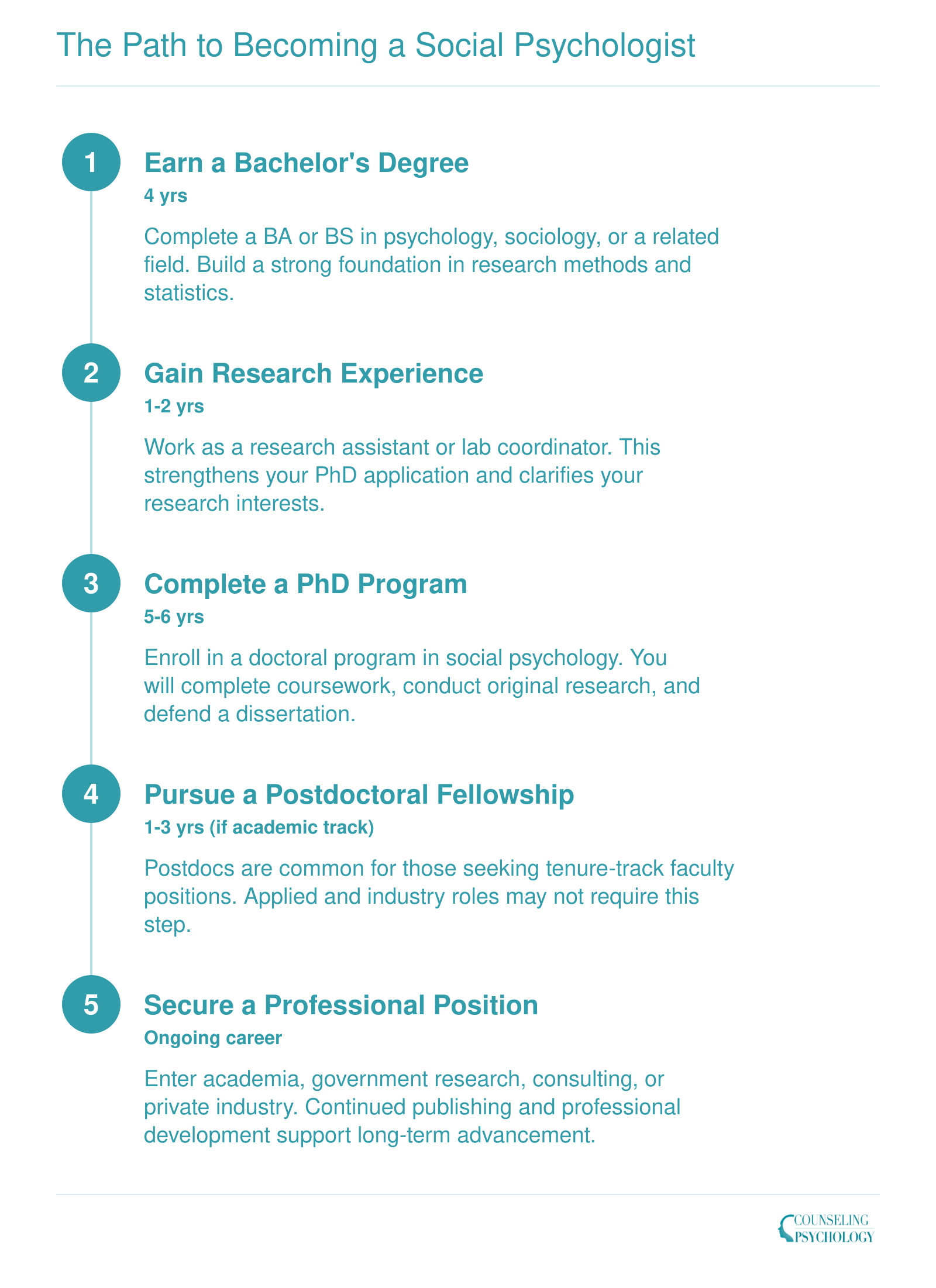
Most social psychology careers require a doctorate, which means a substantial investment of time. The full pathway from your first day of college to landing a professional role typically spans 10 to 15 years, depending on whether you pursue a postdoctoral fellowship.
Licensure and Certification for Social Psychologists
Academic research careers versus clinical practice roles demand fundamentally different credentials, and understanding this distinction is essential before investing time in licensure requirements that may not apply to your path.
The Biggest Misconception About Social Psychology Credentials
Most social psychologists working in universities, research institutions, or applied behavioral science settings do not need clinical licensure. This is the single largest gap in how people understand the profession. If you plan to conduct research, teach at the college level, work in UX research, consult on organizational behavior, or analyze consumer psychology, you typically do not need to sit for any licensing exam or obtain state approval to practice.
Your doctoral degree and publication record serve as your primary credentials in these settings. Employers hiring for research scientist roles, academic positions, or industry consulting care about your training, dissertation work, and demonstrated expertise rather than a clinical license.
When Licensure Becomes Necessary
Licensure requirements enter the picture under specific circumstances:
- Direct clinical services: If you provide therapy, psychological assessments, or clinical interventions to clients, you must hold a license in your state. Those drawn to this path should explore the steps to become a clinical psychologist, since that route aligns more closely with direct-service work.
- Protected title usage: Many states restrict who can call themselves a "psychologist." Even if you only do research, using this title without licensure can violate state law depending on where you practice.
- Forensic work involving clinical opinions: Serving as an expert witness on psychological matters often requires demonstrating licensed status. If courtroom psychology interests you, review the forensic psychologist requirements to understand what that career demands.
Licensure typically involves completing an APA-accredited doctoral program, accruing supervised postdoctoral hours, and passing the Examination for Professional Practice in Psychology (EPPP). Each state sets its own hour requirements and additional exams, so check your state board's specific standards.
Optional Board Certification
The American Board of Professional Psychology offers diplomate status with a specialty focus, including social psychology applications. This credential is entirely voluntary. It signals advanced expertise and can strengthen your credibility when consulting on forensic cases, serving as an expert witness, or seeking high-level consulting engagements. Most researchers and academics never pursue it because their work does not require this additional validation.
A Simple Decision Framework
Will your career involve direct client contact, clinical assessment, or using the protected title of psychologist in private practice or hospital settings? Pursue licensure. Will you conduct research, teach, analyze behavior for organizations, or work in applied settings where your job title does not require clinical credentials? You likely do not need it. Clarifying your intended career path early saves years of unnecessary preparation and keeps your focus where it matters most for your professional goals.
Questions to Ask Yourself
Social Psychologist Salary and Job Outlook
The Bureau of Labor Statistics does not publish a separate salary category specifically for social psychologists. However, most social psychologists fall under the "Psychologists, All Other" classification, which captures psychology specialties outside clinical, counseling, school, and industrial-organizational tracks. The national figures below offer a useful frame of reference, though individual earnings will vary by employer type, geographic location, and years of experience. Job growth for psychologists broadly is projected to outpace the average for all occupations, driven by rising demand for behavioral research expertise in healthcare, technology, and public policy settings.
| BLS Occupation | National Employment | 25th Percentile Salary | Median Salary | 75th Percentile Salary | Mean Salary |
|---|---|---|---|---|---|
| Psychologists, All Other (includes social psychologists) | 17,790 | $73,820 | $117,580 | $145,200 | $111,340 |
| Psychologists (all categories combined) | 154,860 | $71,140 | $94,310 | $126,340 | $102,100 |
| Clinical and Counseling Psychologists | 72,190 | $67,470 | $95,830 | $131,510 | $106,850 |
| Industrial-Organizational Psychologists | 1,050 | $80,790 | $109,840 | $198,170 | $134,400 |
| School Psychologists | 63,830 | $73,240 | $86,930 | $108,210 | $93,610 |
Highest-Paying States for Psychologists
Compensation for psychologists varies significantly by state, specialty, and local demand. The table below draws from BLS data for several psychology subcategories, highlighting states where median annual wages are highest. Because social psychologists are not tracked as a standalone occupation by the BLS, these figures cover related psychology roles and offer a useful benchmark for earning potential across the field.
| State | Psychology Subcategory | Median Annual Wage | 25th Percentile | 75th Percentile |
|---|---|---|---|---|
| California | Psychologists, All Other | $147,650 | $78,310 | $169,330 |
| Oklahoma | Psychologists, All Other | $147,010 | $103,330 | $161,350 |
| Nevada | Psychologists, All Other | $144,390 | $131,250 | $153,890 |
| California | Industrial-Organizational Psychologists | $140,540 | $106,330 | $168,510 |
| Nebraska | Psychologists, All Other | $137,990 | $93,790 | $163,880 |
| North Carolina | Psychologists, All Other | $137,130 | $90,440 | $157,190 |
| South Carolina | Psychologists, All Other | $135,950 | $115,090 | $152,960 |
| Texas | Industrial-Organizational Psychologists | $130,630 | $83,290 | $134,990 |
| New York | Clinical and Counseling Psychologists | $99,910 | $78,500 | $132,520 |
| New York | School Psychologists | $99,310 | $78,080 | $129,370 |
| Massachusetts | School Psychologists | $98,150 | $78,200 | $111,440 |
| Connecticut | School Psychologists | $98,080 | $78,630 | $110,110 |
| Iowa | Clinical and Counseling Psychologists | $98,580 | $73,520 | $124,640 |
| Georgia | School Psychologists | $96,810 | $80,890 | $109,140 |
| Oregon | Industrial-Organizational Psychologists | $94,180 | $76,980 | $132,140 |
Career Paths With a Social Psychology Degree
A social psychology degree opens doors to diverse careers beyond academia, spanning behavioral science roles in technology, consulting, public health, international development, and government. While traditional academic positions remain common for PhD holders, the applied behavioral science sector has grown significantly over the past decade, creating employer demand for professionals who understand how social context shapes decision-making, attitudes, and behavior. Below are concrete examples of career paths and employer types actively hiring social psychology graduates.
Behavioral Science Consulting Firms
Specialized consultancies apply social psychology research to organizational and policy challenges. ideas42, a nonprofit behavioral design lab with offices in New York and San Francisco, employs behavioral scientists to tackle problems in education, financial health, and criminal justice reform. The BVA Nudge Unit, headquartered in Paris with a presence in London, hires PhDs and master's-level researchers to design interventions for government and corporate clients across Europe. The Behavioural Insights Team, originally spun out of the UK government, now operates globally and recruits social psychologists for project management and applied research roles. These firms typically seek candidates with training in experimental design, statistics, and the ability to translate academic findings into actionable recommendations.
Technology and Product Research
Major technology companies employ social psychologists in user experience research, product design, and data science. Meta (formerly Facebook) hires behavioral scientists for its Core Data Science and User Experience Research teams to study social influence, group dynamics, and online behavior. Google's People Analytics and User Research divisions recruit PhDs to optimize workplace culture and consumer products. Microsoft Research employs social psychologists in its Computational Social Science group. LinkedIn's Economic Graph team analyzes professional networks and labor market trends, drawing on social psychology expertise. Startups focused on health tech, fintech, and EdTech also hire social psychologists to shape user engagement and behavior-change features.
Government and International Development
Federal agencies and international organizations apply behavioral insights to public policy. The Centers for Disease Control and Prevention (CDC) employs social psychologists in its Division of Health Communication and Marketing to design health campaigns addressing topics like vaccination uptake and chronic disease prevention. USAID's Development Innovation Ventures and behavioral science teams fund and evaluate interventions in global health, agriculture, and governance, often hiring PhDs for technical advisory roles. The World Bank's eMBeD (Mind, Behavior, and Development) unit integrates behavioral science into poverty-reduction projects worldwide, recruiting social psychologists as consultants and staff researchers.
Academic Medical Centers and Public Health
Health systems and research institutes hire social psychologists to study patient behavior, health disparities, and intervention design. The National Institutes of Health funds behavioral research positions across its institutes, particularly within the National Cancer Institute and National Institute on Drug Abuse. Academic medical centers like Johns Hopkins, UCSF, and Duke maintain behavioral medicine and health psychology divisions that employ social psychologists to lead prevention and adherence research.
Market Research and Consumer Insights
Market research firms such as Nielsen, Ipsos, and Kantar recruit social psychologists to analyze consumer attitudes, survey design, and audience segmentation. Corporate insights teams at companies like Procter & Gamble, Unilever, and PepsiCo employ behavioral scientists to inform branding, advertising, and product development strategies.
Finding Opportunities and Employer Intelligence
To explore these career paths in depth, visit the Bureau of Labor Statistics website to review occupational outlooks for Survey Researchers, Sociologists, and related roles, which provide data on job growth and median wages that inform social psychology career planning. Real-time job boards like Indeed and LinkedIn surface current openings when you search keywords such as "behavioral scientist," "applied social psychology," "nudge unit," or "user experience researcher." Many employers use these terms rather than "social psychologist" in job postings, so keyword variation is essential.
University career services pages and program alumni directories offer concrete job placement data and employer examples. Harvard's Department of Psychology and Stanford's social psychology program publish alumni outcomes showing recent placements. Professional associations provide exclusive career resources: the Society for Personality and Social Psychology (SPSP) maintains a job board and career development webinars, while the Association for Psychological Science (APS) publishes industry reports on non-academic roles for behavioral scientists. Networking via LinkedIn and informational interviews with professionals in target sectors helps you identify current job titles, understand day-to-day responsibilities, and learn which skills employers prioritize most.
Skills and Qualities for Success in Social Psychology
What skills do you actually need to succeed as a social psychologist, and how do they differ depending on whether you pursue an academic or applied career? The answer splits neatly into two categories: research and technical competencies on one side, and communication and interpersonal abilities on the other. Both matter, but the balance shifts depending on your career track.
Research and Technical Skills
Social psychology is, at its core, an empirical science. You will need a firm command of experimental design, survey methodology, and the ability to conduct rigorous literature reviews. Statistical fluency is non-negotiable. Most doctoral programs expect proficiency in tools like SPSS and R, and increasingly in Python as well, particularly for large-scale data analysis and text mining.
Modern social psychologists are also expected to engage with data science adjacent competencies. Familiarity with machine learning techniques, computational modeling, and large dataset management is becoming a genuine differentiator on the job market. Open science practices, including pre-registration of studies, transparent data sharing, and reproducibility protocols, are now standard expectations rather than optional extras.
Applied and Communication Skills
On the applied side, the ability to translate statistical findings into clear, actionable recommendations is what separates a good researcher from a valuable one. Data visualization skills help you present complex results to audiences who may have no statistical training. If you work in consulting, policy, or organizational settings, stakeholder communication becomes a daily requirement. You need to distill months of research into a five-minute briefing that drives real decisions.
For academic careers, scientific writing and grant writing are essential survival skills. Securing federal grants from agencies like the National Science Foundation or the National Institutes of Health often determines whether a research program thrives. For applied careers, polished presentation skills and the ability to build rapport with clients or organizational leaders carry equivalent weight. Professionals committed to growth should also recognize the importance of continuing education for psychologists, as the field's methods and ethical standards evolve rapidly.
Personal Qualities That Matter
Beyond technical ability, certain temperamental qualities serve social psychologists well:
- Intellectual curiosity: A genuine fascination with why people think, feel, and behave the way they do sustains motivation through the long slog of doctoral training and beyond.
- Comfort with ambiguity: Not every study produces a clean result. Null findings are common, and learning to interpret them productively rather than viewing them as failures is a mark of professional maturity.
- Ethical sensitivity: Social psychologists work with human subjects. Understanding the ethical complexities of deception paradigms, informed consent, and vulnerable populations is a baseline requirement, not an afterthought.
The most effective social psychologists combine analytical rigor with genuine empathy for the people they study. If you find yourself naturally drawn to both numbers and narratives, this field is designed for exactly that combination of strengths.
Frequently Asked Questions About Becoming a Social Psychologist
Below are answers to some of the most common questions prospective social psychologists ask. Each response draws on the education, licensure, salary, and career details covered throughout this article.
Explore Careers
- Become a Behavior Interventionist
- BCaBA
- BCBA
- Biogerontologist
- Child Psychologist
- Clinical Psychologist
- Cognitive Neuroscientist
- Cognitive Psychologist
- Comparative Psychologist
- Consumer Psychologist
- Counseling Psychologist
- Criminal Psychologist
- Cultural Psychologist
- Forensic Psychologist
- Air Force Psychologist
- Applied Psychologist
- Army Psychologist
- Educational Psychologist
- Engineering Psychologist
- Environmental Psychologist
- Experimental Psychologist