
What you’ll learn in this article…
- Becoming a child psychologist requires a doctoral degree (PhD or PsyD) and takes 8 to 12 years total.
- The national median salary for clinical and counseling psychologists is $95,830 according to BLS data.
- Bachelor's or master's holders cannot use the title psychologist but can pursue related roles in child mental health.
- Roughly one in five U.S. children ages 3 to 17 has a diagnosed mental, emotional, or behavioral condition.
Child psychologists are doctoral-trained clinicians who assess, diagnose, and treat mental, emotional, and developmental conditions in children and adolescents. Every U.S. state restricts the title to practitioners holding a PhD or PsyD, and the full path from freshman year to independent licensure runs roughly 8 to 12 years.
Demand is climbing. The CDC reports about 21% of U.S. children ages 3 to 17 have a diagnosed mental, emotional, or behavioral condition, and the pipeline of qualified providers has not kept pace. The tension for most prospective students is real: the doctoral requirement, supervised hours, and EPPP exam represent a significant time and tuition commitment before the $95,830 national median wage becomes accessible. For those exploring adjacent paths in the mental health field, counseling careers offer related but distinct entry points worth understanding before you commit to the doctoral track.
What Does a Child Psychologist Do?
Clinical work and research work: some child psychologists do one, some do both. Understanding where that line falls, and what happens on each side of it, helps clarify whether this career matches what you are imagining.
Core Clinical Responsibilities
At the most basic level, child psychologists are licensed mental health professionals who assess, diagnose, and treat emotional, behavioral, and developmental disorders in children and adolescents, generally from infancy through age 17. A typical caseload might include kids struggling with:
- Anxiety disorders: generalized anxiety, social anxiety, separation anxiety, and school refusal
- ADHD: attention difficulties, impulsivity, and executive function challenges
- Autism spectrum disorder: evaluating developmental milestones and supporting social and adaptive skills
- Trauma and PTSD: helping children process abuse, loss, accidents, or community violence
- Learning disabilities: identifying processing disorders that affect reading, writing, or math performance
Day-to-day work usually involves a mix of psychological assessments (standardized IQ tests, personality inventories, and behavioral rating scales), individual therapy sessions using approaches like cognitive behavioral therapy (CBT) or play therapy, and consultations with parents, teachers, and school counselors. Writing detailed treatment plans and progress notes is a constant part of the job, even for clinicians who find the paperwork less rewarding than the direct care.
Consulting Beyond the Therapy Room
Child psychologists rarely work in isolation. A significant portion of their time goes toward collaborating with schools on individualized education programs (IEPs), briefing pediatricians on a child's psychological profile, or coaching parents on behavior management strategies at home. This systems-level involvement is one thing that distinguishes the role from, say, a school counselor whose scope is narrower. Professionals interested in childhood trauma counseling often find that the child psychologist role offers a deeper clinical toolkit for these cases.
Clinical Practice vs. Research Roles
Some child psychologists spend their entire careers in clinical settings, including private practices, hospitals, community mental health centers, and school districts. Others split their time between direct client care and academic research, studying topics like early childhood adversity, developmental trajectories, or the effectiveness of specific interventions. The PhD is more common in research-oriented positions; the PsyD tends to attract those focused primarily on clinical work, though both degrees can open either path. The role shares meaningful overlap with a clinical psychologist, though the specialization in youth development sets child psychology apart.
One Important Boundary
Child psychologists do not prescribe medication. That authority belongs to psychiatrists and, in a small number of states, specially trained psychologists with prescriptive privileges. When a child may benefit from medication alongside therapy, a psychologist coordinates with a prescribing physician rather than handling it directly. That distinction shapes how child psychology compares to related careers in the field.
Child Psychologist Vs. Related Careers
Child psychology sits within a broader ecosystem of mental health and educational support roles, each with distinct training paths and scopes of practice. Understanding these differences helps you choose the credential that aligns with your clinical interests and career goals.
Child Psychologist
A child psychologist holds a doctoral degree (PhD or PsyD) and provides both psychological assessment and therapy to children and adolescents.1 Typically working in private practice, hospitals, outpatient clinics, or pediatric medical settings, child psychologists conduct diagnostic evaluations, administer standardized tests, and deliver evidence-based interventions for developmental, behavioral, and emotional concerns. They cannot prescribe medication in most states, though a small number of jurisdictions grant prescribing authority after additional postdoctoral training.
Child Psychiatrist
Child psychiatrists complete medical school (MD or DO) followed by a four-year residency in general psychiatry and an additional two-year fellowship in child and adolescent psychiatry.2 Because they hold a medical license, they can prescribe medication and order laboratory tests. Their practice centers on medical evaluation, diagnosis of psychiatric disorders, and pharmacological management, often in hospital or outpatient psychiatry settings. While some provide psychotherapy, many focus primarily on medication oversight and refer patients to psychologists or therapists for ongoing counseling.
School Psychologist
School psychologists typically earn a specialist-level degree (EdS) or doctoral degree and work within K-12 school districts.3 Their role emphasizes assessment for special education eligibility, consultation with teachers and parents, and the design of behavioral and academic interventions. Unlike child psychologists in clinical settings, school psychologists address learning disabilities, ADHD, and behavioral challenges within the educational context and rarely provide long-term individual therapy.
Licensed Child Therapist or Counselor
Master's-level clinicians (LPC, LMFT, LCSW) complete graduate programs in counseling, marriage and family therapy, or social work, followed by 2,000 to 4,000 hours of supervised experience.2 They provide psychotherapy in outpatient practices, community mental health centers, and schools but do not conduct formal psychological testing or prescribe medication. If you are interested in this pathway, you can learn more about how to become a child counselor. Their training focuses on therapeutic modalities rather than comprehensive diagnostic assessment.
Pediatric Psychologist
Pediatric psychologists hold doctoral degrees and specialize in the intersection of physical health and psychological well-being.1 Working in children's hospitals and pediatric clinics, they address issues such as chronic illness management, adherence to medical treatment, pain coping, and adjustment to hospitalization. Their work often involves collaboration with physicians, nurses, and other healthcare providers in integrated care teams. For a broader look at the field, explore other careers in psychology.
Child Psychologist Education Requirements
The doctoral degree is the legal foundation for independent practice as a psychologist in every U.S. state, but the education landscape is shifting as more graduate programs emphasize direct clinical training alongside research.
The Degree Pathway: Bachelor's to Doctorate
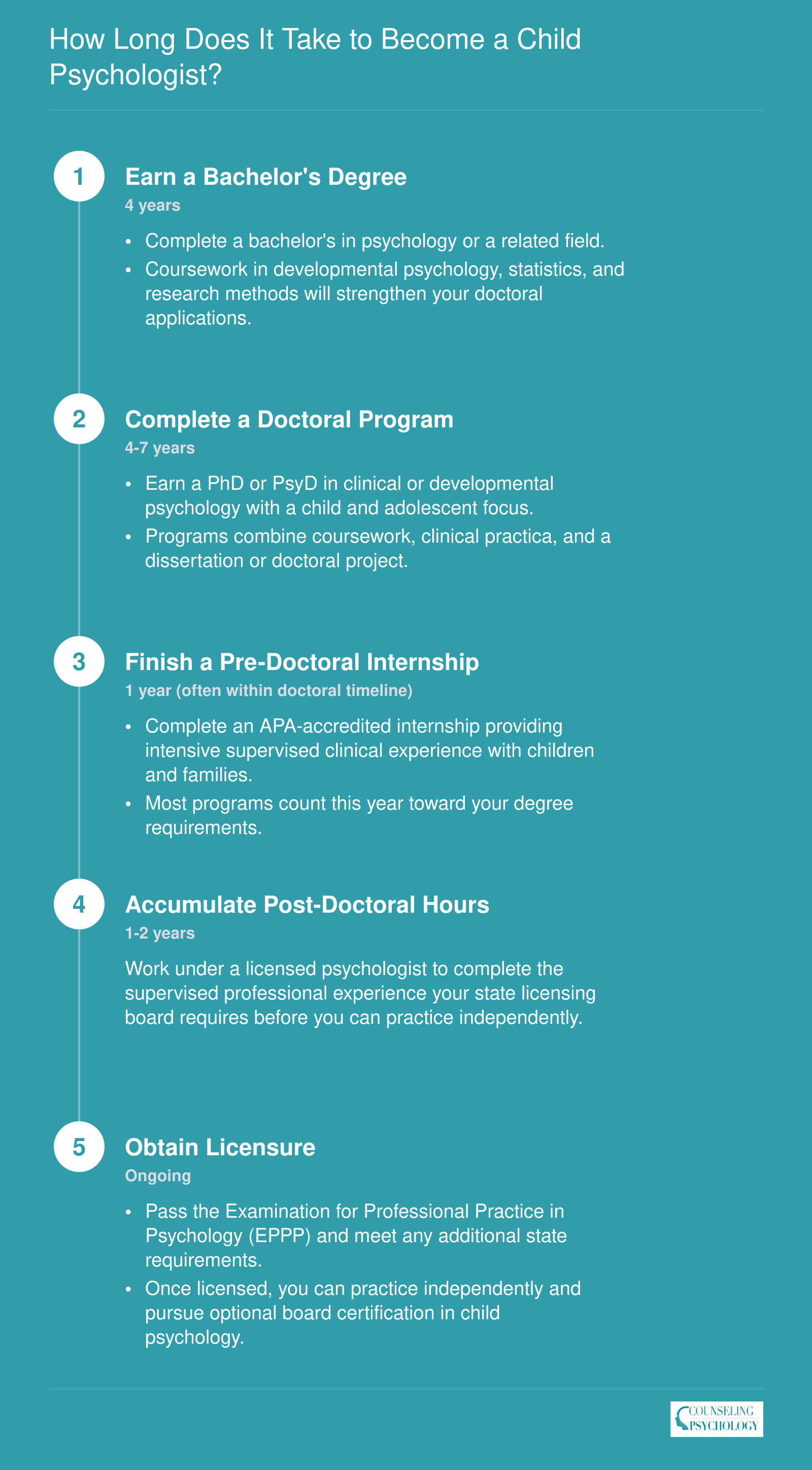
A career as a child psychologist starts with a four-year bachelor's degree, typically in psychology or a closely related field. Many doctoral programs require or strongly prefer applicants to have completed some graduate-level work first, so earning a master's degree in psychology, counseling, or child development is a common intermediate step. However, many PhD and PsyD programs admit students directly from undergraduate programs if their academic record is strong.
The core of child psychologist education requirements is the doctoral degree. A PhD or PsyD in clinical, counseling, or school psychology with a focus on children and adolescents takes 4 to 7 years of full-time study after the bachelor's degree, including coursework, supervised practica, a dissertation or doctoral project, and a full-time internship. In total, aspiring child psychologists spend roughly 8 to 12 years in higher education and supervised training before they can practice independently. Without a doctorate, you cannot legally call yourself a psychologist or provide independent psychological services in any state.
Choosing the Right Undergraduate Major
Psychology is the most common undergraduate major for future child psychologists because it covers the foundational concepts of human behavior, cognition, and development. That said, graduate programs do not require a specific major as long as you complete the prerequisite coursework. Majors such as developmental psychology, child development, neuroscience, or sociology can all work, provided they include rigorous training in research methods and human biology. Some students even combine a minor in psychology with a major in a related field to build a competitive application. Students interested in exploring the broader landscape of counseling degrees may find that certain programs overlap significantly with psychology prerequisites.
Building a Competitive Application with Key Coursework
Doctoral programs look for evidence that you can handle graduate-level scientific and clinical work. Typical prerequisite courses include: - Abnormal psychology: Understanding psychological disorders across the lifespan. - Developmental psychology: Core theories of cognitive, emotional, and social growth in children. - Statistics and research methods: Essential for consuming and conducting research. - Biology or physiological psychology: Basic neuroscience as it relates to behavior and mental processes.
In addition to coursework, hands-on experience such as volunteering in a child mental health setting, working as a research assistant in a developmental lab, or participating in a child-focused internship significantly strengthens your application.
PhD vs PsyD: Two Paths to Licensure
Both degrees prepare you for clinical licensure, but they differ in emphasis and structure. PhD programs are research-heavy, require a dissertation, and often provide funding through teaching or research assistantships. They typically take 5 to 7 years, including internship, and are ideal if you want to combine clinical work with academic or research careers. If your interests lean toward broader clinical populations, you may also want to review clinical psychologist degree requirements to compare training models.
PsyD programs emphasize clinical practice and applied skills. They still require a doctoral project or scholarly work, but the focus is on direct client contact. PsyD programs can often be completed in 4 to 6 years, though they are usually more expensive and offer less institutional funding. Both degrees meet licensure requirements, so your choice should align with your career goals and financial situation.
The Central Role of APA Accreditation
Graduating from an APA-accredited doctoral program is effectively a requirement for licensure in most U.S. states. Licensing boards almost universally require applicants to have completed an APA-accredited program and an APA-accredited internship. Board certification as a specialist in child or adolescent psychology through the American Board of Professional Psychology also mandates an accredited education. Attending a non-accredited program can severely limit your career options, even if the curriculum is strong. Always verify a program's accreditation status on the APA website before applying.
Related Articles
How Long Does It Take to Become a Child Psychologist?
From your first undergraduate course to independent practice, becoming a child psychologist typically takes 8 to 12 years. That timeline can sound daunting, but doctoral programs are deliberately structured to build clinical competence in stages, so each year prepares you for the next. And if you are wondering whether starting later puts you at a disadvantage: many doctoral cohorts include students in their mid-to-late 20s or older, and admissions committees regularly value the perspective that career changers and nontraditional applicants bring.
Licensure and Certification
Every state now requires aspiring psychologists to pass a standardized licensing exam before they can practice independently, yet the supervised experience needed to reach that milestone varies dramatically from one jurisdiction to the next. Understanding both the national exam and your state's specific requirements is essential for planning your timeline.
The EPPP: Your Gateway to Licensure
The Examination for Professional Practice in Psychology (EPPP) is the standardized test all states use to assess readiness for independent practice. Administered by the Association of State and Provincial Psychology Boards, the computer-based exam covers eight content domains: biological bases of behavior, cognitive-affective bases of behavior, social and cultural bases of behavior, growth and lifespan development, assessment and diagnosis, treatment and intervention, research methods and statistics, and ethical, legal, and professional issues. Candidates must achieve a scaled score of at least 500 out of 800 to pass in most jurisdictions.
Most candidates take the EPPP after completing their doctoral degree and partway through their supervised hours, though exact timing rules differ by state. The exam is offered year-round at Pearson testing centers. The process shares some structural similarities with licensure pathways in adjacent fields, such as forensic psychologist requirements.
State Variation in Supervised Hours
Post-doctoral supervised clinical hours represent one of the most variable licensing requirements across the country. Most states require between 1,500 and 2,000 hours, but the specifics can be quite different:1
- California: Uses a detailed postdoctoral supervised experience framework with multiple conditions rather than a single hour threshold, including specific supervision ratios and setting requirements.
- New York: Requires a formal supervised professional experience tied to registered supervision and a structured pathway.
- Texas: Maintains an explicit hour-based postdoctoral structure that many candidates find straightforward to track.
- Oregon: Known for detailed documentation standards regarding supervised practice.
Before committing to a supervision arrangement, verify your state board's exact requirements, as hours completed under improperly credentialed supervisors may not count toward licensure.
ABPP Board Certification
Once licensed, many child psychologists pursue voluntary board certification through the American Board of Professional Psychology (ABPP).2 The ABPP credential in Clinical Child and Adolescent Psychology signals specialty-level competence that goes beyond basic licensure.3
To qualify, candidates must hold a doctoral degree from an accredited program, maintain an active license, and have completed at least one full-time academic year of residency training.4 The certification process follows a standard pathway: credentials review, submission of practice samples demonstrating clinical work with children and adolescents, and an oral examination conducted by a committee of three or more board-certified peers.5
Employers in academic medical centers, children's hospitals, and specialized clinics often prefer or require board certification. The credential can also support higher reimbursement rates and leadership opportunities.
Maintaining Your License
Licensure is not a one-time achievement. Most states require psychologists to complete 20 to 40 continuing education hours during each renewal cycle, which typically spans one to two years. Topics often include ethics updates, cultural competency, and emerging treatment modalities. Some states mandate specific coursework in areas like child abuse reporting or suicide risk assessment. Keeping current with CE requirements protects your license and ensures your clinical skills remain sharp throughout your career.
Can You Work in Child Psychology With a Bachelor's or Master's Degree?
You cannot legally call yourself a child psychologist or work independently in that role with only a bachelor's or master's degree. Every U.S. state reserves the title "psychologist" for doctoral-level practitioners who have completed a PhD or PsyD, thousands of supervised hours, and a national licensing exam. This applies whether you want to work with children, adults, or any other population. If your goal is specifically to become a licensed psychologist who conducts psychological testing and uses that protected title, a doctorate is non-negotiable.
Bachelor's-Level Roles in Child Mental Health
That restriction does not mean a bachelor's degree is useless in the field. Numerous entry-level positions exist in the broader child mental health ecosystem, including behavioral technician, applied behavior analysis (ABA) therapist, case manager, residential youth counselor, and program coordinator roles. These positions typically involve direct support: implementing treatment plans written by licensed clinicians, collecting behavioral data, coordinating services, or supervising daily activities in group homes or after-school programs. Salaries are modest, often in the $30,000 to $45,000 range, and you work under the supervision of licensed professionals. These roles can provide valuable frontline experience and help clarify whether graduate school is the right next step.
Master's-Level Clinical Autonomy
A master's degree opens significantly more clinical independence. Licensed professional counselors (LPC), marriage and family therapists (MFT), clinical social workers (LCSW), and school counselors all hold master's-level credentials and can work with children under their own licenses. You will diagnose, deliver evidence-based therapy, write treatment plans, and bill insurance, all without doctoral oversight once you complete post-degree supervision requirements (typically 2,000 to 4,000 hours depending on the state and credential). Master's programs generally require two to three years of full-time study, and median salaries for these roles range from $50,000 to $70,000 depending on setting and geography.
Important Scope Limitations
Even with full licensure, master's-level clinicians face clear scope restrictions. You typically cannot administer or interpret psychological tests such as intelligence assessments, neuropsychological batteries, or personality inventories, as those fall within the psychologist's scope of practice. You also cannot use the title "psychologist" in marketing, business cards, or clinical documentation. If comprehensive assessment and diagnosis of complex developmental or learning disorders is central to your career vision, a doctoral program remains the only path.
Is a Two-Year Psychology Degree Worth It?
An associate's degree in psychology has extremely limited standalone career value. It qualifies you for very few positions beyond general human-services aide roles, and most employers require at least a bachelor's for serious consideration. An associate's can serve as an affordable stepping stone: complete general education and introductory psychology courses at a community college, then transfer to a four-year institution to finish a bachelor's. However, it is not an endpoint if you want a professional role in child psychology. Students weighing their options may also want to explore how to become a school counselor, a master's-level career that offers direct work with children in educational settings.
Questions to Ask Yourself
Child Psychologist Salary and Job Outlook
Child psychologists fall under the Bureau of Labor Statistics category for clinical and counseling psychologists (SOC 19-3033), which provides the closest available salary benchmarks. The national median annual wage for this group is $95,830, though earnings vary considerably by experience, setting, and geography. On the job outlook side, the BLS projects 11% growth for clinical and counseling psychologists from 2024 to 2034, which is faster than the average for all occupations and translates to roughly 28,900 new positions over the decade. Rising demand for children's mental health services, expanded insurance coverage, and greater awareness of developmental disorders are all fueling this growth.
| Occupation | Total National Employment | 25th Percentile Wage | Median Annual Wage | 75th Percentile Wage | Mean Annual Wage |
|---|---|---|---|---|---|
| Clinical and Counseling Psychologists | 72,190 | $67,470 | $95,830 | $131,510 | $106,850 |
| Child, Family, and School Social Workers | 382,960 | $47,480 | $58,570 | $74,060 | $62,920 |
| Psychology Teachers, Postsecondary | 41,610 | $62,290 | $80,330 | $106,640 | $93,530 |
Highest-Paying States for Child Psychologists
The BLS tracks compensation for clinical and counseling psychologists (SOC 19-3033), the category that includes most child psychologists. Salaries vary significantly by state, driven by cost of living, demand, and funding levels for children's mental health services. The table below shows the highest-paying states based on median annual wage data from the BLS.
| State | Median Annual Wage | Mean Annual Wage | 25th Percentile | 75th Percentile | Employed in State |
|---|---|---|---|---|---|
| New York | $99,910 | $112,980 | $78,500 | $132,520 | 7,190 |
| Iowa | $98,580 | $102,560 | $73,520 | $124,640 | 760 |
| Maine | $97,630 | $114,470 | $86,180 | $117,120 | 180 |
| Illinois | $97,470 | $106,360 | $66,570 | $138,890 | 3,470 |
| Tennessee | $92,320 | $103,190 | $81,790 | $120,450 | 780 |
| Mississippi | $92,390 | $95,140 | $64,390 | $101,360 | 200 |
| North Carolina | $91,840 | $99,940 | $68,660 | $117,060 | 2,420 |
| Oklahoma | $91,140 | $97,350 | $71,810 | $119,830 | 360 |
| Pennsylvania | $90,450 | $103,980 | $67,450 | $124,990 | 3,850 |
| Utah | $88,990 | $94,070 | $68,080 | $121,980 | 1,000 |
| Virginia | $87,110 | $105,480 | $68,990 | $110,970 | N/A |
| Massachusetts | $87,060 | $102,440 | $73,670 | $132,840 | 3,470 |
| Missouri | $86,340 | $90,480 | $60,710 | $115,130 | 1,490 |
| South Dakota | $85,790 | $87,040 | $62,300 | $105,890 | 100 |
| Florida | $84,020 | $92,010 | $49,690 | $126,460 | 3,230 |
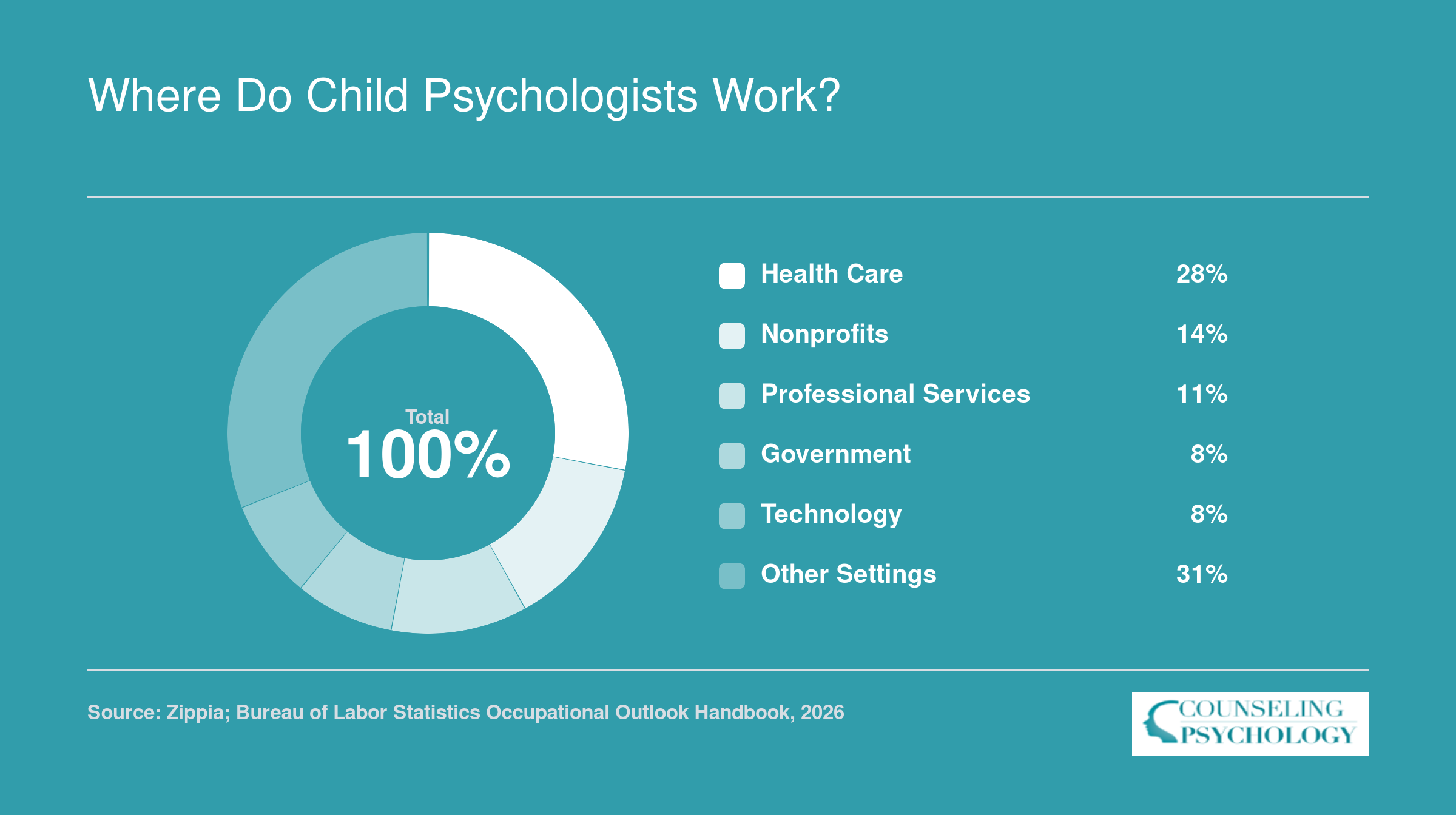
Where Do Child Psychologists Work?
Child psychologists practice across a range of clinical, educational, and community settings. Private practice is the most common destination, but it typically comes later in a career after you have built supervised experience and a referral network. Early-career professionals often start in hospitals, government agencies, or community mental health centers. Two emerging settings worth watching: telehealth-based child psychology practices and integrated primary care clinics, both of which have expanded steadily since 2020.
According to the Centers for Disease Control and Prevention, roughly one in five U.S. children ages 3 to 17, about 21%, had a diagnosed mental, emotional, or behavioral condition as of 2021. That staggering prevalence far outpaces the current supply of child psychologists, making this one of the most in-demand specialties in mental health care.
Common Questions About Becoming a Child Psychologist
Prospective child psychologists tend to ask the same practical questions about timelines, degrees, and career options. Below are direct answers drawn from current licensure standards, Bureau of Labor Statistics data, and professional practice guidelines.
Becoming a child psychologist requires sustained commitment: a bachelor's degree, a doctoral program (PhD or PsyD), supervised clinical hours, and state licensure. The 8 to 12 year timeline reflects deliberate, staged training that prepares you to work with children facing complex mental health challenges.
If you are ready to move forward, start researching APA-accredited doctoral programs that match your clinical interests and geographic preferences. Career changers and older students bring valuable life experience to this work, and graduate programs actively seek diverse backgrounds. With one in five U.S. children experiencing a diagnosed mental health condition, the need for qualified child psychologists continues to grow.
Explore Careers
- Become a Behavior Interventionist
- BCaBA
- BCBA
- Biogerontologist
- Clinical Psychologist
- Cognitive Neuroscientist
- Cognitive Psychologist
- Comparative Psychologist
- Consumer Psychologist
- Counseling Psychologist
- Criminal Psychologist
- Cultural Psychologist
- Forensic Psychologist
- Air Force Psychologist
- Applied Psychologist
- Army Psychologist
- Educational Psychologist
- Engineering Psychologist
- Environmental Psychologist
- Experimental Psychologist
- Navy Psychologist
- Neurologist
- Neuropsychologist
- Personnel Psychologist
- Physiatrist
- Police Psychologist
- Positive Psychologist
- Psychiatrist
- Psychological Anthropologist
- Psychometrician
- Psychometrist
- Registered Behavior Technician (RBT)
- Rehabilitation Psychologist in
- School Psychologist
- Social Psychologist
- Spiritual Psychologist
- Sports Psychologist