
What you’ll learn in this article…
- Becoming a cultural psychologist typically requires 10 to 12 years of education, culminating in a doctoral degree.
- Every U.S. state requires psychologists to pass the EPPP, with a recommended score of 500 on a 200 to 800 scale.
- BLS projects psychologist employment to grow 7 percent from 2024 to 2034, more than double the national average.
- California, Oklahoma, Nevada, and Nebraska rank among the highest paying states for psychologists in related BLS categories.
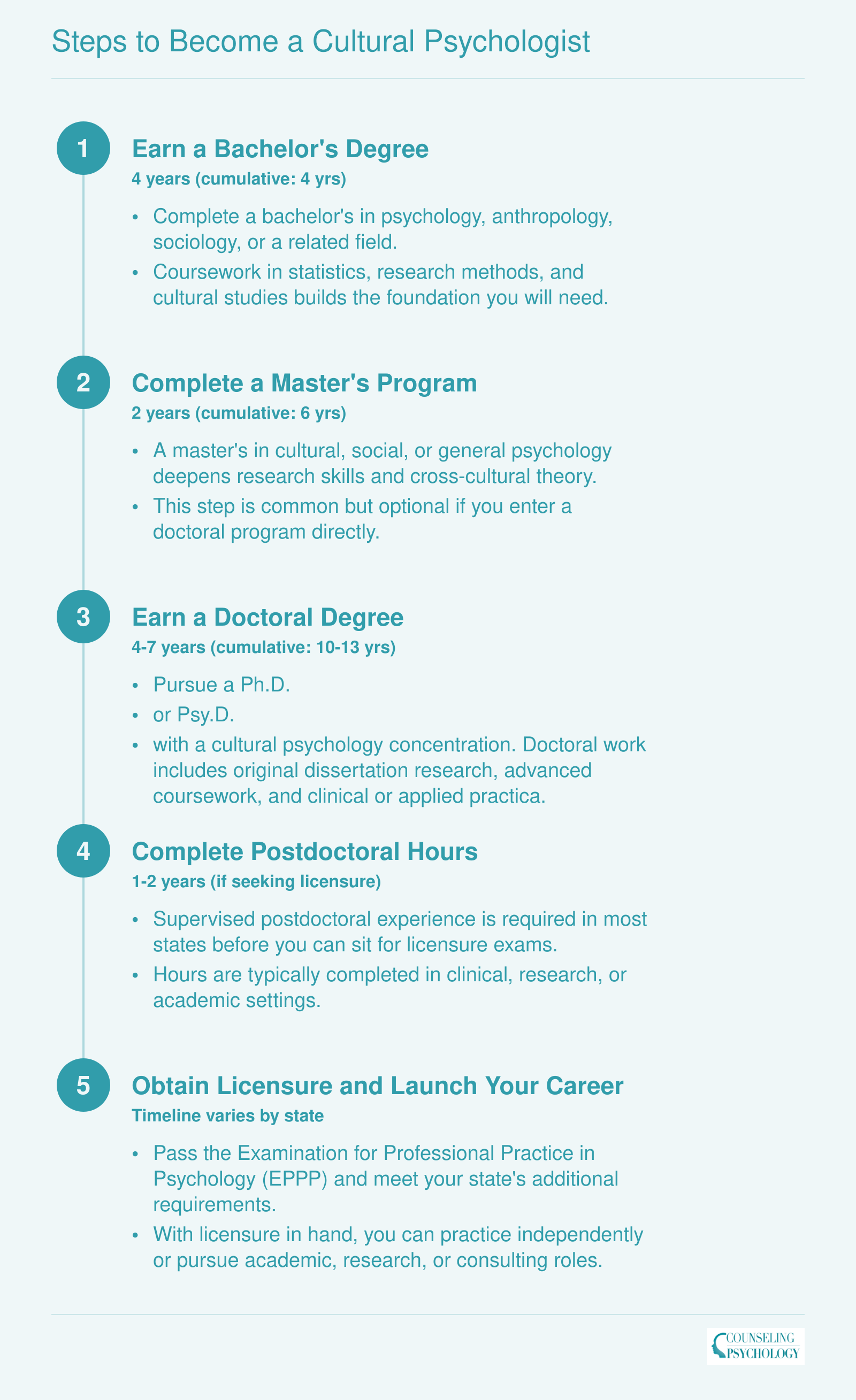
Demand for psychologists who can parse how culture shapes cognition, emotion, and behavior is climbing faster than the profession overall, with BLS projecting 7 percent employment growth for psychologists through 2034. Yet the path is long: earning a bachelor's degree, completing a master's or proceeding directly into a doctoral program, finishing a supervised postdoctoral year, and passing the EPPP typically adds up to 10 to 12 years of training before independent practice or a tenure-track appointment.
That timeline, combined with wide salary variation by state and setting, makes early planning essential. The investment pays differently depending on whether you land in academia, a federal research agency, or a global consulting firm. Below, we break down what cultural psychologists actually do, how the field compares to cross-cultural and multicultural psychology, and the education, licensure, and skill requirements you will need to navigate along the way.
What Does a Cultural Psychologist Do?
What exactly does a cultural psychologist do on a daily basis, and where do they apply their expertise? Cultural psychologists study how culture, ethnicity, race, and social context shape psychological processes (cognition, emotion, identity, behavior) and translate those insights into practical interventions, policy recommendations, and research. Their work spans academia, clinical practice, corporate settings, and government or nonprofit organizations, each demanding a distinct set of responsibilities.
Finding Real Job Descriptions and Day-to-Day Duties
The Bureau of Labor Statistics groups cultural psychologists under the broader psychologist occupation and describes core functions such as conducting research, designing experiments, analyzing data, and applying findings to solve real-world problems. To narrow that general frame to cultural psychology specifically, review resources from APA Division 45, the Society for the Psychological Study of Culture, Ethnicity and Race. Division 45 advances psychology as a science and applies research findings to address minority concerns through conference planning, mentorship programs, and position statements on racial justice.1 The division's journal, *Cultural Diversity & Ethnic Minority Psychology*, publishes studies that advance the science of culture, ethnicity, and race and often profiles researchers whose career paths illustrate how cultural psychologists work in practice.2
The International Association for Cross-Cultural Psychology offers additional practitioner profiles and career resources that show how cultural psychologists collaborate across borders, design culturally adapted interventions, and consult on international development projects. University psychology department websites, especially those offering graduate programs in cultural or cross-cultural psychology, frequently list alumni career paths, detailing positions in academic research, clinical assessment, diversity and inclusion consulting, and program evaluation for NGOs.
Day-to-Day Responsibilities Across Work Settings
In academia, cultural psychologists design and conduct studies on topics such as acculturation stress, racial identity development, or cultural variations in parenting. They teach courses in multicultural psychology, mentor graduate students, publish peer-reviewed articles, and secure grant funding. Clinical cultural psychologists assess and treat clients from diverse backgrounds, adapting evidence-based therapies to fit cultural values and communication styles, and often supervise trainees in culturally responsive practice. Professionals interested in related clinical roles may also explore multicultural counseling as a complementary career path.
In corporate settings, cultural psychologists consult on global workforce strategies, design cross-cultural training programs, evaluate employee engagement across regions, and advise product teams on culturally appropriate marketing. Government and nonprofit roles, searchable on platforms such as USAJobs or UN Careers, require cross-cultural expertise for policy analysis, community intervention design, program evaluation, and international development. Job boards including APA PsycCareers, HigherEdJobs, and Indeed list openings with detailed descriptions: keywords such as "cultural psychologist," "diversity researcher," or "cross-cultural consultant" return postings that specify daily tasks, required competencies, and expected deliverables in each setting.
Cultural Psychology Vs. Cross-Cultural Psychology
These two branches of psychology share an interest in culture, but they frame the relationship between culture and the mind quite differently. A third discipline, multicultural psychology, rounds out the picture with a clinical and social justice lens. Understanding where they overlap and diverge will help you position yourself within the field.
Cultural Psychology
Cultural psychology starts from the premise that culture and mind are mutually constitutive: you cannot peel one away from the other.1 Researchers in this tradition immerse themselves in specific cultural meaning systems, local rituals, and everyday practices to understand how a particular way of life shapes selfhood, emotion, or cognition. Methods tend to be qualitative or mixed, relying on culture-grounded measures rather than standardized instruments imported from another context. A typical research question might ask how a specific community practice influences the way members experience grief or define personal success.
Cross-Cultural Psychology
Cross-cultural psychology treats culture more like an independent variable. The goal is comparison: are psychological constructs, effects, or developmental patterns universal, or do they shift across groups?2 Researchers use cross-group surveys, controlled experiments, and statistical invariance testing to answer that question. Where cultural psychology digs deep into one context, cross-cultural psychology casts a wide net across many. A representative study might test whether a well-known cognitive bias replicates in collectivist and individualist societies.
Multicultural Psychology
Multicultural psychology turns the focus inward, examining diversity within a single society. It centers on race, ethnicity, immigration status, and intersecting dimensions of identity, with a strong emphasis on inequality, oppression, and social justice.2 Methods range from surveys and qualitative interviews to community-based participatory research and intervention studies. APA Division 45, the Society for the Psychological Study of Culture, Ethnicity, and Race, is a major hub for scholarship in this area. A driving question in the field might explore how systemic racism and intersecting identities affect mental health outcomes and the effectiveness of clinical interventions.
Where the Three Converge
In practice, the boundaries are porous. Many graduate programs blend coursework from all three traditions, and working professionals routinely draw on insights across these lines. A cultural psychologist consulting for a global health organization may need the comparative data that cross-cultural research provides, while a multicultural counselor benefits from the deep contextual understanding that cultural psychology cultivates. If you are evaluating graduate programs, look at faculty research profiles and course catalogs rather than relying on a program title alone. The label "cultural psychology" might sit inside a department that leans heavily toward cross-cultural methods, or a multicultural psychology track might incorporate ethnographic fieldwork more typical of cultural psychology.
Knowing where each tradition places its emphasis helps you choose the right research training and, eventually, the right career niche. Most professionals who call themselves cultural psychologists have at least a working familiarity with all three perspectives.
Questions to Ask Yourself
Steps to Become a Cultural Psychologist
The path to becoming a cultural psychologist typically spans 10 to 12 years of education and training. Some students enter doctoral programs directly after earning a bachelor's degree, which can shorten the overall timeline by up to two years.
Education Requirements: From Bachelor's Through Doctorate
Cultural psychology demands the deepest educational investment of any psychology specialty, with doctoral training serving as the standard credential for independent research and academic positions.1
Building Your Foundation at the Bachelor's Level
Undergraduate preparation should blend psychology with social science breadth. A major in psychology, anthropology, or sociology provides the strongest base, though double majors or minors across these disciplines often prove advantageous during doctoral admissions. Prioritize coursework in introductory cultural psychology (if offered), research methods, statistics, and developmental psychology. Courses in linguistic anthropology, cross-cultural communication, and ethnic studies round out your preparation.
Beyond coursework, hands-on experience matters enormously. Seek research assistant positions with faculty studying culture, identity, or intergroup processes. Study abroad programs and multicultural field research demonstrate genuine engagement with cultural contexts, and admissions committees notice this experience. Many successful doctoral applicants completed honors theses examining cultural variables, showcasing their ability to design and execute independent research.
Master's Programs: Specialization Within Broader Fields
Dedicated master's degrees labeled "cultural psychology" remain uncommon. Instead, most students pursue master's degree in psychology training in social, developmental, or general psychology while selecting cultural coursework and thesis topics. Some programs in applied anthropology or human development also accommodate cultural psychology interests.
When evaluating master's programs, look for faculty whose research addresses cultural processes, identity formation across groups, or psychological dimensions of immigration and globalization. A master's degree can strengthen your doctoral application if your undergraduate record needs bolstering, though many competitive Ph.D. programs admit students directly from bachelor's programs.
Doctoral Training: The Terminal Degree
The doctorate represents the field's terminal credential. Two primary paths exist:
- Ph.D. programs: Emphasize original research, statistical training, and preparation for academic or research careers. Most cultural psychologists hold Ph.D.s.
- Psy.D. programs: Focus on clinical practice and applied assessment. These suit students wanting to provide therapy with cultural competence, though pure cultural psychology research positions typically require the Ph.D. Students drawn to the clinical route may also want to explore the path to become a clinical psychologist.
Several universities host notable doctoral programs or research concentrations in cultural psychology:1
- University of Michigan offers the Culture and Cognition program within its psychology department, emphasizing how cultural contexts shape thought and behavior.
- Columbia University houses a Cultural Psychology area producing influential scholarship on self, emotion, and meaning across societies.2
- University of Pennsylvania includes Social and Cultural Psychology within its Ph.D. program, blending experimental and cultural approaches.3
- University of Chicago operates the Committee on Human Development, an interdisciplinary doctoral program where students examine psychological processes within cultural and historical contexts.
- UCLA provides doctoral training through its Program for Psychocultural Studies and Medical Anthropology, bridging anthropological and psychological methods.
- UC San Diego offers a Ph.D. in Anthropology with psychological anthropology as a specialization, ideal for students wanting deeper ethnographic training.
UC Santa Cruz and other institutions support cultural psychology research through social psychology programs, even without dedicated program labels. When evaluating doctoral options, investigate specific faculty research rather than relying solely on program names.
Is 25 Too Late to Start?
Absolutely not. Many doctoral students in psychology begin their programs in their late 20s or 30s, and some enter even later. Life experience, professional maturity, and clear research direction often strengthen applications. Graduate programs value candidates who demonstrate genuine intellectual commitment, regardless of age. If anything, applicants with work experience in culturally diverse settings bring valuable perspective to their research.
Alternative Entry Routes
Professionals trained in anthropology, sociology, social work, or public health can transition into cultural psychology through several pathways. Interdisciplinary doctoral programs like the Committee on Human Development at the University of Chicago explicitly welcome applicants from diverse academic backgrounds. Postdoctoral retraining offers another option for those holding doctorates in related fields who want to redirect their research toward cultural psychology questions. Cross-disciplinary collaboration, increasingly common in academia, also creates opportunities for researchers to engage with cultural psychology without formal retraining. For a broader look at the landscape, our overview of careers in psychology covers many related paths.
Licensure and Certification Requirements
Every U.S. state and territory requires psychologists to pass the Examination for Professional Practice in Psychology (EPPP), and the Association of State and Provincial Psychology Boards (ASPPB) sets a recommended pass score of 500 on a scaled range of 200 to 800. Most jurisdictions adopt that 500 benchmark, but a handful set their own cut score, so the first move in any licensure plan is to confirm your state's exact threshold before you sit for the exam.
State Variation in Supervised Hours
Supervised professional experience is the other gating requirement, and the hour count varies more than newcomers expect. Most states require roughly 1,500 to 2,000 postdoctoral hours, while a growing number (including California, Washington, and Utah) have eliminated the postdoctoral requirement and accept supervised hours accrued during the doctoral program instead. Predoctoral internship hours, typically 1,500 to 2,000, are nearly universal. Because the rules shift, check your state psychology licensing board's website directly, then cross-reference with the ASPPB Handbook of Licensing and Certification Requirements for a side-by-side comparison.
A few other state-level items to verify:
- Jurisprudence exam: Many states add a separate law and ethics test covering local statutes.
- Coursework audits: Some boards require specific coursework in cultural diversity, ethics, or assessment as a condition of licensure.
- Background checks and fees: Fingerprinting, character references, and application fees in the $400 to $800 range are common.
Voluntary Credentials for Cultural Psychologists
Beyond the state license, two voluntary credentials carry weight in cultural psychology work. Board certification through the American Board of Professional Psychology (ABPP) signals advanced competence in a specialty area; ABPP offers specialty boards in clinical, counseling, and other areas relevant to culturally focused practice, and the process involves credential review, a practice sample, and an oral exam. If you are still exploring the broader credentialing landscape, our guide to counseling licensure acronyms breaks down common designations. The American Psychological Association's Division 45 (Society for the Psychological Study of Culture, Ethnicity and Race) offers membership, mentorship, and recognition that strengthen a cultural psychologist's professional identity, though it is not a license.
For a general overview of psychologist credentialing, the Bureau of Labor Statistics is a reasonable starting point, but the binding details always live with your state board and ASPPB.
Related Articles
Essential Skills and Competencies for Cultural Psychologists
Mastering cultural psychology demands a blend of methodological fluency, interpersonal nuance, and the capacity to turn research into actionable insights. Unlike areas that rely solely on large-scale surveys, cultural psychology often requires deep engagement with small, hard-to-reach communities, where qualitative depth is as critical as quantitative precision. The skills below reflect the real-world demands of the field.
Research Methods: Depth Over Breadth
Cultural psychologists routinely draw on qualitative and mixed-methods approaches that capture lived experience. Ethnography, narrative analysis, and participatory action research are central tools, especially when studying populations where standardized measures fall short. These methods reveal how cultural meanings shape behavior in ways that surveys alone cannot. At the same time, quantitative skills remain vital for validating findings and conducting cross-cultural comparisons. The ideal researcher pairs statistical literacy with the intuition to know when a single in-depth interview carries more weight than a hundred questionnaires.
Cultural Humility and Ethical Practice
The APA's multicultural competency guidelines emphasize that expertise in cultural psychology is never truly finished. Cultural humility is an ongoing practice of self-reflection, recognizing the limits of one's own perspective and remaining open to learning from the communities you serve. Reflexivity (examining how your identity and biases influence your work) is built into every stage, from hypothesis design to dissemination. This mindset protects against unintentional harm and strengthens the credibility of your findings. It also aligns with recent revisions to the APA Ethics Code, which stress respect for diverse worldviews and the avoidance of cultural insensitivity.
Language as a Bridge
Fluency or even working proficiency in a second language is one of the strongest assets a cultural psychologist can bring to fieldwork. It opens doors to communities that mistrust outsiders and enables data collection that retains linguistic and cultural authenticity. For research involving interviews, oral histories, or collaborative design, language skills reduce reliance on interpreters and minimize translation errors that can distort results. Even in domestic settings, familiarity with local dialects or heritage languages strengthens rapport and deepens the ecological validity of the research.
Navigating the Funding Landscape
Academic cultural psychologists depend heavily on external grants to sustain their work. The National Science Foundation (NSF) and National Institute of Mental Health (NIMH) are primary sources, with dedicated programs for cultural and behavioral science. These grants demand rigorous proposals that clearly articulate theoretical frameworks, community engagement plans, and potential for societal impact. Beyond securing funds, effective grant writing requires aligning your research questions with agency priorities while retaining intellectual independence. Early-career researchers often benefit from mentorship programs and pilot grants that help build a track record.
Bridging Research and Practice
Cultural psychology's value extends well beyond academia. Whether consulting for organizations, advising on policy, or leading diversity, equity, and inclusion (DEI) initiatives, psychologists must translate nuanced findings into practical recommendations. Professionals who pursue clinical psychologist training, for example, learn to design culturally adapted interventions that resonate across populations. This means replacing jargon with clear briefs and communicating evidence to stakeholders with no research background. The ability to pivot from peer-reviewed journals to boardroom presentations or legislative testimony is what transforms insights into impact.
Cultural Psychologist Salary: National Overview
The Bureau of Labor Statistics does not track cultural psychologists as a standalone occupation, so the closest national proxy is the "Psychologists, All Other" category, which captures specialty roles outside clinical, counseling, school, and industrial-organizational psychology. Below is a comparison of national median and percentile wages across major psychologist categories. Cultural psychologists with doctoral training who work in research, consulting, or academia may fall anywhere along this range depending on employer, geography, and years of experience.
| Occupation | Total Employment | 25th Percentile Salary | Median Salary | 75th Percentile Salary | Mean Salary |
|---|---|---|---|---|---|
| Psychologists, All Other | 17,790 | $73,820 | $117,580 | $145,200 | $111,340 |
| Clinical and Counseling Psychologists | 72,190 | $67,470 | $95,830 | $131,510 | $106,850 |
| School Psychologists | 63,830 | $73,240 | $86,930 | $108,210 | $93,610 |
| Industrial-Organizational Psychologists | 1,050 | $80,790 | $109,840 | $198,170 | $134,400 |
| Psychologists (All Categories Combined) | 154,860 | $71,140 | $94,310 | $126,340 | $102,100 |
Highest-Paying States and Metro Areas for Psychologists
Because the Bureau of Labor Statistics does not track "cultural psychologist" as a standalone occupation, the table below draws on the closest available BLS categories at the state level. California, Oklahoma, Nevada, and Nebraska consistently top the list for the "Psychologists, All Other" classification, which captures many specialty and research psychologists. Keep in mind that cost of living varies significantly across these states, so a high median salary does not always translate to greater purchasing power.
| State | BLS Category | Median Annual Salary | 25th Percentile | 75th Percentile | Estimated Employment |
|---|---|---|---|---|---|
| California | Psychologists, All Other | $147,650 | $78,310 | $169,330 | 1,780 |
| Oklahoma | Psychologists, All Other | $147,010 | $103,330 | $161,350 | N/A |
| Nevada | Psychologists, All Other | $144,390 | $131,250 | $153,890 | 100 |
| Nebraska | Psychologists, All Other | $137,990 | $93,790 | $163,880 | 50 |
| North Carolina | Psychologists, All Other | $137,130 | $90,440 | $157,190 | 480 |
| South Carolina | Psychologists, All Other | $135,950 | $115,090 | $152,960 | 140 |
| California | Industrial-Organizational Psychologists | $140,540 | $106,330 | $168,510 | 100 |
| New York | Clinical and Counseling Psychologists | $99,910 | $78,500 | $132,520 | 7,190 |
| New York | School Psychologists | $99,310 | $78,080 | $129,370 | 7,250 |
| Massachusetts | School Psychologists | $98,150 | $78,200 | $111,440 | 2,730 |
| Connecticut | School Psychologists | $98,080 | $78,630 | $110,110 | 1,100 |
| Georgia | School Psychologists | $96,810 | $80,890 | $109,140 | 1,670 |
The Bureau of Labor Statistics projects that employment of psychologists will grow 7 percent from 2024 to 2034, more than twice as fast as the average for all occupations (3.1 percent), driven by increasing demand for mental health services across diverse populations.
Where Cultural Psychologists Work
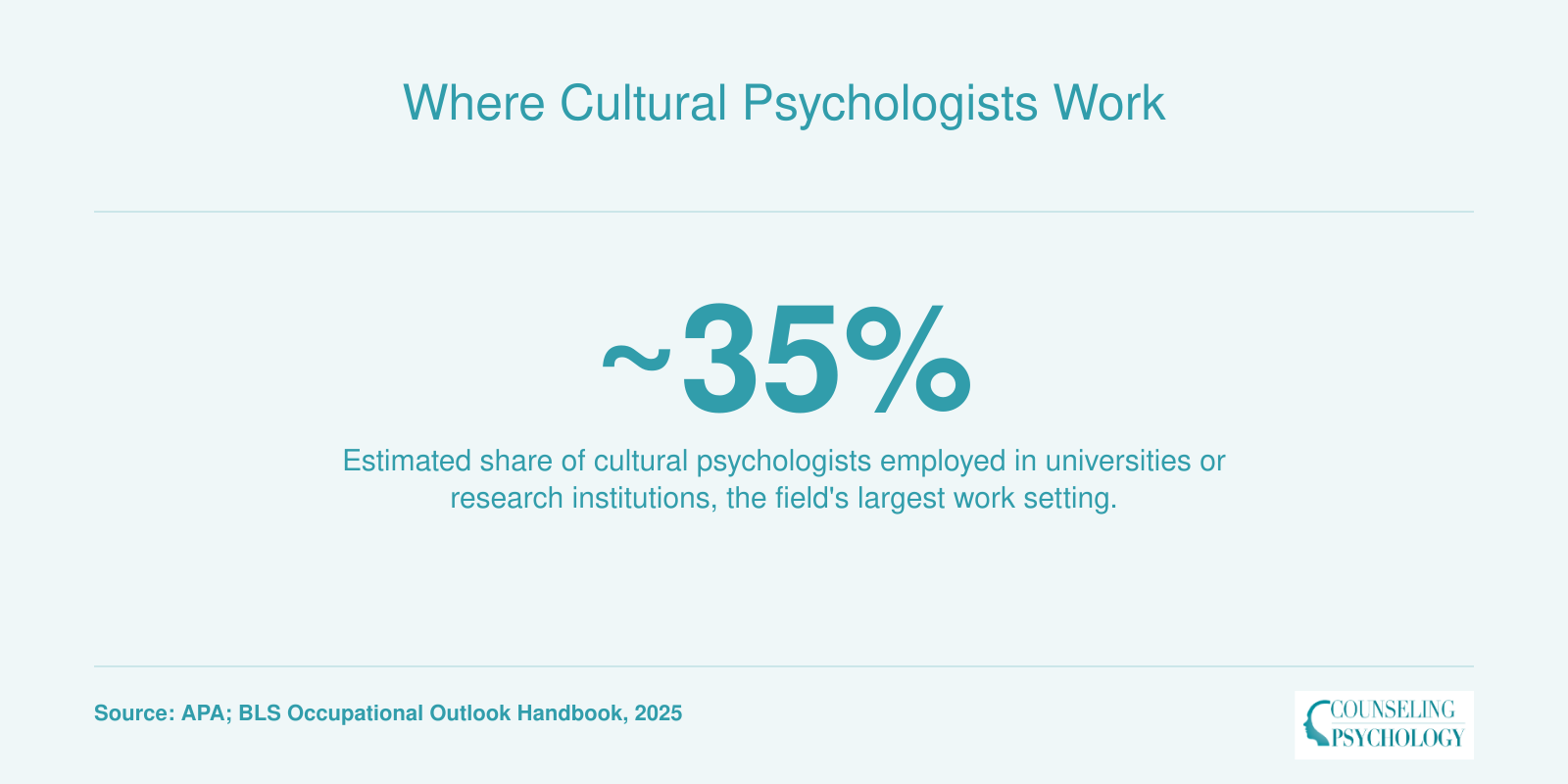
Cultural psychologists work across a range of settings, though academia and research institutions remain the dominant employers. Roughly 30% to 40% of psychologists overall work in academic or research roles, and that share skews even higher for cultural psychology specialists, who often anchor their careers to university departments or federally funded research centers. Applied roles are expanding, however, particularly in tech companies focused on cross-cultural user experience, healthcare systems pursuing equity initiatives, and international development organizations.
Frequently Asked Questions About Cultural Psychology Careers
Cultural psychology sits at the intersection of human behavior and cultural context, which naturally raises questions about training timelines, earning potential, and career options. Below are answers to the questions prospective students ask most often.
Explore Careers
- Become a Behavior Interventionist
- BCaBA
- BCBA
- Biogerontologist
- Child Psychologist
- Clinical Psychologist
- Cognitive Neuroscientist
- Cognitive Psychologist
- Comparative Psychologist
- Consumer Psychologist
- Counseling Psychologist
- Criminal Psychologist
- Forensic Psychologist
- Air Force Psychologist
- Applied Psychologist
- Army Psychologist
- Educational Psychologist
- Engineering Psychologist
- Environmental Psychologist
- Experimental Psychologist
- Navy Psychologist
- Neurologist
- Neuropsychologist
- Personnel Psychologist
- Physiatrist
- Police Psychologist
- Positive Psychologist
- Psychiatrist
- Psychological Anthropologist
- Psychometrician
- Registered Behavior Technician (RBT)
- Rehabilitation Psychologist
- School Psychologist
- Social Psychologist
- Spiritual Psychologist
- Sports Psychologist