![How to Become a Consumer Psychologist: Career Guide [2026]](https://www.counselingpsychology.org/wp-content/uploads/esy-composites/06fb1b083b2ff31fdb1920a4d7156900212b9f10.jpg)

Key Takeaways
- A master's degree qualifies you for most corporate consumer psychology roles, making a PhD optional outside academia.
- Entry-level consumer psychologists earn roughly $60,000 to $75,000, while senior practitioners can exceed $130,000 annually.
- The full path from bachelor's degree to professional role typically spans seven to twelve years.
- Licensure is generally unnecessary for industry positions, saving significant time and supervised-practice requirements.
Behavioral science now shapes decisions across product design, pricing algorithms, and ad campaigns at a scale that barely existed a decade ago. Consumer psychology sits at the center of this shift, studying why people buy what they buy and how cognitive biases, emotions, and social context drive those choices.
The practical tension for most aspiring consumer psychologists is straightforward: a PhD opens academic doors, but a master's degree is sufficient for the majority of industry roles, and the salary gap between the two tracks is narrower than many expect. Knowing which credential fits your target career matters more than defaulting to the longest program available.
What Does a Consumer Psychologist Do?
Consumer psychologists occupy a distinctive position in the business world: they study the mental and emotional machinery behind purchasing decisions, not just what people buy, but why they buy it.
The Core of the Work
At its foundation, consumer psychology applies scientific principles from cognitive psychology, behavioral economics, and social psychology to understand how people evaluate products, respond to advertising, and make choices under uncertainty. Practitioners examine how emotions like anxiety or excitement alter spending behavior, how cognitive biases such as the anchoring effect or scarcity heuristic nudge consumers toward certain options, and how social pressures shape brand loyalty. The goal is to translate those insights into actionable intelligence that organizations can actually use.
Day-to-Day Responsibilities
The daily work varies by employer and seniority, but a few tasks appear consistently across settings:
- Survey design: Crafting research instruments that measure attitudes, perceptions, and implicit associations without leading respondents or introducing systematic bias.
- Focus groups and qualitative interviews: Facilitating conversations that surface the motivations consumers rarely articulate in a checkout survey.
- A/B test analysis: Interpreting split-test data from digital campaigns or product pages to determine which messaging, layout, or offer structure drives conversion.
- Brand strategy advising: Presenting findings to marketing and product teams, translating psychological research into recommendations on positioning, pricing, and communication tone.
Consumer Psychologists vs. Market Researchers
The distinction here matters for career planning. Market researchers focus heavily on describing consumer behavior: purchase frequency, demographic breakdowns, category trends. Consumer psychologists go a layer deeper, building explanatory models for the behavior. Why does a premium price signal quality in one category but feel exploitative in another? Why does a red label outperform a blue one with certain audiences? Those questions require a psychological framework, not just a data dashboard. Unlike a clinical psychologist, whose work centers on assessment and treatment, the consumer psychologist directs that same scientific rigor toward understanding marketplace behavior.
Where They Work
Consumer psychologists are employed across a wide range of sectors. Advertising and media agencies rely on them to sharpen campaign strategy. Technology companies use consumer psychology expertise to improve user experience and reduce churn. Consumer packaged goods brands bring them in to understand how shelf placement and packaging influence perceived value. Management consulting firms embed them on teams advising retail and financial services clients. Academic positions exist as well, typically at research universities where faculty combine teaching with funded behavioral research programs. For a broader look at the field, explore other careers in psychology to see how consumer psychology fits into the discipline's wider landscape.
Steps to Becoming a Consumer Psychologist
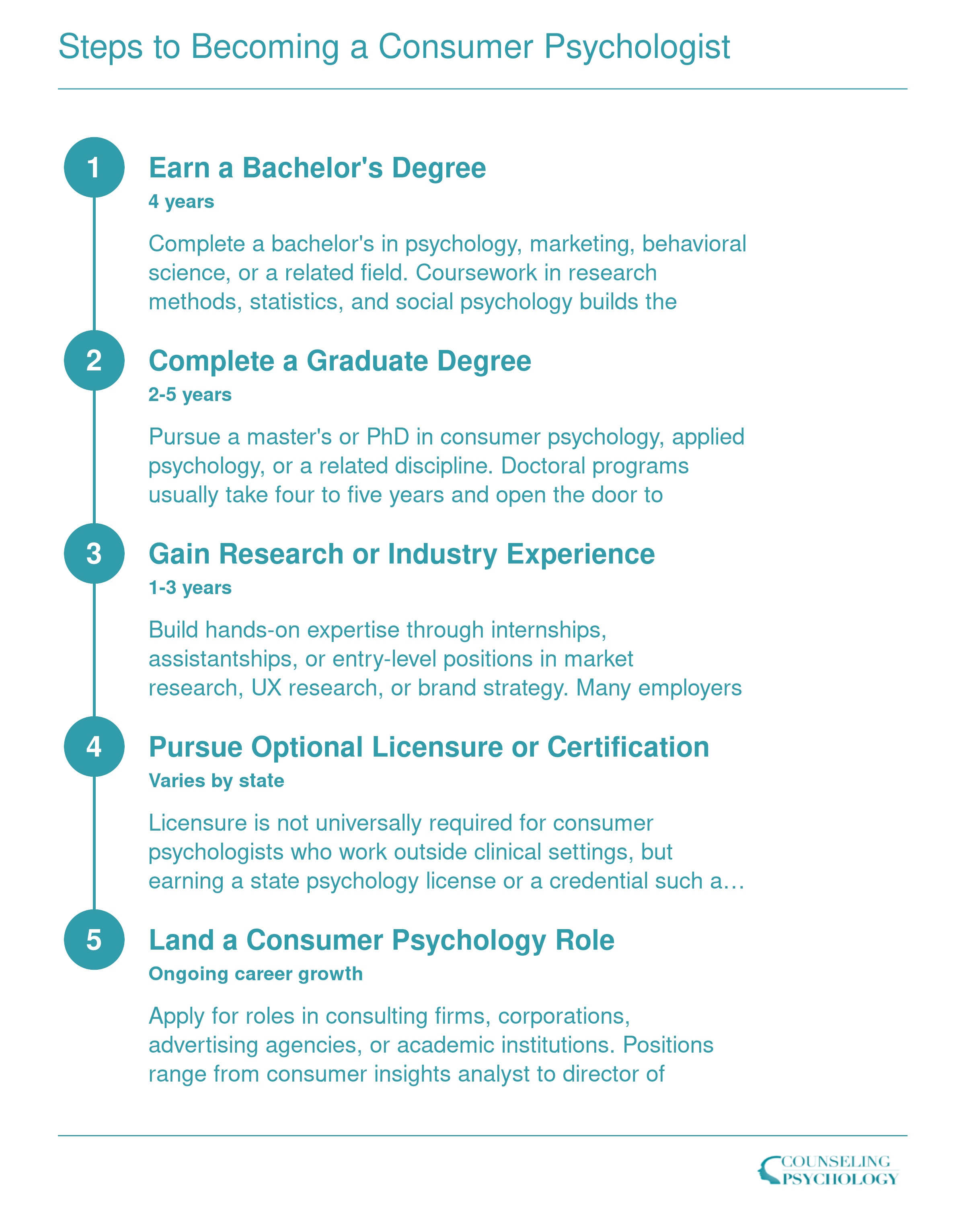
Consumer psychology blends behavioral science with marketplace strategy. The path from undergraduate coursework to a professional role typically spans seven to twelve years, depending on whether you pursue a master's or doctoral track.
Consumer Psychologist Education Requirements
Education for a consumer psychologist follows a layered path: each degree level opens different doors, and the right stopping point depends on whether you want to work in industry, consulting, or academia. Here is what to expect at each stage.
Bachelor's Degree: Building the Foundation
Most consumer psychologists start with a bachelor's in psychology, marketing, behavioral science, or cognitive science. A four-year degree alone will not earn you a consumer psychologist title, but it gives you fluency in research methods, statistics, and human behavior that employers value immediately. Graduates at this level typically land roles such as market research analyst, marketing coordinator, or behavioral data analyst, positions that let you apply consumer insights without requiring graduate credentials.
If you know early that consumer psychology is your goal, look for undergraduate programs that offer electives in social psychology, persuasion, judgment and decision-making, or consumer behavior.
Master's Degree: The Industry Sweet Spot
A master's degree is where most industry-oriented consumer psychologists find their practical ceiling. Few U.S. programs carry the exact title "Consumer Psychology" at the master's level, so students typically pursue degrees in closely related fields:
- Applied behavioral science or I-O psychology: Strong grounding in human motivation and organizational decision-making.
- Marketing with a consumer behavior track: Programs like USC's MS in Marketing or NYU's MS in Integrated Marketing blend psychology with brand strategy and analytics.
- Market research and consumer behavior: IE University offers a 12-month Master in Market Research and Consumer Behavior that covers both quantitative methods and qualitative consumer insight.
The University of Michigan's graduate offerings in marketing and applied statistics also prepare students for research-heavy consumer roles.2 Because accreditation frameworks like APA's focus on clinical and counseling psychology, these marketing-adjacent programs are typically accredited by their university's business or social science college rather than by APA directly.
A master's degree is often sufficient for positions in brand strategy, UX research, consumer insights, and consulting.
Doctoral Degree: For Academia and Senior Research
A PhD becomes necessary if you want to teach at a university or lead high-level research programs. Consumer psychologists at the doctoral level most often hold PhDs in social psychology, marketing, or judgment and decision-making rather than a degree specifically titled "Consumer Psychology."3 Wharton's Joint Doctoral Degree in Marketing and Psychology is one prominent example, combining rigorous experimental methods with real-world market applications.
That said, most industry employers do not require a doctorate. If your goal is a corporate or consulting career, the years and opportunity cost of a PhD may not pay off the way a master's degree plus hands-on experience would.
The Salary Gap: Master's vs. PhD
Nationally, consumer psychologists earn in the range of roughly $65,000 to $90,000, but credentials create meaningful separation within that band.3 Professionals holding a PhD can expect to earn approximately $15,000 to $30,000 more per year than peers with a master's degree, a gap that reflects both the seniority of roles open to doctoral holders and the premium academic institutions place on terminal degrees.
For students weighing whether the additional years of doctoral study justify the investment, the calculus often depends on career setting. In corporate consumer insights or UX research, a master's holder with five years of experience frequently matches or exceeds entry-level PhD salaries. In academia, the PhD is non-negotiable.
Licensure and Certification for Consumer Psychologists
Whether you actually need a license is one of the first questions worth settling, because the answer shapes how much time, money, and supervised experience you invest before entering the workforce.
Here is the good news: most consumer psychologists working in corporate, agency, or consulting settings never obtain a state license. Licensure is typically required only when you provide direct clinical or therapeutic services to individuals, or when you want to use the protected title "psychologist" in states that restrict it. If your career path runs through marketing departments, product teams, or research labs, licensure is usually not on the table.
The Licensed Track
If you do plan to hold yourself out as a licensed psychologist, whether for independent consulting under that title or for a hybrid role that overlaps with becoming a clinical psychologist, most states require the same core sequence:
- A doctoral degree (PhD or PsyD) from an accredited program
- One to two years of supervised professional experience, often including a predoctoral internship and postdoctoral hours
- A passing score on the Examination for Professional Practice in Psychology (EPPP)
- Additional state-specific requirements, which may include a jurisprudence exam or supplemental oral examination
Title-protection laws vary by state, so review the regulations in the jurisdiction where you plan to practice. Some states restrict only the term "psychologist," while others extend restrictions to phrases like "psychological services."
Non-Licensed Career Tracks
The majority of consumer psychology graduates sidestep licensure entirely by working under titles that are not regulated. Common examples include behavioral scientist, consumer insights researcher, UX researcher, and market strategist. These roles let you apply the same theoretical training, including decision science, persuasion research, and behavioral economics, without the overhead of a clinical license.
Optional Certifications Worth Considering
Even if you skip licensure, targeted credentials can strengthen your professional profile:
- Board Certification (ABPP): The American Board of Professional Psychology offers specialty certification that signals advanced competence, relevant if you hold a doctorate and want to differentiate yourself in consulting.
- UX-specific credentials: Programs such as the Nielsen Norman Group UX Certification or Google's UX Design Certificate demonstrate applied research and design skills valued by tech employers.
- Market research certifications: The Insights Association and similar bodies offer credentials that signal methodological rigor to insights teams.
None of these are mandatory, but they can close credibility gaps, especially for professionals who hold a master's degree rather than a doctorate and want to compete for senior research or strategy roles.
Related Articles
Questions to Ask Yourself
Consumer Psychologist Salary: National Overview
Consumer psychology sits at the intersection of behavioral science and business, and compensation reflects that dual value. The figures below draw on aggregated salary data from industry sources alongside Bureau of Labor Statistics (BLS) wage estimates for the broader psychologist occupation. Because the BLS does not track consumer psychologists as a standalone category, the closest federal benchmarks come from the "Psychologists, All Other" and "Industrial-Organizational Psychologists" classifications, both of which capture professionals doing similar applied work.
| Category | Low End | Median or Midpoint | High End | Source or Note |
|---|---|---|---|---|
| Consumer Psychologist, Entry Level | $55,000 | $65,000 | $75,000 | Aggregated industry data (2026 estimates) |
| Consumer Psychologist, Mid Career | $80,000 | $95,000 | $110,000 | Aggregated industry data (2026 estimates) |
| Consumer Psychologist, Senior Level | $115,000 | $127,500 | $140,000 | Aggregated industry data (2026 estimates) |
| Psychologists, All Other (BLS National) | $73,820 (25th percentile) | $117,580 | $145,200 (75th percentile) | BLS, May 2024 national data |
| Industrial-Organizational Psychologists (BLS National) | $80,790 (25th percentile) | $109,840 | $198,170 (75th percentile) | BLS, May 2024 national data |
| All Psychologists (BLS National) | $71,140 (25th percentile) | $94,310 | $126,340 (75th percentile) | BLS, May 2024 national data |
Consumer Psychologist Salary by State and Metro Area
Consumer psychology does not have its own BLS occupation code, so salary estimates draw from the closest proxy categories: Industrial-Organizational Psychologists (19-3032) and Psychologists, All Other (19-3039). Both capture professionals who apply psychological principles in organizational and commercial settings. The table below shows state-level median and mean annual wages from the most recent BLS data. California leads both categories, while states with lower costs of living tend to report lower pay.
| State | BLS Category | Median Annual Wage | Mean Annual Wage | 25th Percentile | 75th Percentile |
|---|---|---|---|---|---|
| California | Industrial-Organizational Psychologists | $140,540 | $137,540 | $106,330 | $168,510 |
| Texas | Industrial-Organizational Psychologists | $130,630 | $115,960 | $83,290 | $134,990 |
| Oregon | Industrial-Organizational Psychologists | $94,180 | $100,180 | $76,980 | $132,140 |
| California | Psychologists, All Other | $147,650 | $130,940 | $78,310 | $169,330 |
| Oklahoma | Psychologists, All Other | $147,010 | $126,730 | $103,330 | $161,350 |
| Nevada | Psychologists, All Other | $144,390 | $130,120 | $131,250 | $153,890 |
| Nebraska | Psychologists, All Other | $137,990 | $125,420 | $93,790 | $163,880 |
| North Carolina | Psychologists, All Other | $137,130 | $122,490 | $90,440 | $157,190 |
| South Carolina | Psychologists, All Other | $135,950 | $127,190 | $115,090 | $152,960 |
| Utah | Psychologists, All Other | $90,270 | $99,720 | $82,220 | $129,810 |
| Oregon | Psychologists, All Other | $82,960 | $102,460 | $79,380 | $130,520 |
| Texas | Psychologists, All Other | $81,830 | $96,040 | $61,740 | $133,240 |
| Illinois | Psychologists, All Other | $81,270 | $92,810 | $51,700 | $137,820 |
| Michigan | Psychologists, All Other | $78,670 | $91,060 | $56,490 | $131,140 |
| New Hampshire | Psychologists, All Other | $75,990 | $93,840 | $67,630 | $133,970 |
| Vermont | Psychologists, All Other | $76,490 | $85,670 | $63,540 | $95,710 |
| Maine | Psychologists, All Other | $63,490 | $80,140 | $63,490 | $92,740 |
| West Virginia | Psychologists, All Other | $41,900 | $63,650 | $33,470 | $77,410 |
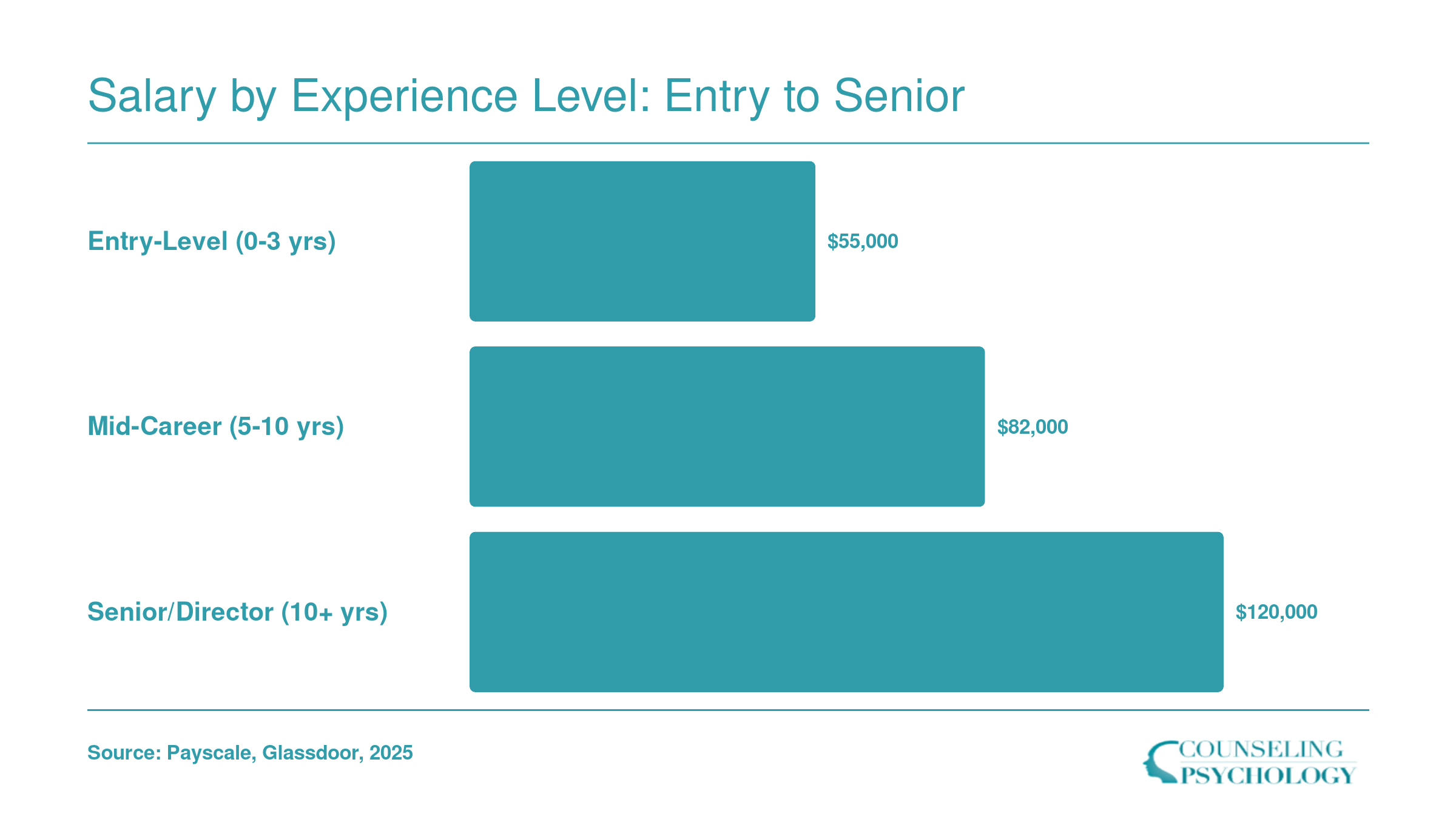
Salary by Experience Level: Entry to Senior
Consumer psychologist compensation climbs significantly with experience. Early-career professionals typically work in analyst or associate research roles, while senior practitioners move into director-level positions overseeing brand strategy, UX research departments, or consulting practices.
Consumer Psychology Jobs and Career Paths
Some consumer psychology graduates land in research-heavy roles where the daily work looks like designing studies and analyzing data, while others move into strategy roles where the same training gets applied to brand positioning and messaging decisions. Both paths draw on the same foundation, but they reward different temperaments, and the title on your business card can shift your salary band by $20,000 or more.
Research-Focused Roles
These jobs sit closest to traditional consumer psychology training and tend to value advanced degrees the most.
- Consumer Insights Manager: $90,000 to $130,000 nationally. You lead research programs that explain why customers buy, churn, or switch. Common employers include consumer packaged goods companies, retail and e-commerce brands, technology firms, media and entertainment, financial services, and consulting agencies.
- UX Researcher: $75,000 to $115,000 nationally. You run usability studies, interviews, and behavioral experiments to shape digital products. The biggest hiring pools are tech and SaaS, e-commerce, fintech, healthcare technology, and automotive or IoT companies.
- Behavioral Scientist: $80,000 to $120,000 nationally. You apply theories from judgment and decision-making to real-world problems like savings behavior, health adherence, or policy compliance. Hiring shows up in technology and product companies, financial services and fintech, health and wellness organizations, government policy units, and consulting or research firms.
Strategy and Analyst Roles
These paths are more accessible with a bachelor's or master's degree and often serve as an entry point.
- Market Research Analyst: $50,000 to $95,000 nationally. You run surveys, analyze syndicated data, and report on market trends. Employers include market research agencies, advertising and media agencies, CPG and retail, healthcare and pharma, and financial services.
- Brand Strategist: $60,000 to $90,000 nationally. You translate consumer insight into positioning, messaging, and creative direction. Most openings are at advertising and creative agencies, branding consultancies, in-house brand teams, and media or streaming companies.
Choosing a Lane
If you like running studies and defending methodology, the insights and behavioral science track fits. If you prefer synthesizing research into recommendations and presenting to executives, strategy roles will feel more natural. Many practitioners move between the two over a career, and employers increasingly value people who can do both.
How to Become a Consumer Psychologist Without a PhD
Most consumer psychology work in industry happens at the master's level, not the doctoral level. Companies hire master's-prepared professionals into roles like consumer insights analyst, behavioral researcher, and UX researcher, where they apply psychological principles to product development, marketing strategy, and customer experience without the credential or timeline of a PhD.
The Practical Master's Path
The most common route starts with a bachelor's degree in psychology, marketing, or a related behavioral science. From there, pursue a master's in consumer psychology, applied psychology, or industrial-organizational (I-O) psychology. Programs typically run 18 to 24 months and emphasize applied coursework in behavioral economics, consumer decision-making, research methods, and data analytics. An industry internship during or immediately after the master's program opens the door to a full-time role at a tech firm, consulting agency, or corporate research team. Graduates often start as junior analysts or associate researchers and move into senior individual-contributor or manager roles within three to five years.
Alternative Entry Points
Professionals already working in market research, data analytics, or UX design can pivot into consumer psychology without returning to school full-time. Targeted upskilling through behavioral science certificates, short-term bootcamps, or online courses in experimental design and behavioral analytics builds the necessary expertise. Employers value demonstrable skills and portfolio work, so transitioning internally within a company or moving laterally across industries is very feasible with a few months of focused learning.
The Trade-Off
Without a PhD you will not teach at a university or lead academic research programs. Faculty positions and clinical licensure paths remain closed. However, corporate advancement to director-level roles is entirely achievable with a master's degree, strong performance, and strategic career moves. Many consumer psychology directors, heads of insights, and behavioral science leads hold only a master's credential and have built their expertise through years of applied work rather than dissertation research.
Most consumer psychology positions in the private sector require a master's degree, not a PhD. The doctorate becomes essential primarily for tenure-track academic roles or highly specialized senior research scientist positions. For professionals targeting corporate, agency, or consulting careers, a master's in consumer psychology or a related field opens the majority of doors and offers a faster, more cost-effective route into the industry.
Consumer Psychology vs. Related Fields
Consumer psychology shares methodological DNA with industrial-organizational psychology, market research analysis, and UX research, but career trajectories, salary bands, and day-to-day work diverge sharply once you step into the field. Understanding these distinctions helps you plot a degree path that aligns with your interests and income expectations.
Industrial-Organizational Psychology
I-O psychologists (SOC 19-3032) apply psychological principles to workplace challenges: employee selection, training design, performance management, and organizational culture. The Bureau of Labor Statistics groups them under the broader "Psychologists, All Other" category, reporting a 2024 national median wage of $102,900 and 5 percent job growth through 2034. Most roles require a master's degree at minimum; many senior positions and academic posts expect a PhD. O*NET OnLine details core tasks such as conducting job analyses, designing assessment tools, and evaluating training effectiveness. SIOP (Society for Industrial and Organizational Psychology) publishes annual salary surveys showing early-career members (master's level) earning $75,000 to $90,000, while doctoral-level consultants frequently clear $140,000. I-O programs emphasize statistics, psychometrics, and organizational behavior, coursework that overlaps with consumer psychology but tilts toward employee dynamics rather than buyer behavior.
Market Research Analysts
Market research analysts (SOC 13-1161) study market conditions to identify sales opportunities and forecast demand. BLS data show a 2024 median wage of $68,230 and 13 percent growth through 2034, among the fastest of any business occupation. A bachelor's degree suffices for most entry-level roles; employers prioritize survey design, data visualization, and fluency in tools like Tableau or SPSS. O*NET highlights tasks such as preparing questionnaires, analyzing competitor pricing, and presenting findings to marketing teams. AMA (American Marketing Association) resources note that analysts with advanced degrees or specialized certifications (such as the Professional Researcher Certification) command higher pay, often $85,000 to $110,000 mid-career. Degree programs in marketing analytics or applied statistics offer faster entry than a psychology PhD, though you trade depth of behavioral theory for breadth of business application.
UX Researchers
UX researchers study how users interact with digital products, employing ethnography, usability testing, and eye-tracking to inform interface design. BLS categorizes some roles under "Computer and Information Research Scientists" (SOC 15-1211), median wage $142,650, or "Miscellaneous Social Scientists" (SOC 19-3099). O*NET profiles emphasize qualitative methods (contextual inquiry, journey mapping, prototype testing) alongside quantitative metrics like task-completion rates. UXPA (User Experience Professionals Association) and HFES (Human Factors and Ergonomics Society) surveys report median salaries of $95,000 to $120,000 for researchers with three to five years of experience. Most practitioners hold a master's in human-computer interaction, cognitive psychology, or a related field; PhDs are common in research-intensive roles at large tech firms. University programs in HCI combine psychology, design, and computer science, equipping graduates to translate user needs into product roadmaps, a skill set adjacent to consumer psychology's focus on purchase behavior and brand perception.
Comparing Degree Pathways
Review program curricula at schools offering all four tracks. An I-O psychology MS typically requires courses in personnel selection, work motivation, and program evaluation. Marketing analytics programs emphasize econometrics, consumer segmentation, and digital marketing. HCI programs blend prototype development, interaction design, and research methods. Consumer psychology degrees, often housed within business schools or psychology departments, prioritize behavioral economics, persuasion science, and decision-making research. Admission requirements vary: I-O and consumer psychology programs frequently expect GRE scores and undergraduate psychology coursework, while market research and UX programs may accept applicants from communications, business, or design backgrounds without a standardized test.
Check the BLS Occupational Outlook Handbook annually for updated wage and growth projections, and consult O*NET for detailed task inventories by SOC code. Professional association websites offer salary calculators, job boards, and continuing-education opportunities that clarify which credential best fits your target role.
Is Consumer Psychology a Good Career?
The short answer: yes, but with some nuance. Consumer psychology sits at an intersection of behavioral science and business strategy that is only growing more valuable as companies compete on customer experience, personalization, and data-driven decision-making. Here is what the labor market data and industry trends actually tell us.
Job Growth Outlook
The Bureau of Labor Statistics projects that industrial-organizational psychologists (the closest tracked occupation) will see roughly 5% job growth from 2024 to 2034, which edges above the 3.1% average for all occupations.1 O*NET still classifies I-O psychology as a Bright Outlook occupation for the same period.2 The broader psychologist category (SOC 19-3030) has also shown strong projected growth in recent cycles, and the professional, scientific, and technical services sector where many consumer psychologists land is projected to grow at 7.5% over the same decade.1 These numbers do not capture every role that uses consumer psychology skills, since many positions appear under titles like UX researcher, behavioral strategist, or insights analyst, but the trajectory is encouraging.
What Is Driving Demand
Several forces are pushing employers toward professionals who understand consumer behavior:
- E-commerce expansion: Online retail continues to grow, and companies need researchers who can decode digital shopping behavior, optimize product pages, and reduce cart abandonment.
- UX research departments: Tech firms and consumer brands alike have been scaling dedicated UX and behavioral insights teams, creating roles that lean heavily on consumer psychology training.
- Behavioral data investment: Organizations across finance, healthcare, and media are investing in behavioral analytics to improve customer retention and product design.
These demand drivers tend to favor candidates with quantitative research skills on top of their psychology foundation.
How It Compares to Related Fields
Consumer psychology roles frequently pay more than general psychology positions and offer considerably more private-sector mobility. While clinical or counseling psychologists may find the majority of openings in healthcare settings, consumer psychologists can move across industries, from tech to CPG to consulting, often without relicensing hurdles. That flexibility is a meaningful career asset.
Honest Downsides to Consider
The field is relatively small compared to clinical or school psychology. You will rarely see a job posting with the exact title "consumer psychologist." Instead, you will need to search under adjacent titles and be prepared to translate your training for hiring managers who may not know the discipline by name. Geographic flexibility also matters: the densest clusters of these roles are in major metro areas with large corporate or tech footprints. Remote work has eased this constraint somewhat, but it has not eliminated it.
If you are comfortable navigating a field where the work is abundant but the label is not always obvious, consumer psychology offers a compelling blend of intellectual depth, competitive compensation, and cross-industry versatility.
Frequently Asked Questions About Consumer Psychology Careers
Consumer psychology sits at the crossroads of behavioral science and business strategy, which raises practical questions about pay, education, and day-to-day work. Below are concise answers drawn from the salary data, degree requirements, and career details covered earlier in this article.
Explore Careers
- BCBA
- Biogerontologist
- Child Psychologist
- Clinical Psychologist
- Cognitive Neuroscientist
- Cognitive Psychologist
- Comparative Psychologist
- Counseling Psychologist
- Criminal Psychologist
- Cultural Psychologist
- Forensic Psychologist
- Air Force Psychologist
- Applied Psychologist
- Army Psychologist
- Educational Psychologist
- Engineering Psychologist
- Environmental Psychologist
- Experimental Psychologist