
What you’ll learn in this article…
- Ohio has roughly 19 counseling master's programs reviewed here, with about 8 fully online and 10 hybrid.
- Net tuition at Ohio public universities can start below $11,000 after grants and scholarships are applied.
- CACREP accreditation streamlines Ohio licensure, which follows a two-tier path from LPC to LPCC.
- Several Ohio programs offer specialized child and adolescent counseling tracks for working with younger populations.
Ohio's counselor workforce shortage is projected to widen through 2030, and the state's Counselor, Social Worker, and Marriage and Family Therapist Board continues to process record numbers of new license applications. For prospective students, the practical challenge is clear: earning a master's degree that satisfies Ohio's 60-credit-hour licensure requirements without taking on disproportionate debt.
Across the 19 Ohio programs ranked on counselingpsychology.org, graduate tuition ranges from roughly $8,400 to over $27,800 per year, with formats spanning fully online, hybrid, and on-campus delivery. Several hold CACREP accreditation, a credential that streamlines the path to both LPC and LPCC licensure in Ohio. For those still weighing whether this field is the right fit, our guide on how to become a counselor covers the full career trajectory. The gap between the most and least affordable options is wide enough that program selection alone can shift total cost of attendance by tens of thousands of dollars, a variable that directly affects early-career financial flexibility for graduates entering a field where starting salaries cluster in the mid-$40,000s.
Best Master's in Counseling Programs in Ohio
Ohio offers a broad mix of counseling pathways, from CACREP-accredited clinical mental health and school counseling master's degrees to graduate certificates in addiction counseling and specialized child and adolescent work. The programs below were evaluated with an emphasis on affordability and flexible delivery, so students who need online or hybrid options without excessive debt can quickly find the best fit. Keep in mind that graduation rates shown are institution-wide figures and may not reflect the outcomes of individual counseling programs.
Details
- Independent program research
- Internal program database
- College Scorecard graduate earnings — collegescorecard.ed.gov
- NCES-IPEDS federal institutional data — nces.ed.gov

Cleveland State University
Located in downtown Cleveland, Cleveland State University hosts Ohio's first accredited chemical dependency counseling certificate and pairs it with a broader counseling ecosystem that benefits from strong urban clinical placement opportunities. The hybrid format lets working professionals complete coursework online while building supervised hours locally. With a net price of roughly $14,764 and a 16:1 student-to-faculty ratio, CSU consistently ranks among the most affordable public options in the state for counseling-related credentials.
- Ohio's first accredited chemical dependency counseling certificate
- Hybrid format blending online and in-person instruction
- 12-credit sequence completable in a single summer semester
- Meets Ohio licensure requirements for all three CD counseling levels
- Open to applicants with a bachelor's or master's in behavioral sciences
- No application deadline, with Fall, Spring, and Summer starts
Certificate in Chemical Dependency Counseling — Hybrid

University of Akron
The University of Akron delivers a hybrid graduate certificate focused on counseling children and adolescents, giving Ohio-based clinicians and educators a targeted way to deepen their youth-oriented skills without committing to a full degree. The program emphasizes practical, real-world applications and is built for flexibility around professional schedules. Akron's net price of approximately $13,946 makes it the lowest-cost entry on this list, while a 17:1 student-to-faculty ratio keeps class sizes manageable.
- Hybrid delivery designed for working professionals
- Focused specifically on child and adolescent counseling techniques
- Accessible to those holding a bachelor's degree
- Emphasizes practical, real-world counseling applications
- Flexible scheduling to accommodate full-time employment
- Complements existing master's-level counseling credentials
Counseling Children and Adolescents Graduate Certificate — Hybrid

University of Toledo
The University of Toledo stands out for offering both a fully online Master of Arts in School Counseling and a hybrid PhD in Counselor Education, creating a clear ladder from licensure to academic leadership within one department. The school counseling master's launched its 100% online delivery beginning Fall 2025, making it a timely choice for 2026 applicants across Ohio. Asynchronous coursework and local K-12 internship placements give working teachers and career-changers the scheduling flexibility they need.
- 60-credit fully online master's aligned with CACREP 2024 Standards
- 100% asynchronous instruction with part-time completion option
- 100-hour practicum plus 600-hour K-12 internship
- Prepares graduates for Ohio school counselor licensure
- Designed for working educators and career-changers
- Launched online delivery in Fall 2025
- Hybrid format combining online and campus-based learning
- Prepares graduates for teaching, research, and clinical leadership
- Focuses on leadership, advocacy, and ethical practice
- Requires a master's in counseling or related field for admission
- Financial aid and assistantship options available
- Ideal for those pursuing faculty or supervisory roles
Master of Arts in Counselor Education, School Counseling — Hybrid
Doctor of Philosophy in Counselor Education — Hybrid

Wright State University
Wright State University in Dayton pairs a CACREP-accredited Master of Education in School Counseling with an Addictions Counseling Graduate Certificate, covering two of Ohio's highest-demand specializations under one roof. The school counseling program boasts a 100% pass rate on the Ohio Assessments for Educators exam, and evening plus partial-online scheduling is tailored to Dayton-area working professionals. A net price near $15,415 keeps both pathways competitively priced among Ohio publics.
- 60-credit-hour CACREP-accredited program
- 100% OAE exam pass rate among graduates
- Evening and partial-online class delivery
- Includes practicum and internship field experiences
- Prepares students for Ohio Pupil Services Licensure
- Career consultant available to enrolled students
- Hybrid learning format for working professionals
- Covers substance use disorders and process addictions
- Evidence-based treatment strategies and historical context
- Requires a relevant graduate degree or current graduate enrollment
- Designed to complement existing counseling credentials
- Flexible scheduling blending online and campus sessions
Master of Education in School Counseling — Hybrid
Addictions Counseling Graduate Certificate — Hybrid

Ohio University
Ohio University offers a fully online Master of Education in School Counseling that draws on a statewide network of practicum and internship sites, letting students complete field hours in their own local Ohio school districts. The CACREP-accredited, 60-credit program is built around Ohio's school counselor licensure standards and accepts applicants from any bachelor's-level discipline. A single annual summer intake means prospective 2026 students should plan ahead, but the payoff is a well-structured, licensure-aligned online pathway from a respected public research university.
- Fully online, CACREP-accredited 60-credit program
- 100-hour practicum and 600-hour internship in local Ohio schools
- Open to bachelor's degree holders from any discipline
- Structured around Ohio Licensed School Counselor requirements
- Summer-only start date (plan accordingly for 2026)
- Expert faculty mentorship with flexible asynchronous coursework
- Statewide internship site network reduces travel for working adults
Master of Education in School Counseling — Online

University of Cincinnati
The University of Cincinnati brings the resources of a major urban research institution to its counseling and behavioral health programs. While its featured online pathway focuses on a Bachelor of Science in Substance Abuse Counseling that meets Ohio's Chemical Dependency Counselor Assistant requirements, UC's broader graduate offerings and clinical partnerships across Greater Cincinnati provide a strong foundation for students who plan to continue into master's-level work. An institution-wide graduation rate of 75% is the highest among the public universities on this list.
- Fully online, flexible degree format
- Meets Ohio CDCA certification requirements
- Prepares students for counseling and recovery service careers
- Provides a licensure pathway in multiple states
- Addresses the critical substance abuse epidemic
- Serves as a stepping stone to graduate counseling study
Bachelor of Science in Substance Abuse Counseling — Online

Ashland University
Ashland University's 64-credit Master of Arts in Clinical Mental Health Counseling merges CACREP accreditation with a Christian worldview, a combination that is uncommon among Ohio's affordable hybrid options. Graduates have posted an 89.6% pass rate on the National Counselor Examination, and the curriculum is explicitly mapped to Ohio Licensed Professional Counselor requirements. With a 14:1 student-to-faculty ratio and diverse field placement settings including community centers, hospitals, and private practices, Ashland offers a personalized, faith-informed path to clinical licensure.
- CACREP-accredited, 64-credit-hour hybrid program
- 89.6% pass rate on the National Counselor Examination
- Integrates Christian worldview with professional licensure preparation
- Meets Ohio LPC licensure requirements
- Field experiences in hospitals, schools, and community centers
- Multicultural counseling emphasis with professional ethics focus
- 14:1 student-to-faculty ratio for personalized mentorship
Master of Arts in Clinical Mental Health Counseling — Hybrid

Miami University
Miami University in Oxford delivers a robust counselor education department with hybrid master's tracks in clinical mental health counseling, school counseling, and a dual-track option that covers both. At $700 per credit hour for Ohio residents and 700 to 1,300 field placement hours depending on track, the programs are designed to produce well-practiced graduates ready for Ohio's LPC and school counselor licensure. The institution's 79.8% graduation rate is the highest among all schools on this list, signaling strong institutional support for student completion.
- 60-credit hybrid program aligned with CACREP standards
- 100 hours of practicum plus 600 hours of internship
- Prepares graduates for Ohio school counselor licensure
- Meets ASCA National Model expectations
- Includes 48 core credits and 6 elective credits
- Strong pipeline into Ohio K-12 school placements
- Hybrid online and onsite delivery at $700 per credit hour
- 60-credit-hour curriculum with 700 field placement hours
- Ohio-focused recruitment with local agency partnerships
- Prepares graduates for Licensed Professional Counselor credential
- 2.75 minimum undergraduate GPA required for admission
- Clinical supervision in Ohio community mental health settings
- Combines clinical mental health and school counseling preparation
- 60 to 66 total credit hours depending on track requirements
- 700 to 1,300 field placement hours across both specializations
- CACREP standards alignment for both tracks
- Ohio residents only for this hybrid program
- Efficient path to dual licensure eligibility in the state
Master of Education in Counselor Education, School Counseling — Hybrid
Master of Education in Counselor Education, Clinical Mental Health Counseling — Hybrid
Master of Education in Counselor Education, Dual Track — Hybrid

Ohio Christian University
Ohio Christian University offers an online Bachelor of Arts in Substance Abuse Counseling rooted in a Christian worldview while meeting Ohio's licensure requirements for chemical dependency counselors. The 45-credit program is available 100% online or on campus in Circleville, providing maximum flexibility for students who need an affordable, faith-based pathway into addiction recovery work. Program-level earnings data are not yet available, but the curriculum covers assessment, intervention, group and individual techniques, and ethical practice, all mapped to Ohio CDCA certification standards.
- Available 100% online or on campus in Circleville
- 45 total credit hours with practicum or capstone experience
- Meets Ohio CDCA certification requirements
- Integrates Christian principles with evidence-based counseling
- Covers group and individual counseling techniques
- Addresses ethical and legal issues in substance abuse treatment
Bachelor of Arts in Substance Abuse Counseling — Online

Cedarville University
Cedarville University's online Master of Theological Studies in Biblical Counseling is a 36-credit program designed for ministry and parachurch settings rather than state-regulated clinical practice. It does not prepare graduates for Ohio LPC or school counselor licensure, so it fits students whose counseling goals center on church-based care. Multiple annual start dates, full or part-time pacing, and online delivery make the program accessible to working ministry professionals across Ohio and beyond.
- 36-credit fully online master's degree
- Full-time or part-time pacing with multiple start dates
- Blends core theology with specialized counseling training
- Designed for church and parachurch ministry contexts
- Does not lead to Ohio state counselor licensure
- Financial aid available to eligible students
- Practical counseling experiences integrated into coursework
Master of Theological Studies, Biblical Counseling — Online
How Much Does a Master's in Counseling Cost in Ohio?
Sticker tuition can be misleading. The figure that matters most is net price, which reflects what students actually pay after grants and scholarships are applied. Among Ohio's public universities, net prices for counseling programs start below $11,000, while private institutions generally land in the $20,000 to $33,000 range. A bonus for online learners: many public Ohio schools extend in-state tuition rates to all online graduate students, which can significantly narrow the gap between resident and non-resident costs. Median graduate debt at completion, shown in the rightmost column, gives you the clearest picture of what borrowers actually owe when they finish.
| School | Type | In-State Tuition | Out-of-State Tuition | Net Price (After Aid) | Median Graduate Debt |
|---|---|---|---|---|---|
| Miami University, Middletown | Public | $7,491 | $19,407 | $10,809 | $23,000 |
| Miami University, Hamilton | Public | $16,359 | $37,399 | $11,286 | $23,000 |
| University of Akron | Public | $10,125 | $15,885 | $13,946 | $23,250 |
| Cleveland State University | Public | $11,297 | $21,107 | $14,764 | $21,797 |
| Wright State University | Public | $15,771 | $25,759 | $15,415 | $22,750 |
| University of Toledo | Public | $17,605 | $29,426 | $17,249 | $22,250 |
| Ohio University | Public | $9,720 | $17,712 | $21,637 | $21,056 |
| University of Cincinnati | Public | $13,363 | $28,697 | $25,648 | $21,250 |
| Miami University (Oxford) | Public | $16,751 | $37,791 | $28,384 | $23,000 |
| Walsh University | Private | $13,500 | $13,500 | $20,493 | $27,000 |
| Ohio Christian University | Private | $19,190 | $19,190 | $20,607 | $29,579 |
| Malone University | Private | $13,830 | $13,830 | $20,948 | $26,289 |
| Ashland University | Private | $8,400 | $8,400 | $21,988 | $25,000 |
| Capital University | Private | $13,530 | $13,530 | $22,576 | $26,889 |
| Cedarville University | Private | $11,015 | $11,015 | $24,468 | $20,937 |
| John Carroll University | Private | $15,782 | $15,782 | $28,746 | $26,000 |
| University of Dayton | Private | $19,580 | $19,580 | $29,533 | $23,250 |
| Xavier University | Private | $19,218 | $19,218 | $32,997 | $23,250 |
Questions to Ask Yourself
Do you need a fully online format, or can you attend weekend residencies for practicum?
Is CACREP accreditation a must for your licensure goals and potential out-of-state moves?
Are you drawn to a specialization like child and adolescent counseling, or do you want a general clinical mental health track?
CACREP-Accredited Counseling Programs in Ohio
Does CACREP accreditation actually matter for getting licensed in Ohio, or is it just a credential that looks good on paper?
The answer is practical and concrete. CACREP, the Council for Accreditation of Counseling and Related Educational Programs, sets a nationally recognized curriculum and clinical training standard for graduate counseling programs. Ohio's Counselor, Social Worker, and Marriage and Family Therapist Board evaluates applicants for the Licensed Professional Counselor (LPC) and Licensed Professional Clinical Counselor (LPCC) credentials, and completing a CACREP-aligned program streamlines the educational review process.1 Graduates do not have to spend time documenting that their coursework covered required content areas because CACREP accreditation signals that the curriculum already meets those benchmarks. For students whose primary goal is Ohio licensure, choosing a CACREP-accredited program reduces friction at the application stage.
Which Ohio Programs in Our Rankings Hold CACREP Accreditation
Three programs featured in this guide carry confirmed CACREP accreditation for their clinical mental health counseling online programs:
- University of Akron: The M.A. in Clinical Mental Health Counseling has held CACREP accreditation continuously since 1985, one of the longest-standing records of any program in Ohio.2
- Ashland University: The M.A. in Clinical Mental Health Counseling offered through Ashland Theological Seminary is CACREP-accredited, combining clinical training standards with the university's integrative approach.3
- Ohio University: The M.Ed. in Clinical Mental Health Counseling holds CACREP accreditation. Prospective students should note that the program's accreditation was operating under 2016 CACREP Standards with an expiration date of October 31, 2025, so verifying the current renewal status directly with the program is a sound step before enrolling.4
Several other programs in the rankings, including those at Ohio University and Miami University, note alignment with CACREP standards for their school counseling tracks. Confirming accreditation status for your specific specialization is always worth a direct inquiry to the program.
Licensure Portability Across State Lines
For students who are open to practicing outside Ohio after graduation, CACREP accreditation carries a meaningful career advantage. Most states have adopted licensure frameworks that recognize CACREP training as satisfying educational requirements, which improves the odds that your degree will be accepted during an endorsement or reciprocity review.5 That said, no automatic license transfer exists between states. You will still need to apply in each new state, meet any additional supervised hours requirements, and pass any required exams. Students exploring the broader LPCC pathway may want to review licensed professional clinical counselor degree options to understand how different programs map to multi-state requirements. CACREP accreditation makes the educational portion of that process easier, not automatic.
How the 2024 CACREP Standards Affect Current Students
CACREP released updated standards in 2024 that programs are in the process of adopting. The 2024 standards place greater emphasis on social justice competencies, trauma-informed care, and telehealth practice skills, areas that reflect how the counseling field has shifted since the previous 2016 standards. Clinical hours requirements remain substantial, with programs continuing to require practicum and internship placements that give students direct client contact under supervision. If you are evaluating programs now, ask admissions staff which standards cycle the program is currently operating under and when they expect to complete the transition to 2024 standards. Programs mid-transition are not a red flag, but understanding the timeline helps you know what curriculum to expect.
Online Vs. On-Campus Counseling Programs in Ohio
Ohio's counseling programs span three delivery formats, each with distinct trade-offs for schedule flexibility, clinical training logistics, cost, and professional networking. Among the 19 programs reviewed on counselingpsychology.org, roughly 8 are fully online, 10 use a hybrid model, and a smaller number are offered entirely on campus. Regardless of format, every master's in counseling requires supervised practicum and internship hours, so even fully online students must secure local clinical placements in their community.
| Dimension | Fully Online | Hybrid (Online + On-Campus) | Traditional On-Campus |
|---|---|---|---|
| Schedule Flexibility | Highest: asynchronous coursework and virtual class sessions let students study around full-time jobs. Programs like Ohio University and Walsh University deliver content entirely online. | Moderate: core lectures may be online, but periodic on-site intensives or evening classes are required. Schools such as Cleveland State, Ashland University, and John Carroll University use this model. | Lowest: fixed class schedules, typically weekday evenings or daytime cohort meetings, which can be difficult for working professionals. |
| Practicum and Internship Logistics | Students must independently arrange supervised clinical hours at an approved site near their home. Ohio University's online school counseling program, for example, requires a 100-hour practicum plus a 600-hour internship completed locally. | Programs often help coordinate placements within the university's existing clinical network, which can simplify the process. Capital University and Miami University both embed 700 or more field hours into their hybrid tracks. | Placement support tends to be strongest because faculty maintain close relationships with nearby agencies and school districts. Students benefit from on-the-ground supervision and same-day mentoring. |
| Cost Considerations | May carry lower net prices because students avoid campus fees, parking, and commuting costs. In-state graduate tuition at Ohio University starts at about $9,720 per year; Walsh University charges roughly $13,500 for its online offerings. | Costs vary widely. In-state tuition at Cleveland State is approximately $11,297, while Ashland University lists $8,400 for its hybrid clinical mental health counseling master's. Travel to campus for required sessions adds indirect expenses. | Typically the most expensive option when housing, transportation, and full campus fees are factored in. University of Cincinnati's net price reaches about $25,648 and John Carroll University's is roughly $28,746. |
| Peer Networking and Cohort Experience | Virtual discussion boards and synchronous video sessions offer connection, but organic peer relationships can be harder to build. Some online programs add optional residencies to address this gap. | Blends the convenience of remote learning with periodic face-to-face cohort meetings, creating stronger peer bonds than a fully online model. Antioch University, for instance, requires two in-person residencies within its low-residency format. | Offers the richest day-to-day interaction with classmates and faculty. Students form study groups, attend campus events, and build local professional networks that often translate into post-graduation referrals and job leads. |
Related Articles
Child and Adolescent Counseling Specializations in Ohio
Working with young clients is a distinct discipline. Children and adolescents communicate differently, respond to different therapeutic modalities, and exist within systems (families and schools) that adults typically navigate more independently. Ohio graduate programs recognize this, and a handful offer focused options for students who want to build expertise in this population before or alongside completing a master's degree.
Concentrations vs. Standalone Certificates
The first thing to understand is that "specialization" can mean two different things in graduate counseling education. A concentration is woven into a master's program, shaping your electives, practicum placements, and sometimes even your core coursework. A standalone graduate certificate, by contrast, is a shorter credential, typically 12 to 18 credits, that you can pursue after completing a master's or stack on top of one you are currently enrolled in.
Both paths have genuine value. A concentration signals depth to employers and licensing boards from the start. A certificate lets mid-career counselors or students already in a general clinical mental health program add targeted child-focused training without starting over.
Ohio Programs Worth Knowing
Three Ohio programs stand out based on available information:
- Cleveland State University: Offers a 15-credit Early Childhood Mental Health Counseling Graduate Certificate focused specifically on children ages zero to six.1 It is designed to stack with a clinical mental health counseling master's, making it a practical add-on for students in CSU's graduate counseling program.
- University of Akron: Offers a Counseling Children and Adolescents Certificate, running approximately 12 to 15 credits.2 Like the CSU certificate, it is stackable with a clinical mental health counseling master's and targets students who want formal recognition of child and adolescent specialization.
- Ohio University: The M.Ed. in Clinical Mental Health and School Counseling, at 64 credit hours, integrates a child and adolescent focus into its dual-track design, bridging school counseling competencies with clinical mental health training.3
For students interested in John Carroll, Xavier, or Kent State, it is worth contacting those programs directly, as child-focused tracks and elective sequences can change from year to year and may not be prominently listed in public-facing materials.
Practicum Settings and What to Expect
Child-focused placements look different from general adult clinical sites. Students in these specializations often complete supervised hours in elementary or middle school settings, pediatric behavioral health clinics, community mental health centers with youth caseloads, or residential programs for children and adolescents. Play therapy rooms, art therapy spaces, and family therapy settings are common. These environments require trainees to adapt quickly to developmental differences and to coordinate with parents, teachers, and pediatric medical providers.
Career Paths After Specialization
Graduating with a child and adolescent specialization opens several distinct directions. School counseling licensure in Ohio is a natural fit, particularly for graduates of dual-track programs; you can learn more about how to become a school counselor at the national level. Clinical mental health counselors with documented child-focused training are also competitive for positions in community agencies, hospital outpatient programs, and private practice. Students drawn to pediatric populations may also want to explore the broader child counselor degree requirements. Those who pursue additional post-graduate training in play therapy can work toward the Registered Play Therapist credential through the Association for Play Therapy, a recognized credential in pediatric mental health settings across the state.
Ohio Counselor Licensure: LPC Vs. LPCC Requirements
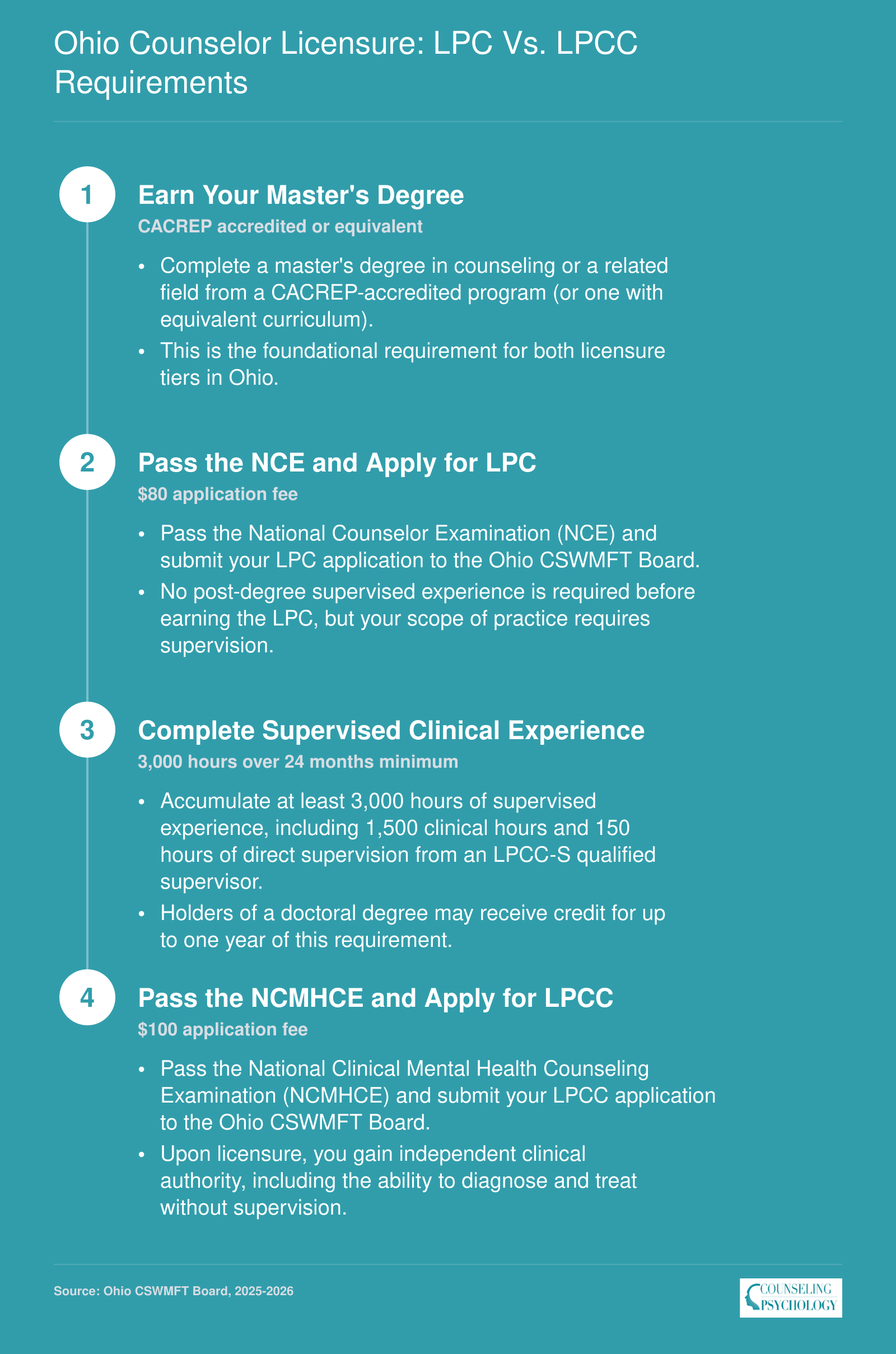
Ohio uses a two-tier licensure system overseen by the CSWMFT Board. You begin as a Licensed Professional Counselor (LPC), then advance to Licensed Professional Clinical Counselor (LPCC) after completing supervised clinical experience. The critical distinction: LPCs may diagnose and treat only under supervision, while LPCCs hold independent clinical authority.
Salary and Career Outcomes for Ohio Counseling Graduates
Knowing what counselors actually earn in Ohio matters as much as knowing where to study. The federal Bureau of Labor Statistics tracks wages for two occupations most relevant to graduates of Ohio counseling master's programs: Substance Abuse, Behavioral Disorder, and Mental Health Counselors (SOC code 21-1014) and School and Career Counselors and Advisors (SOC code 21-1012). For context, the national median annual wage for mental health counselors was $59,190 in 2024.1 Ohio-specific figures may differ from this national number, and you should look them up directly rather than assume parity.
Pulling Ohio Wage Data From the BLS
The most authoritative source for state-level wages is the BLS Occupational Employment and Wage Statistics program. To get Ohio numbers:
- Go to the OEWS page on bls.gov and select Ohio as the state.
- Search by SOC code: 21-1014 for mental health counselors, 21-1012 for school and career counselors.
- Review the median wage, the 10th percentile (entry-level benchmark), the 90th percentile (experienced practitioners), and total state employment.
For custom comparisons across metro areas like Cleveland, Columbus, Cincinnati, Dayton, and Akron, use the BLS data query tool at data.bls.gov to generate tables by area. The most recent OEWS release covers May 2025 data.2 O*NET Online also publishes local wages for mental health counselors in Ohio and is a quick cross-check.
Supplementing With Ohio-Specific Sources
BLS numbers are a starting point, not the whole picture. Round out your research with:
- Ohio Means Jobs: The state's labor market site publishes occupational profiles, projected growth, and regional demand indicators.
- Ohio Counseling Association: Professional association directories and member surveys sometimes include regional compensation reports and benefits data the BLS does not capture.
- School counselor pay schedules: For the 21-1012 occupation, the BLS lumps K-12 and postsecondary advisors together. To get a realistic figure for school counselors specifically, cross-reference the Ohio Department of Education and individual school district HR pages, which post negotiated salary schedules by years of experience and degree level.
Combining these sources gives you a defensible salary range to plan around. For an entry-level licensed professional counselor, that range sets realistic expectations right out of a master's program, while experienced LPCCs with a private practice or supervisory role can aim considerably higher. If you are still exploring the broader landscape, reviewing available counseling careers can help you identify which specialty aligns with your goals.
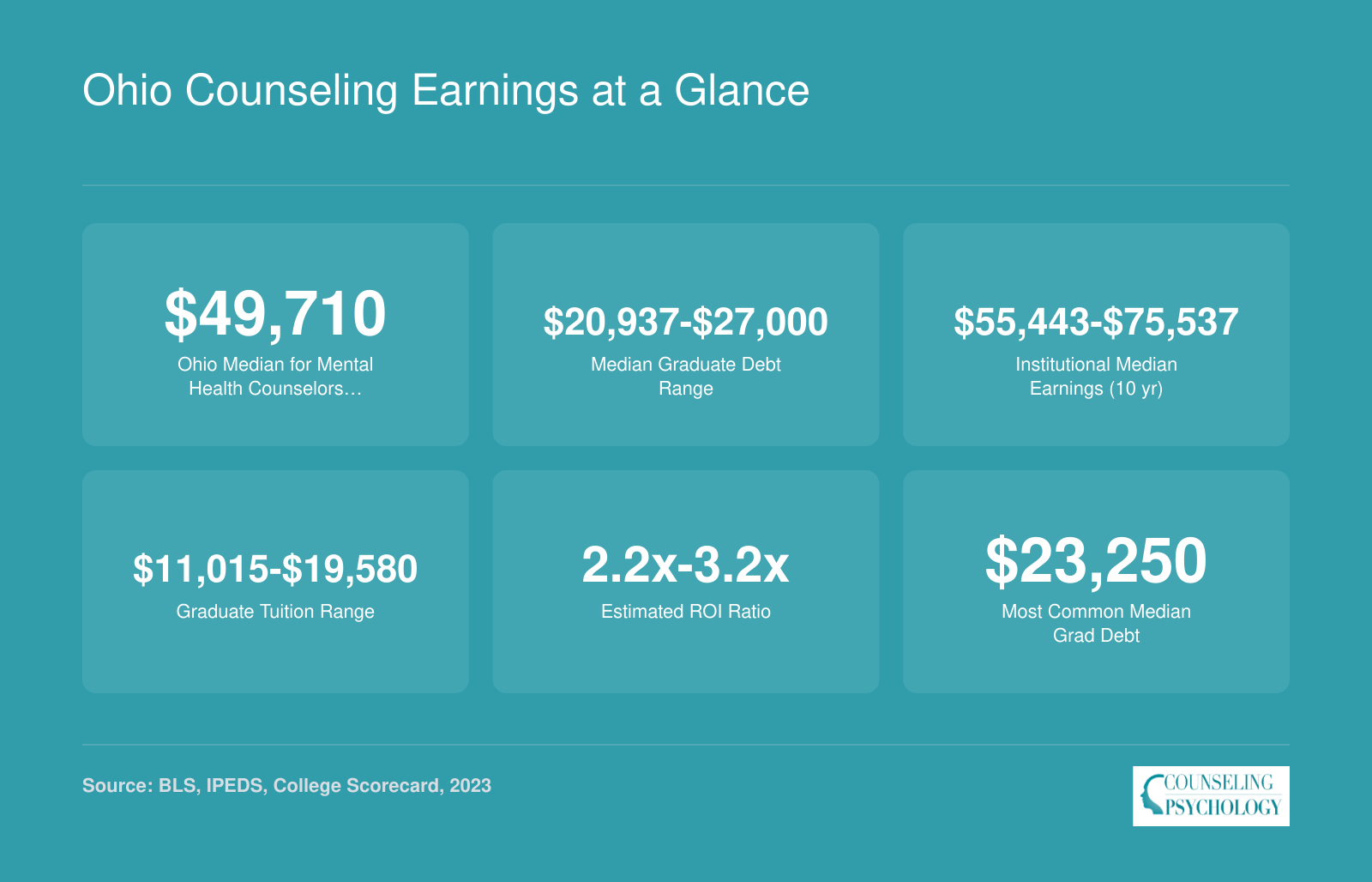
Ohio Counseling Earnings at a Glance
How do counseling graduate earnings stack up against typical student debt in Ohio? These figures offer a quick return-on-investment snapshot for prospective students weighing program costs.
How to Choose the Right Counseling Program in Ohio
With more Ohio universities launching hybrid and fully online counseling tracks each year, students now face a wider, and sometimes more confusing, set of choices than ever before. A structured decision framework can cut through the noise and keep your search focused on what actually matters for licensure, career fit, and financial health.
Five Factors That Should Drive Your Decision
Before comparing individual programs, weigh each school against these five criteria:
- Accreditation status: CACREP accreditation is the clearest quality signal in the field and the fastest path to Ohio licensure.1 Programs without it may require additional coursework or supervised hours down the road.
- Specialization fit: Not every program offers the concentration you need. If you plan to work with children or adolescents, look for dedicated child counseling tracks, play therapy electives, and school-based practicum partnerships.
- Total cost and debt load: Tuition varies widely across Ohio institutions. Calculate total program cost, not just per-credit rates, and factor in fees, textbook costs, and any required on-campus residencies for online students.
- Format (online vs. on-campus): Online programs offer scheduling flexibility, but on-campus cohorts often provide richer peer networking and easier access to faculty-led research. Some programs blend both through hybrid models.
- Clinical hour structure: The way a program organizes its practicum and internship placements has a direct impact on your readiness for post-degree supervised practice. Ask about site placement support, supervisor qualifications, and whether evening or weekend clinical hours are available for working students.
How Long Does It Take to Get a Master's in Counseling in Ohio?
Most CACREP-accredited clinical mental health counseling programs in Ohio require 60 credit hours and take between two and three years of full-time study.23 Timelines vary by institution and enrollment pace. Bowling Green State University, for example, structures its program across roughly 30 months, while Walsh University's timeline can extend to 36 to 40 months depending on course load.45 Part-time students at Malone University may take anywhere from 24 to 42 months to finish.6 For a broader look at program options nationwide, explore our guide to the best counseling master's programs online.
Why Clinical Hours Deserve Extra Scrutiny
Ohio's path to the Licensed Professional Clinical Counselor (LPCC) credential requires substantial supervised experience, so the fieldwork built into your master's program is foundational. CACREP-accredited programs in the state typically require 100 practicum hours and 600 internship hours, totaling 700 hours of supervised clinical contact before graduation.7 That is a significant commitment, and the quality of those placements matters as much as the quantity. Programs with strong community agency partnerships, hospital affiliations, or school district agreements tend to produce graduates who feel more prepared on day one of post-degree supervision. Students interested in the LPCC pathway specifically can learn more about online licensed professional clinical counseling programs.
A Note for Future Child and Adolescent Counselors
If working with young people is your goal, do not assume every program will prepare you equally. During your search, ask specific questions: Does the program offer a child and adolescent counseling concentration? Are play therapy courses available as electives or built into the curriculum? Can you complete practicum hours at a school, pediatric clinic, or child advocacy center? The answers will tell you whether a program aligns with your career vision or whether you will need to piece together that training on your own after graduation.
Frequently Asked Questions About Counseling Programs in Ohio
Below are answers to common questions prospective students ask when exploring master's in counseling programs in Ohio. For deeper detail on any topic, refer to the relevant sections of this article.
- How much does an online master's in counseling cost?
- Tuition for an online master's in counseling in Ohio generally ranges from roughly $20,000 to over $60,000 for the full program, depending on the institution and residency status. Public universities such as the University of Akron and Cleveland State University tend to fall on the lower end for in-state students. See the cost comparison table earlier in this article for specific figures.
- What are the CACREP-accredited counseling programs in Ohio?
- Ohio is home to numerous CACREP-accredited programs at schools including the University of Cincinnati, Ohio University, Kent State University, John Carroll University, and Xavier University, among others. CACREP accreditation is widely recommended because it streamlines licensure and signals program quality. The dedicated section on CACREP-accredited programs in this article provides a fuller list.
- How long does it take to get a master's in counseling in Ohio?
- Most full-time students complete a master's in counseling in two to three years. Programs typically require 48 to 60 semester credit hours, including practicum and internship components. Part-time and online formats may extend the timeline to three or four years, so check each program's scheduling options before committing.
- What is the difference between LPC and LPCC licensure in Ohio?
- In Ohio, a Licensed Professional Counselor (LPC) may practice under clinical supervision, while a Licensed Professional Clinical Counselor (LPCC) has completed additional supervised experience (typically 3,000 hours) and can practice independently and diagnose mental health conditions. The licensure infographic earlier in this article outlines each pathway's specific requirements in detail.
- Are there online master's in counseling programs in Ohio?
- Yes. Several Ohio institutions offer fully online or hybrid counseling master's programs. Schools such as the University of Dayton, Walden University (serving Ohio residents), and Liberty University provide flexible online formats. Most still require in-person practicum and internship hours. The online vs. on-campus comparison section above breaks down the trade-offs.
- What can you do with a master's in counseling in Ohio?
- Graduates work as licensed professional counselors in community mental health agencies, hospitals, schools, private practices, and substance abuse treatment centers. Common titles include clinical mental health counselor, school counselor, marriage and family therapist, and rehabilitation counselor. The salary and career outcomes section of this article covers earning potential and job outlook in more detail.
- Do Ohio counseling programs offer child and adolescent specializations?
- Yes. Programs at schools like John Carroll University and the University of Akron offer concentrations or elective tracks in child and adolescent counseling. These specializations prepare graduates to work in school settings, pediatric behavioral health, and family service agencies. See the child and adolescent counseling section of this article for additional program details.
More Ohio Master's in Counseling Programs to Consider
Beyond the top-ranked programs, Ohio offers many additional options for pursuing a master's in counseling. This directory highlights other schools and programs worth exploring, including online and hybrid formats across the state.
Northeast Ohio
- Graduate Certificate in Addictions Counseling
- Master of Arts in Counseling and Human Development (School Counseling)
- Master of Arts in Counseling and Human Development (Clinical Mental Health Counseling)
- Graduate Certificate in Addictions Counseling
- School Counseling Program (MAED)
- Clinical Mental Health Counseling
- Master of Education in School Counseling
- Master of Education in School Counseling (Substance Use Disorder)
- Master of Education in School Counseling (Applied Behavior Analysis)
Central Ohio
- Master of Arts in Education – School Counseling
- Master of Arts – Clinical Mental Health Counseling
Southwest Ohio
- Certificate in School Counseling
- Master of Science in Education in School Counseling
- Addiction Counseling Certificate
- Master of Education in Counselor Education (School Counseling)
- Master of Education in Counselor Education (Clinical Mental Health Counseling)
- Master of Education in Counselor Education (School Counseling)
- Master of Education in Counselor Education (Clinical Mental Health Counseling)
- Master of Arts in Couple and Family Therapy