What you’ll learn in this article…
- Massachusetts counseling master's tuition ranges from about $6,200 to over $37,000 per year depending on the institution.
- CACREP accreditation streamlines your LMHC application and can unlock tuition reimbursement and loan forgiveness savings.
- The BLS projects roughly 17% national job growth for mental health counselors through 2034, well above the overall average.
- LMHC licensure in Massachusetts requires a minimum 60-credit master's degree plus supervised post-graduate clinical hours.
Balancing program cost against clinical training quality is the central tradeoff for students pursuing a master's in counseling in Massachusetts. The state's LMHC credential requires a minimum of 60 graduate credits and 3,360 supervised post-degree hours, making program selection a decision with multi-year consequences. Massachusetts hosts both CACREP-accredited clinical mental health programs and DESE-approved school counseling tracks, with annual tuition ranging from around $6,200 at Fitchburg State to over $37,000 at private institutions.
Online and hybrid options have expanded access, but clinical placements still anchor students to specific regions. The programs ranked here were evaluated on net price, graduate outcomes, and licensure alignment, giving you a framework for comparing affordability against return on investment. Students exploring the broader landscape may also want to review how to become a counselor for a fuller picture of the profession's requirements nationwide.
Best Master's in Counseling Programs in Massachusetts
Massachusetts is home to a strong network of counseling graduate programs, spanning clinical mental health, school counseling, and addiction specializations. The programs below were evaluated using a methodology that weighs affordability, online accessibility, institutional outcomes, and program quality. Whether you are looking for a fully online clinical mental health counseling degree or a hybrid school counseling program with in-person field placements across the Commonwealth, this list highlights 10 options worth a closer look for 2026.
- Net price and overall affordability
- Online and hybrid availability
- Graduation rate and retention
- Graduate earnings after completion
- Program concentration and scope
- Internal program database
- Independent program research
- College Scorecard graduate earnings — collegescorecard.ed.gov
- NCES-IPEDS federal institutional data — nces.ed.gov

Cambridge College
Cambridge College in Boston offers a hybrid Master of Education in School Counseling built for working professionals who need evening and remote coursework options. The 48-credit program prepares graduates for Massachusetts School Counseling licensure with hands-on field experiences alongside online classes. At roughly $639 per credit, it is one of the more competitively priced private options in the state, and the college maintains a 12:1 student-to-faculty ratio. The institution-wide graduation rate sits at about 11%, so prospective students should weigh that broader metric alongside the program's focused, practitioner-led curriculum.
- 48-credit hybrid program with remote coursework
- Prepares for Massachusetts School Counseling licensure
- Evening and flexible class scheduling
- Approximately $639 per credit ($30,672 total)
- In-person field experiences in school settings
- Faculty drawn from practicing school counselors
Master of Education in School Counseling — Hybrid

American International College
American International College in Springfield delivers a fully online Master of Arts in Clinical Mental Health Counseling designed for students who cannot attend campus. The 60-credit, CACREP-aligned program includes 700 hours of supervised clinical practice and can be completed in two years full-time or three years part-time. With a net price of roughly $23,274 and no required campus visits, AIC is a practical choice for students balancing work and study. The institution reports a school-wide graduation rate of about 46% and median earnings of $53,124 ten years after enrollment.
- 100% online coursework with no campus residencies
- CACREP-aligned 60-credit curriculum
- 700 supervised practicum and internship hours
- Full-time (2-year) or part-time (3-year) completion
- $830 per credit; three annual start dates
- Covers crisis intervention and multicultural counseling
Master of Arts in Clinical Mental Health Counseling — Online

Springfield College
Springfield College offers a hybrid Certificate of Advanced Graduate Study (CAGS) in School Counseling geared toward professionals who already hold a master's degree and want to add licensure credentials. The 32-credit program blends online coursework with on-campus sessions and prepares graduates for both School Counseling and Adjustment Counseling licensure in Massachusetts. Springfield College posts a strong institution-wide graduation rate of about 74% and an 11:1 student-to-faculty ratio. Note that this is a post-master's certificate rather than a standalone master's degree, so it is best suited for career changers or professionals seeking an additional credential.
- 32-credit hybrid post-master's program
- Pathways to School Counseling and Adjustment Counseling licensure
- Online and on-ground course mix
- Personalized curriculum planning with advisors
- Financial support options available
- Fall (September) start date
Certificate of Advanced Graduate Study in School Counseling — Hybrid

Regis College
Regis College in Weston offers a fully online Master of Arts in Counseling with a Clinical Mental Health Counseling Licensure Track that prepares graduates for Massachusetts LMHC licensure. The program does not require a GRE for admission, lowering a common barrier for career changers. With a 9:1 student-to-faculty ratio and a school-wide graduation rate near 72%, Regis provides a supportive learning environment. Median earnings for the institution's graduates reach approximately $52,873 ten years after enrollment.
- Fully online format for maximum flexibility
- No GRE required for admission
- Covers assessment, diagnosis, and treatment planning
- Designed for Massachusetts LMHC licensure preparation
- Competitive graduate tuition at a private institution
- Small class sizes with a 9:1 student-to-faculty ratio
MA in Counseling, Clinical Mental Health Counseling Licensure Track — Online

Assumption University
Assumption University in Worcester offers an online Master of Arts in School Counseling approved with distinction by the Massachusetts Department of Elementary and Secondary Education (DESE). The 60-credit program features two licensure tracks: School Counselor and School Adjustment Counselor. Delivered in a synchronous online format at $680 per credit, it keeps class sizes between 10 and 22 students and includes practicum placements in Massachusetts schools. The university's institution-wide graduation rate is approximately 75%, and its median earnings figure of $74,895 is among the highest on this list, though that reflects all graduates school-wide rather than this program alone.
- 60-credit synchronous online program
- Two tracks: School Counselor and School Adjustment Counselor
- DESE approved with distinction
- $680 per credit; no GRE required
- Practicum placements in Massachusetts schools
- Class sizes of 10 to 22 students
- Completable in about two years full-time
Master of Arts in School Counseling — Online

Fitchburg State University
Fitchburg State University is the only public institution on this list, making it a standout for affordability with a net price near $14,262. The 60-credit School Counseling MS offers PreK-8 and 5-12 concentrations through a hybrid format with evening classes, an appealing setup for working educators. Students can finish in as few as two years or stretch to six, and the program is AAQEP-accredited. The institution posts a school-wide graduation rate of about 55% and median earnings of $53,874 ten years after enrollment.
- 60-credit hybrid program with evening courses
- Choose PreK-8 or 5-12 concentration
- AAQEP-accredited educator preparation program
- Flexible completion timeline from 2 to 6 years
- Public university tuition, net price near $14,262
- Prepares for Massachusetts initial school counseling licensure
- 11:1 student-to-faculty ratio
School Counseling MS (PreK-8 or 5-12) — Hybrid

Merrimack College
Merrimack College in North Andover provides both a hybrid Master of Education in School Counseling and an online Master of Science in Clinical Mental Health Counseling, making it one of the most versatile options on this list. The school counseling track is DESE-accredited and includes 600 to 1,200 hours of field experience, while the clinical mental health track requires 700 clinical hours and can be completed in two to four years. No GRE is required for either program, and fellowship opportunities may offset the higher net price of roughly $37,927. Merrimack's school-wide graduation rate of about 70% and median earnings near $75,584 reflect a solid institutional profile.
- DESE-accredited with PK-12 and Adjustment Counseling tracks
- 48 to 60 credits depending on licensure pathway
- 600 to 1,200 hours of supervised field training
- Hybrid format with evening classes and three start dates
- No GRE required; fellowship opportunities available
- Aligned with ASCA national model standards
- 60-credit program with online and on-campus options
- 700 hours of supervised clinical training
- Meets Massachusetts LMHC licensing requirements
- Completable in 2 to 4 years
- Evidence-based, mentored curriculum
- Expert faculty in clinical practice
Master of Education in School Counseling — Hybrid
Master of Science in Clinical Mental Health Counseling — Online

Bay Path University
Bay Path University in Longmeadow stands out for its low net price of roughly $14,271 and a fully online Master of Science in Clinical Mental Health Counseling with multiple concentration options. Students can focus on general clinical mental health, school adjustment counseling, or addiction counseling foundations. The school adjustment counselor concentration includes 450 hours in public school settings, and all tracks require a 100-hour practicum plus a longer internship. Bay Path's 8:1 student-to-faculty ratio is the smallest on this list, which can translate to more personalized mentorship.
- 60-credit fully online program; no GRE required
- 100-hour practicum plus 600 to 800 hour internship
- Prepares for Massachusetts LMHC licensure
- Predominantly asynchronous with three annual start dates
- 8:1 student-to-faculty ratio for personalized support
- Multiple concentrations including addiction and non-licensure tracks
- 60-credit online program with school-based focus
- 450 hours placed in Massachusetts public schools
- Leads to Initial Student Adjustment Counselor license
- Covers trauma intervention and family systems
- MTEL exams required for school-based licensure
- Cultural competence and ethical practice emphasized
MS in Clinical Mental Health Counseling — Online
MS in Clinical Mental Health Counseling, School Adjustment Counselor Concentration — Online

Lesley University
Lesley University in Cambridge offers a hybrid Counseling Psychology program with a School Counseling specialization that prepares graduates for Massachusetts licensure at the PreK-8 or 5-12 level. The 48-credit program emphasizes trauma-informed care, social justice advocacy, and mind-body behavioral health, a distinctive curricular angle among the schools on this list. A yearlong supervised internship rounds out the clinical training. Lesley's median graduate debt of about $21,000 is among the lowest here, and the institution posts school-wide median earnings of roughly $51,173.
- 48-credit hybrid master's program
- Massachusetts licensure for PreK-8 or 5-12
- Yearlong supervised school-based internship
- Trauma-informed and social justice curriculum
- Mind-body behavioral health focus
- Partnerships with Boston-area school districts
- Flexible full-time or part-time scheduling
Counseling Psychology: School Counseling Specialization — Hybrid

Fisher College
Fisher College in Boston rounds out the list with a hybrid Master of Arts in Counseling Psychology featuring an Addictions Counseling concentration. The 60-credit program blends online and on-campus learning and meets Massachusetts LMHC licensure requirements. Coursework covers motivational interviewing, evidence-based addiction treatments, and crisis intervention, making it a specialized option for students drawn to substance use disorder work. The institution's school-wide graduation rate is lower at about 28%, so applicants should ask the program directly about completion outcomes for graduate students. Scholarships, including the Theodore Everett Berlin Scholarship, may help offset costs.
- 60-credit hybrid program (online plus on-campus)
- Meets Massachusetts LMHC licensure requirements
- Practicum and internship with clinical hours
- Specialized coursework in motivational interviewing
- Covers crisis intervention and ethical practice
- Cultural competence training included
- Scholarship opportunities available
Master of Arts in Counseling Psychology, Addictions Counseling Concentration — Hybrid
How We Ranked These Massachusetts Counseling Programs
Choosing a counseling program involves more than prestige or name recognition. For students weighing cost, schedule flexibility, and long-term return on investment, a methodology grounded in financial and outcomes data gives a clearer picture than reputation alone. Here is how this list was built.
What the Ranking Prioritizes
Affordability sits at the center of this ranking. Programs were evaluated on net price (the actual cost students pay after grants and scholarships, not the sticker price), graduation rates, median earnings of graduates, and median student debt at graduation. These data points were combined into a rough return-on-investment ratio that compares what graduates typically earn against what they typically owe. Online and hybrid availability also factored in, since schedule flexibility is a genuine barrier for working adults in Massachusetts who cannot relocate or attend full-time on campus. If you are also exploring best online master's in counseling programs, those same affordability metrics apply.
The Data Points Used
- Net price: Average cost after institutional and federal aid is applied.
- Graduation rate: The share of students who complete their program within 150 percent of the expected time.
- Median earnings: Reported earnings for graduates approximately one to two years after completing their degree.
- Median debt: The midpoint of what graduating borrowers owe at the time they leave the program.
- ROI ratio: A comparison of median earnings against median debt to gauge financial sustainability.
What This Ranking Cannot Tell You
These are institution-wide or broad program-level figures in most cases. A high graduation rate at a university does not guarantee the same outcome in a specific counseling track. This ranking does not measure curriculum depth, faculty-to-student ratios, the quality of clinical placement networks, or how well a program prepares students for the Massachusetts LMHC licensing exam. Those factors matter enormously in counseling education and deserve direct investigation through program visits, conversations with current students, and a close read of each program's clinical training requirements.
Think of these metrics as a shortlist filter, not a final verdict. They narrow the field to programs that appear financially accessible and outcomes-oriented. The rest of your research should fill in what the numbers cannot show.
Tuition and Affordability Comparison for Massachusetts Counseling Programs
Graduate tuition for counseling master's programs in Massachusetts varies widely, from roughly $6,200 per year at a public university to over $37,000 at private institutions. The table below compares annual graduate tuition rates and median graduate debt across schools featured in our rankings. Keep in mind that many students offset these costs through state and professional scholarships: the Massachusetts Behavioral Health Workforce Scholarship offers up to $12,500 per year (maximum $25,000 over two years) for graduate behavioral health students, and the MaMHCA Haberman Williams Scholarship provides a one time $2,000 award to graduate mental health counseling students.
| School | Annual Graduate Tuition | Median Graduate Debt | Student to Faculty Ratio | Program Format |
|---|---|---|---|---|
| Fitchburg State University | $6,246 | $24,239 | 11:1 | Hybrid |
| Cambridge College | $11,763 | $21,791 | 12:1 | Hybrid |
| American International College | $13,314 | $27,000 | 16:1 | Online |
| Bay Path University | $15,162 | $24,901 | 8:1 | Online |
| Assumption University | $15,470 | $27,000 | 11:1 | Online |
| Regis College | $17,910 | $25,500 | 9:1 | Online |
| Lesley University | $19,890 | $21,000 | 10:1 | Hybrid |
| Fisher College | $27,484 | $25,000 | 14:1 | Hybrid |
| Springfield College | $33,722 | $26,250 | 11:1 | Hybrid |
| Merrimack College | $36,800 | $27,000 | 13:1 | Hybrid |
| Boston College | $37,520 | $19,000 | 10:1 | Hybrid |
Questions to Ask Yourself
Online vs. On-Campus Counseling Programs in Massachusetts
Online master's in counseling programs in Massachusetts can match the rigor of on-campus degrees, but the real differentiator is how each program supports your clinical placement. Securing a practicum or internship site requires proactive research, especially in online formats where you may not have the same on-the-ground connections as a campus-based student.
Check the Clinical Placement Policy First
Most counseling programs have a dedicated webpage or student handbook section on field experience. Look for terms like "Clinical Placements" or "Practicum and Internship." This is where you'll learn whether the program maintains a list of affiliated Massachusetts sites, assigns a placement coordinator, or expects you to find your own site. Online programs often rely on you to identify potential supervisors and agencies, then approve them through a faculty advisor. If the website isn't clear, don't assume: reach out.
Ask the Right Questions of Program Coordinators
Email or call the admissions office or clinical coordinator directly. Specific questions yield actionable answers: How many Massachusetts-based sites have hosted your students in the past two years? Do you have signed affiliation agreements with clinics or hospitals in cities like Boston, Worcester, or Springfield? What is the average time it takes an online student to secure a placement? Also confirm the required practicum and internship hours. CACREP-accredited programs must include at least 100 clock hours of practicum and 600 clock hours of internship, but Massachusetts licensure may add further stipulations. If you're exploring the broader path to becoming a licensed mental health counselor, understanding these hour requirements early is essential.
Lean on Authoritative Sources
The Massachusetts Board of Registration of Allied Mental Health and Human Services Professions publishes the official clinical hour requirements for LMHC licensure. Cross-reference those with your program's curriculum to ensure alignment. For broader career context, the Bureau of Labor Statistics (BLS) provides occupational outlook and wage data, which is helpful for understanding where counselors are employed but not a replacement for state-specific licensure rules. CACREP's website clearly outlines the accreditation standards for practicum and internship hours, which serve as a baseline. Students weighing different credential paths may also want to review online licensed professional clinical counseling programs for comparison.
Use State Resources to Plan Ahead
The Massachusetts Counseling Association and the state licensing board's site often list approved clinical supervisors or post job boards where agencies seek interns. Bookmark these resources early. Even if your online program offers some placement assistance, having your own network of contacts can speed up the process and give you more control over your training environment.
CACREP-Accredited Counseling Programs in Massachusetts
CACREP, the Council for Accreditation of Counseling and Related Educational Programs, is the gold-standard specialized accreditor for graduate counseling programs in the United States. For students pursuing a counseling master's degree in Massachusetts, understanding what CACREP accreditation means, and which programs hold it, can shape both your licensure path and your long-term career mobility.
What CACREP Accreditation Means for LMHC Licensure in Massachusetts
The Massachusetts Board of Registration of Allied Mental Health and Human Services Professionals recognizes CACREP-accredited curricula as meeting the educational requirements for Licensed Mental Health Counselor (LMHC) licensure. In practical terms, if you graduate from a CACREP-accredited program, the board can verify your coursework against a known standard rather than conducting a line-by-line transcript review. This typically speeds up the application process and reduces the chance of being asked to complete supplemental courses after graduation.
CACREP accreditation also matters if you ever plan to practice outside Massachusetts. Many states offer streamlined or reciprocal licensure pathways for graduates of CACREP-accredited programs, which can be a significant advantage if you relocate.
Which Ranked Programs Hold CACREP Accreditation?
Here is where Massachusetts presents a somewhat unusual landscape. Based on the current CACREP directory, very few of the state's counseling programs carry full CACREP accreditation, and none of the programs in our ranked list were confirmed as holding active CACREP accreditation status as of the 2025-2026 directory cycle.1 Gordon-Conwell Theological Seminary's Master of Arts in Christian Counseling (Clinical Mental Health) notes a CACREP-accredited designation in its own program materials, but prospective students should verify this directly through the CACREP directory of accredited programs, as accreditation statuses can change between review cycles. No Massachusetts programs were listed under candidacy status in the directory at the time of our research.1
Several programs on our list, such as those at American International College and Bay Path University, describe their curricula as "CACREP-aligned," meaning they follow CACREP standards in course design and clinical hour requirements without holding the formal accreditation. This distinction matters.
What If Your Program Is Not CACREP-Accredited?
Attending a non-CACREP program does not bar you from earning LMHC licensure in Massachusetts. The state board will still evaluate your application, but it may require a more detailed course-by-course evaluation to confirm that your program covered all required content areas, including:
- Human growth and development: Lifespan theories and counseling implications
- Social and cultural foundations: Multicultural competence and advocacy
- Group work: Theory and practice of group counseling
- Assessment: Testing, appraisal, and diagnostic methods
- Research and evaluation: Understanding of research methodology
- Professional orientation: Ethics, legal standards, and professional identity
This additional evaluation can add time and sometimes cost to your licensure process, so factor that into your planning if you choose a non-CACREP program. Students who want to deepen their credentials beyond a master's degree may also explore counseling doctoral programs as a longer-term option.
Always Verify Accreditation Status Directly
Accreditation is not permanent. Programs gain, lose, or voluntarily relinquish CACREP accreditation, and candidacy statuses shift as programs move through the review pipeline. Before you enroll, search the CACREP directory of accredited programs at cacrep.org to confirm the current status of any program you are considering.1 Program websites sometimes display outdated accreditation claims, so the official directory is the only source you should rely on for a definitive answer.
For Massachusetts students specifically, the limited number of CACREP-accredited options means you may need to weigh accreditation status against other factors like cost, format, and specialization availability. A CACREP-aligned program with strong clinical training and faculty can still prepare you well for licensure, but you should go in with clear expectations about the additional documentation the board may require.
Massachusetts LMHC Licensure: Steps from Degree to Practice
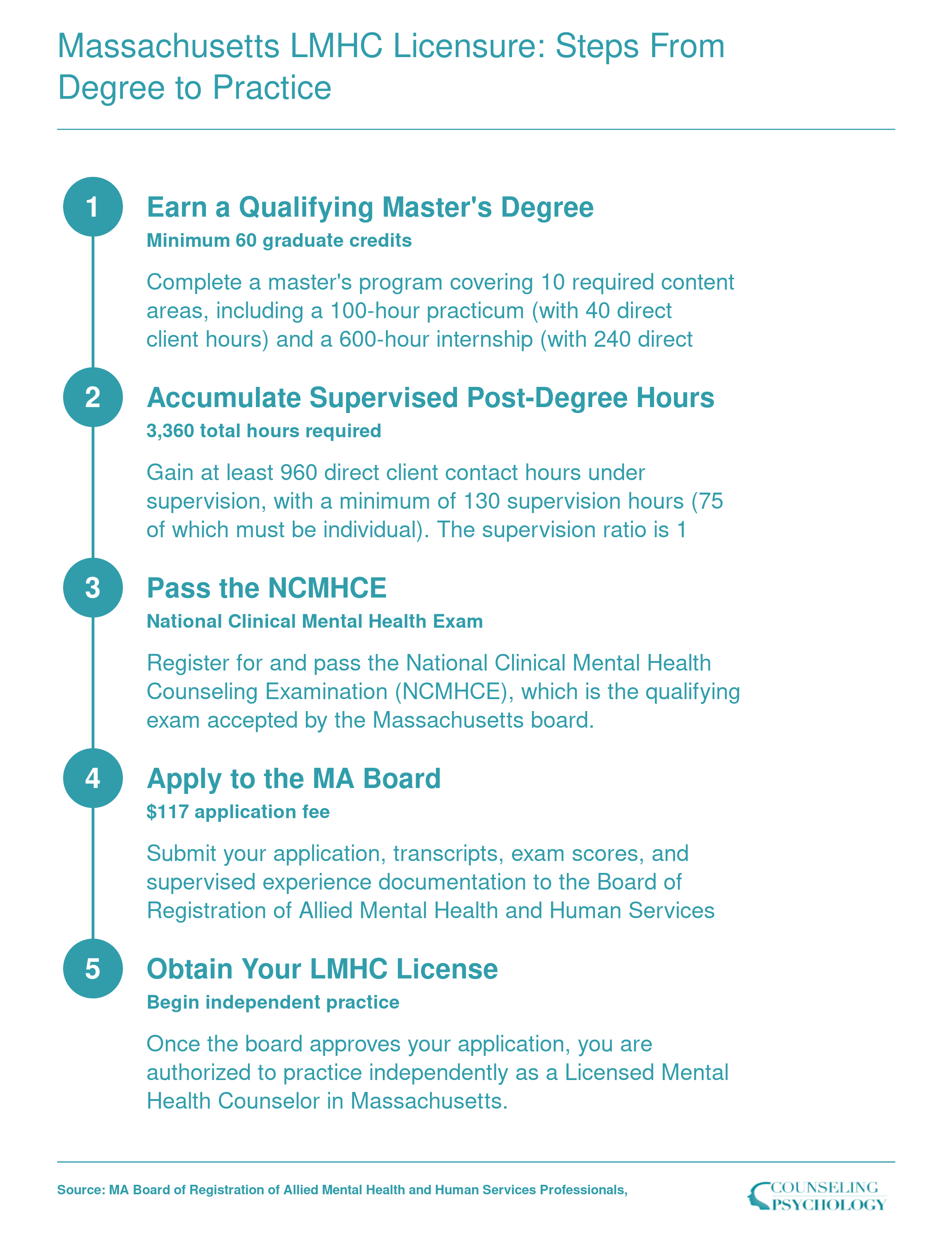
Earning your Licensed Mental Health Counselor (LMHC) credential in Massachusetts is a multi-step process that typically takes two to eight years from the start of your master's program to full licensure. Here is the pathway as defined by the MA Board of Registration of Allied Mental Health and Human Services Professionals.
LMHC Licensure Requirements in Massachusetts: What Your Program Must Cover
Choosing a master's in counseling means balancing a program's format and philosophy with one non-negotiable: alignment with Massachusetts LMHC licensure requirements. Even an excellent program can delay your career if it skips a core content area or undershoots the credit hour minimum. The Massachusetts Board of Registration of Allied Mental Health and Human Services Professions defines precisely what coursework, supervised experience, and examination you need, and many of the programs on our list build their curricula around these rules.1
Meeting the Educational Prerequisites
The Board requires a graduate degree in mental health counseling or a closely related field comprising at least 60 semester hours.1 While the degree title (MA or MS) does not affect your eligibility, the coursework must cover ten specific content areas:
- Human Growth and Development: Theories and life stages
- Social and Cultural Foundations: Multicultural issues and diversity
- The Helping Relationship: Counseling theories and skills
- Group Dynamics and Counseling: Group work processes
- Career and Lifestyle Development: Vocational theories and career counseling
- Assessment and Appraisal: Testing and evaluation techniques
- Research and Program Evaluation: Research methods and analysis
- Professional Orientation: Ethical and legal standards
- Psychopathology: Diagnosis and treatment of mental disorders
- Clinical Instruction: Practicum and internship totaling at least 600 clock hours
CACREP-accredited programs, like several on our list, map directly to these areas, eliminating guesswork.
Post-Degree Supervised Experience Requirements
You must complete 3,360 total hours of post-master's supervised clinical experience, spanning a minimum of two years but no more than eight years.1 Within that total, at least 960 hours must be direct client contact, and 130 hours must be clinical supervision. The supervision must occur at a ratio of one hour of supervision for every 16 hours of clinical work, with at least one hour every two weeks.2 Individual supervision must account for at least 75 of the 130 supervision hours. Couple, family, and individual counseling must make up at least 610 of the direct client hours, while group counseling can contribute up to 350 hours.2
Supervisor Qualifications: Why Your Supervisor Matters
Supervisors must hold a Massachusetts license as an LMHC, LICSW, LMFT, health service provider psychologist, psychiatrist, or psychiatric clinical nurse specialist, with at least three years of post-licensure experience.1 Crucially, 75 of your 130 supervision hours must be provided by an LMHC supervisor.2 This distinguishes the LMHC path from LMFT licensure, which has its own LMFT supervision requirements. Securing an LMHC supervisor early ensures those hours count where they are needed most.
The Licensing Exam: NCMHCE
Massachusetts requires the National Clinical Mental Health Counseling Examination (NCMHCE), not the NCE.3 The NCMHCE uses clinical simulations to test diagnostic and treatment planning skills, mirroring real-world practice. The exam is valid for five years after you pass,4 and because the Board mandates it, nearly all Massachusetts applicants sit for the NCMHCE.
How Our Ranked Programs Help
The programs featured on our list, particularly those with CACREP accreditation, have designed their courses and field placements to satisfy the Board's educational and experience prerequisites. Their curricula cover the required content areas, and many faculty members are familiar with the supervision landscape, helping you connect with qualified supervisors. Choosing a program deliberately built around Massachusetts rules can save you semesters of remediation and hundreds of hours of re-supervised practice.
Child and School Counseling Specializations in Massachusetts
What is the difference between becoming a licensed clinical counselor who works with children and becoming a school counselor in Massachusetts, and which programs prepare you for each path?
These two career tracks overlap in subject matter but diverge sharply in licensure, work setting, and daily scope. Several programs featured in our rankings offer dedicated preparation for one or both paths, so understanding the distinction before you apply is essential.
Two Distinct Licensure Pathways
If your goal is to provide therapy to children and adolescents in a private practice, community agency, or hospital, you are pursuing the Licensed Mental Health Counselor (LMHC) route. For a broader look at this clinical track, see our guide on how to become a child counselor. That credential is governed by the Massachusetts Board of Registration of Allied Mental Health and Human Services Professionals and requires a 60-credit clinical mental health counseling master's degree, supervised post-graduate hours, and the National Counselor Examination or National Clinical Mental Health Counseling Examination.
If you want to work inside a public or private school, you need a different credential entirely: the Massachusetts Department of Elementary and Secondary Education (DESE) school counselor license.1 The DESE pathway has its own approved preparation programs, its own practicum standards, and its own required exam. The two licenses are not interchangeable, though recent legislative interest (Senate Bill S.283) has proposed streamlining a path from the DESE school counselor credential to LMHC licensure, a signal that the state recognizes the need for more flexible credentialing.4
DESE School Counselor Licensure Requirements
To earn an Initial License as a school counselor in Massachusetts, you must complete:1
- A master's degree in counseling from a DESE-approved preparation program
- At least 450 hours of supervised practicum experience in a school setting
- A passing score on the Communication and Literacy Skills MTEL exam
After earning the Initial License, you can work in Massachusetts schools while building toward the Professional License, which requires three years of employment as a school counselor under the Initial License and completion of a 60-credit program (or, alternatively, national certification through the National Board for Professional Teaching Standards or the National Board for Certified Counselors).1
Programs in Our Rankings That Prepare School Counselors
Several of the programs we ranked offer direct school counseling preparation:
- Assumption University offers a fully online Master of Arts in School Counseling that is DESE-approved with distinction. At 60 credits and $680 per credit, it includes practicum placements in Massachusetts schools and offers both PreK-8 and 5-12 licensure tracks.
- Fitchburg State University provides a hybrid Master of Science in School Counseling with PreK-8 or 5-12 concentrations. As a public institution, Fitchburg State is one of the most affordable options in the state for this specialization.
- Boston College offers a hybrid Master of Arts in School Counseling through its Lynch School of Education, with a 600-hour practicum, small cohort sizes, and a social justice-oriented curriculum.
- Cambridge College has a hybrid Master of Education in School Counseling at 48 credits, designed for working professionals who need flexible day and evening scheduling.
- Lesley University offers a Counseling Psychology master's with a School Counseling specialization, preparing graduates for PreK-12 licensure through partnerships with local school districts.
- Merrimack College provides a Master of Education in School Counseling with 600 to 1,200 hours of field training. Note that Merrimack also offers a separate Post-Master's Certificate in School Social Work and Adjustment Counseling, which leads to a different DESE license area, not the school counselor credential.3
- Bay Path University takes a combined approach: its Master of Science in Clinical Mental Health Counseling includes a School Adjustment Counselor concentration. Graduates can pursue both LMHC licensure and the DESE school adjustment counselor license, though the school adjustment counselor credential is distinct from the school counselor license.
Why School Counseling Is a High-Demand Track
Massachusetts school districts have faced persistent counselor shortages, and the state legislature's introduction of bills like S.283 reflects urgency around building workforce capacity in school-based mental health.4 For students who want strong job prospects right after graduation, school counseling offers a clear advantage: districts are actively hiring, and the pipeline of qualified candidates has not kept pace with need. If you are drawn to working with young people in an educational environment, this specialization is worth serious consideration.
A CACREP-accredited program streamlines your LMHC application in Massachusetts by eliminating the need for course-by-course curriculum evaluation. CACREP graduates also qualify for more employer tuition reimbursement programs and federal loan forgiveness options, potentially saving thousands of dollars over your career.
Career Outcomes and Salaries for Massachusetts Counselors
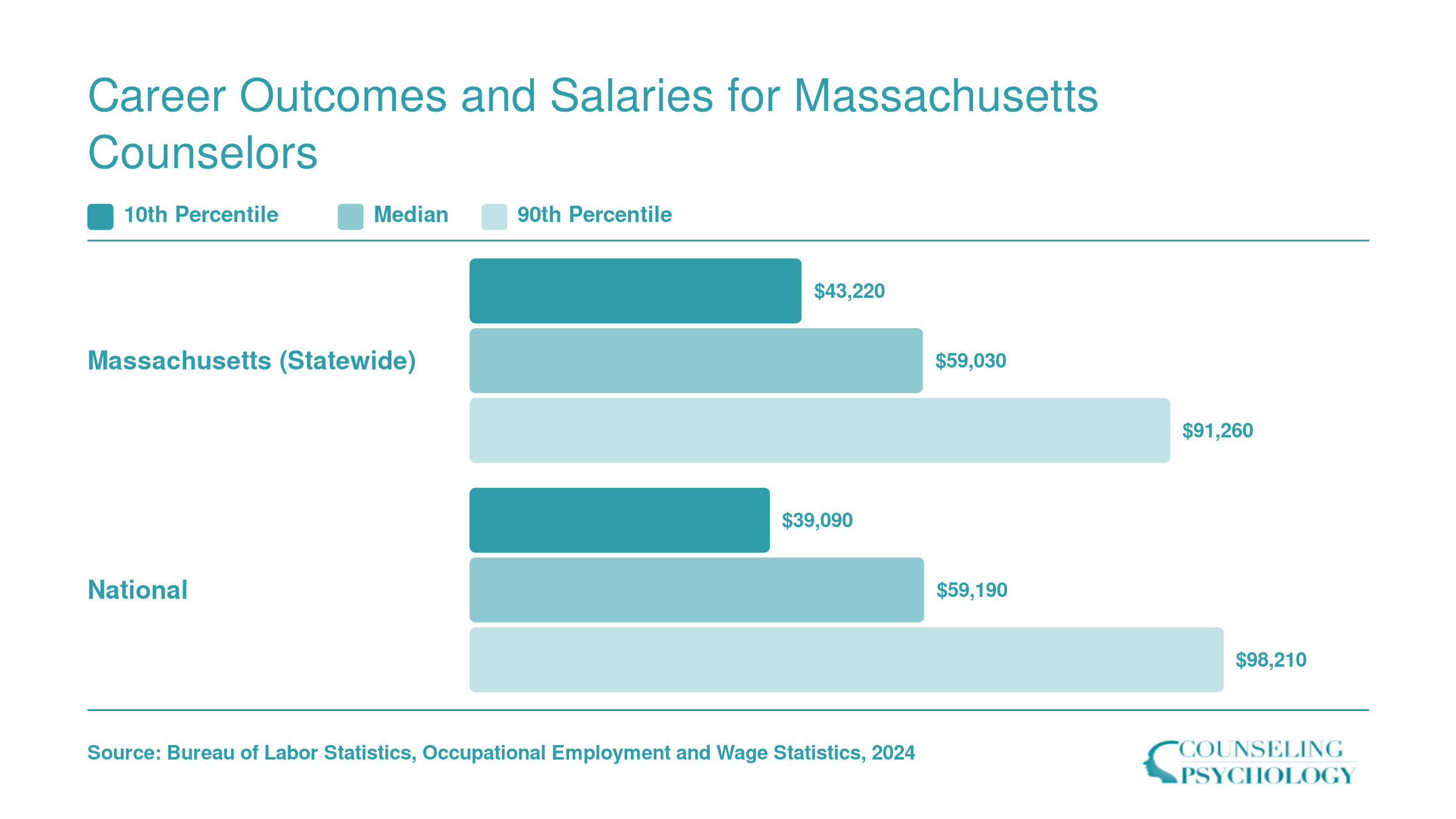
Massachusetts mental health counselors earn salaries that closely track the national median, with strong demand across the state's major metro areas. The BLS projects roughly 17% national job growth for mental health counselors through 2034, well above average. Program-level earnings data for the master's counseling programs featured in this article are not yet available, so the figures below reflect BLS state and metro wage data for mental health counselors (SOC 21-1014).
Frequently Asked Questions About Counseling Master's Programs in Massachusetts
Choosing the right counseling master's program involves weighing accreditation, format, cost, and licensure fit. Below are answers to the questions prospective students ask most often about pursuing a counseling degree in Massachusetts.
More Massachusetts Counseling Programs to Consider
Beyond our top-ranked programs, these additional Massachusetts schools offer quality counseling master's degrees worth exploring. Each program provides unique specializations and flexible learning formats to suit different career goals.
- Master of Arts in Christian Counseling, Clinical Mental Health
- Clinical Mental Health Counseling (Couples and Family Therapy)
- Minor in Addictions Counseling
- Master of Arts (M.A.) in School Counseling