
Key Takeaways
- Becoming a counseling psychologist typically requires 8 to 12 years of education and training after high school.
- The national median salary for clinical and counseling psychologists is $95,830 according to BLS data.
- APA accredits roughly 80 doctoral programs in counseling psychology across the United States.
- Licensure is required in every state and hinges on a doctoral degree, supervised hours, and the EPPP exam.
Counseling psychology is a doctoral-level specialty focused on emotional wellness, life transitions, and developmental challenges rather than severe psychopathology or chronic mental illness. Becoming a licensed counseling psychologist requires completing one of the 80 APA-accredited doctoral programs currently operating in the United States, accumulating 1,500 to 4,000 hours of supervised practice depending on state requirements, and passing the Examination for Professional Practice in Psychology.
The timeline from undergraduate enrollment to independent licensure typically spans 8 to 12 years. National median earnings for clinical and counseling psychologists reach $95,830 annually, though compensation varies substantially by setting and state. Prospective students should understand where this specialty diverges from clinical psychology, since graduate training and career focus differ despite the identical license. For a broader look at related pathways, this guide sits alongside dozens of other counseling psychology careers you can explore within the discipline.
What Does a Counseling Psychologist Do?
Clinical psychology built its reputation around diagnosing and treating mental illness; counseling psychology grew up alongside it with a different center of gravity, focused on growth, resilience, and the developmental challenges that face otherwise healthy people. Both are doctoral-level professions and both are licensed to provide psychotherapy, but the day-to-day work of a counseling psychologist tends to lean toward helping clients navigate transitions rather than treating severe psychopathology.
A Strengths-Based Orientation
Counseling psychologists work with people facing life stressors that are common but rarely simple: career indecision, relationship conflict, grief after a loss, identity questions, academic pressure, adjustment to a chronic illness, or the cumulative weight of discrimination and microaggressions. The orienting assumption is that clients already possess strengths and coping resources, and that therapy's job is to help them mobilize those resources in context. That developmental, contextual lens distinguishes the field from purely pathology-focused models, even when the clinical tools (CBT, ACT, psychodynamic work, EMDR, motivational interviewing) overlap heavily with what clinical psychologists use.
A Typical Week
The work is more varied than a calendar of fifty-minute hours.
- Direct clinical work: individual therapy, couples and family sessions, and group therapy for issues like social anxiety, grief, or substance use.
- Assessment: administering and interpreting personality, career, cognitive, or vocational inventories, then translating results into actionable feedback.
- Consultation: advising schools, employers, athletic departments, or healthcare teams on the psychological dimensions of a case or a system.
- Supervision and training: overseeing practicum students, interns, and early-career therapists.
- Research and program development: evaluating outcomes, designing prevention programs, or publishing on multicultural competence and counseling process.
Populations and Settings
Counseling psychologists serve a broad range of clients: adolescents in school-based clinics, college students at university counseling centers, couples counselor professionals in private practice, veterans counselor roles through the VA system, geriatric counselor work with older adults managing late-life transitions, and historically underserved communities where culturally responsive care is in short supply. Many practitioners blend roles, splitting time between a clinical caseload and a faculty appointment, or between private practice and consulting on workplace wellness, employee assistance, or diversity initiatives. The result is a profession that is rarely therapy-only, and a career path that lets you reshape the mix of clinical, scholarly, and applied work as your interests evolve.
Counseling Psychologist vs. Clinical Psychologist
The distinction between counseling and clinical psychology is real and consequential, even though both paths lead to the same license and legal scope of practice.
Students often assume these specialties are interchangeable, but the differences show up early, in the philosophy of training, the curriculum, and the settings where practitioners tend to build careers. Choosing the right path means understanding what each discipline actually prioritizes.
Training Philosophy
Counseling psychology, organized under APA's Division 17 (Society of Counseling Psychology), is rooted in a strengths-based, developmental perspective.1 Programs emphasize how people grow, adapt, and find meaning across the lifespan, with particular attention to vocational development, multicultural competence, and prevention. The underlying assumption is that most clients are fundamentally capable people navigating difficult circumstances.
Clinical psychology, represented by Division 12 (Society of Clinical Psychology), centers its training on psychopathology, formal diagnosis, and evidence-based interventions for mental disorders.1 Clinical programs typically include heavier coursework in assessment, medically integrated care, and the treatment of severe or chronic conditions.
Neither approach is superior. They reflect different starting points for understanding human distress.
Curriculum and Work Settings
Those differences in philosophy translate directly into what doctoral students study and where they eventually practice.
Counseling psychology programs concentrate on counseling theories, career development, multicultural frameworks, and community-based prevention.1 Graduates are especially well represented in college counseling centers, community mental health agencies, vocational rehabilitation services, and private practice.
Clinical programs weight their curriculum toward psychopathology, psychological assessment, and evidence-based treatment protocols.2 Hospitals, inpatient psychiatric facilities, specialty clinics, and academic medical centers are common landing spots for clinical psychologists.
That said, these boundaries are porous. Counseling psychologists work in hospitals; clinical psychologists work on college campuses. Context and individual training matter as much as the label.
Licensure and Accreditation
Here is where the two paths converge completely. Both counseling and clinical psychology doctoral programs seek accreditation through the APA Commission on Accreditation (APA-CoA), and graduates of both sit for the same licensing examinations.1 Once licensed, a psychologist in either specialty holds the same title, the same authority to diagnose, and the same right to independent practice.
The choice, then, is less about what you can do after training and more about how you want to think about the people you serve. For a broader look at the many directions a psychology degree can take you, explore careers in psychology.
Questions to Ask Yourself
Education Requirements for Counseling Psychologists
Eighty APA-accredited doctoral programs in counseling psychology currently operate across the United States, each designed to prepare graduates for independent licensure as psychologists.1 Earning that title requires completing a doctoral degree, and understanding the educational pathway from undergraduate studies through dissertation defense will help you plan realistically.
Bachelor's Degree: Building Your Foundation
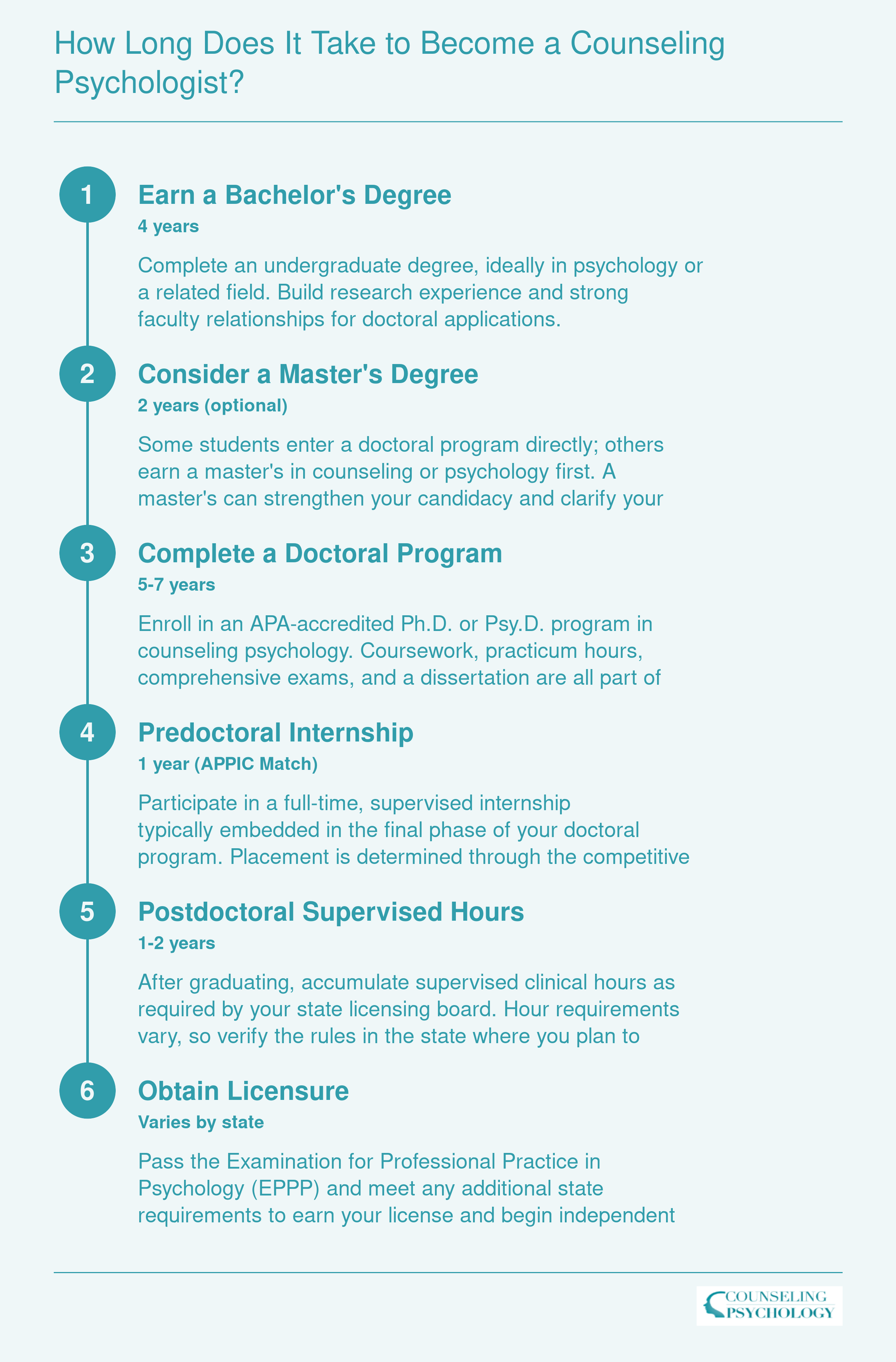
Most aspiring counseling psychologists begin with a four-year bachelor's degree in psychology, human development, sociology, or a related behavioral science. This undergraduate phase introduces core concepts in research methods, abnormal psychology, developmental psychology, and statistics. While no single major is mandatory, strong preparation in psychology coursework and research experience strengthens doctoral applications considerably. Many competitive applicants also gain volunteer or paid experience in clinical settings during their undergraduate years, whether through crisis hotlines, community mental health centers, or research labs studying psychological interventions.
Master's Degree: Common but Not Always Required
A master's degree in counseling, clinical psychology, or a related field is optional for some doctoral programs that accept students directly from undergraduate studies. However, many applicants pursue a master's degree in psychology first, using it to gain supervised clinical hours, clarify their research interests, and strengthen their candidacy for doctoral admission. A master's alone qualifies someone for counseling licensure as a licensed professional counselor, licensed mental health counselor, or marriage and family therapist, depending on the state. It does not, however, qualify someone to use the protected title of psychologist. That distinction matters both legally and professionally.
Doctoral Degree: The Required Credential
Every U.S. state requires a doctoral degree for licensure as a psychologist. Counseling psychology doctoral programs award either a Ph.D. (Doctor of Philosophy) or a Psy.D. (Doctor of Psychology). The Ph.D. traditionally emphasizes research training alongside clinical practice, preparing graduates for academic positions, research careers, and clinical work. The Psy.D. typically prioritizes clinical training with somewhat less emphasis on producing original research, though graduates still complete a doctoral project or dissertation.
Recent accreditation decisions suggest modest growth in Psy.D. options within counseling psychology. Felician University received APA accreditation for its Psy.D. in Counseling Psychology in 20212, and Saint Elizabeth University earned a 10-year accreditation for its Psy.D. program in 2024.3 Meanwhile, some established Ph.D. programs occasionally pause admissions for restructuring. The University of Georgia's Ph.D. in Counseling Psychology, for instance, suspended admissions for the 2026-2027 cycle and plans to resume in 2027-2028.4
Why APA Accreditation Matters
Licensure boards in most states require graduation from an APA-accredited program, making accreditation status a critical factor in program selection. APA-accredited programs must meet rigorous standards for curriculum, faculty qualifications, and supervised training. Coursework typically spans assessment and psychological testing, professional ethics, multicultural psychology, research methods and statistics, and evidence-based therapeutic interventions.
Accredited programs also include structured practicum experiences, usually beginning in the second or third year, followed by a predoctoral internship. The internship, often completed in the final year of training, involves at least 1,500 to 2,000 hours of supervised clinical work. Programs like Arizona State University's Ph.D. in Counseling Psychology5 and Cleveland State University's Counseling Psychology specialization within its Urban Education Ph.D. (accredited since 2010)6 reflect the range of program structures that meet APA standards.
Before committing to any doctoral program, verify its current accreditation status through the APA accreditation search tool or the Society of Counseling Psychology's list of accredited programs. Attending a non-accredited program can create significant barriers to licensure and limit employment opportunities.
How Long Does It Take to Become a Counseling Psychologist?
The path from freshman orientation to independent practice is a marathon, not a sprint. Most counseling psychologists invest 8 to 12 years from the start of their bachelor's degree to full licensure. Doctoral program length is the biggest variable: Ph.D. programs tend to run longer because of intensive research and dissertation requirements, while Psy.D. programs may trim a year or so by emphasizing clinical training. The predoctoral internship is a competitive match process coordinated through the APPIC Match, and completing it is a non-negotiable step before you can move on to postdoctoral hours.
Licensure and Certification Steps
Licensure for counseling psychologists is in a period of gradual modernization, with a skills-based exam on the horizon but traditional requirements still anchoring the pathway. Every state requires a license to practice independently, and the core steps (doctoral degree, supervised hours, and examination) are consistent nationwide, though details vary.
Passing the EPPP: What to Expect
The Examination for Professional Practice in Psychology (EPPP) is the primary licensing exam. It tests foundational knowledge and is administered by the Association of State and Provincial Psychology Boards (ASPPB). Pass rates for counseling psychology doctoral graduates are generally strong, but they can differ by program. For the most current data, consult the ASPPB's official reports or check the websites of individual doctoral programs, which often publish student outcomes. A passing score is typically a scaled score of 500, though some states set a higher threshold. Preparing with study guides and practice tests is standard.
Supervised Postdoctoral Hours: State-by-State Variability
After earning the doctorate, you must complete supervised postdoctoral experience. The number of required hours ranges from 1,500 to 3,000, depending on the state. For instance, some states mandate 1,500 hours, while others require a full two years equating to around 3,000 hours. These hours must be documented and supervised by a licensed psychologist. To find the exact requirement for your intended state, consult that state's psychology licensing board website or the ASPPB's online database of licensure requirements. Planning ahead is crucial because moving between states mid-process can reset or complicate your hour accumulation.
The EPPP-2 Transition: Slow Adoption
A skills-based companion exam, known as the EPPP Step 2 or EPPP-2, has been developed to assess clinical competence through case studies and practical scenarios. However, as of 2025, adoption remains rare. Few states have implemented it, and many are still evaluating the tool. To verify whether your state has adopted the EPPP-2, review ASPPB's exam transition updates and your state board's licensing regulations. The APA and other professional associations provide advocacy updates on workforce trends that influence testing requirements.
Staying Current with Requirements
Licensure standards evolve. The Bureau of Labor Statistics (BLS) offers occupational outlook data that can help you understand job markets, and the APA shares nationwide trends in policy and practice. Related psychology specializations, such as how to become a clinical psychologist, follow a similar licensure structure but may differ in exam emphasis or supervised-hours benchmarks. Always cross-reference state-specific rules with these authoritative sources to ensure you meet every mandate.
Where Counseling Psychologists Work
Counseling psychologists practice across a wider range of settings than many prospective students realize, with options spanning healthcare systems, higher education, government agencies, and private enterprise.
University and College Counseling Centers
Campus counseling centers remain one of the most traditional employment paths for counseling psychologists. These positions involve providing individual and group therapy to students, conducting outreach programming on topics like stress management and healthy relationships, and consulting with faculty and staff. University counseling centers typically offer predictable schedules aligned with the academic calendar, though demand often spikes during midterms and finals.
Veterans Affairs Medical Centers
The VA system stands as one of the largest employers of counseling psychologists in the United States. VA positions involve treating veterans dealing with PTSD, depression, substance use, and adjustment challenges related to military service. Beyond competitive federal salaries and benefits, VA employment often includes loan repayment programs that can forgive substantial portions of educational debt, a significant financial advantage given the cost of doctoral training.
Community Mental Health and Hospital Settings
Community mental health agencies employ counseling psychologists to serve diverse populations, often including underserved communities with limited access to private care. Those drawn to this work may also want to explore what it takes to become a community mental health counselor at the master's level. Hospital systems and integrated health networks increasingly hire psychologists to work alongside physicians in primary care, oncology, rehabilitation, and pain management. These interdisciplinary roles emphasize brief interventions and behavioral health consultation rather than traditional long-term therapy.
Private Practice
Many counseling psychologists eventually move into private practice, either full-time or alongside another position. Running a private practice offers autonomy in choosing clientele, setting fees, and establishing work hours. However, building a sustainable caseload takes time, and practitioners handle their own business operations, including billing, marketing, and insurance credentialing.
Academic and Corporate Positions
Faculty positions at universities allow counseling psychologists to train the next generation of practitioners while conducting research. These roles are competitive and typically require a strong publication record established during counseling doctoral programs. Corporate and organizational consulting represents another pathway, where psychologists address workplace wellness, executive coaching, leadership development, and employee assistance programs.
Work-Life Balance Considerations
Most counseling psychologists maintain standard weekday schedules, particularly those in campus counseling centers, VA facilities, and corporate settings. Private practitioners and hospital-based psychologists may need to offer evening or weekend appointments to accommodate client availability, though this flexibility is often self-directed. Compared to some healthcare professions, counseling psychology generally offers manageable hours without on-call requirements.
Counseling Psychologist Salary: National Overview
According to the most recent Bureau of Labor Statistics data, clinical and counseling psychologists earn a national median annual salary of $95,830, with earnings varying considerably based on experience, setting, and geographic location. The field also shows strong demand: the BLS projects 11% job growth for clinical and counseling psychologists from 2024 to 2034, a rate characterized as much faster than average for all occupations. With roughly 72,190 professionals employed nationally, counseling psychology offers both competitive compensation and solid long-term job security.
| Salary Metric | Annual Amount |
|---|---|
| 25th Percentile | $67,470 |
| Median (50th Percentile) | $95,830 |
| Mean (Average) | $106,850 |
| 75th Percentile | $131,510 |
Highest-Paying States for Counseling Psychologists
Geography plays a major role in what clinical and counseling psychologists earn. The table below ranks every state where BLS data reports a median annual wage, sorted from highest to lowest. Keep in mind that top-paying states often come with a higher cost of living, so weigh salary against local expenses before making a relocation decision.
| State | Total Employment | Median Annual Wage | 25th Percentile | 75th Percentile | Mean Annual Wage |
|---|---|---|---|---|---|
| Oregon | 440 | $132,550 | $120,590 | $134,440 | $129,110 |
| Colorado | 1,940 | $126,260 | $96,310 | $140,710 | $129,500 |
| Kentucky | 850 | $116,480 | $71,030 | $163,320 | $126,740 |
| Washington | 980 | $115,050 | $96,060 | $137,910 | $125,270 |
| California | 11,900 | $114,520 | $77,850 | $158,400 | $124,720 |
| New Jersey | 2,850 | $110,190 | $61,140 | $189,230 | $128,400 |
| North Dakota | 150 | $109,110 | $66,310 | $128,420 | $105,240 |
| Delaware | 190 | $109,120 | $105,620 | $119,880 | $108,440 |
| Hawaii | 300 | $108,840 | $86,910 | $132,630 | $110,900 |
| Arizona | 1,140 | $106,970 | $62,550 | $138,480 | $111,730 |
| Alaska | 80 | $105,870 | $78,330 | $155,850 | $111,840 |
| Maryland | 1,680 | $104,480 | $80,400 | $128,430 | $109,990 |
| Wisconsin | 980 | $103,860 | $83,380 | $136,340 | $117,050 |
| Nevada | 510 | $103,510 | $83,480 | $122,910 | $110,520 |
| Minnesota | 1,490 | $102,650 | $67,920 | $123,790 | $98,260 |
| Ohio | 1,360 | $102,290 | $74,870 | $130,760 | $104,420 |
| Rhode Island | 470 | $101,820 | $83,640 | $121,310 | $103,670 |
| Alabama | 360 | $100,320 | $63,690 | $128,550 | $110,180 |
| New York | 7,190 | $99,910 | $78,500 | $132,520 | $112,980 |
| Iowa | 760 | $98,580 | $73,520 | $124,640 | $102,560 |
| Maine | 180 | $97,630 | $86,180 | $117,120 | $114,470 |
| Illinois | 3,470 | $97,470 | $66,570 | $138,890 | $106,360 |
| Mississippi | 200 | $92,390 | $64,390 | $101,360 | $95,140 |
| Tennessee | 780 | $92,320 | $81,790 | $120,450 | $103,190 |
| North Carolina | 2,420 | $91,840 | $68,660 | $117,060 | $99,940 |
| Oklahoma | 360 | $91,140 | $71,810 | $119,830 | $97,350 |
| Pennsylvania | 3,850 | $90,450 | $67,450 | $124,990 | $103,980 |
| Utah | 1,000 | $88,990 | $68,080 | $121,980 | $94,070 |
| Massachusetts | 3,470 | $87,060 | $73,670 | $132,840 | $102,440 |
| Missouri | 1,490 | $86,340 | $60,710 | $115,130 | $90,480 |
| South Dakota | 100 | $85,790 | $62,300 | $105,890 | $87,040 |
| Florida | 3,230 | $84,020 | $49,690 | $126,460 | $92,010 |
| Indiana | 1,630 | $80,770 | $72,440 | $102,430 | $91,840 |
| Michigan | 2,650 | $80,030 | $66,230 | $101,150 | $88,810 |
| Wyoming | 60 | $79,890 | $67,530 | $86,030 | $79,970 |
| Vermont | 160 | $79,550 | $64,980 | $98,730 | $97,220 |
| Idaho | 370 | $74,820 | $62,330 | $104,500 | $93,220 |
| New Mexico | 220 | $73,860 | $49,440 | $109,450 | $87,710 |
| Texas | 3,410 | $72,320 | $48,760 | $99,050 | $83,830 |
| West Virginia | 650 | $70,540 | $50,090 | $110,160 | $88,540 |
| Louisiana | 370 | $67,470 | $63,850 | $81,940 | $88,950 |
| Kansas | 350 | $61,800 | $48,010 | $75,480 | $65,270 |
| New Hampshire | 390 | $52,510 | $45,840 | $79,480 | $66,140 |
| Georgia | 1,210 | $51,210 | $40,000 | $101,750 | $74,140 |
Counseling Psychologist Salary by Metro Area
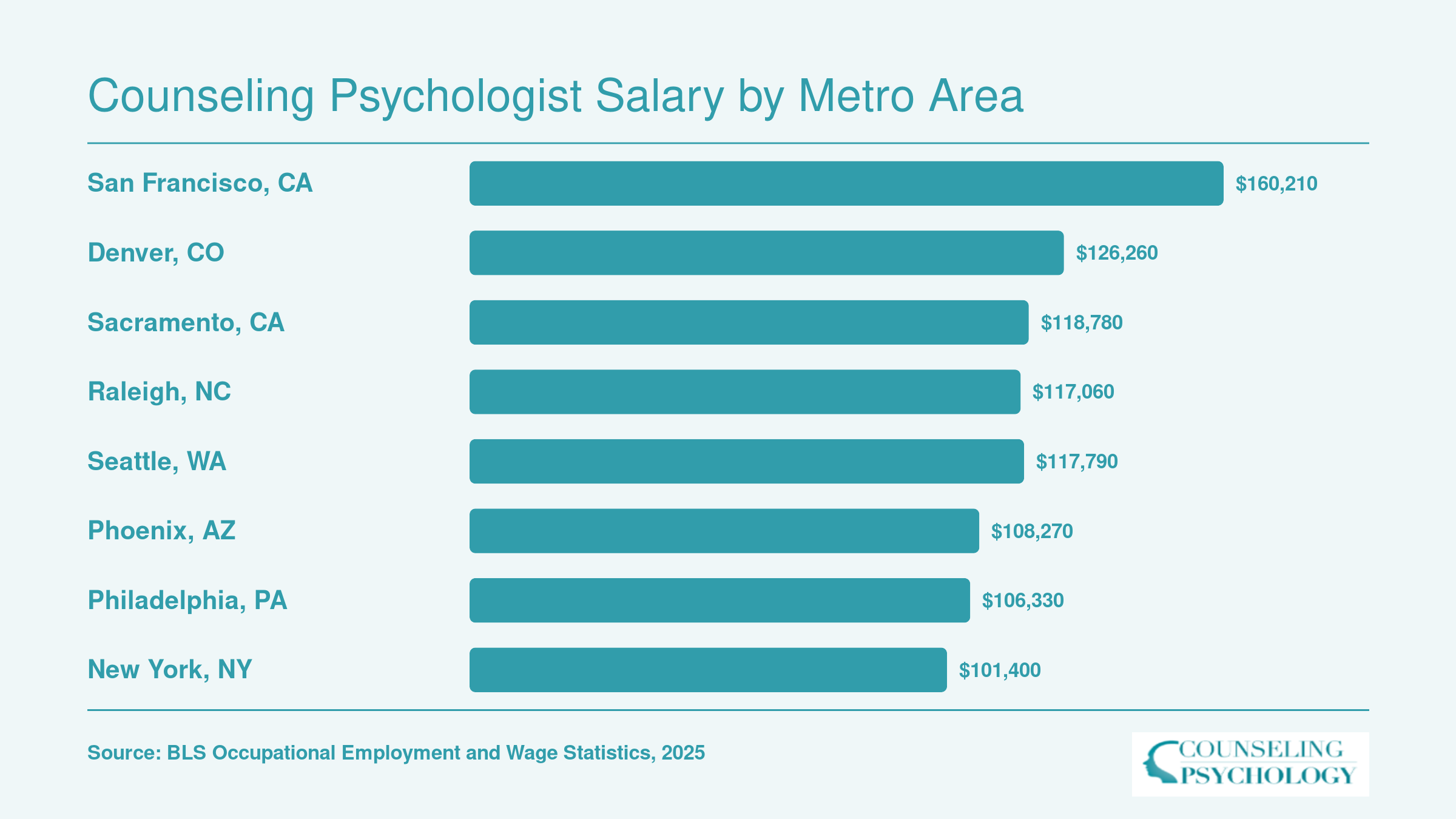
Salaries for clinical and counseling psychologists vary dramatically across metropolitan areas. The highest-paying metros tend to be in high cost-of-living regions, so a six-figure median does not always translate to greater purchasing power. Employment concentration also differs: some metros pay top dollar but have relatively few openings, while larger metros like New York offer thousands of positions at slightly lower median pay.
Honestly, yes. Expect eight to twelve years of postsecondary education, and know that many APA-accredited doctoral programs accept fewer than 10 percent of applicants. The APPIC internship match adds yet another competitive gate before you can pursue licensure. That said, practitioners consistently report high job satisfaction rooted in meaningful client relationships, and demand for counseling psychologists continues to grow. The difficulty is real, but so is the reward.
Frequently Asked Questions About Becoming a Counseling Psychologist
Prospective counseling psychologists tend to ask many of the same questions as they plan their education and career path. Below are straightforward answers to the most common ones.
Related Psychology Careers
- How to Become a BCBA
- How to Become a Biogerontologist
- How to Become a Child Psychologist
- How to Become a Clinical Psychologist
- How to Become a Cognitive Neuroscientist
- How to Become a Cognitive Psychologist
- How to Become a Comparative Psychologist
- How to Become a Consumer Psychologist
- How to Become a Criminal Psychologist
- How to Become a Cultural Psychologist
- How to Become a Forensic Psychologist
- How to Become a Gerontologist
- How to Become a Geropsychologist
- How to Become a Health Psychologist
- How to Become a Media Psychologist
- How to Become a Military Psychologist
- How to Become a Navy Psychologist
- How to Become a Neurologist
- How to Become a Neuropsychologist
- How to Become a Personnel Psychologist
Show 20 more
- How to Become a Physiatrist
- How to Become a Police Psychologist
- How to Become a Positive Psychologist
- How to Become a Psychiatrist
- How to Become a Psychological Anthropologist
- How to Become a Psychometrician
- How to Become a Rehabilitation Psychologist
- How to Become a School Psychologist
- How to Become a Social Psychologist
- How to Become a Spiritual Psychologist
- How to Become a Sports Psychologist
- How to Become a Transpersonal Psychologist
- How to Become an Air Force Psychologist
- How to Become an Applied Psychologist
- How to Become an Army Psychologist
- How to Become an Educational Psychologist
- How to Become an Engineering Psychologist
- How to Become an Environmental Psychologist
- How to Become an Experimental Psychologist
- How to Become an Industrial-Organizational Psychologist