

What you’ll learn in this article…
- Kentucky's ranked 2026 psychology programs have net prices ranging from roughly $8,000 to over $20,000 per year.
- Doctoral licensure through the Kentucky Board of Examiners of Psychology requires supervised hours and multiple exams.
- Early career earnings for Kentucky psychology bachelor's holders generally fall between $43,000 and $59,000.
- Fully online and hybrid psychology tracks are now available at several top-ranked public and private Kentucky schools.
Kentucky employs roughly 1,200 clinical and counseling psychologists, and the state Department for Behavioral Health continues to flag mental health workforce shortages across rural Appalachian counties and urban Louisville alike. That demand is reshaping how Kentucky schools deliver psychology training.
The eight ranked programs in this guide span bachelor's degrees through graduate certificates, with net prices running from about $8,200 at Northern Kentucky University to roughly $25,500 at Spalding. Six of the eight offer fully online coursework, and per-credit rates start near $320. Median early-career earnings for graduates of these institutions cluster between $41,000 and $59,000, a spread that tracks closely with degree level and licensure pathway rather than school prestige. Students exploring adjacent credentials may also want to review Kentucky masters in counseling programs for comparison.
For most Kentucky students, the binding constraint is not admission. It is matching credential to career.
2026 Best Psychology Programs in Kentucky: Rankings
Kentucky's psychology landscape in 2026 spans bachelor's through graduate certificate levels, with strong online options at both public and private institutions. The programs below are ranked using an affordability-weighted composite that rewards low net price, generous financial aid, and solid completion metrics. Schools offering these programs have institution-wide graduation rates ranging from 42% to roughly 71%, so prospective students should look carefully at each school's support services and retention track record. Program-level median earnings data are not yet available for most of these offerings, but institution-wide earnings ten years after enrollment provide a useful benchmark.
- Net price and financial aid
- Institution-wide graduation rate
- Median earnings after enrollment
- Program breadth and delivery format
- Student-to-faculty ratio
- NCES-IPEDS federal institutional data — nces.ed.gov
- College Scorecard graduate earnings — collegescorecard.ed.gov
- Internal program database
- Independent program research

University of the Cumberlands
University of the Cumberlands is a private institution in Williamsburg that consistently ranks among Kentucky's more affordable options for psychology-related graduate study. Its addiction studies curriculum directly aligns with Kentucky Licensed Alcohol and Drug Counselor requirements, making it especially relevant given the state's ongoing behavioral health workforce needs. With a net price of roughly $14,107 and median graduate debt of about $14,911, the school delivers strong value for students pursuing master's-level credentials in a fully online format.
- 30-credit fully online master's program
- Priced at $449 per credit hour
- Aligned with ICRC certification standards
- Prepares graduates for Kentucky LADC licensure
- Curriculum covers screening, assessment, and treatment planning
- Designed for working adults across Kentucky and Appalachia
- Targets substance-use treatment roles in behavioral health
Master of Science in Addiction Studies — Online

Western Kentucky University
Western Kentucky University offers one of the few public-university addictions credentials in the state through its compact, stackable online certificate. At a net price near $10,990, WKU is among the more affordable Kentucky public schools, and its rolling admissions and semester-flexible start dates make it particularly convenient for professionals already employed in community mental health centers or school systems. The 12-credit format is ideal for licensed counselors, social workers, and educators who need formal addictions training without committing to a full degree.
- 12-credit online certificate with rolling admissions
- Covers prevention strategies, assessment, and treatment planning
- Open to bachelor's-level employees and licensed clinicians
- Minimum 2.75 GPA required for admission
- Courses available every semester for flexible scheduling
- Stackable credential suited to Kentucky's behavioral health sector
Addictions Education Graduate Certificate — Online

Eastern Kentucky University
Eastern Kentucky University stands out as one of the most prolific online psychology providers in the state, offering everything from a bachelor's in general psychology to graduate certificates in applied behavior analysis and addictions intervention. EKU pairs a net price of about $11,040 with perks like free textbooks and no application fee, making entry as frictionless as possible. The school's ABA master's track is verified by the Association for Behavior Analysis International, and the child and family psychology concentration addresses workforce gaps in Kentucky's child welfare and school systems.
- 120-credit program available fully online
- Online tuition of $443 per credit hour
- Free textbooks and no application fee
- Prepares students for graduate study or entry-level roles
- Emphasizes critical thinking and research skills
- Flexible admission deadlines with multiple start dates
- Online format with child welfare and school-services focus
- Requires a C or above in all major coursework
- Aligned with Kentucky's family-services workforce needs
- Builds foundation for graduate counseling or social work programs
- Practical curriculum covering developmental and social psychology
- Suitable for students interested in school or community settings
- 100% online, 42-credit program at $703 per credit hour
- Verified by ABAI for BCBA exam eligibility
- No GRE required for applicants with a 3.0 GPA
- Free textbooks and military tuition reductions available
- Practicum arranged near students' home communities in Kentucky
- Accepts up to 12 transfer credits
- 18-credit fully online certificate at $649 per credit hour
- Accelerated 8-week terms with multiple start dates
- Requires a bachelor's degree and 2.5 GPA
- Free textbooks included for enrolled students
- No campus visits required throughout the program
- Targets substance-use intervention skills for Kentucky practitioners
- 30-credit online certificate for those with a master's or doctoral degree
- Prepares graduates for BCBA certification exam
- Minimum 2.75 graduate GPA required for admission
- Includes a comprehensive practicum component
- Research and statistics coursework required
- Designed for educators and clinicians expanding into ABA
Bachelor of Science in Psychology — Online
BS in Psychology, Child and Family Concentration — Online
Master of Science in General Psychology, Applied Behavior Analysis — Online
Graduate Certificate in Addictions Intervention — Online
Graduate Certificate in Psychology, Applied Behavior Analysis — Online

Northern Kentucky University
Northern Kentucky University combines a low net price of about $8,191 with a solid institution-wide graduation rate near 52%, making it one of the strongest value propositions for psychology study in the state. Its fully online BA in Psychology is built for working adults and career changers, while the MAEd in Autism and ABA is one of few teacher-focused BCBA pathways in the Cincinnati/Northern Kentucky metro area. Both programs benefit from NKU's CAEP-accredited education infrastructure and six annual start dates.
- 100% online at $320 per credit hour
- Accepts up to 90 transfer credits
- Covers cognitive, social, organizational, and abnormal psychology
- Requires only a 2.0 GPA for admission
- 12 core psychology courses with research methods training
- Prepares graduates for behavioral health and social services roles
- Fully online, 33-credit program completable in 18 months
- Total tuition around $14,124 with pay-as-you-go billing
- Requires a valid teaching certificate and 2.75 GPA
- BCBA exam eligible upon completion
- CAEP-accredited and recognized by Kentucky school districts
- Six start dates per year for maximum scheduling flexibility
Bachelor of Arts in Psychology — Online
Master of Arts in Education, Teacher as Leader in Autism and Applied Behavior Analysis — Online

University of Louisville
The University of Louisville is the most research-intensive institution on this list and a key provider of autism and ABA graduate training in Kentucky. Its special education master's and ABA certificate programs are available in both hybrid and fully online formats, making them accessible to working teachers and clinicians across the state. Although its net price of about $17,988 is higher than some regional publics, UofL's BCBA-aligned curricula and graduate assistantship opportunities help offset costs for qualifying students.
- Hybrid and fully online options available
- Full-time track at 39 credits; part-time at 30 credits
- Completable in five semesters with evening coursework
- Meets BCBA certification exam requirements
- Graduate assistantships and financial aid available
- 2.75 GPA, personal statement, and two references required
- Online format for licensed professionals expanding into ABA
- Prerequisite courses in autism and ABA must be recent (within three years)
- Designed for psychologists, SLPs, OTs, and social workers
- Rigorous coursework in treatment of challenging behavior
- Focus on ethical practice and evidence-based intervention
- Ideal for BCBA eligibility without a full additional degree
Master of Education in Special Education with a Concentration in Autism Spectrum Disorder and Applied Behavior Analysis — Hybrid
Graduate Certificate in Applied Behavior Analysis — Online

University of Kentucky
As Kentucky's flagship public research university, the University of Kentucky carries strong name recognition that enhances the portability of its credentials. Its two fully online graduate certificates in ABA and autism spectrum disorders are short, focused pathways for mid-career educators and therapists who want to upskill without enrolling in a full master's program. The institution-wide graduation rate of about 71% is the highest on this list, and median earnings ten years after enrollment reach roughly $59,025.
- Fully online, 21-credit program at $753 per credit hour
- Prepares students for the BCBA certification exam
- Open to professionals with a bachelor's degree (no master's required)
- Minimum 2.75 undergraduate GPA for admission
- Covers principles of human behavior and intervention strategies
- Suited to education and psychology professionals across Kentucky
- 15-credit online program with synchronous course options
- Focuses on communication, socialization, and behavior management
- Designed for educators, therapists, and healthcare professionals
- Evidence-based practices for supporting neurodivergent students
- Prepares graduates for specialist roles in Kentucky schools
- Spring and summer application deadlines
Graduate Certificate in Applied Behavior Analysis — Online
Autism Spectrum Disorders Graduate Certificate — Online

Campbellsville University
Campbellsville University is a private institution that occupies an affordability niche among Kentucky's graduate-level behavioral health providers. Its online MS in Applied Behavior Analysis targets working adults, particularly behavior technicians and paraprofessionals looking to advance into BCBA-level roles. No GRE is required, and the 30-credit curriculum includes focused coursework on ethics, research design, and autism spectrum intervention strategies.
- 30-credit fully online master's program
- No GRE required for admission
- Focus on Autism Spectrum Disorder and PTSD interventions
- Covers behavior assessment tools and research design
- Ethics in ABA integrated throughout the curriculum
- Financial aid available; flexible for working adults
Master of Science in Applied Behavior Analysis — Online

Spalding University
Spalding University in Louisville provides an intimate learning environment with a 9:1 student-to-faculty ratio, the lowest on this list. Its BA in Psychology is offered both online and on campus, with evening and weekend scheduling that accommodates non-traditional students. While Spalding's net price of about $25,491 places it at the higher end of these rankings, the identical curriculum across all delivery formats and strong emphasis on individualized faculty attention create a distinctive experience for students who value mentorship.
- Available online, on campus, and in evening/weekend formats
- Identical curriculum regardless of delivery mode
- Senior capstone project or internship required
- Small class sizes with individualized faculty attention
- Prepares graduates for diverse careers or graduate study
- Flexible scheduling suited to working adults and career changers
Bachelor of Arts in Psychology — Online
Online Vs. On-Campus Psychology Degrees in Kentucky
Kentucky students pursuing a psychology degree in 2026 have more format options than ever. Several of the state's top-ranked programs now offer fully online or hybrid tracks alongside traditional campus-based coursework. The table below breaks down the practical differences so you can match the right format to your schedule, budget, and career goals.
| Factor | Online Programs | On-Campus Programs |
|---|---|---|
| Flexibility | Most Kentucky online psychology programs use asynchronous coursework, meaning you can complete lectures and assignments on your own schedule. Eastern Kentucky University, the University of Louisville, and Northern Kentucky University all deliver their online psychology courses primarily through asynchronous formats. | Fixed class schedules during weekday and sometimes evening hours. Spalding University offers evening and weekend on-campus options for added flexibility, but attendance is still location-dependent. |
| Schools Offering This Format | Eastern Kentucky University (BS in Psychology, online), Northern Kentucky University (BA in Psychology, 100% online), Spalding University (BA in Psychology, online option), University of the Cumberlands (MS in Addiction Studies, online), Campbellsville University (MS in Applied Behavior Analysis, online), University of Kentucky (Graduate Certificate in ABA, online) | University of Kentucky, University of Louisville (also hybrid at the graduate level), Western Kentucky University, Spalding University, Northern Kentucky University, Eastern Kentucky University |
| Typical Net Price | Net prices range from roughly $8,191 per year at Northern Kentucky University to about $19,341 at Campbellsville University. Online students at public schools often pay the same in-state net price regardless of residency, which can save out-of-state learners thousands. | In-state tuition at public campuses ranges from about $10,320 (Eastern Kentucky University) to $15,128 (University of Louisville). Out-of-state students face significantly higher sticker prices, sometimes exceeding $30,000 per year. |
| Course Delivery | Primarily asynchronous with recorded lectures, discussion boards, and digital assignments. Some hybrid graduate programs at the University of Louisville blend online coursework with periodic in-person sessions. | Synchronous, face-to-face instruction with direct access to campus labs, study groups, and faculty office hours. |
| Practicum or Clinical Hours Required | At the bachelor's level, online psychology programs at the University of Louisville, Eastern Kentucky University, and Herzing University do not require in-person practicum hours. However, if you plan to pursue licensure as a psychologist in Kentucky, you will eventually need 3,600 supervised clinical hours at the doctoral level, regardless of your undergraduate format. | On-campus programs similarly do not mandate practicum at the undergraduate level, though some offer optional research or internship experiences. Graduate and doctoral campus programs typically embed supervised clinical placements into the curriculum. |
| Student-to-Faculty Ratio | Varies by institution. Campbellsville University and Northern Kentucky University report ratios of 19:1, while the University of the Cumberlands sits at 23:1. Spalding University stands out at 9:1, though its net price is higher. | Ratios mirror online figures at most schools because the same faculty often teach both formats. The University of Louisville offers a 14:1 ratio, while the University of Kentucky reports 18:1. |
Questions to Ask Yourself
How to Choose the Right Psychology Program in Kentucky
Choosing the right psychology program means matching your career goals to a school's accreditation, specialization offerings, admission requirements, and time commitment. Kentucky's psychology programs range from master's tracks preparing you for licensed professional counselor or licensed psychological associate roles to doctoral programs (PhD and PsyD) that lead to full licensure as a psychologist. Each path requires careful consideration of accreditation standards, specialization fit, and your readiness to meet admission benchmarks.
Verify Accreditation Before You Apply
Accreditation protects your investment and opens doors to licensure. For doctoral programs, APA accreditation is the gold standard. In Kentucky, Spalding University's PsyD in Clinical Psychology has held APA accreditation since 19891, and the University of Kentucky's PhD in Clinical Psychology is APA-accredited as of 2026.2 Eastern Kentucky University's PsyD, launched more recently, does not yet hold APA accreditation. APA approval signals that a program meets rigorous training standards in assessment, intervention, and supervised practicum hours, which licensure boards scrutinize closely.
For all degree levels, confirm regional accreditation. Kentucky schools typically fall under SACSCOC (Southern Association of Colleges and Schools Commission on Colleges). Bellarmine, Brescia, and Morehead State all carry SACSCOC accreditation, ensuring that credits transfer smoothly and that your degree will be recognized by employers and licensing boards.3 Morehead State's master's program also holds specialized MPCAC (Master's in Psychology and Counseling Accreditation Council) accreditation, an additional credential that signals alignment with counseling and clinical training standards.4
Match Specialization to Career Goals
Kentucky programs cluster around a few core specializations. Clinical psychology dominates at the master's and doctoral levels, preparing graduates for direct-service roles in hospitals, clinics, and private practice. Morehead State, Bellarmine, Brescia, Spalding, Eastern Kentucky, and the University of Kentucky all offer clinical tracks. If you aim to work in schools, look for programs with school-psychology concentrations or partnerships with local districts for practicum placements.
Counseling psychology blends clinical training with a focus on wellness and development across the lifespan. Some master's programs emphasize this orientation even within a clinical umbrella. Industrial-organizational psychology, which applies psychological principles to workplace productivity and culture, is less common in Kentucky but may appear as an elective strand or concentration at larger universities. For a broader look at the options available, our overview of degrees in psychology breaks down the major types and levels.
Ask each program about faculty research areas, practicum sites, and internship networks. A clinical master's at Morehead State, for example, includes 18 prerequisite credits in psychology and ties closely to community mental health agencies in eastern Kentucky.4 If you envision a career in rural behavioral health or substance-use treatment, that regional grounding matters.
Understand Admission Requirements and Time Commitment
Master's programs in Kentucky typically require a bachelor's degree with a minimum GPA between 2.75 and 3.0. Western Kentucky University's MA in Psychology sets the floor at 2.75 and requires GRE scores with minimums of 142 verbal, 142 quantitative, and 4.0 analytical writing, plus 18 undergraduate psychology credits.6 Eastern Kentucky and Morehead State follow similar patterns.
In contrast, Bellarmine and Brescia have waived the GRE entirely as of 2026, asking instead for a 3.0 GPA and 12 prerequisite credits.37 This shift reflects a broader national trend: many master's programs now view undergraduate GPA and letters of recommendation as stronger predictors of graduate success than standardized test scores.
Doctoral programs maintain higher bars. Eastern Kentucky's PsyD requires a 3.0 GPA, GRE scores, and five prerequisite psychology courses.8 Spalding and the University of Kentucky similarly expect competitive GPAs, strong letters, and often a year or more of research or clinical experience. If you are weighing PhD versus PsyD options at the doctoral level, our guide to doctoral counseling psychology programs can help you compare formats nationwide.
Time to completion varies by degree level. A master's in psychology typically spans two to three years of full-time study, including practicum hours. Doctoral programs demand four to six years: coursework, comprehensive exams, a dissertation (PhD) or doctoral project (PsyD), and a full-year predoctoral internship. If you transfer credits from a master's program, you may shave a year off the doctoral timeline, but confirm each school's transfer-credit cap before assuming equivalency.
Review Transfer Policies and Flexibility
Transfer credit policies differ across programs. Most doctoral programs accept up to 30 semester hours from a master's degree, provided courses align with required competencies. Master's programs, meanwhile, may grant credit for undergraduate coursework if taken within the past seven years and earned with a grade of B or higher.
If you're balancing work or family, investigate part-time enrollment options. Western Kentucky and Morehead State offer evening or weekend formats for some courses, extending the master's timeline to three or four years but preserving flexibility. Doctoral programs are almost always full-time commitments due to intensive practicum and internship requirements.
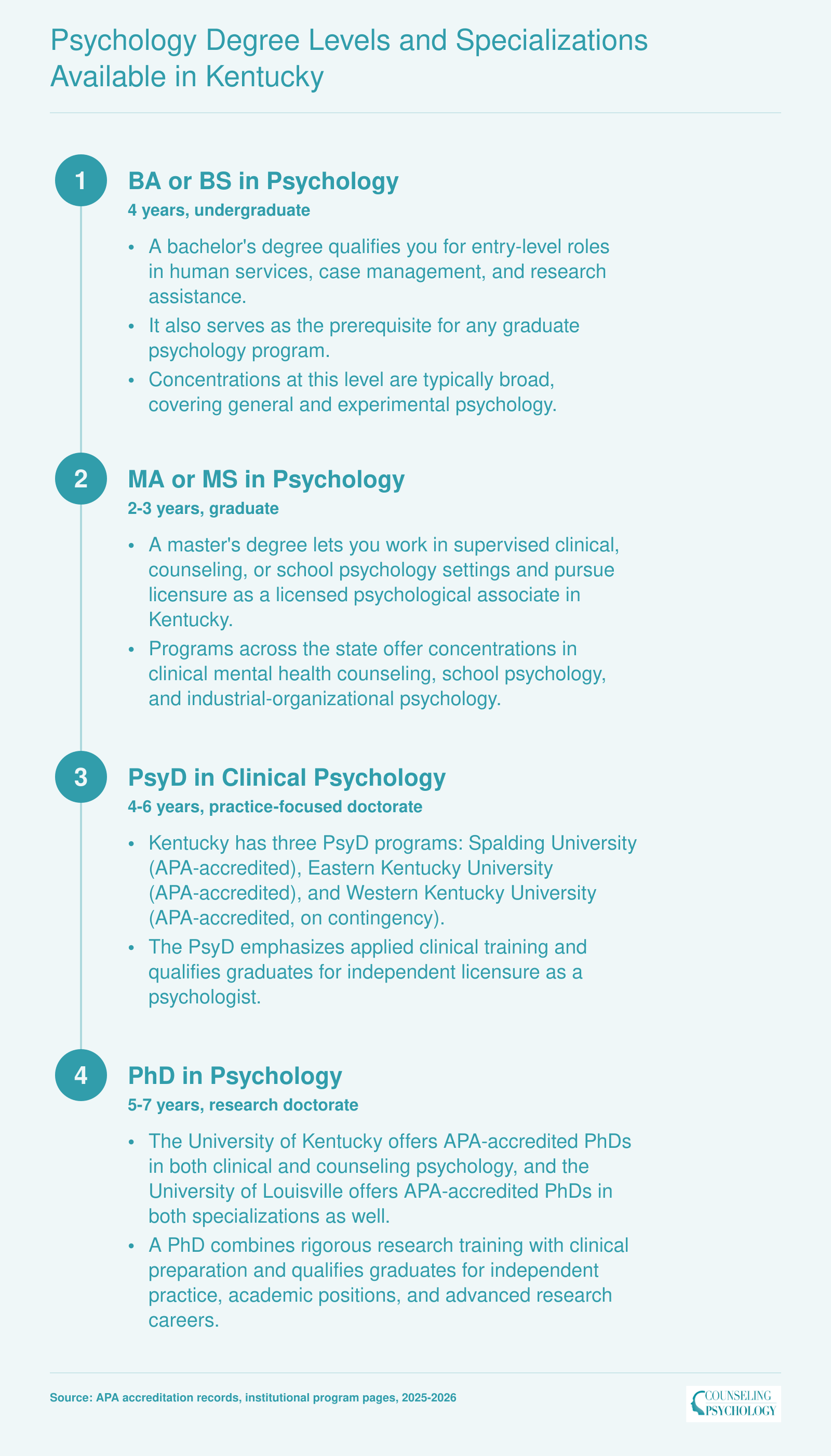
Psychology Degree Levels and Specializations Available in Kentucky
Kentucky offers a clear progression of psychology degrees, each opening distinct professional doors. The state is home to several APA-accredited doctoral programs, and master's-level concentrations span clinical, counseling, school, industrial-organizational, and general/experimental psychology. Here is the credentialing ladder from entry to independent practice.
Related Articles
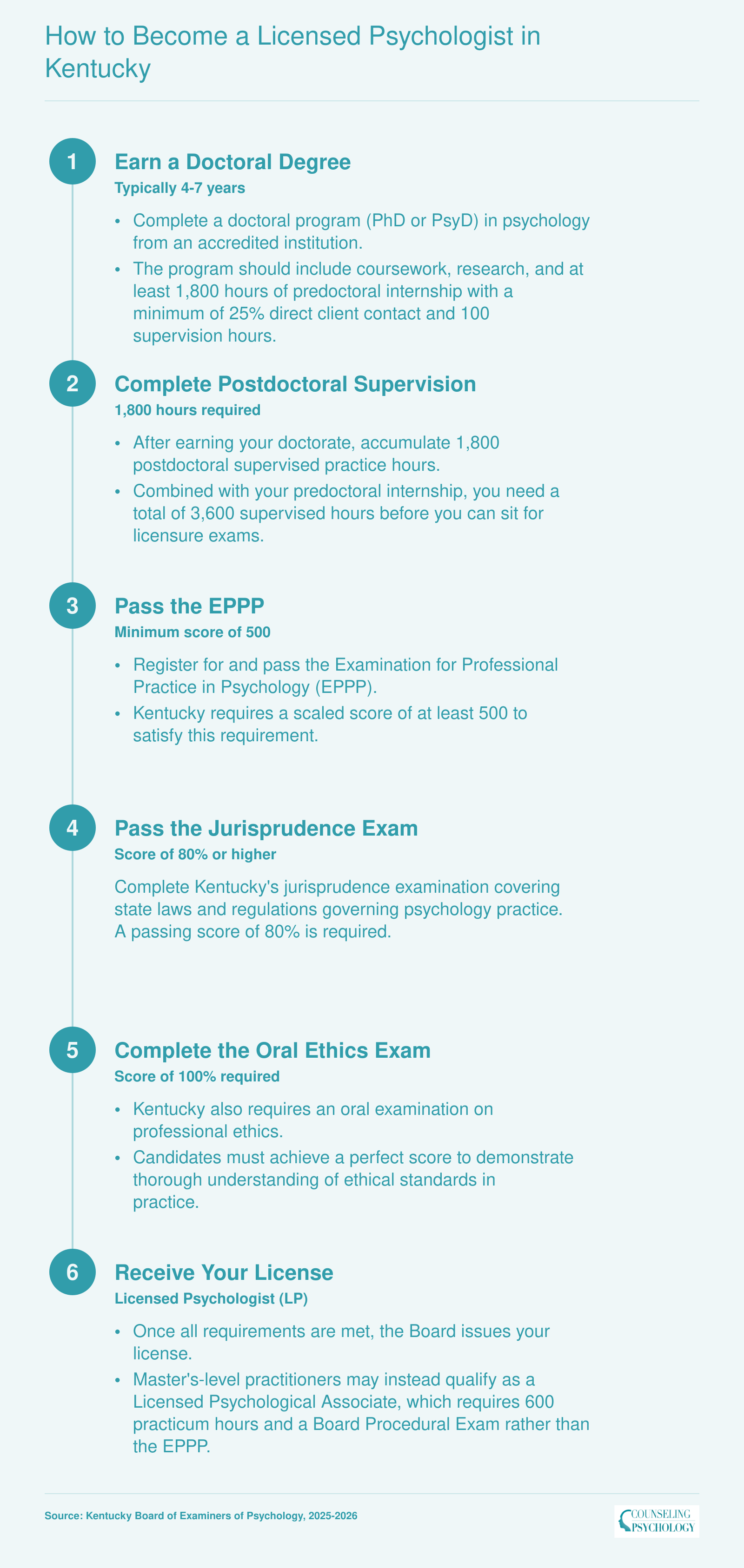
How to Become a Licensed Psychologist in Kentucky
Kentucky's licensure process for psychologists is overseen by the Kentucky Board of Examiners of Psychology. The path requires a doctoral degree, thousands of supervised practice hours, and multiple exams. Master's-level graduates can pursue the Licensed Psychological Associate credential as an alternative route.
Kentucky Psychology Career Outlook and Earnings
Clinical psychologists in Kentucky command a strong salary profile compared to many other healthcare professions, but earnings vary significantly based on education level and practice setting. Understanding both state-level wage data and the actual outcomes of Kentucky psychology graduates helps prospective students set realistic career expectations.
State and National Wage Benchmarks
Clinical and counseling psychologists in Kentucky earned a mean annual wage of $105,140 in 2023.1 Nationally, the median annual wage for clinical and counseling psychologists stood at $96,100 in 2023, with the 10th percentile earning $48,820 and the 90th percentile reaching $168,870.2 Kentucky's mean wage exceeds the national median, suggesting favorable market conditions for licensed psychologists in the state. The BLS projects 11.2% job growth for clinical and counseling psychologists between 2024 and 2034, faster than the average for all occupations. This growth reflects increasing demand for mental health services, insurance parity laws, and expanding telehealth options that allow psychologists to serve broader populations.
Earnings by Degree Level and Career Path
What you can do with your psychology degree in Kentucky depends heavily on the credential you earn. A bachelor's degree opens doors to entry-level roles in social services, case management, human resources, behavioral health support, and research assistance. These positions typically do not require licensure but offer valuable experience for students considering graduate study. Median early-career earnings for Kentucky bachelor's completers vary by institution; the College Scorecard shows median wages 10 years after enrollment ranging from $41,583 to $59,025 for graduates of Kentucky programs listed in this guide. These figures reflect all majors at the institution, not psychology alone, but they offer a baseline for career expectations.
A master's degree in psychology or a related field qualifies graduates to pursue roles such as Licensed Psychological Associate in Kentucky, school counselor, mental health counselor, or behavioral health specialist. For students weighing adjacent options, comparing counselor salary with masters data can help clarify the earning potential across related credentials. Master's-level practitioners typically work under supervision of a doctoral-level psychologist and may provide therapy, conduct assessments, and design treatment plans within that scope. Earnings for master's-level professionals generally fall between bachelor's and doctoral outcomes, though program-specific earnings data remain limited in the College Scorecard for many Kentucky master's programs.
Doctoral degrees (PhD or PsyD) are required for independent practice as a licensed psychologist in Kentucky. Those pursuing clinical psychology at the doctoral level can open private practices, lead clinical teams, conduct psychological testing, supervise trainees, and work in hospitals, universities, or government agencies. The BLS wage data cited above reflects this doctoral-level credential.2
Online Graduates Face the Same Market
Graduates of online psychology programs in Kentucky enjoy the same licensure pathways and career opportunities as on-campus students, provided the program holds proper regional accreditation and meets Kentucky Board of Examiners of Psychology requirements. The format of your degree does not appear on your license or transcript. Employers evaluate clinical competencies, supervised hours, and licensure status, not whether coursework was delivered online or in person.
Net prices across ranked Kentucky psychology programs range from roughly $8,000 to over $20,000 per year, and at several of these schools Pell Grant recipients account for a large share of the student body. That signals real institutional commitment to affordability. Affordable options do exist if you research net price calculators, compare aid packages, and apply for every grant available to you.
Financial Aid and Affordability Tips for Psychology Students in Kentucky
Weighing cost against program quality is central to choosing a psychology program, especially when graduate debt can exceed $20,000 and median early-career earnings for psychology bachelor's holders in Kentucky hover around $43,000 to $59,000. Understanding both net price and funding strategies helps you make a realistic assessment of affordability and return on investment.
Compare Net Prices Across Kentucky Programs
Published tuition rarely tells the full story. Net price, what you pay after grants and scholarships, varies widely across Kentucky psychology programs. Among ranked bachelor's programs, Northern Kentucky University posts the lowest net price at $8,191 annually for in-state students, followed by Eastern Kentucky University at $11,040 and Western Kentucky University at $10,990. These three public institutions also report high Pell grant recipient shares, ranging from 57 percent at Northern Kentucky to 65 percent at Eastern Kentucky, indicating strong access for lower-income students. Private institutions like University of the Cumberlands show a net price of $14,107 despite a sticker price of $9,875, while Spalding University's net price reaches $25,491. At the graduate level, median debt ranges from $14,911 at University of the Cumberlands to $25,250 at Spalding, figures you should weigh against expected earnings in your target role. Bachelor's holders from the University of Kentucky report median earnings of $59,025 ten years post-enrollment, while those from Campbellsville report $41,583, underscoring the importance of aligning debt with realistic salary expectations.
Kentucky-Specific Aid: Undergraduate Focus
Kentucky's primary state grants, the CAP Grant and Kentucky Tuition Grant, are limited to undergraduate students.1 The Kentucky Tuition Grant offers up to $3,300 annually for full-time students at private colleges who demonstrate financial need, but it does not extend to graduate programs.2 The CAP Grant, funded by the Kentucky Lottery, similarly supports only undergraduates.3 Graduate psychology students therefore rely on federal aid, university assistantships, and private scholarships rather than state-funded grants.1 If you are pursuing a master's or doctoral program in Kentucky, your funding strategy must center on federal Direct Unsubsidized Loans, Graduate PLUS loans, and campus-based opportunities like teaching or research assistantships. Students interested in online applied behavior analysis programs or other specialized tracks should factor in the same graduate funding constraints.
Tactical Steps for Maximizing Affordability
- Submit the FAFSA early: Federal aid is awarded on a first-come basis at many institutions. Completing the FAFSA by your school's priority deadline, often in February or March for the following academic year, ensures access to the full range of federal grants, loans, and work-study.
- Compare net price, not sticker price: Use each institution's net price calculator before applying. The difference between published tuition and your actual out-of-pocket cost can exceed $10,000 annually.
- Pursue graduate assistantships: Most Kentucky universities offering master's and doctoral psychology programs provide assistantships that cover tuition and provide a stipend. The University of Louisville and University of Kentucky, for example, advertise assistantship opportunities on their program pages. Competition is stiff, so apply early and highlight research or teaching experience.
- Check online tuition policies: Kentucky online programs generally require in-state residency for in-state tuition rates.1 Out-of-state students enrolling online at Northern Kentucky, Western Kentucky, or Eastern Kentucky typically pay out-of-state rates unless they establish Kentucky residency, which involves living in the state for twelve consecutive months before enrollment and demonstrating intent to remain.
- Frame debt against expected earnings: If you are considering a graduate program with median debt of $22,000 or more, compare that figure to entry-level salaries in your target specialty. Licensed professional counselors in Kentucky earn a median of roughly $45,000 to $50,000 in their first years, while clinical psychologists with doctoral degrees earn substantially more but also accumulate greater debt.
By anchoring your decision in net price data, understanding the limits of state aid for graduate students, and pursuing assistantships and federal aid aggressively, you position yourself for a manageable debt load and a stronger career launch.
Frequently Asked Questions About Psychology Schools in Kentucky
Choosing the right psychology program involves weighing cost, format, licensure requirements, and career outcomes. Below are answers to the questions prospective students ask most often about pursuing psychology degrees in Kentucky.