What you’ll learn in this article…
- Michigan psychology programs range from under $8,000 to over $20,000 in average net price, making school choice a major financial decision.
- Psychologist employment is projected to grow 6% nationally from 2024 to 2034, with roughly 12,900 openings each year.
- Michigan offers two licensure tiers: the Limited Licensed Psychologist (master's level) and the Licensed Psychologist (doctoral level).
- Many Michigan graduate programs have dropped the GRE requirement since 2020, broadening access for applicants.
Michigan's public universities post net prices as low as roughly $9,100 to $9,500 per year for undergraduate psychology students, while graduate tuition for in-state master's candidates ranges from about $12,000 to over $21,000 depending on the school and specialty. That spread matters. Choosing between a CACREP-accredited counseling track at Wayne State, an online applied behavior analysis programs degree at Michigan State, or a hybrid industrial-organizational program at Western Michigan is not just an academic preference; it is a financial and licensure calculation with years of downstream consequences.
Michigan requires a doctoral degree for full psychologist licensure but grants a Limited Licensed Psychologist credential at the master's level, creating two distinct career and cost trajectories that every applicant should map before committing.
Best Psychology Programs in Michigan: 2026 Rankings
Our 2026 rankings of Michigan psychology programs weight affordability and financial aid heavily, so schools with lower net prices and stronger aid packages rise toward the top. Graduation rates, online or hybrid delivery options, and program breadth also factor in. Note that graduation rates listed below are institution-wide figures reported to IPEDS, not specific to any single psychology program.
- Net price and financial aid
- Institution-wide graduation rate
- Online and hybrid availability
- Program breadth and credential levels
- Student-to-faculty ratio
- Internal program database
- NCES-IPEDS federal institutional data — nces.ed.gov
- College Scorecard graduate earnings — collegescorecard.ed.gov
- Independent program research

University of Michigan-Dearborn
The University of Michigan-Dearborn stands out as one of the most affordable public options for psychology in Michigan, with a net price of roughly $9,492 for aided students. Its flexible bachelor's program in psychology can be completed online, on campus, or in a hybrid format, while the fully online Clinical Health Psychology M.S. provides a pathway toward a Limited License in Psychology. Qualifying in-state students may attend tuition-free under the Go Blue Guarantee, further strengthening UM-Dearborn's value proposition. The institution-wide graduation rate is 58%.
- Hybrid format with online, in-person, or blended options
- 38 required psychology credits plus broad electives
- Rolling admissions with no hard application deadline
- Internship opportunities for hands-on experience
- Psychology honors track available for high achievers
- Go Blue Guarantee may cover tuition for eligible students
- Fully online two-year, 48-credit master's program
- No GRE required for admission
- Practicum placements in clinical settings included
- Pathway to Michigan Limited License in Psychology
- Optional thesis track for research-oriented students
- Minimum 3.0 undergraduate GPA for admission
Psychology BA/BS — Hybrid
Clinical Health Psychology, MS — Online

Wayne State University
Wayne State University pairs strong graduate training with an urban Detroit location that gives students access to diverse clinical populations. Its CACREP-accredited M.A. in Counseling (Clinical Mental Health track) is delivered in a hybrid format and includes an addiction treatment concentration, while the fully online M.S. in Applied Behavior Analysis prepares graduates for BCBA certification with eligibility in 37 states. The institution-wide graduation rate is about 58%, and the net price for aided students is approximately $12,766.
- CACREP-accredited 60-credit hybrid program
- Concentration in addiction treatment counseling
- Practicum and internship embedded in curriculum
- Multicultural counseling competency emphasis
- Prepares for Michigan professional counselor licensure
- Diverse clinical experience across Detroit-area sites
- 100% online with a five-semester completion timeline
- Uniform tuition rate for in-state and out-of-state students
- Prepares for BCBA certification exam
- Cohort model with discussion-based coursework
- Focus on evidence-based autism treatment
- Field work integrated throughout the program
M.A. in Counseling, Clinical Mental Health Counseling (Addiction Treatment) — On-Campus
Master of Science in Applied Behavior Analysis — Online

Oakland University
Oakland University offers multiple fully online graduate certificates focused on Autism Spectrum Disorder, making it a go-to for educators, school psychologists, and clinicians looking to build ASD expertise without pursuing a full degree. Certificates range from 18 to 36 credits and can lead to Michigan's ASD endorsement. With a net price near $9,120 for aided undergraduate students, Oakland is among the most affordable public options on this list, and its institution-wide graduation rate sits at about 58%.
- Fully online, designed for non-teaching professionals
- Completion in 18 to 24 months
- Minimum 3.0 GPA and bachelor's degree required
- Targets school psychologists, social workers, clinicians
- No on-campus visits needed
- Practical insights for supporting individuals with ASD
- 28-credit online program with fieldwork component
- Eligible for Michigan ASD teaching endorsement
- Combines coursework with applied behavioral strategies
- 12 to 24 month expected completion
- Focus on communication and behavioral interventions
- Designed for educators seeking endorsement credentials
- 36-credit fully online program
- Requires existing special education endorsement
- Hands-on field experience integrated into coursework
- Eligible for Michigan ASD endorsement
- Prepares for diverse ASD education leadership roles
- No on-campus residency required
Graduate Certificate in Autism Spectrum Disorder (Multiple Disciplines) — Online
Basic Graduate Certificate in Autism Spectrum Disorder — Online
Advanced Graduate Certificate in Autism Spectrum Disorder — Online

Baker College
Baker College is a private institution that charges a flat tuition rate of $13,000 regardless of residency, making it one of the most budget-friendly choices for out-of-state online learners. Its B.S. in Psychology follows APA-aligned guidelines and includes a 160-hour work experience, while the fully online M.S. in Industrial-Organizational Psychology can be completed in roughly two years. The institution-wide graduation rate is lower at about 36%, so prospective students should weigh affordability against completion support. The 9:1 student-to-faculty ratio is the smallest on this list.
- 120 credits with online and on-campus options
- APA-aligned curriculum covering core psychology areas
- 160-hour required work experience
- Prepares for graduate study or entry-level roles
- Flexible scheduling for working adults
- Small 9:1 student-to-faculty ratio
- 100% online, 36 total credit hours
- Approximately two-year completion timeline
- Accelerated path option available
- Focuses on organizational performance and workforce strategy
- Flat tuition for all students regardless of state
- Builds skills in personnel selection and training
Bachelor of Science in Psychology — Online
Master of Science in Industrial-Organizational Psychology — Online

Saginaw Valley State University
Saginaw Valley State University delivers an online Graduate Certificate in Applied Behavior Analysis tailored to special educators and clinicians working with children with disabilities. The 21-credit, seven-course program aligns with BACB certification requirements, making it a focused, relatively quick credential for professionals who already hold a master's degree. SVSU's net price of about $10,775 and its position among Michigan's lower-tuition publics make it a cost-effective path to BCBA eligibility. The institution-wide graduation rate is approximately 48%.
- Fully online, seven-course certificate (21 credits)
- Designed to prepare students for BCBA certification
- Requires a master's degree or concurrent enrollment
- Evidence-based intervention and assessment strategies
- Research and experimental design coursework included
- Minimum 3.0 GPA for admission
- Interdisciplinary collaboration emphasis throughout
Graduate Certificate in Applied Behavior Analysis in Special Education — Online

Michigan State University
Michigan State University brings its research-university reputation to a fully online M.A. in Applied Behavior Analysis with an Autism Spectrum Disorders concentration. MSU's 80.7% institution-wide graduation rate is the highest on this list, reflecting broad institutional strength, though the net price of roughly $19,680 is also among the highest. The program is built for working professionals and emphasizes evidence-based ABA practices, preparing graduates for certification and careers supporting individuals with ASD across clinical and educational settings.
- Fully online with flexible scheduling for working professionals
- Concentration specifically in Autism Spectrum Disorders
- Prepares graduates for BCBA certification
- Evidence-based practices woven through curriculum
- Financial aid options available to offset costs
- Bachelor's degree and relevant prerequisites required
- Hands-on experience integrated into coursework
Master of Arts in Applied Behavior Analysis and Autism Spectrum Disorders — Online

Western Michigan University
Western Michigan University is nationally recognized for behavior analysis training, and its I-O Behavior Management programs reflect that strength at both the master's and doctoral levels. The hybrid M.A. and Ph.D. in Industrial Organizational Behavior Management apply behavior-analytic methods to workplace performance, a distinctive niche. WMU also offers a fully online M.A. in Counseling Psychology that prepares students for Michigan's Limited License Psychologist credential. The institution-wide graduation rate is about 58%, and aided students face a net price near $15,273.
- Hybrid format, minimum 36 credit hours
- Integrates behavior analysis with I-O psychology
- Flexible practicum and elective options
- Prepares for doctoral study or immediate employment
- Minimum B grade required in coursework
- Research and applied skills developed in tandem
- Hybrid doctoral program (30 coursework + 12 dissertation credits)
- Research-focused with organizational performance emphasis
- Prepares for consulting, academia, or senior practitioner roles
- Minimum 3.0 GPA required for admission
- Comprehensive research training throughout
- Builds on WMU's national reputation in behavior analysis
- Fully online master's program
- Leads to Michigan Limited License Psychologist track
- No graduate entrance test required
- Three recommendation letters needed for admission
- Supervised mental health practice included
- Focus on working with diverse populations
Master of Arts in Industrial Organizational Behavior Management — Hybrid
Doctor of Philosophy in Industrial Organizational Behavior Management — Hybrid
Counseling Psychology, M.A. — Online

Northern Michigan University
Northern Michigan University serves students across the Upper Peninsula and beyond with a fully online, asynchronous M.S. in Applied Sport Psychology. Two distinct tracks let students pursue either certification as a Mental Performance Consultant or licensure as a Limited Psychologist in Michigan, giving graduates career flexibility in both performance consulting and clinical work. NMU's net price sits at about $14,085, and its institution-wide graduation rate is roughly 52%.
- Fully online, asynchronous delivery
- Prepares for AASP Mental Performance Consultant certification
- Core curriculum plus specialized sport psychology courses
- Designed for coaches, athletes, and working professionals
- Flexible scheduling accommodates nontraditional students
- Interdisciplinary curriculum spanning health and performance
- Fully online, asynchronous format
- Pathway to Michigan Limited Psychologist licensure
- Combines clinical foundations with sport psychology focus
- Certification and licensure preparation integrated
- Ideal for Upper Peninsula and rural Michigan learners
- Two distinct career tracks within one degree program
Applied Sport Psychology, M.S. (Mental Performance Consultant Track) — Online
Applied Sport Psychology, M.S. (Limited Psychologist Licensure Track) — Online

Concordia University Ann Arbor
Concordia University Ann Arbor is a faith-based private institution offering a hybrid Master's in Counseling with professional and school counseling concentrations. At $690 per credit hour, Concordia is moderately priced for a private school, though its net price of roughly $32,811 is the highest on this list. The program integrates Christian values into counseling training and requires 700 hours of practicum and internship. The institution-wide graduation rate is about 48%, and the 45% retention rate signals that prospective students should evaluate academic support resources carefully.
- Hybrid format with mostly online coursework
- 60 credits for the professional counseling track
- 700 hours of practicum and internship required
- Faculty are experienced practicing counselors
- Christian values integrated into counseling framework
- Substance abuse counseling certificate option available
- Scholarship opportunities to offset private tuition
- Hybrid delivery with two required in-person courses
- 48 credits for the school counseling track
- 600 practicum and internship hours required
- Eight-week class format for scheduling flexibility
- No teaching license required for admission
- 3.0 GPA recommended for full acceptance
- Career-focused curriculum for K-12 school settings
Master's in Counseling (Professional Counseling) — Hybrid
Master's in Counseling (School Counseling) — Hybrid
How We Ranked Michigan Psychology Programs
Our ranking uses a transparent scoring model that compares Michigan psychology programs on cost, completion, and accessibility, with the heaviest weight placed on what students actually pay out of pocket. Because this page targets affordable options, net price and aid metrics drive most of the score, not prestige or selectivity.
What We Measure
- Net price and aid: Average net price after grants and scholarships carries the largest weight. We pull this from federal IPEDS tuition reporting and the U.S. Department of Education's College Scorecard, which captures what undergraduates actually pay after institutional and federal aid.
- Graduation rate: We use the institution-wide 150%-time completion rate (students who finish within six years for a four-year degree). This is a school-level figure, not a psychology-specific completion rate, since program-level graduation data is not consistently published.
- Program-level earnings: Where available, median earnings of psychology graduates one year after completion, drawn from College Scorecard's field-of-study data.
- Format verification: Each program is tagged Online, Campus, or Both based on institutional reporting and direct verification of the school's current catalog. When a reader applies the online filter, only programs that genuinely deliver coursework online appear.
Why This Approach
We rely on federal datasets rather than surveys or reputational scores because the numbers are reproducible. Anyone can pull the same College Scorecard and IPEDS files and replicate our ordering. That matters more than a proprietary algorithm: you can see the inputs, weigh them against your own priorities, and decide whether our emphasis on affordability matches yours. Whether you are exploring an associate degree in psychology or considering a clinical psychology doctorate programs track, the same methodology applies across every level we cover.
Questions to Ask Yourself
Online vs. On-Campus Psychology Programs in Michigan
Michigan offers psychology programs in fully online, on-campus, and hybrid formats, giving students real flexibility in how they earn their degree. The right choice depends on your schedule, career goals, and how you learn best. Here is a practical breakdown of the tradeoffs.
Pros
- Online programs let working professionals study on their own schedule, with schools like MSU offering accelerated 21-month master's completions in compact five-week course blocks.
- Studying online often carries a lower effective cost because you avoid relocation, commuting, and many campus fees, especially valuable if you live outside southeast Michigan.
- Statewide access means a student in Marquette can enroll at Baker College or Eastern Michigan without moving, opening up 30- to 36-credit master's options from anywhere in the state.
- Online and part-time pacing options let you stretch a program over more semesters or compress it into an accelerated timeline, depending on your personal obligations.
- Hybrid programs, such as Western Michigan's accelerated 4+1 counseling psychology pathway or Wayne State's clinical mental health counseling M.A., blend online coursework with focused in-person sessions for a balanced experience.
Cons
- On-campus programs provide direct access to in-person practicum sites and faculty mentorship, which is harder to replicate remotely, particularly for clinically focused tracks like UM-Dearborn's 48-credit Clinical Health Psychology M.S.
- Structured on-campus schedules tend to support consistent progress toward graduation, reducing the risk of falling behind that some self-paced online learners face.
- Peer networking and study groups form more naturally in on-campus cohorts, which can translate into stronger professional connections after graduation.
- Even fully online programs require supervised practicum or internship hours completed locally, so students must research and secure placement sites in their own community well before those courses begin.
- Clinically intensive programs, especially at the doctoral level, may not be available in a fully online format because of the volume of supervised contact hours required for licensure.
Related Articles
Michigan Psychology Program Costs and Financial Aid
The cost of a psychology degree in Michigan varies widely depending on the institution and residency status. The table below sorts programs by net price (the institution-wide average cost after financial aid). Keep in mind that net price is calculated across all undergraduate aid recipients at each school, so your actual out-of-pocket cost will depend on your personal financial situation, degree level, and aid package. The gap between the most affordable option (Oakland University at $9,120) and the most expensive (Concordia University Ann Arbor at $32,811) is roughly $23,700 per year, which underscores just how much shopping around matters. Schools with a higher share of Pell Grant recipients often serve students with greater financial need and tend to offer more robust aid packages. Graduate students should also look beyond sticker prices: assistantships, employer tuition reimbursement programs, and federal graduate loans (Direct Unsubsidized and Grad PLUS) can significantly reduce net costs at any of these institutions.
| School | In-State Tuition | Out-of-State Tuition | Avg. Net Price (After Aid) | Pell Grant Recipients (%) |
|---|---|---|---|---|
| Oakland University | $21,960 | $24,648 | $9,120 | 56.2% |
| University of Michigan, Dearborn | $15,640 | $32,896 | $9,492 | 73.9% |
| Saginaw Valley State University | $18,360 | $18,360 | $10,775 | 54.5% |
| Wayne State University | $17,960 | $36,542 | $12,766 | 68.4% |
| Baker College | $13,000 | $13,000 | $13,157 | 77.0% |
| Northern Michigan University | $12,196 | $15,652 | $14,085 | 55.3% |
| Western Michigan University | $20,103 | $29,681 | $15,273 | 55.5% |
| Michigan State University | $21,772 | $41,848 | $19,680 | 46.4% |
| Concordia University Ann Arbor | $15,870 | $15,870 | $32,811 | 50.0% |
Graduate Outcomes: Earnings and ROI After a Michigan Psychology Degree
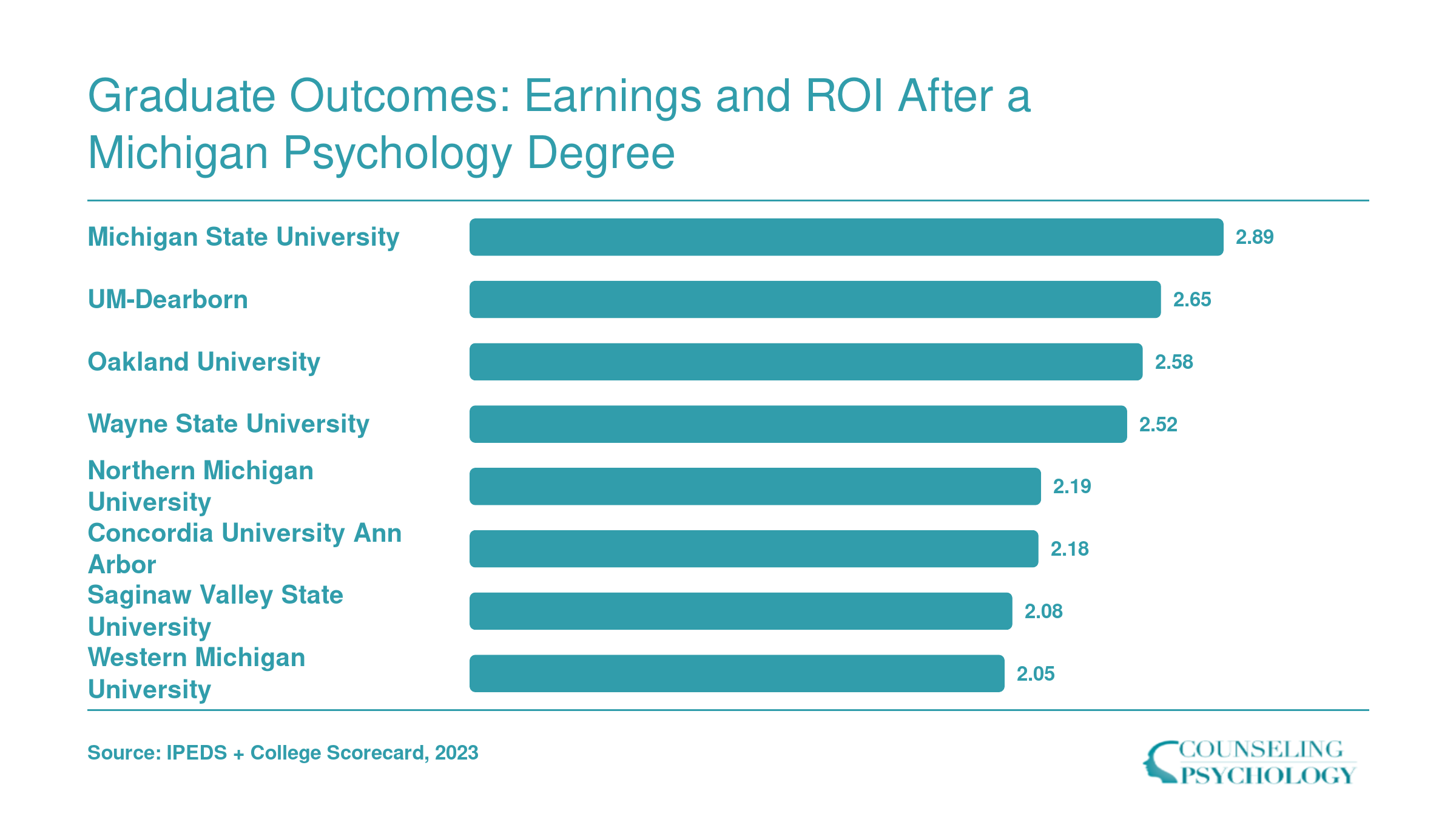
How much can you expect to earn after completing a psychology program in Michigan, and how does that compare to what you borrowed? The chart below shows the ratio of ten-year median earnings to median graduate debt for top Michigan programs. A higher ratio signals stronger long-term return on your educational investment. For context, clinical and counseling psychologists in Michigan earned a median of $82,770 per year as of 2023, according to BLS state-level data, well above the state's all-occupations median of $46,950. Program-level earnings at one year and four to five years after completion are not yet reported for most of these programs, so we use institution-wide ten-year earnings as a proxy.
The Bureau of Labor Statistics projects psychologist employment to grow 6% nationally from 2024 to 2034, faster than the average for all occupations, with about 12,900 job openings projected each year. That demand reflects expanding mental health needs across schools, healthcare systems, and private practice, including in Michigan.
How to Become a Licensed Psychologist in Michigan
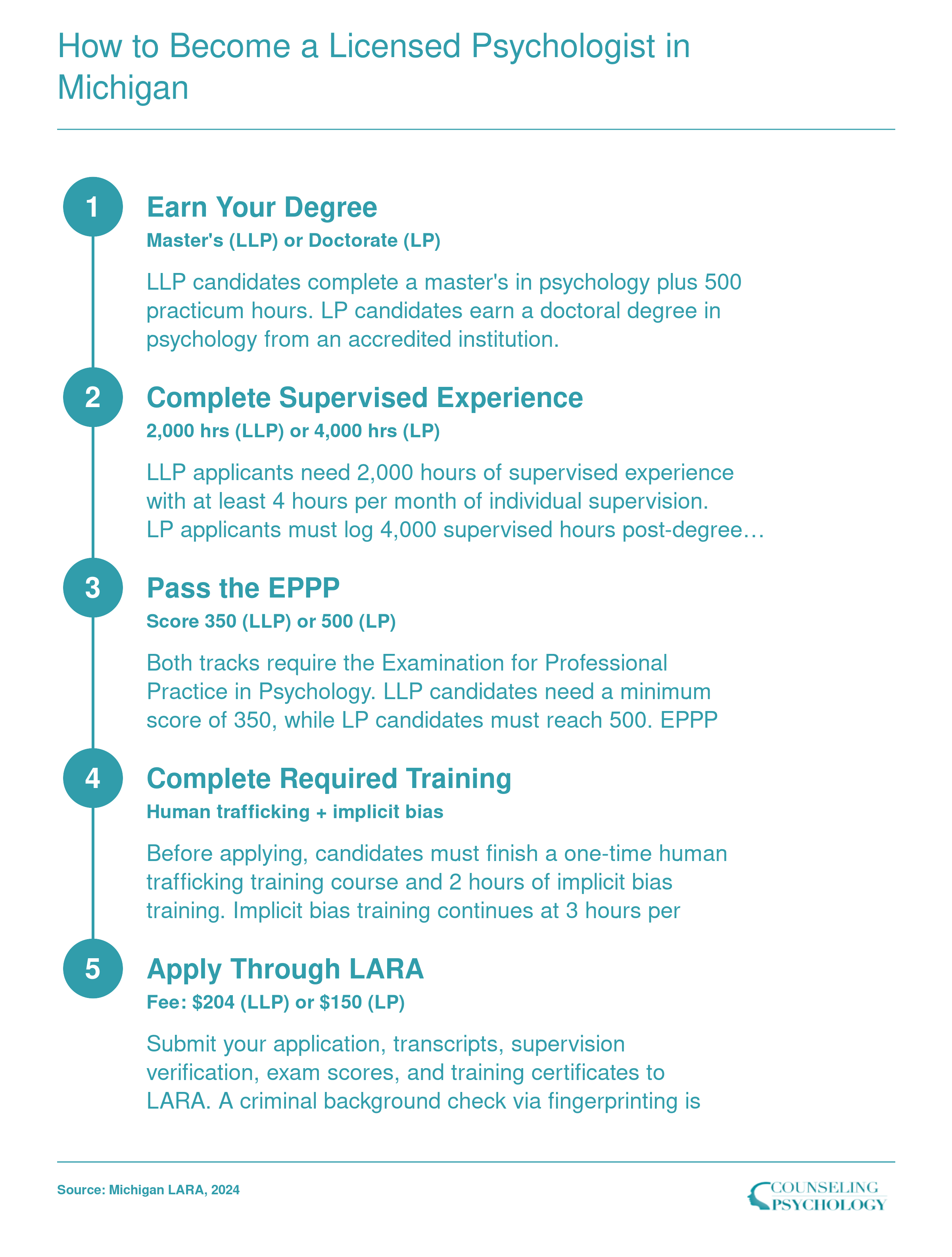
Michigan offers two tiers of psychology licensure: the Limited Licensed Psychologist (LLP), which requires a master's degree, and the Licensed Psychologist (LP), which requires a doctoral degree. Both credentials are administered through the Michigan Department of Licensing and Regulatory Affairs (LARA). There is no separate jurisprudence exam, but applicants must complete one-time human trafficking training and initial implicit bias training (2 hours) before licensure. The typical timeline from program start to full LP licensure is 7 to 9 years; the LLP path generally takes 3.5 to 5 years.
Choosing the Right Psychology Specialty in Michigan
Your specialty choice shapes every decision that follows, from the programs you apply to, the credential you earn, and the career you ultimately build. Michigan offers a broad set of specialty tracks across its psychology programs, but the admissions landscape, accreditation standards, and professional endpoints differ significantly from one track to the next.
Clinical Psychology
Clinical psychology is the most popular and most competitive doctoral specialty in the state. The University of Michigan, Michigan State University, and Eastern Michigan University all hold APA accreditation for their clinical psychology doctoral programs (2025-2026).123 These are PhD programs rooted in a clinical science model, which means heavy emphasis on research methodology alongside supervised clinical training. Acceptance rates at top clinical programs routinely fall into single digits, and successful applicants typically present strong GRE scores, published or in-progress research, and substantial clinical volunteer hours. Graduates pursue licensure as clinical psychologists and work in hospitals, private practice, community mental health centers, and academic settings. For a detailed look at the career trajectory, see our guide on how to become a clinical psychologist.
Counseling Psychology
Counseling psychology overlaps with clinical work but tends to focus on wellness, adjustment, and less severe psychopathology. At the doctoral level, Andrews University and Western Michigan University both offer APA accredited counseling psychology PhD programs.4 For students who want to practice as licensed professional counselors rather than psychologists, master's-level counseling programs are the faster route. Wayne State University, for example, offers a CACREP-accredited M.A. in Clinical Mental Health Counseling, and Concordia University Ann Arbor runs a hybrid master's in counseling with professional and school counseling tracks. CACREP accreditation matters here because Michigan's counselor licensure board recognizes it as the gold standard for master's-level training. Students exploring this path can also compare best masters in counseling programs in Michigan.
Industrial-Organizational Psychology
I/O psychology sits apart from the clinical and counseling tracks because it does not lead to clinical licensure. Western Michigan University offers a Master of Arts in Industrial Organizational Behavior Management, a hybrid program that prepares graduates for corporate roles in talent management, organizational development, and workforce analytics. I/O psychologists typically do not need state licensure, which means the career timeline is shorter, though salaries in this field vary widely depending on industry and geographic market.
School Psychology
School psychology programs prepare graduates to work in K-12 settings, conducting assessments, designing interventions, and supporting students' social-emotional development. When evaluating school psychology programs in Michigan, look for approval from the National Association of School Psychologists (NASP), which is the recognized accrediting body for specialist-level school psychology training. The credential you earn, typically an Education Specialist (Ed.S.) degree, qualifies you for certification through the Michigan Department of Education. Our overview of school psychologist requirements breaks down the full credentialing process.
PhD vs. PsyD: Picking the Right Doctoral Path
The distinction between a PhD and a PsyD is not just academic. PhD programs emphasize research training and often provide tuition waivers plus stipends. Michigan's APA-accredited clinical and counseling doctoral programs are PhD programs, and they tend to be smaller cohorts with intense mentorship. PsyD programs, in contrast, are practice-oriented, accept larger cohorts, and usually require students to pay full tuition. If your goal is to conduct research or work in an academic medical center, a PhD is the stronger fit. If you want to move into full-time clinical practice as quickly as possible, a PsyD can get you there, though you should weigh the higher debt load carefully.
Matching Specialty to Career Outcome
Before applying anywhere, map your specialty choice onto a concrete career path:
- Clinical or counseling psychology (doctoral): Licensure as a psychologist in Michigan, qualifying you for independent practice, hospital-based roles, or faculty positions.
- Counseling (master's level): Licensure as a Licensed Professional Counselor (LPC), with opportunities in community agencies, private practice, and school settings.
- I/O psychology: Corporate and consulting roles with no licensure requirement, though some graduates pursue SHRM or SIOP credentials.
- School psychology: State certification to work in Michigan public and private schools, with strong demand driven by growing student mental health needs.
The right specialty is not always the most prestigious one. It is the one that aligns with how you actually want to spend your working life.
Admissions: What Michigan Psychology Programs Expect
Graduate psychology admissions in Michigan have shifted markedly since 2020, with many programs dropping the GRE requirement altogether or making it optional. The GRE-optional trend gained momentum during the pandemic and has continued through the 2025-2026 admissions cycle, particularly at master's programs and some clinical science PhD tracks. Yet standards for GPA, prerequisite coursework, and supervised experience remain firm. If you are weighing the difficulty of this process, our overview of how hard it is to get into grad school for psychology offers useful context.
GPA and Academic Prerequisites
Most Michigan psychology graduate programs set a minimum GPA threshold between 3.0 and 3.2. Eastern Michigan University's clinical master's and PhD programs, for example, require a 3.0 undergraduate GPA, while Michigan State University's psychology PhD program holds applicants to a 3.2 minimum.2 These floors are not negotiable without offsetting strengths elsewhere in the application.
Prerequisite coursework typically includes introductory psychology, statistics, and research methods. Michigan State requires either a psychology major or at least 12 credits in psychology with a B or better, plus upper-division coursework in the field.2 Eastern Michigan and the University of Michigan-Dearborn both ask for abnormal or clinical psychology as a foundation for their clinical tracks.4 If you lack these courses, most programs expect you to complete them before matriculation rather than after admission.
GRE Requirements: The Optional Wave
The GRE landscape varies widely. The University of Michigan-Ann Arbor's Clinical Science PhD and the University of Michigan-Dearborn's Clinical Health Psychology master's program both waived the GRE for the 2024-2025 cycle.14 Eastern Michigan University, by contrast, still requires the GRE for both its clinical master's and PhD programs. If you are applying to multiple programs, budget time and cost for the exam even if half your list has gone test-optional.
Practicum and Internship Hours
Pre-admission practicum hours are not required at the Michigan programs surveyed here.12 However, all graduate psychology programs embed supervised clinical hours into their curricula. For online or hybrid students, those placements are typically arranged near your home, not the campus. The burden of securing a local supervisor and site often falls on you, though program staff provide guidance and approval.
Application Components
Every program expects a personal statement, typically 500 to 1,000 words, explaining your research interests, career goals, and fit with faculty. Three letters of recommendation are standard, ideally from professors or supervisors who can speak to your academic readiness and clinical potential. Relevant experience (paid or volunteer work in clinical, research, or community-psychology settings) strengthens your file, especially for competitive PsyD and PhD cohorts. Students exploring masters in psychology options nationally will find that terminal master's programs tend to admit a broader range of applicants, but even there, evidence of commitment to the field matters.
Frequently Asked Questions About Michigan Psychology Programs
Choosing a psychology program in Michigan raises practical questions about cost, format, and career timelines. Below are answers to the questions prospective students ask most often, drawn from current program data and Michigan licensure requirements.