

What you’ll learn in this article…
- Regional accreditation and APA or CACREP program approval directly determine licensure eligibility in most states.
- Psychology tuition ranges from roughly $6,000 per year at public schools to $50,000 at private institutions.
- Doctoral graduates qualify for psychologist licensure, while master's graduates typically pursue LPC or LMFT credentials.
- Industrial-organizational and clinical psychologists earn significantly higher national median wages than bachelor's-level roles.
How many accredited psychology programs actually deliver every credit hour online, from first course to dissertation defense? As of 2026, hundreds do, spanning associate through doctoral levels, and that changes the math on school selection entirely.
Searching for psychology schools near you makes sense as a starting point, but proximity is no longer the constraint it once was. Regional accreditation, licensure-prep alignment, supervised practicum logistics, and format flexibility (asynchronous, synchronous, hybrid) matter more than a campus ZIP code when the classroom is your laptop.
The real tension is sorting signal from noise: APA accreditation versus CACREP, PsyD versus PhD cost structures, and whether a program's practicum network actually reaches your state. Understanding these distinctions across counseling schools and psychology programs is where a smart search begins.
Psychology Degree Levels Explained: Associate Through Doctorate
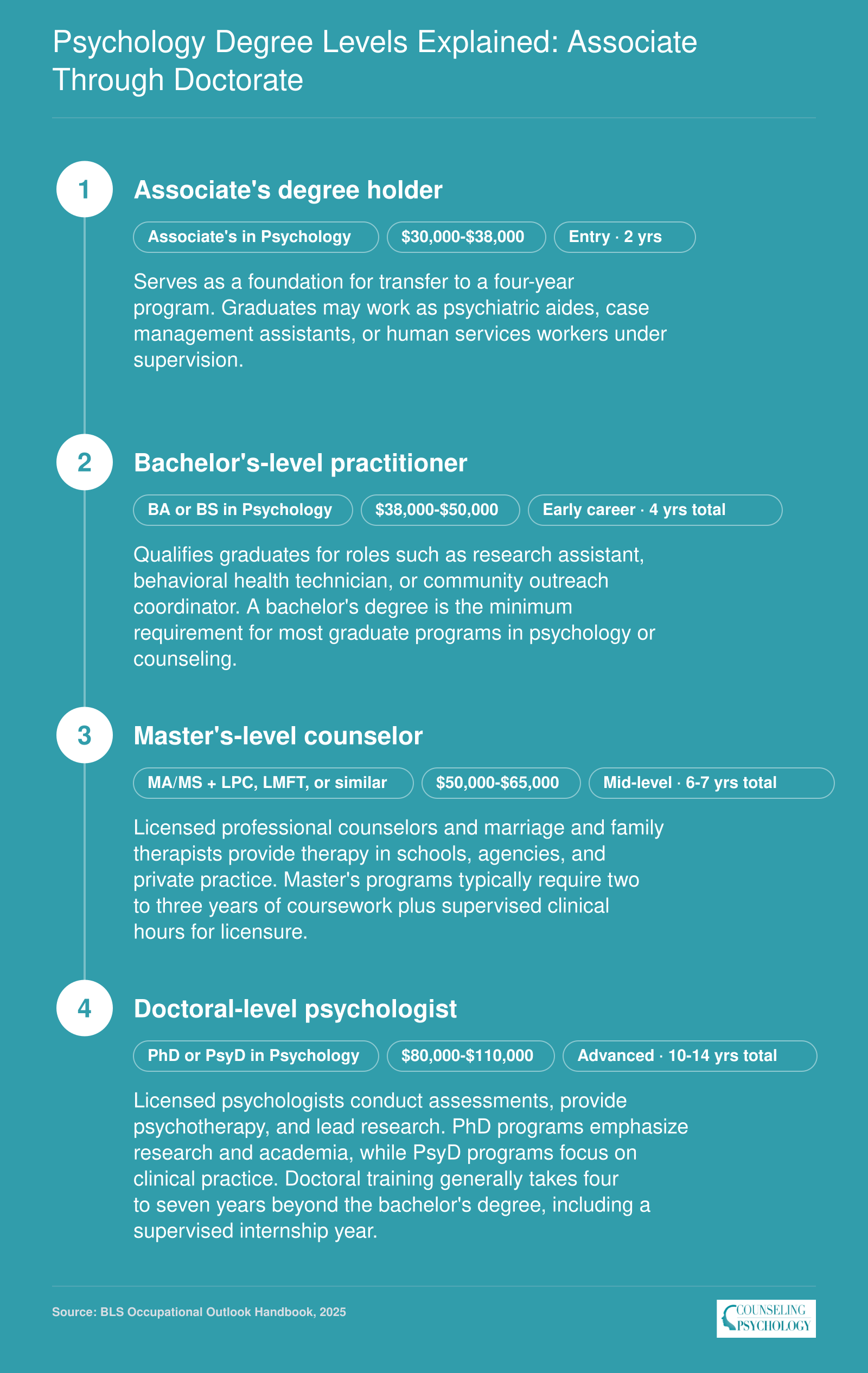
Psychology offers a clear credentialing ladder, with each degree level opening new career roles and, in many cases, new licensure eligibility. Only doctoral graduates can become licensed psychologists in most states, while master's-level graduates typically pursue counselor licenses such as the LPC or LMFT. At the graduate level, clinical psychology programs tend to focus on diagnosing and treating severe mental health disorders in hospital or clinical settings, whereas counseling psychology programs emphasize wellness, adjustment, and development across community, school, and private-practice environments.
How to Find the Best Psychology School for You
The single most important filter in your psychology school search is accreditation, and every other evaluation criterion flows from it. A program without proper accreditation can leave you ineligible for licensure, unable to transfer credits, and locked out of the career you spent years preparing for. Here is a practical framework for narrowing your options.
Start With Accreditation Verification
Before you compare tuition rates or campus locations, confirm that every program on your shortlist holds active accreditation from the right body.
- Doctoral programs in clinical or counseling psychology: Search the APA's Psychology Programs Database, maintained by the Commission on Accreditation.1 It is updated continuously and displays only currently accredited programs, along with their status (accredited, on contingency, or on probation). Columbia University's Clinical Psychology PhD, for example, holds APA accreditation through June 2031.2
- Master's counseling programs: Check the CACREP directory for accredited counseling programs. CACREP accreditation is increasingly tied to licensure eligibility in many states.
- Regional accreditation: Regardless of specialty accreditation, confirm the institution itself is regionally accredited. You can verify this through the U.S. Department of Education's database of accredited postsecondary institutions.
Evaluate Licensure-Exam Pass Rates and Clinical Training
Accreditation is your baseline. After that, dig into outcomes. Programs that prepare graduates well for the EPPP (for psychologists) or the NCE/NCMHCE (for counselors) will often publish their pass rates. If a program does not share this data on its website, ask the admissions office directly.
Equally important is the quality of practicum and internship placements. Find out how many clinical hours the program guarantees, whether placements are at recognized training sites, and how much support you receive in securing them. If you are considering a fully online program, verify that its supervised clinical hour structure satisfies your state's specific licensure requirements. Some states impose restrictions on hours completed through distance-supervised arrangements.
Weigh Program Format and Cost
Once clinical quality checks out, consider practical fit. Does the program offer evening, weekend, hybrid, or asynchronous options that work with your schedule? What is the total cost of attendance, including practicum travel? Financial aid availability and employer tuition reimbursement eligibility can shift the calculus significantly. Students weighing different counseling degrees and degree levels should factor in both time-to-completion and long-term earning potential.
Know the GPA Benchmarks
Admissions competitiveness varies by degree level. As general guidance, master's programs in psychology and counseling typically look for a cumulative GPA in the 3.0 to 3.3 range, while doctoral programs often expect 3.5 or higher. Fielding Graduate University's Clinical Psychology PhD, for instance, lists a minimum GPA requirement of 3.0.3 These benchmarks are not guarantees of admission. Strong letters of recommendation, relevant research or clinical experience, and a compelling personal statement can compensate for a GPA that falls slightly below the target range.
Approach your search methodically: accreditation first, then outcomes data, then format and cost. That sequence keeps you focused on what actually determines whether a degree will get you where you want to go.
Explore By State
- Alabama
- Alaska
- Arizona
- Arkansas
- California
- Colorado
- Connecticut
- Delaware
- Florida
- Georgia
- Hawaii
- Idaho
- Illinois
- Indiana
- Iowa
- Kansas
- Kentucky
- Louisiana
- Maine
- Maryland
- Massachusetts
- Michigan
- Minnesota
- Mississippi
- Missouri
- Montana
- Nebraska
- Nevada
- New Hampshire
- New Jersey
- New Mexico
- New York
- North Carolina
- North Dakota
- Ohio
- Oklahoma
- Oregon
- Pennsylvania
- Rhode Island
- South Carolina
- South Dakota
- Tennessee
- Texas
- Utah
- Vermont
- Virginia
- Washington
- Washington DC
- West Virginia
- Wisconsin
- Wyoming
Related Articles
Accreditation: What to Look for in a Psychology Program
Accreditation is the single most important quality marker when evaluating psychology programs. It directly affects whether you can sit for licensure exams, qualify for funded internships, and compete for jobs. Before you commit tuition dollars to any program, verify its accreditation status through the right channels.
Doctoral Programs and APA Accreditation
If you are pursuing a PhD or PsyD in clinical, counseling, or school psychology, the American Psychological Association (APA) is the gold-standard accrediting body. The APA's Office of Program Consultation and Accreditation maintains a searchable directory of every accredited doctoral program in the United States and Canada, along with each program's current status and any conditions or probationary notes. Bookmark that directory early in your search, because most state licensing boards require graduation from an APA-accredited program (or one designated by the Association of State and Provincial Psychology Boards) as a prerequisite for licensure. Graduates of accredited doctoral programs go on to work in roles ranging from clinical practice to applied psychology careers.
Master's Counseling Programs and CACREP
For master's-level counseling degrees, the Council for Accreditation of Counseling and Related Educational Programs (CACREP) sets the standard. CACREP accreditation is increasingly written into state licensure laws for Licensed Professional Counselors, Licensed Mental Health Counselors, and related credentials. Check the CACREP directory to confirm any program you are considering holds current accreditation. Keep in mind that the planned merger between CACREP and the Council on Rehabilitation Education (CORE) has reshaped standards for rehabilitation counseling tracks. Review official CACREP announcements for the latest details on how merged standards may affect your specific program's standing and your eligibility for licensure.
Cross-Reference With Your State Licensing Board
Accreditation requirements vary by state. The Bureau of Labor Statistics at BLS.gov offers helpful overviews of general licensure expectations across psychology and counseling occupations, but these are starting points, not substitutes for your state board's rules. Look up your state's psychology or counselor licensing board directly to confirm:
- Which accrediting bodies your state recognizes
- Minimum supervised clinical or internship hours required
- Whether recent changes to hour requirements or exam prerequisites apply to current students
Talk to the Program Itself
Do not rely solely on a program's marketing materials. Contact the admissions office and ask pointed questions:
- Is the program's accreditation current, and when is its next review?
- How have recent revisions to internship hour requirements been incorporated into the curriculum?
- What percentage of graduates successfully obtain licensure within two years of completing the program?
A program that cannot answer these questions clearly deserves extra scrutiny. Accreditation protects your investment, so treat it as non-negotiable when narrowing your list of psychology schools.
Questions to Ask Yourself
Licensure Preparation and Career Outcomes for Psychology Graduates
The gap between earning a psychology degree and actually practicing independently is wider than many incoming students realize, and the specific program you choose can either shorten or lengthen that journey considerably.
Two Main Licensure Tracks
Psychology graduates generally pursue one of two credential paths, depending on degree level:
- Licensed psychologist: Requires a doctoral degree (PhD or PsyD), a period of postdoctoral supervised experience, and a passing score on the Examination for Professional Practice in Psychology (EPPP). This route leads to roles in clinical assessment, psychological testing, and independent practice.1
- Licensed professional counselor or LMFT: Requires a master's degree, completion of post-degree supervised clinical hours, and a passing score on a state-recognized exam such as the National Counselor Examination (NCE) or the National Clinical Mental Health Counseling Examination (NCMHCE).
Both tracks demand significant supervised practice after graduation, but the hour requirements differ substantially from state to state.
State Requirements Are Not Uniform
One of the biggest mistakes prospective students make is assuming licensure rules are the same everywhere. They are not. For the master's-level LPC credential alone, states vary widely. Colorado requires 2,000 supervised hours, while Alabama, Arizona, Washington, and Wyoming each require 3,000 or more. Virginia's requirement can reach 3,400 hours depending on the supervision arrangement. The accepted exam also shifts: Florida mandates the NCMHCE, Arizona requires the NCE, and states like Alabama, Virginia, and Wyoming accept either.
If you plan to practice in a particular state, verify that state's current rules before you commit to a program. A curriculum built around one exam may leave you underprepared for another. The APA publishes state-by-state licensure details for psychologists that doctoral-level candidates should review carefully. Students pursuing a licensed professional counselor online degree should likewise confirm their program's curriculum aligns with their target state's exam and hour requirements.
Career Outlook Worth Knowing
According to the Bureau of Labor Statistics, psychologists held roughly 207,500 jobs nationally as of 2023.1 Employment in the field is projected to grow 6 percent through 2033, faster than average across all occupations. The national median annual wage for psychologists was $94,310 as of May 2024.1 Keep in mind that this figure reflects doctoral-level practitioners across all specialties; master's-level counselors typically fall under a separate BLS category with different earnings data. For a broader look at the range of roles available, explore careers in psychology and the salary benchmarks associated with each path.
Ask Programs About Pass Rates
A program's EPPP pass rate (for doctoral programs) or NCE/NCMHCE pass rate (for master's programs) is one of the clearest signals of how well it prepares students for licensure. Not every school publishes this data publicly, but that does not mean you cannot access it. Contact admissions or program directors directly and ask for first-time pass rates over the last three to five years. Programs with strong clinical training, integrated exam prep, and well-structured practicum sequences tend to produce consistently higher pass rates. If a program hesitates to share this information or does not track it, treat that as a data point in itself.
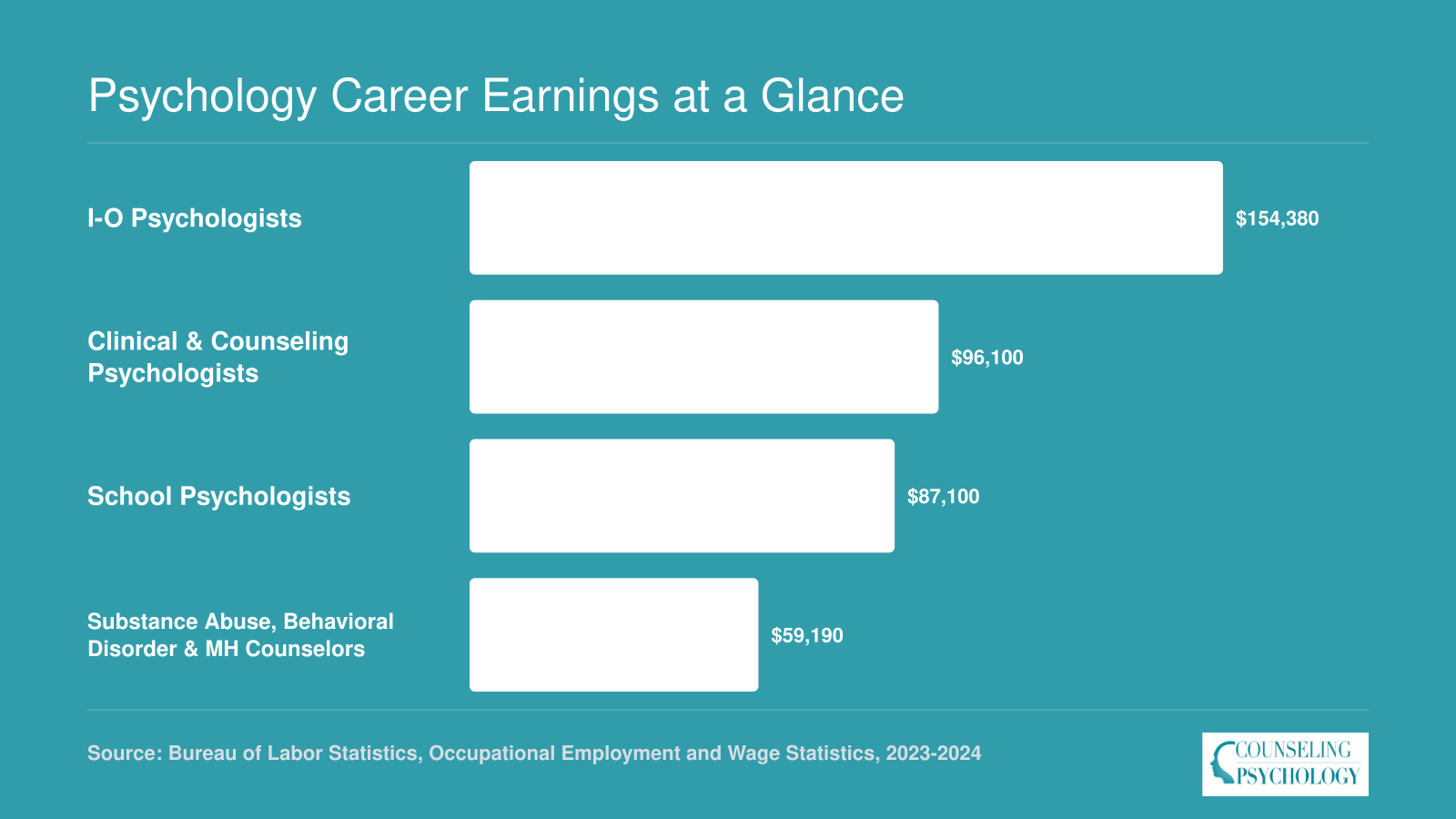
Psychology Career Earnings at a Glance
Degree level is the single biggest driver of salary differences across psychology-related careers. Doctoral-level roles such as industrial-organizational psychologist or clinical psychologist command significantly higher pay than master's or bachelor's-level counseling positions. The national median wages below, drawn from BLS data, illustrate the spread from roughly $49,000 to over $150,000.
Online, Hybrid, and Part-Time Options for Working Adults
Every ranked program featured earlier in this article is 100 percent online, but the broader landscape of psychology education includes formats that look quite different from one another. Understanding those differences is essential if you are balancing coursework with a job, family responsibilities, or both.
Fully Online, Hybrid, and Asynchronous Formats
Fully online programs deliver all lectures, discussions, and assignments through a learning management system. Many are asynchronous, meaning you can complete work on your own schedule rather than logging in at a set time. This is the most flexible option for working adults.
Hybrid programs blend online coursework with periodic on-campus residencies. These intensive weekends or week-long sessions are common at the doctoral level and in clinical or counseling concentrations where faculty want to observe skill development in person. Students exploring clinical psychology doctorate programs will encounter hybrid residency requirements especially often. Before enrolling, confirm exactly how many campus visits are required each year and where they take place.
Part-Time Enrollment and Accelerated Timelines
Many online programs let students choose between full-time and part-time tracks. Evening coursework and shorter academic terms (eight weeks instead of sixteen) make it possible to maintain steady progress without giving up a paycheck. On an accelerated, part-time schedule:
- A bachelor's degree can be completed in roughly 2.5 years, depending on transfer credits.
- Some master's programs wrap up in 18 to 24 months, even at a reduced course load per term.
Ask admissions advisors for a semester-by-semester plan so you can map out the realistic time commitment before you start.
Why Location Still Matters for Clinical Programs
Here is the detail that catches many online students off guard: virtually every clinical or counseling psychology program, whether it is a master's or a doctorate, requires supervised practicum and internship hours completed in person at an approved site. Those hours cannot be done remotely. You will need a clinic, hospital, school, or community agency in your area willing to host you.
Some programs maintain partnerships with practicum sites across multiple states and will help coordinate your placement. Others leave the search entirely up to the student. The difference can add weeks of legwork and uncertainty to your timeline. This is particularly relevant for students in marriage and family therapy master's programs, which typically carry substantial supervised-hours requirements. Before you commit, ask admissions two direct questions:
- Does the program assist with placing students at local practicum sites?
- What happens if a student cannot secure a placement in their area?
A program that actively supports field placement logistics is a meaningful advantage, especially if you live in a rural area or a state where the school has few existing site agreements. Location flexibility is one of the greatest strengths of online education, but for clinical tracks, your zip code still plays a role in how smoothly the experience unfolds.
Cost and Financial Aid for Psychology Programs
Psychology program tuition for the 2025-2026 academic year ranges from approximately $6,000 to $15,000 per year at public institutions for in-state bachelor's students, while out-of-state and private college tuition climbs to $25,000 to $50,000 annually. Master's programs typically cost $12,000 to $30,000 per year at public universities and $30,000 to $60,000 at private institutions. Doctoral programs, especially PsyD tracks, can reach $35,000 to $50,000 per year at many accredited schools. These figures come from NCES institutional surveys and represent tuition only, not the full cost of attendance.
Published tuition numbers rarely tell the complete story. Psychology students face ancillary costs that add thousands of dollars to the total bill, and these expenses often remain invisible until enrollment.
Hidden Fees in Clinical and Counseling Programs
Practicum and internship fees vary widely but commonly range from $500 to $2,500 per placement semester. Background checks required for clinical placements cost $50 to $150 per screening, and many programs require renewal every year or with each new site. Professional liability insurance is mandatory for students entering clinical settings and typically costs $25 to $100 annually for coverage through providers recommended by the American Psychological Association or state boards. Some universities bundle these fees into a single practicum course charge, while others bill them separately. Students exploring clinical psychology certificate programs should pay close attention to these add-on costs, which can vary significantly between online and on-campus formats.
Getting Accurate Cost Estimates
Start with the Net Price Calculator tool on each university's financial aid page. These calculators factor in your household income, state residency, and enrollment status to estimate total cost of attendance, including tuition, fees, books, housing, and transportation. The result is far more useful than sticker tuition alone.
Next, contact the psychology department coordinator or admissions office directly. Ask for a complete fee schedule that includes practicum costs, mandatory insurance, technology fees, and any required testing or certification expenses. Request clarification on whether fieldwork placements require students to cover their own travel or relocation costs.
Professional associations offer additional guidance. The APA publishes resources on typical student insurance requirements, and state psychology licensing boards often list the ancillary costs candidates should anticipate during training. Cross-referencing these sources with individual school disclosures ensures you budget accurately before committing to a program.
Frequently Asked Questions About Psychology Schools
Choosing a psychology program raises practical questions about timelines, accreditation, and career qualifications. Below are answers to the questions prospective students ask most often, grounded in current requirements and typical program structures.