
What you’ll learn in this article…
- The University of Alaska Fairbanks is currently the only in-state institution offering a CACREP-accredited counseling master's program.
- Alaska mental health counselors earn well above the national median, reflecting strong demand in urban and remote communities.
- UAF requires a minimum 3.0 GPA for admission and has waived the GRE for the current admissions cycle.
- Clinical Mental Health Counseling and School Counseling are the two specialization tracks available to Alaska students.
Alaska's mental health workforce shortage places the state among the most underserved in the nation, with rural and Alaska Native communities facing especially acute gaps in counseling access. For students pursuing a master's in counseling, this scarcity shapes everything from job prospects to the programs available. Only a handful of accredited options serve the entire state, making your choice of program unusually consequential.
The University of Alaska Fairbanks offers the primary in-state pathway, with a digitally delivered format designed for students across remote regions. CACREP accreditation, licensure requirements, tuition differences, and specialization tracks all factor into the decision. For those weighing this path alongside broader career goals, understanding how to become a mental health counselor provides important context. The guide below breaks down how these elements connect, helping you avoid costly missteps in a state where program options are few and employer demand remains high.
Alaska's Top-Ranked Master's in Counseling Programs
Alaska's options for an in-state master's in counseling are limited, but the programs that do exist are tailored to the state's unique geography and communities. The University of Alaska Fairbanks stands out as the only institution in the state offering CACREP-accredited counseling master's degrees, a distinction that directly affects licensure eligibility. Alaska Pacific University, while not offering a CACREP-accredited counseling master's, provides an undergraduate behavioral health pathway that can serve as a foundation for future graduate study. All graduation rates listed below are institution-wide figures and do not reflect program-specific completion.
- CACREP accreditation status
- Tuition and net price affordability
- Program delivery flexibility
- Alaska-focused clinical training
- Institutional graduation and retention rates
- Internal program database
- NCES-IPEDS federal institutional data — nces.ed.gov
- College Scorecard graduate earnings — collegescorecard.ed.gov
- Independent program research

University of Alaska Fairbanks
The University of Alaska Fairbanks is the only institution in Alaska that holds CACREP accreditation for its counseling programs, making it the default choice for students who want a clear path to LPC licensure in the state. UAF's counseling department emphasizes preparation for working with rural and Indigenous Alaskan communities, with most coursework delivered digitally so place-bound students across the state can participate. In-state tuition runs approximately $13,040 per year (out-of-state approximately $25,060), with an average net price of about $10,892. The institution-wide graduation rate is 38%, and the student-to-faculty ratio of 11:1 supports close mentorship throughout clinical training.
- CACREP-accredited 60-credit program preparing graduates for Alaska LPC licensure
- Entirely digitally delivered with synchronous evening and afternoon classes
- Hybrid format supports working professionals across remote Alaskan communities
- Emphasizes rural counseling skills and service to diverse Alaska populations
- Hands-on practicum and internship completed in students' local communities
- Admits students once per year with a February 10 application deadline
- Faculty-guided student research and conference presentation opportunities
- CACREP-accredited 60-credit program for aspiring K-12 school counselors
- Available via distance learning or face-to-face sessions in Anchorage and Fairbanks
- Prepares graduates for both state and national school counseling certification
- Field practicum component integrated into the degree requirements
- Designed for students who want to serve Alaska school districts
- Approved by the State of Alaska Department of Education and Early Development
- 30-credit post-master's certificate for professionals with an existing graduate degree
- Fully digitally delivered for maximum flexibility across Alaska
- Approved by the State of Alaska for school counselor certification
- Personalized course planning based on prior graduate coursework
- Ideal for social workers or psychologists adding school counseling credentials
- Requires a master's degree in a human services field for admission
Master of Education in Clinical Mental Health Counseling — Hybrid
Master of Education in School Counseling — Online
Graduate Certificate in School Counseling — Online

Alaska Pacific University
Alaska Pacific University in Anchorage does not currently hold CACREP accreditation for a counseling master's degree, which is an important consideration for students planning to pursue LPC licensure in Alaska. APU does offer a Bachelor of Science in Health Sciences with a Behavioral Health concentration, a culturally grounded undergraduate program that can serve as a stepping stone toward graduate counseling study. Tuition is approximately $20,760 regardless of residency, with a net price of around $21,616. The institution-wide graduation rate is about 47%, and its small 7:1 student-to-faculty ratio provides a personalized learning environment.
- 128-credit bachelor's degree with a focus on culturally safe behavioral health
- Hybrid delivery combining on-campus and online synchronous coursework
- Emphasizes cultural safety and service to Alaska and Indigenous communities
- Minimum 2.5 GPA required for admission
- Daytime and evening courses accommodate working students
- Application fee waiver available to reduce upfront costs
- Serves as a preparatory pathway for future graduate counseling programs
Bachelor of Science in Health Sciences, Behavioral Health Concentration — Hybrid
How We Ranked Alaska Counseling Programs
What criteria separate a genuinely affordable, career-ready counseling program from one that saddles graduates with debt and limited prospects? Our rankings prioritize net cost and measurable outcomes over reputation scores or marketing reach, giving you a clear picture of which Alaska programs deliver value.
Affordability Drives the Order
We weight net price more heavily than any other factor. A lower net price reflects not just sticker tuition but the full financial aid package typical students receive. Programs that secure federal or state grant aid for their students rise in the rankings because affordability directly impacts whether graduates can accept lower-paying positions in underserved communities or must chase higher salaries to manage debt.
Core Ranking Factors
- Net price: The average annual cost after grants and scholarships, drawn from College Scorecard institution-level data and IPEDS tuition files.
- Graduation rate: Completion within 150 percent of normal time signals program support and student preparedness.
- Program-level earnings and debt: Where available, we use College Scorecard program-level data on median earnings one and two years post-graduation and median federal loan debt at completion. These figures capture how well a specific counseling program equips graduates for the workforce.
- Accreditation status: CACREP accreditation satisfies Alaska licensure requirements for LPC candidates and often accelerates interstate mobility. Programs holding current CACREP accreditation receive a meaningful boost.
Transparent Data, No Hidden Weights
Competitor sites often list schools alphabetically or by paid partnership. We publish the methodology upfront and tie every ranking position to quantifiable metrics. If you are still exploring the broader landscape of counseling master's programs online, the same affordability-first framework applies. When program-level earnings are not yet available for a newer track, we note the gap rather than invent a score. This approach keeps the list honest and gives you confidence that affordability and outcomes, not advertising budgets, determine the order.
Questions to Ask Yourself
Online vs. On-Campus Counseling Programs in Alaska
Alaska's geography makes the choice between online and on-campus study more consequential than in most states. With major counseling programs concentrated at the University of Alaska Fairbanks, students in remote communities face real trade-offs. Understanding what 'online' actually means in practice is essential, because most Alaska counseling programs blend digital coursework with mandatory in-person clinical hours.
Pros
- Online delivery lets students in rural Alaska complete coursework from home, removing the need to relocate to Fairbanks or Anchorage.
- UAF's synchronous evening classes combined with asynchronous modules allow working professionals to keep their jobs while earning a degree.
- On-campus enrollment provides stronger faculty mentorship through regular face-to-face interaction and easier access to research opportunities.
- Studying on campus simplifies practicum coordination, since clinical placement sites are more plentiful in Fairbanks and Anchorage.
- On-campus students benefit from organic peer networking, cohort bonding, and informal study groups that are harder to replicate online.
Cons
- Even in fully online programs like UAF's M.Ed. in Clinical Mental Health Counseling, students must secure in-person practicum and internship placements at approved local sites.
- Online learners in isolated areas may find fewer approved clinical sites nearby, requiring travel or temporary relocation for fieldwork hours.
- Peer networking in online programs tends to be limited to virtual discussion boards and scheduled video sessions, which some students find less engaging.
- On-campus programs require proximity to Fairbanks or, for other health sciences options, Anchorage, limiting access for most of the state's population.
- On-campus schedules offer less flexibility for students juggling work, family, or community obligations that are common across Alaska's diverse communities.
CACREP Accreditation and Why It Matters in Alaska
CACREP-accredited programs versus non-CACREP alternatives represent two different pathways to professional counseling licensure, each with distinct regulatory implications in Alaska. Understanding this distinction is critical before you commit to a graduate program.
What Is CACREP?
The Council for Accreditation of Counseling and Related Educational Programs (CACREP) is the specialized accrediting body for counseling programs at the master's and doctoral levels. CACREP sets rigorous standards for curriculum content, supervised clinical experience, faculty qualifications, and student outcomes. Graduating from a CACREP-accredited program signals to employers, licensing boards, and insurance panels that you have completed training meeting the profession's highest benchmarks.
Alaska's LPC Licensure and CACREP
Alaska does not mandate CACREP accreditation for Licensed Professional Counselor (LPC) candidates.1 The Alaska Board of Professional Counselors accepts a master's or doctoral degree in counseling or a related field, provided the program includes at least 60 semester hours and covers eight core content areas specified in Alaska regulation 12 AAC 62.1 This flexibility allows graduates of non-CACREP programs to pursue licensure, but the burden is on you to document that your coursework satisfies each of the eight required domains. If your transcript shows gaps in required content areas, you will need to complete additional graduate coursework before the board approves your application. A counseling graduate certificate can sometimes fill those gaps, though it still adds time and expense to your path to licensure.
Portability and Employer Preferences
Even though Alaska does not strictly require CACREP graduation, many other states do. If you anticipate moving or practicing via telehealth across state lines, a CACREP credential simplifies reciprocity and endorsement applications. Some states will not recognize non-CACREP degrees at all, or they impose supplemental coursework and supervision requirements that can extend your timeline by a year or more. For those considering advanced study, counseling doctoral programs typically expect applicants to hold a CACREP-accredited master's degree.
Employers and third-party payers also favor CACREP training. Many managed-care panels, hospital systems, and school districts prefer or require CACREP credentials when credentialing counselors for reimbursement or employment. Graduating from a CACREP program opens more doors and reduces administrative friction throughout your career, whether you plan to become a counselor in Alaska or elsewhere.
The Bottom Line
While Alaska's regulations permit non-CACREP pathways, choosing a CACREP-accredited program offers the clearest, most portable route to licensure and employment. If your program lacks CACREP accreditation, review its curriculum against Alaska's eight core content areas and plan for possible supplemental coursework before you apply for licensure.
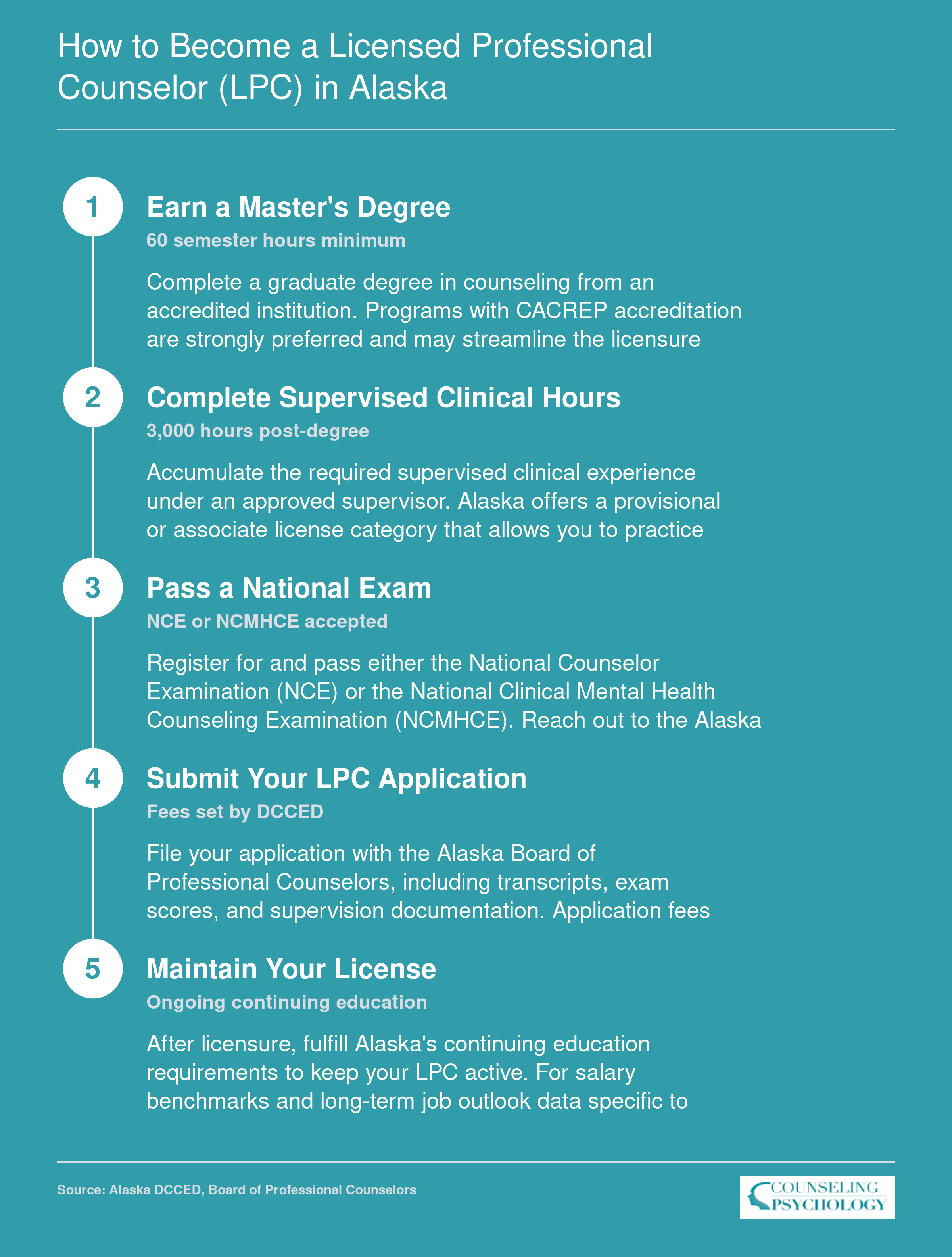
How to Become a Licensed Professional Counselor (LPC) in Alaska
Earning your LPC in Alaska involves a structured sequence of education, supervised experience, and examination. Because state regulations can change, always verify current requirements directly with the Alaska Board of Professional Counselors through the Department of Commerce, Community, and Economic Development (DCCED) licensing page. The Alaska Counseling Association and individual graduate school websites are also valuable resources for the most up-to-date guidance.
Tuition and Financial Aid for Alaska Counseling Students
Understanding the full cost of a counseling degree in Alaska means looking beyond sticker price. The table below compares published tuition, estimated net price, median graduate debt, and the share of students receiving Pell Grants at two Alaska institutions. Note that net price and debt figures reflect institution-wide averages from federal data and may not correspond exactly to graduate counseling programs. Program-level earnings and debt data are not yet available for these specific counseling offerings. Beyond institutional aid, Alaska counseling students should explore tribal education benefits (which vary by tribe and may support graduate study), and the National Health Service Corps (NHSC) Loan Repayment Program, which offers substantial loan forgiveness for licensed mental health professionals who serve in federally designated Health Professional Shortage Areas. Much of rural Alaska qualifies, making NHSC a powerful option for counseling graduates willing to practice in underserved communities. The Alaska Education Grant, a state need-based award of $500 to $4,000, is limited to undergraduate students and does not apply to master's programs.
| Institution | In-State Tuition | Out-of-State Tuition | Estimated Net Price | Median Graduate Debt | Est. Monthly Payment (10-yr) | Pell Grant Share |
|---|---|---|---|---|---|---|
| University of Alaska Fairbanks | $13,040 | $25,060 | $10,892 | $20,291 | Approx. $210 | 66.5% |
| Alaska Pacific University | $20,760 | $20,760 | $21,616 | $23,500 | Approx. $245 | 65.1% |
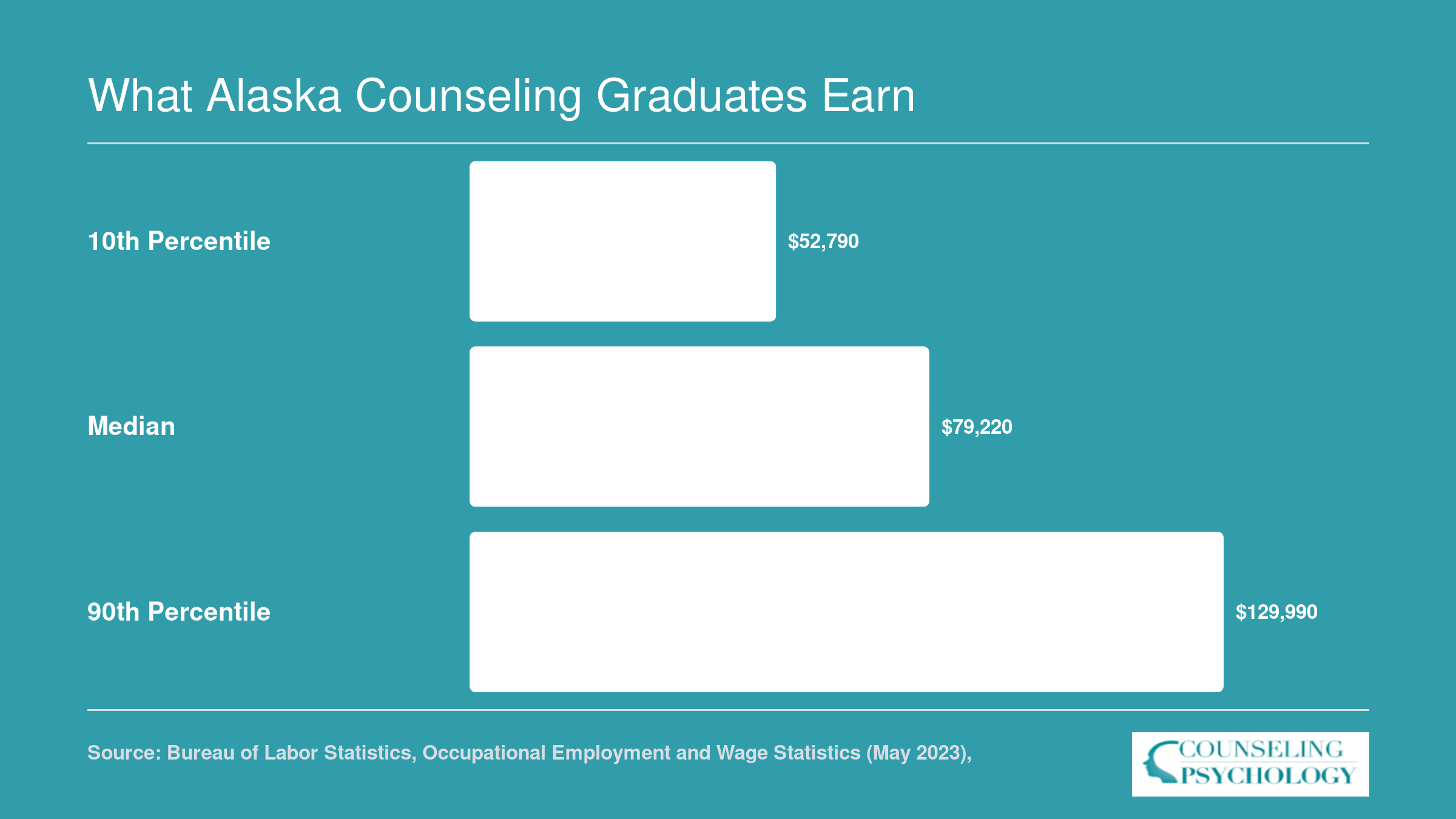
What Alaska Counseling Graduates Earn
Alaska's mental health counselors earn well above the national median, reflecting the state's high demand for behavioral health professionals in both urban and remote communities. Program-level earnings data for the specific counseling programs at the University of Alaska Fairbanks and Alaska Pacific University are not yet available from federal sources, so the figures below draw on Alaska-specific wage data from the Bureau of Labor Statistics.
Counseling Specializations Available in Alaska
Alaska's master's-level counseling landscape has consolidated around two tracks that map directly to the state's two main credentials: Clinical Mental Health Counseling and School Counseling. Choosing between them is less a matter of curriculum preference than of deciding which licensure door you want to walk through after graduation.
Clinical Mental Health Counseling
The Clinical Mental Health Counseling M.Ed. at UAF is CACREP-accredited (2016 standards) and runs 60 to 72 credits.12 Graduates are eligible to pursue Licensed Professional Counselor status in Alaska, though the license itself requires additional post-degree supervised practice beyond the master's.3 Coursework prepares students for roles in community mental health agencies, private practice settings, hospitals, and substance use programs.
Field hours are the structural backbone of this track. Students complete 700 total clinical hours: a 100-hour practicum followed by 600 internship hours, sequenced through COUN F635 Practicum, COUN F636 Internship I, and COUN F686 Internship II.5 Placements must be in clinical or community mental health settings, supervised by a licensed counselor, and a background check is required before students see clients.5
School Counseling Tracks
UAF's School Counseling specialization leads to Alaska school counselor certification rather than LPC licensure, so graduates work inside K-12 schools rather than clinical settings. Students choose among Elementary, Secondary, K-12, or dual concentrations, with the K-12 track requiring placements at both elementary and secondary levels.25 The fieldwork sequence adds COUN F687 Internship III to the standard practicum and internship courses, and total clinical hours match the clinical track at 700. Supervisors must be certified school counselors working in an accredited K-12 setting.7
Child Counseling as a Sub-Focus
Child and adolescent counseling is not a standalone Alaska degree, but students in either track can shape their practicum and internship placements toward youth populations: school counseling students through elementary placements, and clinical students through community agencies serving children and families. Those focused specifically on working with younger clients may find it helpful to explore the broader child counselor career path for program comparisons across states.
Admission Requirements for Alaska Counseling Programs
A minimum GPA of 3.0 on a 4.0 scale is the baseline academic requirement for the University of Alaska Fairbanks M.Ed. in Counseling program, with no standardized test required for the 2025, 2026 admissions cycle.1 This GRE waiver policy removes a significant barrier for prospective students, allowing applicants to focus on demonstrating their readiness through other application components.
Academic Prerequisites and Degree Requirements
UAF requires applicants to hold a bachelor's degree, preferably in a human services field such as psychology, social work, education, or a related discipline.1 However, students without an undergraduate psychology degree are not automatically excluded. Applicants from other academic backgrounds may be considered, particularly if they can demonstrate relevant coursework or professional experience in helping professions. If you are wondering how hard it is to get into grad school for psychology, understanding these flexible prerequisites can offer some reassurance.
Typical prerequisites across Alaska counseling programs include:
- Undergraduate GPA: Minimum 3.0 cumulative GPA from an accredited institution
- Personal statement: A written essay describing your interest in counseling, career goals, and relevant experience
- Letters of recommendation: Usually two to three letters from academic or professional references who can speak to your potential as a counselor
- Interview: UAF specifically requires an interview as part of the admissions process1
- Background check: Required before beginning practicum experiences at UAF1
Application Deadlines for the 2026 Cycle
For Fall 2025 admission, UAF's application deadline was February 10.1 Students planning to apply for the Fall 2026 cohort should anticipate a similar early February deadline, though checking the program's admissions page directly for updated dates is essential. Early preparation is advisable given the interview requirement and the time needed to gather recommendation letters.
Preparing a Competitive Application
Beyond meeting minimum requirements, successful applicants typically demonstrate genuine commitment to the counseling profession through volunteer work, relevant employment, or coursework in areas like abnormal psychology, human development, or multicultural studies. The personal statement offers an opportunity to articulate your understanding of the counseling field and your vision for serving clients in Alaska's unique communities.
Frequently Asked Questions About Counseling Programs in Alaska
Prospective counseling students in Alaska often have questions about costs, accreditation, licensure, and career prospects. Below are answers to the most common questions, grounded in current data and Alaska-specific requirements.