
What you’ll learn in this article…
- Online ASD credentials range from graduate certificates requiring around 12 credits to full master's degrees exceeding 30 credits.
- BCBA certification requires a specific ABAI verified course sequence, so not every autism program qualifies graduates for that exam.
- Special education teacher salaries vary widely by metro area, with some regions paying over $20,000 above the national median.
- Before enrolling, confirm your program's eligibility with both the BACB and your state department of education.
Demand for professionals trained in autism spectrum disorders has risen sharply over the past decade, driven by higher identification rates, expanding insurance coverage for behavioral therapy, and growing recognition of autism as a distinct instructional and clinical specialty across K-12 schools, private practices, and hospital-based clinics. Online programs now span the full credential continuum: graduate certificates, bachelor's degrees in autism studies, master's degrees in special education with ASD endorsements, and doctoral programs in applied behavior analysis.
Accreditation and program structure determine what doors the degree actually opens. A graduate certificate may satisfy state requirements for a teaching endorsement in one state but not another, and only a subset of master's programs meet the Behavior Analyst Certification Board's coursework and supervision requirements for Board Certified Behavior Analyst (BCBA) certification. Tuition ranges from under six thousand dollars for a stand-alone certificate to more than forty thousand dollars for a full master's degree, and practicum requirements vary from zero supervised hours to five hundred or more.
Most online ASD programs enroll working educators and clinicians seeking to specialize without leaving the workforce, so asynchronous formats dominate and admission thresholds remain moderate. The challenge is not getting in but choosing the credential that aligns with your state's licensure rules and your employer's salary schedule.
Best Online Autism Spectrum Disorders Programs
Online autism spectrum disorders programs prepare educators, clinicians, and support professionals to work effectively with individuals on the autism spectrum. These programs range from graduate certificates to full master's degrees and often incorporate coursework in applied behavior analysis, evidence-based interventions, and family collaboration. The following schools offer some of the strongest online options available nationally, selected for their curriculum depth, faculty expertise, institutional reputation, and overall value.
- Independent program research
- U.S. Department of Education College Scorecard (collegescorecard.ed.gov)
- National Center for Education Statistics (NCES-IPEDS) (nces.ed.gov)
University of Kansas
The University of Kansas offers a highly regarded online Master's in Autism Spectrum Disorder through its School of Education. With median alumni earnings of nearly $62,000 and a strong research tradition in special education, KU provides rigorous training grounded in evidence-based practices. The program is designed for working professionals and covers assessment, intervention, and collaboration strategies.
- Fully online master's degree focused specifically on autism
- Covers evidence-based assessment and intervention strategies
- Emphasizes collaboration with families and multidisciplinary teams
- Designed for working educators and related professionals
- Faculty includes nationally recognized ASD researchers
- Coursework addresses social, communication, and behavioral supports
- Flexible pacing to accommodate full-time employment
Master's in Autism Spectrum Disorder — Online
Michigan State University
Michigan State University's College of Education offers an online Master's in Applied Behavior Analysis and Autism Spectrum Disorder. With an 81% graduation rate and median earnings exceeding $67,000, MSU pairs academic rigor with strong career outcomes. The program integrates ABA principles with ASD-specific coursework for comprehensive professional preparation.
- Combines applied behavior analysis and autism spectrum disorder focus
- Fully online format from a top-tier research university
- May fulfill coursework requirements toward BCBA certification
- 81% institutional graduation rate reflects strong student support
- Faculty specializing in behavioral interventions and ASD research
- Covers functional assessment, intervention design, and data analysis
- Emphasizes ethical practice and evidence-based decision-making
Master's in Applied Behavior Analysis and Autism Spectrum Disorder — Online
Arizona State University
Arizona State University offers both a full online MA in Special Education with an Autism Spectrum Disorders concentration and a standalone graduate certificate in ASD. ASU's digital immersion platform delivers a seamless online experience with robust student support services. The programs emphasize practical strategies for inclusive education and behavior management across diverse settings.
- Full master's degree with dedicated ASD concentration
- Delivered through ASU's award-winning online platform
- Covers assessment, instructional strategies, and behavior support
- Addresses needs across the lifespan from early childhood to adulthood
- Prepares graduates for roles in schools, clinics, and agencies
- Includes coursework on culturally responsive ASD practices
- Flexible scheduling designed for working professionals
- Shorter credential ideal for practicing educators and clinicians
- Focused coursework on characteristics and needs of individuals with ASD
- Can serve as a pathway into the full master's program
- Covers evidence-based instructional and behavioral strategies
- Fully online with asynchronous course options
- Developed by ASU's Mary Lou Fulton Teachers College
MA in Special Education – Autism Spectrum Disorders — Online
Graduate Certificate in Autism Spectrum Disorders — Online
The University of Alabama
The University of Alabama offers an online MA in Special Education with a concentration in Autism, blending foundational special education knowledge with specialized ASD coursework. With a 73% graduation rate and median alumni earnings near $59,000, UA provides a strong balance of affordability and outcomes. The program prepares graduates for leadership roles in autism education and support services.
- Online master's with a dedicated autism concentration
- Covers characteristics, identification, and intervention for ASD
- Emphasizes evidence-based teaching and behavior support strategies
- Prepares graduates for advanced roles in autism education
- Flexible online delivery from a nationally recognized university
- Addresses transition planning and family collaboration
- In-state tuition approximately $12,180 per year
MA in Special Education – Concentration in Autism — Online
George Mason University
George Mason University's online special education programs include ASD-focused coursework within its College of Education and Human Development. Graduates report the highest median earnings on this list at over $76,000, reflecting the strong market demand in the Northern Virginia and Washington, D.C. region. Mason's proximity to federal agencies and advocacy organizations enriches its curriculum with policy and research connections.
- Online special education programs with ASD-related coursework
- Graduates report median earnings exceeding $76,000
- Curriculum informed by proximity to federal agencies and research centers
- Emphasizes inclusive practices and individualized instruction
- Strong focus on evidence-based interventions for diverse learners
- Median graduate debt of just $19,500 reflects strong value
Special Education Online Programs — Online
Eastern Michigan University
Eastern Michigan University offers an online MA in Autism Spectrum Disorders, one of the few programs nationally focused entirely on ASD at the master's level. EMU charges the same tuition rate for in-state and out-of-state online students at approximately $16,240 per year, making it an accessible option for learners across the country. The program covers diagnostics, behavior supports, and inclusive education practices.
- Fully online master's degree dedicated entirely to ASD
- Same tuition for in-state and out-of-state online students
- Covers diagnostic assessment, behavior support, and inclusion
- Addresses communication, social skills, and sensory needs
- Designed for teachers, counselors, and related service providers
- Includes coursework on family systems and community resources
- Flexible asynchronous format for working professionals
MA in Autism Spectrum Disorders — Online
University of North Carolina at Charlotte
UNC Charlotte offers an online Graduate Certificate in Autism Spectrum Disorder designed for educators and professionals seeking targeted ASD knowledge without committing to a full degree. With in-state tuition around $7,239, it stands out as one of the most affordable options on this list. The certificate can often be stacked toward a future master's degree in special education.
- Online graduate certificate focused on autism spectrum disorder
- Among the most affordable options with in-state tuition near $7,239
- Ideal for educators wanting ASD specialization without a full degree
- Covers identification, assessment, and evidence-based interventions
- Credits may apply toward a master's in special education
- Flexible online format suited for working professionals
Graduate Certificate in Autism Spectrum Disorder (ASD) — Online
Fitchburg State University
Fitchburg State University offers an online Graduate Certificate in Autism Spectrum Disorders that provides focused, practical training for educators and clinicians. With a relatively low out-of-state tuition of around $17,426 and a net price of approximately $14,262, Fitchburg State is a budget-friendly choice for students seeking specialized ASD credentials.
- Online graduate certificate focused on ASD practices
- Affordable tuition even for out-of-state online students
- Covers behavioral strategies, social skills, and communication supports
- Designed for teachers, paraprofessionals, and related clinicians
- Compact credential format allows quick skill development
- Coursework grounded in current research and best practices
Graduate Certificate in Autism Spectrum Disorders — Online
University of Cincinnati
The University of Cincinnati offers an online Graduate Certificate in Autism Spectrum Disorders through its College of Education. UC's strong 75% graduation rate and established online infrastructure support a quality learning experience. The certificate focuses on professional development for educators and specialists already working with individuals on the autism spectrum.
- Online graduate certificate from a nationally ranked university
- Designed as professional development for practicing educators
- Covers identification, assessment, and intervention for ASD
- Flexible online format with asynchronous coursework options
- 75% institutional graduation rate reflects student success culture
- Credits may transfer toward advanced special education degrees
Graduate Certificate in Autism Spectrum Disorders — Online
University of Kentucky
The University of Kentucky offers an online Graduate Certificate in Autism Spectrum Disorder through its College of Education. With a 71% graduation rate and strong retention, UK provides solid institutional support for online learners. The certificate is well suited for teachers and service providers looking to deepen their understanding of autism across educational and community settings.
- Online graduate certificate with focused ASD coursework
- Offered through UK's established College of Education
- Covers evidence-based practices for supporting individuals with ASD
- Addresses social, communication, and behavioral characteristics
- Designed for working teachers and related service providers
- Median alumni earnings near $59,000 reflect strong career value
Graduate Certificate in Autism Spectrum Disorder — Online
Types of Autism Spectrum Disorders Degrees and Certificates
Autism spectrum disorders credentials come in several distinct forms online, and understanding which type matches your career goals is essential before you invest time and tuition. The landscape includes graduate certificates, master's degrees in autism studies, applied behavior analysis (ABA) degrees with ASD specialization, special education master's programs with ASD concentration, and a small number of bachelor's and doctoral programs. Each serves a different audience and leads to different professional outcomes.
What Is an Autism Studies Degree?
An autism studies degree is a master's-level program specifically designed to prepare graduates to work with children and adults on the autism spectrum. These programs typically require 30 to 36 credits and focus on evidence-based interventions, sensory processing, communication strategies, family support, and legal frameworks under IDEA.1 Eastern Michigan University and Florida State University both offer dedicated Autism Spectrum Disorders master's programs online.23 Autism studies degrees differ from ABA degrees in emphasis: while ABA programs center on behavioral principles applicable across disabilities, autism studies programs concentrate on the unique characteristics of autism and co-occurring conditions. Some autism studies master's programs align with state autism endorsement requirements for educators, though not all do.2
ASD Graduate Certificates
Graduate certificates in autism spectrum disorders are shorter credentials, typically 9 to 18 credits, with 12 credits (four courses) being the most common structure.3 These certificates require an existing bachelor's degree and are designed for practicing teachers, speech pathologists, counselors, or social workers who want specialized training without committing to a full master's program. The University of Florida autism certificate programs, for instance, can be completed in one to two semesters.
Stackable Pathways
Many universities now offer stackable credential pathways, allowing students to begin with a graduate certificate and later apply all those credits toward a master's degree if they choose to continue.1 This approach reduces both cost and time to completion for students who want to test the waters before committing to a full program or who need immediate professional development.
Special Education with ASD Concentration
Special education master's programs with an autism concentration blend general special education coursework aligned with Council for Exceptional Children (CEC) standards with autism-specific electives.1 These programs, typically 30 to 36 credits, prepare graduates for state special education licensure and often include a student-teaching or practicum requirement. They differ from standalone autism studies degrees by covering a broader disability spectrum. Students exploring related online master's in psychology programs may find overlap in foundational coursework, though the clinical focus differs significantly.
Availability by Degree Level
Graduate certificates and master's programs dominate the online ASD field. Bachelor's degrees explicitly titled "autism studies" are rare online, and doctoral programs (EdD or PhD) with ASD emphasis exist but are far less common than master's options. Students seeking BCBA certification will need to confirm that their chosen program meets specific coursework and supervision requirements, a topic covered in the licensure section below. Not all autism credentials carry the same professional weight or eligibility for state endorsements, so verifying alignment with your licensing goals is critical.
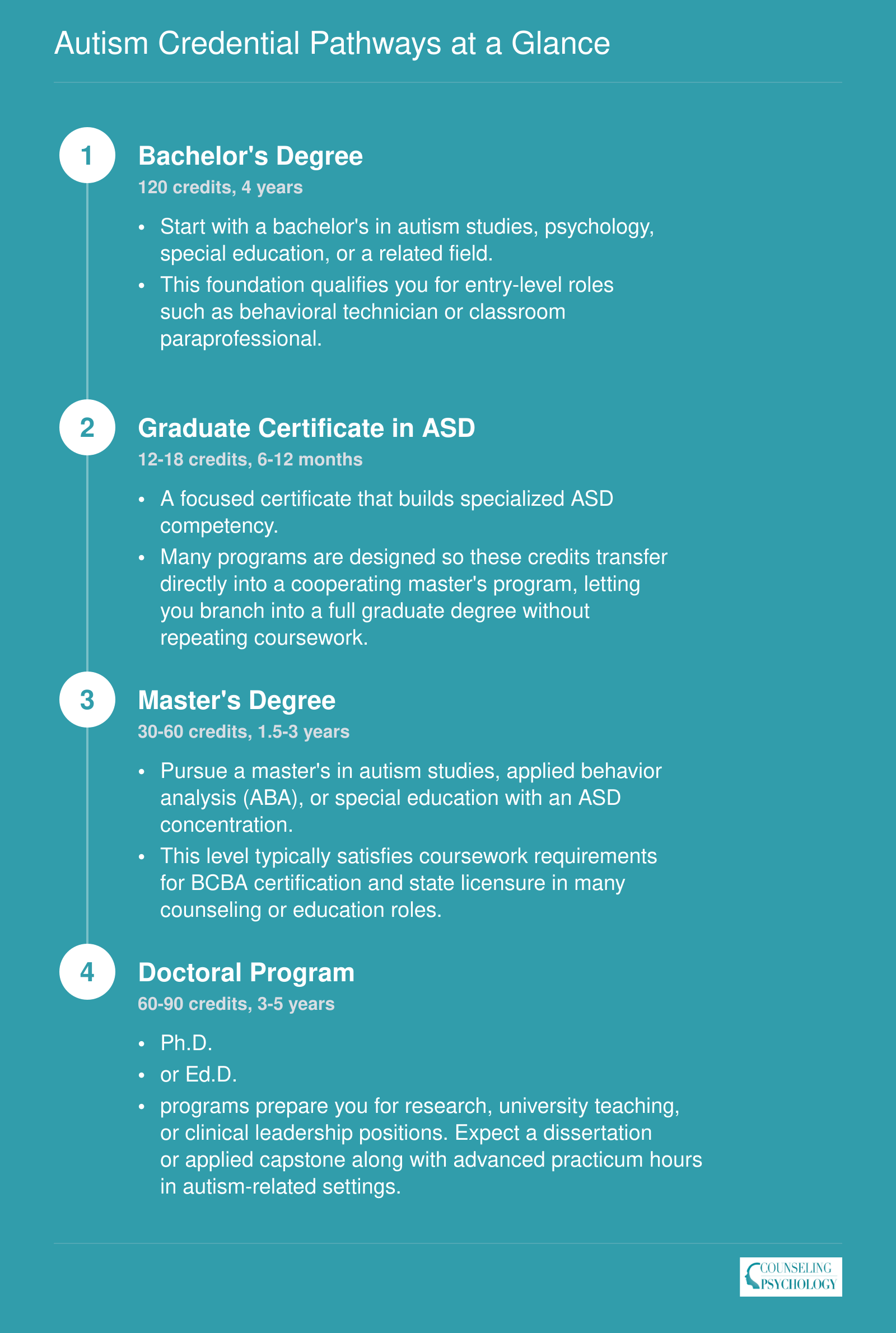
Autism Credential Pathways at a Glance
Most professionals working with individuals on the autism spectrum follow a layered credentialing path. Each level opens new career doors, and a graduate certificate can serve as either a standalone credential or a stepping stone into a full master's program.
How to Choose the Right Online ASD Program
What should you look for when comparing online autism spectrum disorders programs to make sure your investment pays off in the career you want?
Selecting the right program involves more than browsing course catalogs. You need to verify accreditation status, evaluate how the online format fits your life, understand true costs, and confirm the credential will actually qualify you for licensure or certification in your state.
Accreditation Essentials
Start with regional accreditation, the baseline standard that ensures your credits will transfer and your degree will be recognized by employers and licensing boards. For education-focused programs, look for Council for the Accreditation of Educator Preparation (CAEP) approval, which signals the curriculum meets national teaching standards.
Programs with autism or special education specializations may also align with Council for Exceptional Children (CEC) standards. CEC-aligned coursework covers evidence-based practices specific to learners with disabilities, including those on the autism spectrum. If you plan to pursue national recognition as a special educator, CEC alignment matters.
Online Format and Flexibility
Online programs vary widely in structure. Some require synchronous sessions where you attend live virtual classes at set times. Others are fully asynchronous, letting you complete coursework on your own schedule. Cohort-based programs move a fixed group of students through the curriculum together, which can build professional connections but limits flexibility. Self-paced options offer maximum scheduling freedom but require strong self-discipline.
Practicum and fieldwork arrangements deserve special attention. Many autism programs require hands-on hours in schools, clinics, or behavioral health settings. Ask whether the program helps distance learners secure local placements or whether you must arrange your own. Clarify supervision requirements and any travel expectations.
Cost Considerations
Compare programs by tuition per credit hour rather than sticker price alone. A 30-credit certificate at $450 per credit costs $13,500, while a similar program at $650 per credit runs $19,500. Factor in fees, technology requirements, and any costs associated with proctored exams or in-person residencies.
Check whether your program qualifies for federal financial aid. Many certificate programs do not. Investigate employer tuition reimbursement if you work in education or healthcare, as many school districts and health systems offer support for employees pursuing autism-related credentials.
Stackable Credentials
If you might want a master's degree later, ask whether certificate credits transfer into a graduate program at the same institution. Stackable credentials let you build toward an advanced degree over time without repeating coursework. Not all programs offer this pathway, so confirm transferability in writing before enrolling.
Licensure Alignment
Before committing to any program, verify it meets your state's requirements. If you want an autism endorsement on your teaching license, check that the coursework matches your state education agency's specifications. If you plan to become a Board Certified Behavior Analyst, confirm the program holds Association for Behavior Analysis International (ABAI) verification or meets Behavior Analyst Certification Board (BACB) coursework requirements.
State requirements differ significantly. A program that qualifies you for an autism endorsement in Texas may not satisfy Ohio's criteria. Contact your state licensing board directly and request a written evaluation of any program you are considering.
Questions to Ask Yourself
Do I want a standalone credential, or do I plan to stack it into a master's degree later?
Does this program's coursework satisfy BCBA eligibility or my state's autism endorsement requirements?
Can I complete the required practicum or fieldwork hours near where I live?
Autism Spectrum Disorders Program Curriculum and Clinical Requirements
Coursework-only certificates versus programs with embedded practicum hours represent two distinct pathways in online autism education, and the difference matters for your professional credentials and readiness to work directly with individuals on the spectrum. Most graduate certificates and master's programs in autism spectrum disorders share a common curricular core but diverge sharply in their field-experience requirements, with direct implications for licensure and certification eligibility.
Core Coursework Across Online ASD Programs
Whether you pursue a 12-credit certificate or a 30-credit master's, expect a curriculum anchored in evidence-based practice. Core courses typically include applied behavior analysis principles, social communication interventions, assessment and diagnosis, family collaboration strategies, and research methods for evaluating evidence-based practices. Arcadia University's 12-credit Autism Education Certificate, for example, opens with Characteristics of Students with Autism Spectrum Disorders and builds from there.1 Programs aligned with the Behavior Analyst Certification Board task list often include coursework in experimental design, ethical conduct, and functional behavior assessment, preparing graduates to sit for BCBA or BCaBA exams. Others follow Council for Exceptional Children Initial Preparation Standards, emphasizing individualized education program development and inclusive instructional strategies.
Practicum and Fieldwork Expectations
Online programs handle supervised clinical hours in one of three ways: embedded practicum requirements, optional field placements, or purely coursework-based tracks. Graduate certificates typically require 100 to 300 supervised hours, while master's programs may mandate 500 or more. Marywood University's ASD Endorsement, for instance, includes 80 hours of supervised field experience and aligns explicitly with CEC standards.2 Online programs arrange local placements by partnering with schools, clinics, and community agencies near your home or by allowing you to propose a site and supervisor for approval. Settings range from public school special education classrooms to private ABA clinics and early-intervention programs.
Why the Practicum Distinction Matters
Programs without a practicum component deliver foundational knowledge but do not fulfill supervised-experience requirements for most state licensure or national certification. If your goal is to become a licensed special education teacher, board-certified behavior analyst, or credentialed autism specialist, verify that your program includes the clinical hours your credential requires. Coursework-only certificates suit educators already licensed who seek endorsement-level coursework, but they do not substitute for supervised practice. Check BACB requirements if you plan to pursue behavior-analyst certification and confirm your state's special education or autism endorsement rules before enrolling.
Related Articles
Career Outcomes and Salary for ASD Program Graduates
Graduates of online autism spectrum disorders programs enter a broad range of careers, and earning potential varies significantly by degree level and role. A graduate certificate may qualify you for a classroom autism endorsement or a paraprofessional position, while a master's degree opens doors to clinical roles, board certification (BCBA), and program leadership. The table below presents national median salary estimates for common career paths. These figures draw on BLS occupational data and salary aggregator estimates; actual compensation will differ by employer, region, and experience level.
| Job Title | Typical Degree Level | National Median Annual Salary | Data Source |
|---|---|---|---|
| Special Education Paraprofessional | Certificate or Associate's | $27,877 | Salary aggregator estimate |
| Early Intervention Specialist | Bachelor's | $40,596 | Salary aggregator estimate |
| Autism Specialist | Bachelor's or Graduate Certificate | $41,125 | Salary aggregator estimate |
| Behavioral Specialist | Bachelor's or Master's | $53,885 | Salary aggregator estimate |
| Inclusion Specialist | Bachelor's or Master's | $54,131 | Salary aggregator estimate |
| Special Education Teacher, Preschool | Bachelor's or Master's | $62,190 | BLS (national median) |
| Special Education Teacher, Middle School | Bachelor's or Master's | $64,880 | BLS (national median) |
| Special Education Teacher, Secondary School | Bachelor's or Master's | $69,590 | BLS (national median) |
| Autism Spectrum Disorder Specialist | Master's | $70,620 | Salary aggregator estimate |
| Education Teacher, Postsecondary | Master's or Doctorate | $72,090 | BLS (national median) |
| ABA Therapist / BCBA | Master's (with board certification) | $75,302 | Salary aggregator estimate |
| Special Education Administrator | Master's or Doctorate | $90,560 | Salary aggregator estimate |
| Developmental Disabilities Case Manager | Master's | $96,326 | Salary aggregator estimate |
Special Education Teacher Pay by Metro Area
Special education teaching remains the most common career outcome for ASD credential holders, and compensation varies significantly by region. The table below draws from BLS metro-level data for special education teachers across preschool, middle school, and secondary school settings. Keep in mind that the highest-paying metros, particularly New York and Los Angeles, also carry substantially higher costs of living, so a six-figure salary in those areas may stretch about as far as $65,000 to $75,000 in more affordable cities like Dallas or Atlanta.
| Metro Area | Teaching Level | Median Annual Salary | 25th Percentile | 75th Percentile | Employed in Area |
|---|---|---|---|---|---|
| New York, Newark, Jersey City (NY, NJ) | Preschool Special Ed | $132,930 | $78,200 | $156,610 | 4,420 |
| New York, Newark, Jersey City (NY, NJ) | Secondary Special Ed | $99,410 | $77,180 | $127,200 | 16,090 |
| New York, Newark, Jersey City (NY, NJ) | Middle School Special Ed | $88,380 | $73,780 | $111,420 | 9,070 |
| Los Angeles, Long Beach, Anaheim (CA) | Secondary Special Ed | $103,150 | $77,230 | $121,310 | 4,070 |
| Los Angeles, Long Beach, Anaheim (CA) | Middle School Special Ed | $97,030 | $77,560 | $104,480 | 2,570 |
| Los Angeles, Long Beach, Anaheim (CA) | All Other Special Ed | $87,600 | $77,120 | $103,010 | 2,930 |
| Boston, Cambridge, Newton (MA, NH) | Preschool Special Ed | $82,760 | $61,400 | $105,400 | 500 |
| Boston, Cambridge, Newton (MA, NH) | Middle School Special Ed | $82,110 | $64,060 | $99,320 | 1,970 |
| Boston, Cambridge, Newton (MA, NH) | Secondary Special Ed | $81,900 | $66,900 | $100,240 | 2,980 |
| Chicago, Naperville, Elgin (IL, IN) | Secondary Special Ed | $80,840 | $64,950 | $101,100 | 6,940 |
| Chicago, Naperville, Elgin (IL, IN) | Middle School Special Ed | $74,960 | $59,800 | $90,440 | 3,190 |
| Washington, Arlington, Alexandria (DC, VA, MD, WV) | Secondary Special Ed | $81,570 | $64,640 | $104,690 | 3,940 |
| Washington, Arlington, Alexandria (DC, VA, MD, WV) | Preschool Special Ed | $79,420 | $64,860 | $97,190 | 390 |
| Philadelphia, Camden, Wilmington (PA, NJ, DE, MD) | Secondary Special Ed | $78,900 | $61,160 | $92,960 | 5,320 |
| Philadelphia, Camden, Wilmington (PA, NJ, DE, MD) | Middle School Special Ed | $78,560 | $62,410 | $95,140 | 3,110 |
| Atlanta, Sandy Springs, Roswell (GA) | Preschool Special Ed | $82,370 | $69,480 | $90,710 | 500 |
| Atlanta, Sandy Springs, Roswell (GA) | Middle School Special Ed | $75,980 | $63,860 | $81,400 | 2,710 |
| Minneapolis, St. Paul, Bloomington (MN, WI) | Secondary Special Ed | $76,390 | $58,960 | $84,180 | 3,120 |
| Dallas, Fort Worth, Arlington (TX) | Middle School Special Ed | $63,790 | $59,470 | $70,960 | 6,140 |
| Dallas, Fort Worth, Arlington (TX) | Secondary Special Ed | $64,330 | $61,880 | $68,710 | 2,510 |
| Houston, Pasadena, The Woodlands (TX) | Secondary Special Ed | $66,420 | $62,860 | $71,960 | 2,220 |
| Houston, Pasadena, The Woodlands (TX) | Middle School Special Ed | $64,410 | $61,920 | $68,140 | 1,860 |
Licensure, Certification, and BCBA Pathways
Earning a credential in autism spectrum disorders can mean very different things depending on what you want to do professionally. A graduate certificate in ASD, a state teaching endorsement, and the Board Certified Behavior Analyst (BCBA) certification are three distinct credentials with different requirements, different governing bodies, and different career applications. Conflating them is one of the most common mistakes prospective students make.
BCBA Certification: What It Actually Requires
The BCBA is issued by the Behavior Analyst Certification Board (BACB), not by any university or state agency. Completing an ASD graduate certificate does not, by itself, make you eligible to sit for the BCBA exam. To qualify, you need all of the following:1
- Degree: A master's degree or higher in behavior analysis, education, psychology, or a closely related field.
- Coursework: Completion of a BACB-Verified Course Sequence (VCS) or enrollment in an accredited behavior analysis program, with a grade of C or better (or Pass) in each course.
- Fieldwork: Supervised Fieldwork or Concentrated Supervised Fieldwork hours under a qualified supervisor who has completed 8 hours of BACB-required supervisor training.
- Exam: Passing the BCBA exam (currently the 6th edition task list), administered as a computer-based multiple-choice test.2
The BACB has also been updating its eligibility pathways. As of January 1, 2026, a Coursework Attestation is required for candidates using Pathway 2.3 Starting January 1, 2027, the pathways shift further: Pathway 1 requires an accredited program, and Pathway 2 requires a minimum of 315 hours of qualifying coursework.4 The BACB has signaled that Pathway 1 will eventually be the only route, effective January 1, 2032.3 If you are starting a program now with BCBA goals in mind, check the BACB website directly to confirm whether that program's course sequence is verified under the requirements that will be in effect when you graduate.
Do Online Autism Degrees Lead to BCBA Certification?
Some online ASD programs do include a BACB-verified course sequence embedded within the degree, which means graduates may be eligible to apply for the BCBA exam after completing fieldwork. Many others do not include a verified sequence. The program name or description alone is not reliable evidence. Before enrolling anywhere, search the BACB's published list of verified course sequences to confirm the program's status.
State Autism Endorsements for Teachers
Several states offer autism-specific add-on endorsements for licensed teachers, and the requirements vary considerably:
- Ohio: Offers an autism spectrum disorder endorsement that typically requires targeted coursework in autism characteristics, instructional strategies, and applied behavior analysis, usually completed alongside an existing teaching license.
- Indiana: Provides an autism spectrum disorders content area license add-on, with required coursework covering assessment, communication supports, and behavior intervention.
- Virginia: Allows teachers to add an autism endorsement through coursework aligned with state special education competencies, often available through approved university programs.
- California: Does not currently offer a standalone autism endorsement in the same form; teachers working with students with ASD typically hold the Mild-Moderate or Extensive Support Needs credential, with autism-related competencies embedded in those programs.
- Texas: Offers supplemental certification routes for special education, with districts sometimes requiring or encouraging additional autism-specific training; a formal statewide autism endorsement structure is less standardized than in states like Ohio or Indiana.
If teaching students with autism is your goal, contact your state's department of education directly to get current endorsement requirements. Requirements change, and program advisors at universities with state-approved programs are another reliable source.
One Rule Worth Following
Verify everything directly at the source. The BACB website lists currently verified course sequences by institution. State education agency websites publish current endorsement requirements. Neither this article nor any program's marketing materials are a substitute for checking those primary sources before you commit to a program.
Not every online ASD program qualifies graduates for BCBA certification or a state autism endorsement. Before enrolling, confirm program eligibility directly with the Behavior Analyst Certification Board and your state department of education, because requirements vary and assumptions can cost you time and money.
Admission Requirements for Online Autism Programs
Most online graduate certificate and master's programs in autism spectrum disorders maintain moderate admission thresholds designed to accommodate working educators and clinicians already in the field. The typical applicant holds a bachelor's degree in education, psychology, social work, or a related human-services discipline, though many programs accept candidates from adjacent fields if prerequisite coursework or professional experience is documented.1 Understanding these requirements early allows you to prepare a competitive application without unnecessary delays.
GPA and Academic Background
Minimum GPA requirements typically range from 2.75 to 3.2 on a 4.0 scale. Arizona State University and George Mason University both set a 3.0 floor2, while the University of Wisconsin-Milwaukee accepts applicants at 2.753 and the University of New Mexico requires 3.2.4 These thresholds apply to your undergraduate cumulative GPA or, for applicants with prior graduate work, the most recent degree earned. If your GPA falls slightly below the stated minimum, some programs will review applications holistically and may consider offsetting strengths such as years of classroom experience or licensure in special education.
No GRE, Lower Barriers
The majority of online ASD certificate programs do not require the GRE, a significant advantage for mid-career professionals who have been out of academic testing environments for years. George Mason University explicitly lists no required entrance exam2, and this pattern holds across most certificate offerings. Master's programs may retain GRE requirements or offer waivers based on professional credentials or prior graduate coursework, so confirm the policy for degree-track programs if you plan to continue beyond the certificate level.
Prerequisite Coursework and Waivers
Common prerequisite expectations include introductory courses in special education, child development, or foundations of psychology. Many programs waive these prerequisites if you hold a teaching license, work as a paraprofessional in special education, or have documented experience supporting individuals with autism. Professionals interested in broader work with younger populations may also explore a child counselor degree as a complementary credential. If you lack formal coursework, you may be asked to complete one or two foundational courses concurrently with your first certificate class.
Rolling Admissions and Flexibility
Programs such as the University of New Mexico offer rolling admissions, allowing you to apply and begin coursework in any term rather than waiting for a single annual cohort start.4 This structure is especially helpful if you are balancing a full-time teaching or clinical schedule and need to align enrollment with your work calendar. Most programs require two to three letters of recommendation and a statement of purpose outlining your professional goals in autism services.1
Frequently Asked Questions About Autism Degrees
Prospective students often have overlapping questions about program formats, credentials, and career paths in autism spectrum disorders. Below are direct answers to the most common questions we hear.
- What is the best degree for working with autism?
- It depends on your career goal. A bachelor's in special education or psychology provides a strong foundation for classroom and support roles. A master's in applied behavior analysis (ABA) or autism studies positions you for clinical work and Board Certified Behavior Analyst (BCBA) certification. If you plan to conduct research or teach at the university level, a doctoral program in special education or clinical psychology is the typical path.
- Can you get a degree in autism online?
- Yes. Many accredited universities offer fully online certificates, bachelor's, and master's programs in autism spectrum disorders or closely related fields like ABA. Online formats typically include asynchronous coursework paired with locally arranged fieldwork or practicum hours. Accreditation from a recognized body and, where applicable, ABAI verification of the course sequence are the key quality markers to check before enrolling.
- What is the difference between an autism certificate and an ABA degree?
- An autism certificate is a focused credential, usually 12 to 18 credits, that builds specialized knowledge in assessment, intervention, and support strategies for individuals on the spectrum. An ABA degree is a broader academic program rooted in behavioral science principles that may apply to populations beyond autism. Both can contribute to BCBA eligibility, but a full ABA master's degree generally satisfies more licensure and certification requirements.
- What jobs can you get with an autism spectrum disorders degree?
- Graduates work as behavior analysts, autism specialists, special education teachers, early intervention coordinators, and disability services managers. At the master's level, BCBA certification opens roles in clinical supervision, school consulting, and private practice. Some graduates also move into program development, advocacy organizations, or research positions within universities and medical centers.
- Do online autism degrees lead to BCBA certification?
- They can, provided the program includes a Verified Course Sequence (VCS) approved by the Association for Behavior Analysis International. After completing the coursework and accumulating the required supervised fieldwork hours, graduates are eligible to sit for the BCBA exam administered by the Behavior Analyst Certification Board. Always confirm VCS status directly with the program before enrolling.
- What is an autism studies degree?
- An autism studies degree is an interdisciplinary program that combines coursework in psychology, education, communication sciences, and behavioral intervention with a specific focus on understanding and supporting individuals with autism. Programs typically cover topics such as social skill development, sensory processing, assistive technology, and family collaboration. Graduates are prepared for roles in schools, clinics, and community agencies.
- How much do online autism programs cost?
- Tuition varies widely by institution and degree level. Graduate certificates may range from roughly $5,000 to $15,000 in total tuition, while master's programs commonly fall between $15,000 and $45,000. Public universities with in-state online rates tend to sit at the lower end. Financial aid, employer tuition assistance, and military benefits can reduce out-of-pocket costs significantly.
- How long does it take to complete an online autism degree?
- Certificate programs typically require one to three semesters. A bachelor's degree takes about four years of full-time study, though transfer credits can shorten that timeline. Master's programs generally run 18 to 24 months at a full-time pace. Part-time options extend completion but offer greater scheduling flexibility for working professionals balancing careers and coursework.
Explore Programs
Related Programs
- Best Climate Psychology
- Best Online Applied Behavior Analysis
- Best Online Applied Psychology Degree
- Best Online Associate Degrees in Psychology for
- Best Online Bachelor's in Psychology
- Best Online Child Psychology Degree
- Best Online Clinical Psychology Programs for
- Best Online Cognitive Psychology Degree
- Best Online Counseling Psychology Programs for
- Best Online Developmental Psychology
- Best Online Educational Psychology Degrees
- Best Online Forensic Psychology Degree
- Best Online Graduate Certificate in Psychology
- Best Online Health Psychology Programs for
- Best Online I/O Psychology
- Best Online International Psychology
- Best Online Master's in Psychology Programs for
- Best Online Neuropsychology Programs for
- Best Online Ph.D. in Psychology
- Best Online Positive Psychology Programs for
- Best Online Psychopharmacology Programs for
- Best Online PsyD Programs for
- Best Online School Psychology
- Best Online Social Psychology Programs for
- Best Online Sports Psychology Programs in
- Engineering Psychology Degrees
- Online Geropsychology