
What you’ll learn in this article…
- Most spiritual psychologists need at least a master's degree plus 2,000 to 4,000 supervised clinical hours for state licensure.
- No standalone board certification for spiritual psychology exists, so practitioners license as psychologists or counselors first.
- Doctoral-level clinical psychologists consistently earn significantly more than master's-level counselors in this specialty area.
- Programs blending spiritual coursework with clinical training vary widely in accreditation, so verifying licensure eligibility is critical.
Interest in therapists who integrate spirituality into clinical practice has grown steadily over the past decade, driven by client demand for whole-person care and mounting research on mindfulness, meaning-making, and existential resilience. Yet becoming a spiritual psychologist is not a faster or simpler route than conventional clinical training. Every state that licenses psychologists or counselors requires candidates to complete an accredited degree, log thousands of supervised hours, and pass a national examination, regardless of whether the curriculum includes spiritual content.
The central tension: programs that emphasize spiritual or transpersonal frameworks do not always meet regional accreditation standards required for licensure, leaving some graduates credentialed to teach or coach but not to diagnose or bill insurance. Aspiring practitioners must therefore map their education carefully, choosing programs that satisfy both clinical psychologist degree requirements and their interest in integrating spiritual dimensions into therapy.
What Is Spiritual Psychology?
Clinical therapy grounded in conventional psychology on one hand, and spiritual care offered by clergy on the other: spiritual psychology sits at the intersection of these two traditions, drawing rigorously from both while remaining distinct from each.
A Whole-Person Therapeutic Framework
Spiritual psychology is a clinical approach that addresses the whole person (mind, body, and spirit) within a structured therapeutic framework. Rather than treating spirituality as tangential to mental health, practitioners view it as a core dimension of human experience that can be engaged directly in therapy. The goal is not religious instruction or doctrinal guidance. It is the integration of spiritual awareness into evidence-informed clinical practice so clients can explore questions of meaning, purpose, identity, and transcendence alongside more traditional psychological concerns.
This makes spiritual psychology fundamentally different from pastoral counseling, which is typically provided by ordained or specially trained religious professionals who work from a theological foundation, often within seminaries or divinity schools.1 Pastoral counselors blend psychological methods with spiritual care, but their training ground and professional identity are rooted in ministry. Spiritual psychologists, by contrast, hold graduate-level psychology training and typically pursue state licensure as therapists or psychologists.
Roots in Transpersonal Psychology
The field traces its intellectual lineage to transpersonal psychology, which emerged in the late 1960s through the work of figures like Abraham Maslow and Stanislav Grof.2 Transpersonal psychology sought to integrate spiritual and transcendent aspects of human experience with modern psychological theory, focusing on experiences of connectedness beyond the ordinary ego and on post-egoic developmental stages.3 It adopted a trans-religious stance, drawing on world spiritual traditions including Buddhist, Christian, Hindu, and Sufi sources without aligning with any single faith.4
Over the decades, transpersonal psychology evolved from a primarily theoretical and research-oriented discipline into an applied clinical field. The term "spiritual psychology" came to describe its practical, therapy-facing side.2 Institutions such as the California Institute of Integral Studies, Sofia University, and Meridian University developed graduate programs explicitly organized around this applied focus.5 APA Division 36, the Society for the Psychology of Religion and Spirituality, further legitimized the scholarly study of spiritual experience within mainstream psychology.6
What Sets It Apart in Practice
Spiritual psychology uses evidence-informed techniques alongside conventional therapeutic modalities. Common tools include:
- Mindfulness practices: structured meditation and present-moment awareness integrated into clinical sessions.
- Meaning-making frameworks: helping clients construct coherent narratives around suffering, loss, or life transitions.
- Existential exploration: engaging questions about mortality, freedom, isolation, and purpose as therapeutic material rather than philosophical abstractions.
- Somatic awareness: attending to the interrelatedness of mind, body, and spirit through body-centered interventions.
These techniques supplement, rather than replace, standard approaches such as cognitive-behavioral therapy, psychodynamic work, or humanistic counseling. The distinguishing factor is the explicit welcome of spiritual content into the therapeutic space, treated with the same clinical rigor as any other presenting concern.
This is not a loosely regulated wellness practice. Because spiritual psychologists function as licensed mental health professionals, they are held to the same ethical standards, supervision requirements, and continuing education obligations as any other therapist. The "spiritual" in the title describes the scope of clinical attention, not an exemption from professional accountability.
Spiritual Therapist Vs. Religious Counselor Vs. Psychotherapist
Spiritual psychologists, religious counselors, and general psychotherapists occupy distinct professional niches, each defined by different training requirements, scopes of practice, and regulatory oversight. Understanding these differences is essential for anyone considering a career that blends psychological principles with spiritual or religious dimensions. While all three may share a common goal of improving mental and emotional well-being, their approaches, settings, and legal standing vary significantly.
Credentials and Licensure
Spiritual psychologists hold graduate degrees (master's or doctoral) in psychology or a closely related field and must obtain state licensure to practice.1 This licensure typically requires supervised clinical experience and passing a national examination. In contrast, religious or pastoral counselors often earn credentials through ordination or completion of a seminary program focused on ministry rather than clinical psychology.2 Most states do not require these counselors to hold a mental health license, and their practice is often overseen by religious institutions rather than state licensing boards. Those interested in this route can explore spiritual counseling certification pathways. General psychotherapists, such as licensed professional counselors or clinical psychologists, also need a graduate degree and state licensure, with training centered on diagnosing and treating mental disorders using evidence-based modalities.
Scope of Practice
The scope of practice for spiritual psychologists integrates psychotherapy with spiritual exploration. They may use techniques like mindfulness, meditation, or transpersonal approaches to address a client's psychological concerns while acknowledging their spiritual beliefs, and they are trained to treat clinical conditions such as anxiety or depression.1 Religious counselors, by comparison, focus on faith-based guidance, often using scripture and prayer, and may address personal or family issues from a doctrinal perspective.2 They do not typically diagnose or treat mental disorders unless they also hold a separate clinical license. General psychotherapists provide a broad range of psychotherapy for mental health conditions, from cognitive-behavioral therapy to psychodynamic approaches, without an explicit spiritual framework, though they may incorporate a client's belief system as part of holistic care.
Typical Work Settings
Spiritual psychologists commonly work in private practice, hospitals, or integrative health clinics where they can offer spiritually informed psychotherapy alongside other medical or mental health services.1 Religious counselors are primarily found in churches, synagogues, mosques, or faith-based nonprofit organizations, providing support within a community of shared beliefs. Students considering a masters in pastoral counseling will find that many of these programs prepare graduates specifically for congregational settings. General psychotherapists share similar clinical environments as spiritual psychologists, including private offices, hospitals, and community mental health centers, but their work is framed by diagnostic codes and treatment plans governed by standard psychological practice and insurance reimbursement.
Choosing among these paths requires a clear understanding of one's own professional identity and the legal boundaries of counseling in a given state.
Steps to Become a Spiritual Psychologist
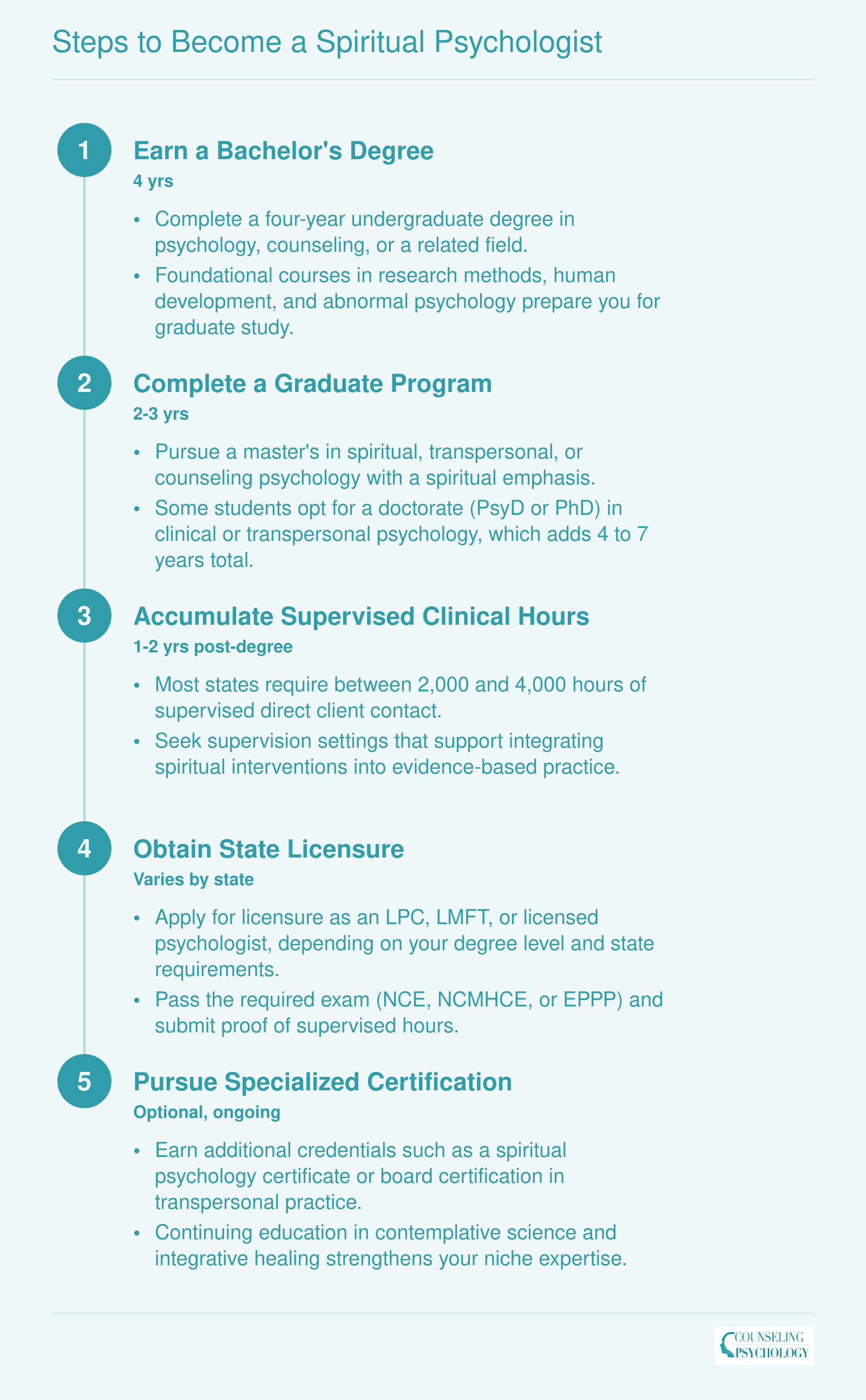
The path to practicing as a spiritual psychologist follows a credentialing ladder that blends conventional clinical training with specialized coursework in transpersonal or spiritual frameworks. Depending on whether you pursue a master's or doctoral route, expect a total timeline of roughly 6 to 12+ years from your first undergraduate class to full licensure.
Step-By-Step: Education, Training, and Licensure
The path to becoming a spiritual psychologist takes a minimum of six years for master's-level counselors and ten to twelve or more years for doctoral-level psychologists. The exact timeline depends on which credential you pursue, your state's requirements, and how quickly you accrue supervised clinical hours after graduation.
Step 1: Earn a Bachelor's Degree (4 years)
Very few schools offer a spiritual psychology major at the undergraduate level, so most students build a foundation in a related field. Psychology is the most direct choice because it covers developmental, cognitive, and abnormal psychology, all of which appear on later licensure exams. Social work and religious studies are also viable, particularly if you plan to integrate faith-based practice. Use electives to take courses in comparative religion, meditation studies, or philosophy of mind, and try to land a research assistantship or volunteer role at a counseling center to strengthen graduate applications. Exploring careers in psychology early can help you decide which credential track fits your long-term goals.
Step 2: Complete a Master's or Doctoral Program (2 to 7 years)
This is where the two career tracks diverge. A master's degree, such as an MA in spiritual psychology, transpersonal psychology, or counseling with a spiritual integration focus, typically takes two to three years and qualifies graduates to pursue licensure as a counselor or therapist. Students on this track can learn more about the process to become a licensed professional counselor. A doctoral degree (PsyD or PhD with a transpersonal concentration) takes four to seven years and is required to use the title "psychologist" in most states. The legal protection of that title is strict: calling yourself a psychologist without a doctorate and state license can constitute the unauthorized practice of psychology.
Step 3: Accumulate Supervised Clinical Hours (1 to 2 years)
After graduation, most states require 1,500 to 3,000+ post-degree supervised hours before you can sit for a licensure exam. Hours must be logged under a licensed clinical supervisor. Because spiritual psychology is a niche specialization, you may need to arrange supervision with a licensed mentor whose clinical credentials satisfy the state board, even if their theoretical orientation is more conventional.
Step 4: Pass the Licensure Exam
The exam depends on your track:
- Doctoral psychologists: Examination for Professional Practice in Psychology (EPPP), plus a state jurisprudence exam in many states.
- Master's-level counselors: National Counselor Examination (NCE) or National Clinical Mental Health Counseling Examination (NCMHCE), depending on the license type.
- Marriage and family therapists: AMFTRB national MFT exam.
Once licensed, ongoing continuing education keeps the credential active, and many practitioners pursue additional certification in modalities such as mindfulness-based stress reduction, EMDR, or transpersonal coaching.
Questions to Ask Yourself
Spiritual Psychology Degree Programs and Certificates
The number of accredited programs blending spiritual inquiry with psychological practice has grown over the past decade, yet prospective students must navigate a field where many degrees are not designed for clinical licensure.
Where to Start Looking
Begin with the U.S. Department of Education's Database of Accredited Postsecondary Institutions and Programs (ope.ed.gov) to verify institutional accreditation. For programs that lead to licensed professional counselor (LPC) or marriage and family therapist (MFT) credentials, the Council for Accreditation of Counseling and Related Educational Programs (CACREP) directory is essential, though only a handful of spiritual psychology tracks appear there. Many transpersonal and spiritual psychology programs carry regional accreditation (e.g., WASC Senior College and University Commission) but do not hold programmatic accreditation, which affects licensure portability.
Degree Options at a Glance
- Naropa University (Boulder, CO): The MA in Clinical Mental Health Counseling with a concentration in Transpersonal Wilderness Therapy is CACREP-accredited and meets educational requirements for LPC licensure in most states. This on-campus program integrates contemplative practice and takes about three years.
- California Institute of Integral Studies (CIIS) (San Francisco, CA): The MA in Integral Counseling Psychology is a licensure-track program that prepares graduates for MFT and LPCC licensure in California. It spans two to three years of full-time, on-campus study and blends psychodynamic, humanistic, and transpersonal theories.
- Sofia University (Palo Alto, CA, and online): Offers an MA in Counseling Psychology (licensure-track in California for MFT/LPCC) that emphasizes transpersonal perspectives, as well as a non-licensure MA in Transpersonal Psychology and a PhD in Transpersonal Psychology. Formats include on-campus, online, and hybrid; program length varies.
- University of Santa Monica (Santa Monica, CA): The MA in Spiritual Psychology is a two-year, hybrid program rooted in principles of forgiveness and compassionate self-awareness. It is regionally accredited but does not lead to clinical licensure; graduates often pursue spiritual coaching, ministry, or personal development work.
- Saybrook University (online): Offers an MA and PhD in Psychology with a specialization in Consciousness, Spirituality, and Integrative Health. These programs are research-oriented and do not directly prepare for licensure, but they can complement an existing clinical degree or support careers in academia and writing.
Many institutions now offer post-master's certificates in spiritual or transpersonal counseling for licensed clinicians seeking specialization. Those drawn to related holistic approaches may also want to explore how to become a transformational counselor.
Evaluating Licensure Fit
Because licensure boards require specific coursework and supervised hours, always consult your state's licensing board early in your search. The American Psychological Association (APA) accredits doctoral programs in clinical, counseling, and school psychology, but transpersonal or spiritual psychology doctoral programs are rarely APA-accredited; thus, becoming a licensed psychologist via those routes may require extra steps, such as a respecialization program. For counselor licensure, CACREP accreditation significantly streamlines the process. Students considering advanced research degrees should review counseling doctoral programs to compare accreditation and format options. If you are not pursuing licensure, determine whether the degree's learning outcomes align with your career goals, whether that is spiritual coaching, chaplaincy, or research.
Next Steps in Research
Cross-reference school information with the U.S. Bureau of Labor Statistics (BLS) Occupational Outlook Handbook to understand typical education and earnings for psychologists and counselors. You can also browse counseling schools to compare programs by format, cost, and accreditation. Professional associations such as the Association for Humanistic Psychology and the International Association for Transpersonal Psychology can offer networking opportunities and updates on emerging standards. Finally, visit each school's official website for the latest program details, as formats and accreditation status can change.
Licensure and Certification Requirements
The path to licensure and certification in spiritual psychology lacks a single, unified credential, requiring practitioners to navigate a patchwork of professional certifications, state regulations, and scope-of-practice boundaries.
No Widely Recognized Board Certification Exists
Unlike clinical psychology, there is no board certification specifically for spiritual psychology that is endorsed by the American Psychological Association (APA) or the American Board of Professional Psychology (ABPP).1 The American Institute of Health Care Professionals (AIHCP) offers a certification in spiritual psychology, but it is not recognized by these mainstream psychology organizations. Similarly, APA Division 36 (Society for the Psychology of Religion and Spirituality) provides membership criteria that signal specialized interest and expertise, yet membership alone does not constitute a clinical credential.
For those drawn to transpersonal perspectives, programs at institutions like Saybrook University or Sofia University may offer certificates, and the Association for Transpersonal Psychology sometimes lists credentialing opportunities. However, none carry the same weight as a state-issued psychology license.
Certification for Licensed Mental Health Professionals
If you already hold a full mental health license, the Association for Clinical Pastoral Education (ACPE) offers a Spiritually Integrated Psychotherapy (SIP) Trainer Certification.2 This advanced credential requires you to be an ACPE Psychotherapist Member, complete 30 hours of curriculum and 20 consultation hours, submit a case presentation and a 600-word personal statement, and renew every three years with 18 continuing education hours.2 It deepens the integration of spirituality into your existing clinical practice but does not grant new independent practice rights.
Non-Clinical Certification Paths
Spiritual coach certification and spiritual direction training programs typically do not require a mental health license, as they focus on spiritual formation, discernment, and coaching rather than diagnosing or treating mental disorders.34 These certifications can be a legitimate route for those who wish to guide clients in spiritual growth without entering regulated therapy domains. Practitioners interested in pastoral counseling certification may find a natural overlap with spiritual direction training. Yet non-clinical credentials clearly operate within a limited scope, and practitioners must avoid any activities that could be construed as psychotherapy.
Navigating State Title and Scope Laws
The ability to use a title like "spiritual counselor" without a license varies by state. In many jurisdictions, as long as you do not provide clinical assessment, diagnosis, or treatment, you may be exempt from mental health licensing requirements. However, each state's counseling or health licensing board sets its own definitions. Always cross-reference information with authoritative sources such as the National Board for Certified Counselors or your state regulatory board. When details are unclear, contacting professional organizations directly is the most reliable way to confirm current requirements.
What Does a Spiritual Psychologist Do?
A review of more than 200 mindfulness-based intervention studies found moderate effect sizes across conditions including stress, anxiety, depression, chronic pain, and relapse prevention, offering a concrete clinical foundation for the work spiritual psychologists do every day.12
Daily Work and Core Practice
Spiritual psychologists spend most of their working hours in individual and group therapy sessions, but the texture of those sessions differs from conventional talk therapy. A single session might move from structured cognitive behavioral techniques into existential questioning about meaning and purpose, then close with a guided meditation or reflective exercise drawn from contemplative traditions. Rather than treating spirituality as a peripheral concern, these practitioners treat it as a legitimate therapeutic variable, one that can be assessed, explored, and woven into evidence-based frameworks including psychodynamic therapy, humanistic approaches, and mindfulness-based cognitive therapy (MBCT).
Research published in Frontiers in Psychology highlights how Buddhist-informed mindfulness integration adds compassion cultivation, ethical inquiry, and insight practices to standard MBCT protocols.3 A separate study in Mental Health and Social Inclusion found that spirituality functions as a partial mediator of mindfulness outcomes, meaning the spiritual dimension of these practices appears to carry some of the therapeutic weight, not just the attention-regulation mechanics.2
Client Populations
The people who seek out spiritual psychologists tend to arrive at pivotal or painful crossroads:
- Grief and loss: Clients processing bereavement often need a framework that holds both psychological pain and questions about meaning, legacy, and what persists after death.
- Existential crisis: Life transitions, identity disruptions, or prolonged dissatisfaction can surface questions that purely symptom-focused therapy does not fully address.
- End-of-life care: Hospice and palliative settings draw practitioners skilled at sitting with mortality and facilitating dignity and peace.
- Addiction recovery: Twelve-step programs carry an explicit spiritual component, and clients in recovery frequently benefit from a therapist who can engage that dimension without either dismissing it or prescribing a particular belief system.
- Religious trauma: Individuals leaving high-control religious groups or processing spiritual abuse need a clinician who understands doctrine without pathologizing sincere belief.
- Spiritual emergencies: Sudden mystical experiences, kundalini activations, or near-death experiences can be profoundly disorienting; transpersonal therapists are among the few clinicians trained to hold that space.
Clients dealing with bereavement may also benefit from working with a clinician who specializes in grief counseling, while those navigating end-of-life care sometimes connect with professionals trained in geriatric counseling.
Treatment Modalities
Spiritual psychologists draw from a broader toolkit than most licensed clinicians:
- Transpersonal therapy: Addresses experiences that extend beyond ordinary ego boundaries, including peak experiences and states of unity.
- Logotherapy: Viktor Frankl's meaning-centered approach, particularly useful for existential distress and terminal illness.
- Contemplative psychotherapy: Integrates meditation, somatic awareness, and Buddhist psychology into the therapeutic relationship itself.
- Mindfulness-Based Stress Reduction (MBSR) and MBCT: Both are research-supported protocols; the APA recognizes mindfulness meditation as a proven stress-reduction tool.1
- Psychedelic-assisted therapy: An emerging area with active clinical trials; some spiritual psychologists are pursuing specialized training as the regulatory landscape evolves.
Work Settings
Practitioners work across a range of environments that reflect the breadth of this specialty:
- Private practice (often integrated with coaching or spiritual direction)
- Integrative health clinics
- Hospice and palliative care programs
- Addiction treatment and residential recovery centers
- Retreat and contemplative wellness centers
- University counseling centers, particularly at institutions with religious affiliations
The setting shapes the caseload considerably. A hospice-based spiritual psychologist focuses almost entirely on end-of-life themes, while a university counselor may address a wider range of presenting concerns with spirituality as one thread among many.
Spiritual Psychologist Salary and Job Outlook
Because "spiritual psychologist" is not tracked as a separate occupation by the Bureau of Labor Statistics, compensation data falls under the broader psychologist categories. Your actual earnings will depend heavily on credential level, practice setting, and whether you hold a doctoral or master's degree. The BLS projects 6% employment growth for psychologists nationally from 2024 to 2034, a rate categorized as faster than average, with roughly 12,900 openings projected each year. Demand drivers include greater recognition of mental health needs and expanding interest in holistic, integrative approaches to care.
| Occupation (National) | Total Employment | Median Annual Wage | 25th Percentile | 75th Percentile | Mean Annual Wage |
|---|---|---|---|---|---|
| Psychologists (All) | 154,860 | $94,310 | $71,140 | $126,340 | $102,100 |
| Clinical and Counseling Psychologists | 72,190 | $95,830 | $67,470 | $131,510 | $106,850 |
| School Psychologists | 63,830 | $86,930 | $73,240 | $108,210 | $93,610 |
| Psychologists, All Other | 17,790 | $117,580 | $73,820 | $145,200 | $111,340 |
| Industrial-Organizational Psychologists | 1,050 | $109,840 | $80,790 | $198,170 | $134,400 |
Highest-Paying States for Psychologists
Because the Bureau of Labor Statistics does not track "spiritual psychologist" as a standalone occupation, the closest proxy is the Clinical and Counseling Psychologists category (SOC 19-3033). The table below highlights the top-paying states within that group, based on the most recent BLS data. Keep in mind that your actual earnings will depend on your credential level, practice setting, and whether you hold a doctoral degree or a master's level license.
| State | Median Annual Wage | Mean Annual Wage | 25th Percentile | 75th Percentile | Employed in State |
|---|---|---|---|---|---|
| New York | $99,910 | $112,980 | $78,500 | $132,520 | 7,190 |
| Iowa | $98,580 | $102,560 | $73,520 | $124,640 | 760 |
| Maine | $97,630 | $114,470 | $86,180 | $117,120 | 180 |
| Illinois | $97,470 | $106,360 | $66,570 | $138,890 | 3,470 |
| Mississippi | $92,390 | $95,140 | $64,390 | $101,360 | 200 |
| Tennessee | $92,320 | $103,190 | $81,790 | $120,450 | 780 |
| North Carolina | $91,840 | $99,940 | $68,660 | $117,060 | 2,420 |
| Oklahoma | $91,140 | $97,350 | $71,810 | $119,830 | 360 |
| Pennsylvania | $90,450 | $103,980 | $67,450 | $124,990 | 3,850 |
| Utah | $88,990 | $94,070 | $68,080 | $121,980 | 1,000 |
| Massachusetts | $87,060 | $102,440 | $73,670 | $132,840 | 3,470 |
| Missouri | $86,340 | $90,480 | $60,710 | $115,130 | 1,490 |
| Florida | $84,020 | $92,010 | $49,690 | $126,460 | 3,230 |
Doctoral-level psychologists consistently out-earn master's-level counselors by a substantial margin, so the extra years of education carry real financial weight. Beyond credentials, practitioners who build a private practice or specialize in high-demand niches like addiction recovery or hospice care often push their income well above the national median for their occupation.
Frequently Asked Questions About Spiritual Psychology Careers
Prospective students often have practical questions about timelines, credentials, and scope of practice in spiritual psychology. Below are answers to the most common ones, grounded in current licensing standards and labor data.
Explore Careers
- Become a Behavior Interventionist
- BCaBA
- BCBA
- Biogerontologist
- Child Psychologist
- Clinical Psychologist
- Cognitive Neuroscientist
- Cognitive Psychologist
- Comparative Psychologist
- Consumer Psychologist
- Counseling Psychologist
- Criminal Psychologist
- Cultural Psychologist
- Forensic Psychologist
- Air Force Psychologist
- Applied Psychologist
- Army Psychologist
- Educational Psychologist
- Engineering Psychologist
- Environmental Psychologist
- Experimental Psychologist
- Navy Psychologist
- Neurologist
- Neuropsychologist
- Personnel Psychologist
- Physiatrist
- Police Psychologist
- Positive Psychologist
- Psychiatrist
- Psychological Anthropologist
- Psychometrician
- Psychometrist
- Registered Behavior Technician (RBT)
- Rehabilitation Psychologist in
- School Psychologist
- Social Psychologist
- Sports Psychologist